Arrows, Cannons, and Destiny
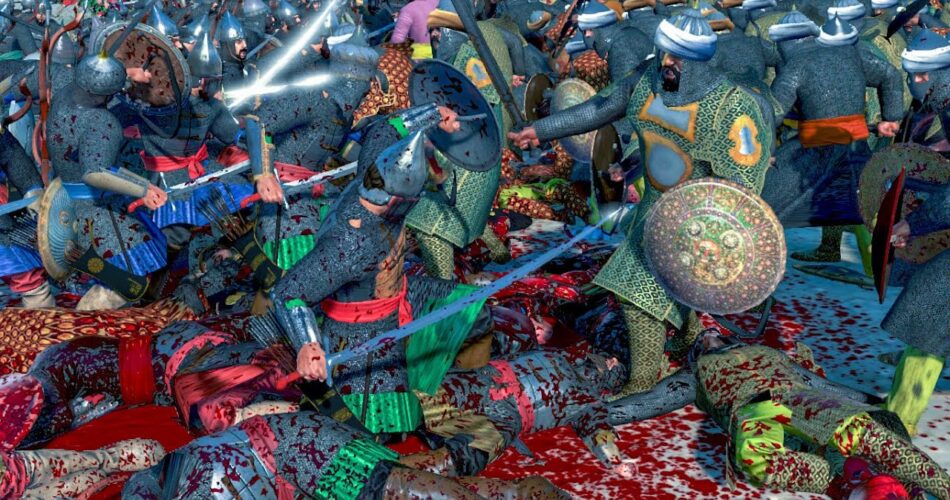
The plains of Khanwa trembled with the roar of armies, as the fate of northern India hung in the balance. On one side stood Rana Sanga, the proud Rajput king, leading his warriors with unmatched courage and unshakable resolve. On the other, Babur’s Mughal forces, armed with the thunder of cannons and disciplined formations, advanced to claim supremacy. What unfolded was more than a battle—it was a clash of honour and ambition, where every arrow, every charge, and every volley of cannon fire carried the weight of kingdoms and the legacy of warriors. The Rajputs fought with valor that would echo through centuries, yet the tide of gunpowder and strategy threatened to overwhelm even their fiercest courage. Khanwa was not just a battlefield; it was the crucible where the old Rajput order met the rising Mughal Empire, and history itself was forced to take sides.
Babur and Rana Sangram Singh’s Clash of Ambitions
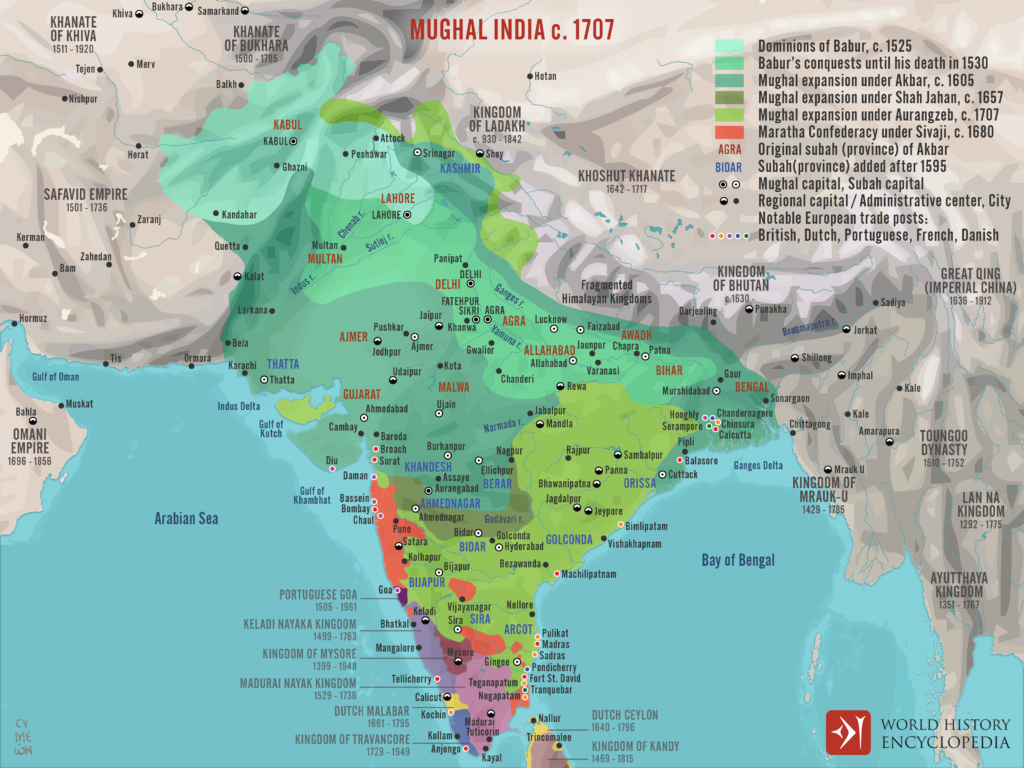
Map © Simeon Netchev
Babur and Rana Sangram Singh’s territorial expansions created an inevitable path towards war between the two monarchs. Babur expressed his hostility towards Sangram Singh in his memoirs, citing an instance where he accused the latter of destroying Muslim control over 200 towns and displacing their ruling families. After securing victory over the Lodi Empire, Babur sought control of Bayana, a crucial fort in defending Agra against Sangram’s advances. Bayana was under the control of Afghan chieftain Nizam Khan, and Babur sent 2,500 men to take the fort alongside Nizam Khan’s brother Alam Khan and his Afghan troops. However, Nizam Khan’s numerically superior army emerged from the fort and defeated the Mughal army, routing them. With time running out, and Rana Sangram’s army approaching, Babur called for a Jihad against the Rana, enlisting the support of Afghan chieftains from Bayana, Dholpur, and Gwalior. Although initially intimidated by Rana Sangram’s military might, the Afghan chieftains ultimately chose to accept Babur’s overlordship.
The Bayana Campaign: Rajput Strategy and Mughal Setbacks
Rana Sangram Singh laid siege to the fortress of Bayana with great organization and strategy. He divided his army into four parts and placed his trusted nobles at the forefront. The garrison, in an attempt to sally forth and fight, was quickly defeated by the Rajputs. The besieged Afghans lost morale and ultimately surrendered the fort to Rana Sangram Singh. Babur, the Mughal emperor at that time, sent an army under Abdul Aziz to prevent Rana Sangram Singh’s advance, but the Mughals were defeated and scattered by the Rajputs, led by Rana Sanga. This victory marked a significant triumph in the career of Rana Sangram Singh, as he now held control over the forts of Chittor, Ranthambore, Kandar, and Bayana, all key points in central Hindustan. The brief yet fierce encounters with the Mughals sent a thrill of terror and discouragement throughout the Mughal army. William Erskine, a renowned 19th-century Scottish historian, described the Rajputs as a formidable foe, always ready to meet their enemies face to face and lay down their lives for their honour. The Afghans in Babur’s army began to leave, and the Turks started to express their dissatisfaction with defending a land they despised. They even asked Babur to depart for Kabul with the valuable treasures his army had gathered. Babur later wrote that he had not heard any manly word or brave council from anyone, which allowed Rana Sangram Singh to safely march towards Khanwa, leading to the Battle of Khanwa.
Rajput Military Alliance: The Gathering of Northern India’s Kings
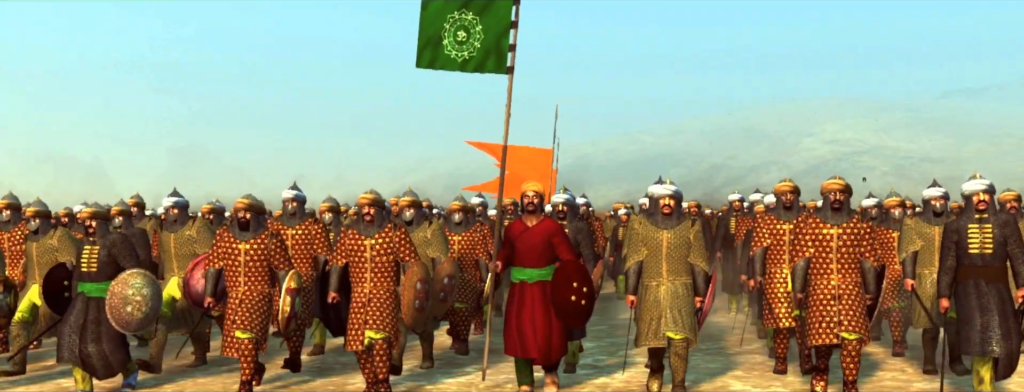
Rana Sangram had formed a powerful military alliance against Babur, which included the leading Rajput kings from various regions in Rajasthan, such as Harauti, Jalor, Sirohi, Dungarpur, and Dhundhar. Although Rao Ganga of Marwar did not personally join the alliance, he sent a contingent led by his son, Maldev Rathore. Additionally, Rao Medini Rai of Chanderi of Malwa and Mahmud Lodi, the younger son of Sikandar Lodi, also joined the alliance with their troops. The ruler of Mewat, Khanzada Hasan Khan Mewati, also contributed to the alliance with his men. Babur claimed that Rana Sangram’s army consisted of 200,000 soldiers, but Alexander Kinloch argued that this is an overstatement. According to Kinloch, the Rajput army did not exceed 40,000 men during the campaign in Gujarat. Regardless of the exact number, it is clear that Sangram’s army greatly outnumbered Babur’s forces, as noted by Satish Chandra.
Mughal Dilemma: Facing a Superior and Fearless Enemy
The battle of Khanwa presented Babur with the ultimate challenge of his generalship. His troops, already disheartened by their recent defeat at Bayana, were further weakened by tales of Rajput heroism and astrological predictions of ill omens, as well as the desertion of timid allies. Meanwhile, the enemy he faced was more than twice the size of his own and emboldened by a string of victories. Defeat or even a drawn-out battle followed by retreat would have shattered Babur’s fledgling empire of Delhi. However, he possessed a unique advantage that the Rajputs lacked in their arsenal: mortars and matchlocks that were completely foreign to North India. Above all, his military genius and experience in warfare, gained through countless battles since the age of 12, shone through. The Rajput warriors were undoubtedly brave, but they lacked the strategic skills and unity that Babur’s army possessed.
Babur’s Battle Plan: Strategy, Fortifications, and Firepower
During the Khanwa campaign, Babur adopted a cautious approach and gradually advanced towards the decisive battle. He was aware of the risks involved in the battle and prioritized the safety of his camp and men. To ensure the safety of his army, Babur fortified his position every evening to prevent any surprise attacks and secure a safe base in case of a retreat. Babur was well aware that his army would be vulnerable to a Rajput charge in open combat. Therefore, he devised a defensive strategy to counter the Rajput army’s offensive moves. Babur’s plan of battle at Khanwa was to transformed his army front into a fortified wall of carts, armed with fire-arms and held his ground during the initial stage of the battle. He also thought, by using his matchlock guns and mortars he could repelled wave after wave of Rajput assaults until their numbers dwindled, and their leaders were slain. Only then did he assume the offensive, attacking from his fortified camp to secure victory. Babur, before drawing up his battle formation, issued strict instructions to all his commanders to maintain their position until receiving orders directly from him. The Mir Bakhshi, standing at Babur’s side, dispatched couriers to convey these directives to the commanders throughout the course of the battle.
Mughal Battle Formation: Carts, Cannons, and Cavalry
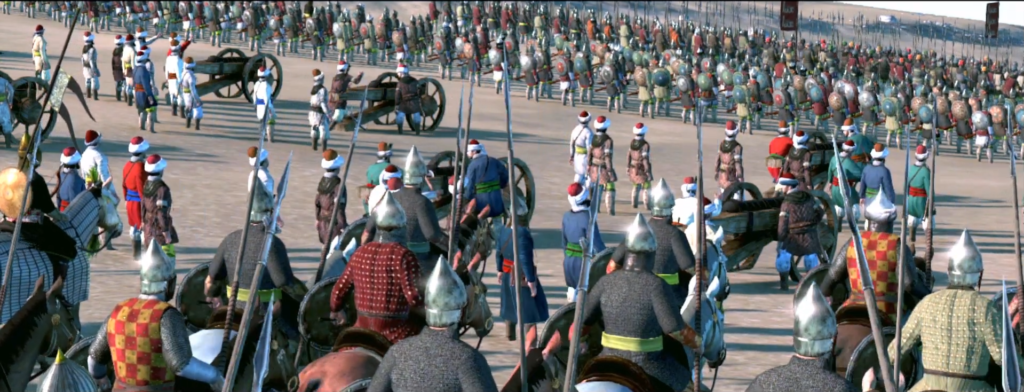
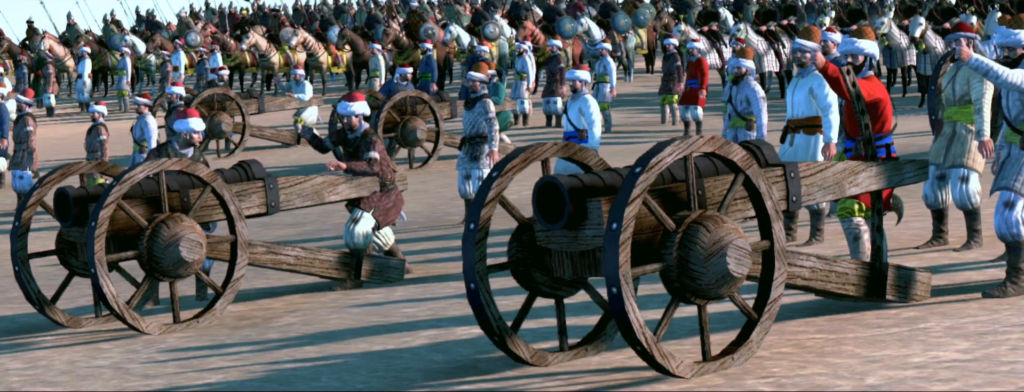
On the morning of March 17th, 1527, Babur arranged his force in a strategic formation. First, the army’s baggage carts were placed in a line at a distance of about 40 feet from each other, secured with rawhide thongs in the Turkic style. Between each pair of carts, five or six movable shields were fixed to wheeled bases, allowing musketeers to take cover and fire from behind. Openings were left at intervals of about 60 yards for groups of a hundred horsemen to launch attacks. The second line was comprised of mortars, small field-guns, and foot-musketeers, while the third line consisted of heavy cavalry, the primary weapon of attack.
Ustad Ali Quli positioned himself in front of the center with his mortar and other wheeled guns, while his rival Mustafa Rumi stationed his musketeers and swivel guns in front of the center of the right wing. The cavalry was divided into three main divisions – the right wing led by Prince Humayun with an estimated strength of 5,000 soldiers, the left wing led by Mahdi Khwaja with around 3,000 soldiers, and the center commanded by Babur himself with approximately 10,000 soldiers, including detachable left and right flanks. Two bodies of specially selected cavalry, each consisting of not more than a thousand soldiers, were also present at the extreme end of the two wings to execute the infamous Turkish tulughma tactic by turning the enemy’s flanks and attacking from the rear. There was no distinct reserve, rearguard, or vanguard apart from the center front. Babur’s Indian allies were positioned in his left wing, which had a significant portion of its front unprotected by firearms.
The First Clash: Rajput Courage Meets Mughal Firearms
As the Rajputs charged towards Babur’s center in a great, tumultuous, shouting crowd, they suddenly saw a blinding flash of light, followed by a deafening roar. Then, hurtling towards them like a burning meteor, they saw a massive, hot stone ball, which collided with them at a distance of 1.2 kilometers, crushing everything in its path. The sheer force of the impact was so great that not even the mighty elephants could withstand it. This was the first shot fired from Ustad Ali-QuIi’s recently cast mortar. As the Rajputs galloped closer to the front, they were suddenly struck by small fire-flashes, which spewed forth a hail storm of burning slugs and stone chips, spreading like grape-shot through their ranks. These were the musket-bullets, and the Rajputs had never seen anything like it before. Their advance towards the center was halted for the rest of the day, and they attempted instead to probe the enemy’s wings.
At this point, both armies focused their efforts on the flanks. The Rajputs were unable to make progress against the formidable cannons and muskets in front of them, while Babur wisely chose to maintain his stationary line of carts. This defensive strategy proved effective in stopping the fierce charge of the Rajput and their enraged elephants. Had Babur advanced his horsemen into the plain too soon, before the enemy had been weakened and disorganized, his army would have been engulfed by the overwhelming number of Rajput cavalry, and his own forces would have been caught in the crossfire.
The Flank Battles: Charges, Counters, and Tactical Maneuvers
The Rajputs, were unable to launch an assault on the fortress-like center of the Mughal army. Instead, they attacked from the sides by riding their elephants towards the two wings of the Mughal army. The first strike was aimed at the Mughal right wing. However, Babur, the Mughal emperor, was quick to notice the Rajputs’ strategy. He immediately sent reinforcements to this wing, which successfully repelled the attack. Additionally, the right-hand section and tulughma corps of the Mughal army launched a counter-attack, which pushed the Rajputs back to their own center. Despite this setback, the Rajputs regrouped and launched another wave of assault. By this time, Mustafa Rumi, had learned about the Rajputs’ disposition and distances, and he ordered his soldiers to open fire on them using their matchlocks. The Rajputs continued to fight despite being on broken ground, but Babur ordered fresh troops to support his men. As described by Babur’s secretary, “Band after band of pagan followed each other to help their men, we in our turn sent detachment after detachment to reinforce our fighters on that side.”
During the battle, Babur’s left wing was charged by the Rajput right simultaneously with the first attack. The fighting was intense and both sides had to put in all their efforts to keep their ground. The combat was a see-saw battle, with both sides gaining and losing ground intermittently. Eventually, Babur’s left wing was strengthened by additional troops from the vanguard and they were able to counter-charge the Rajputs and push forward as far as their rear. However, the pincer movement was not yet complete as “the two horns of the crescent” had not closed yet. Babur’s men had to retreat to their own positions once again. More and more troops sent from Babur’s center to meet the enemy pressure on this wing, therefore the Rajputs were unable to make any significant breakthrough. Nevertheless, the Rajputs continued to make periodic attacks throughout the day, but each time they were repulsed without breaking the perimeter. This left many wounded or dying men and horses piled around the barricades.
The Turning Point: Betrayal, Wounds, and Chaos Among the Rajputs
The battle was fierce and intense, with both the Rajputs and Mughal soldiers locked in deadly combat. In the center, the Rajputs were hopelessly outmatched. They fell without being able to retaliate in the least, as they were outclassed in weaponry and their dense masses only increased their slaughter. Every bullet that was fired found its target, causing immense damage to the Rajput army. However, the situation was different on the wings. The Rajputs’ expertise in close combat, their valor, and the sheer weight of their numbers began to take a toll on the Mughal army. It was at this crucial juncture that the Sardar Silhadi of Raisen betrayed Rana Sangram and went over to Babur’s army. This betrayal had devastating consequences for the Rajputs, as Silhadi’s numbers were enough to tilt the balance of power in the Mughals’ favor. This unexpected turn of events forced the Rajput army to change their entire battle plan. During this time, Rana Sanga was hit with a bullet and fell unconscious, causing much confusion amongst the Rajput ranks and a lull in the fighting for a short period. The loyal Jhala sardar Ajay Singh, acting as the Rana, tried to restore discipline and led the Rajput army while the senseless and heavily wounded Rana Sangram Singh was taken away from the battlefield. The battle continued to rage on, but the Rajputs were now at a significant disadvantage, and their chances of victory seemed bleak.
Babur’s Offensive: From Defense to Crushing Victory
During the battle, Babur, the Mughal emperor, observed that the time had come for him to take the offensive. He ordered his elite guard corps, which had been kept in reserve behind the carts, to be let loose “like tigers held back by leashes”. They sallied out of their fortified positions through two open lanes on the right and left of the line of musketeers in the centre and launched an attack on the enemy’s centre from two sides. Following this, the matchlockmen of the Mughal centre emerged from their shelter and began attacking the Rajputs in front, wreaking havoc from a safe distance. Finally, the wheeled artillery was advanced and Babur himself followed them with his centre into the thick of the fight. His men swarmed around him on all sides “like the waves of a surging ocean”. A fierce and mixed combat ensued under clouds of dust and universal confusion. The battle raged on for an hour, and steadily the Rajputs were pushed back. Most of their sardars and chiefs, who had rushed to the front to lead their men, fell in the midst of the battle.
The battlefield was a chaotic scene as the Rajputs warriors prepared for their final assault. The Rajputs charged forward with reckless abandon, their ragged line advancing towards Babur’s barricades. However, the Mughal artillery was ready and cannon balls rained down upon the charging Rajputs, knocking men over and sending elephants into a panicked frenzy. Despite the chaos, the hypnotic beat of the Rajput drummers continued, urging their comrades forward even as they fell. As the Rajput cavalry closed in on the barricades, they rode over the bodies of the fallen from previous attacks, jabbing their horses into action. Meanwhile, the infantry used the bodies of their fallen comrades as stepping stones to cross the trenches and climb the barricades. The fighting was fierce and personal, with hand-to-hand combat raging along the entire perimeter of the battlefield. The greatest crush of the battle occurred directly downhill from Babur and Humayun, where the bravest of the Rajputs were cut down in droves. Despite their valiant efforts, the battle ultimately ended in their defeat, with dead bodies littering the ground for miles around. The Mughals were too exhausted and suffered heavy casualties to give chase, and Babur abandoned his plans to invade Mewar.
Aftermath: Skulls, Survival, and the Legacy of Khanwa
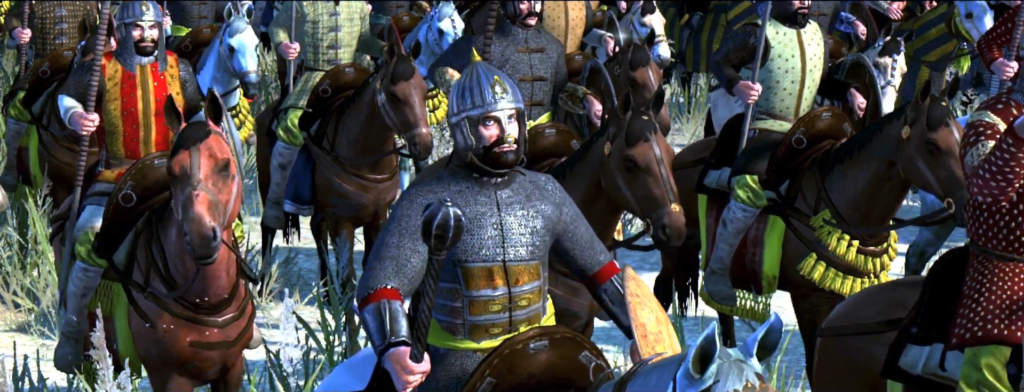
After the battle, Babur gave orders to construct a tower of enemy skulls, a practice initiated by Timur. Satish Chandra explains that the purpose of the tower was not only to celebrate the victory, but also to intimidate opponents. Babur had previously used the same tactic against the Afghans of Bajaur. During the battle, Sangram Singh was rescued from the field by Prithviraj Kachwaha and Maldev Rathore of Marwar, while unconscious. Upon regaining consciousness, he vowed to defeat Babur and banish himself from Chittor. He also stopped wearing a turban and instead opted to wrap a cloth around his head. Despite his determination to fight Babur until the end, Sangram Singh passed away on January 30, 1528. It is believed that if it weren’t for Babur’s luck and artillery, Sangram Singh might have emerged victorious. The Battle of Khanwa solidified the gains made during the first Battle of Panipat and introduced muskets and cannons as important weapons in Indian warfare. As a result, many kingdoms began hiring mercenaries to train their soldiers in gunpowder warfare and even started constructing their own cannons. The Battle of Khanwa marked the end of some of the outdated methods of warfare in the Indian subcontinent.
© 2026 History and War
Author: Jishu Roy
Unauthorized reproduction of this content is prohibited.