Fall of a Caliphate
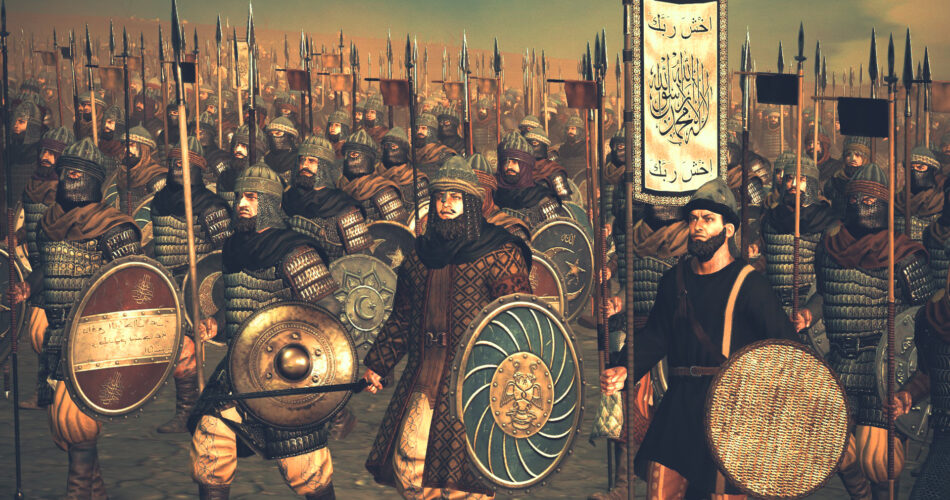
By AD 750, the Umayyad Caliphate, rulers of the Islamic world for nearly a century, teetered on the edge. Across the plains of the Great Zab River, the Abbasid forces, organized and inspired by the brilliant and determined Abu Muslim, had gathered for a decisive confrontation. His men, weary from years of struggle, were driven by hope for a new order. The Umayyads, led by Caliph Marwan II, marched with fear and pride tangled in their hearts. They fought to preserve a dynasty, to hold a fading empire together. When these armies met, it was more than a battle—it was tradition against change, the past against the future. By nightfall, the echoes of an empire would vanish into history, and a new force would rise in the shadows. The Islamic world would never be the same. This is the story of the Battle of Zab.
The Collapse of Umayyad Unity
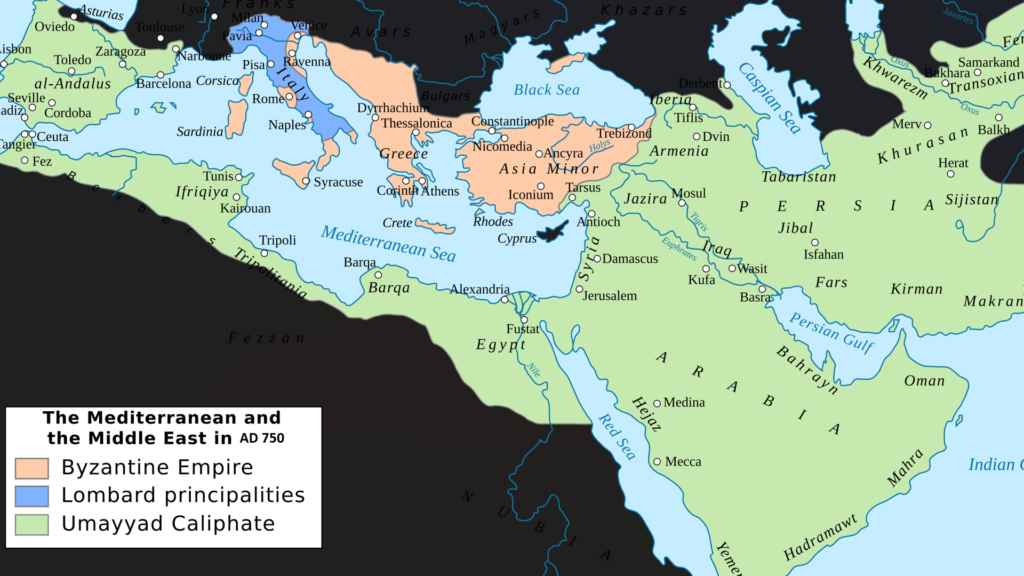
In February of AD 743, the wise Umayyad Caliph Hisham passed away, leaving a prosperous and stable caliphate for his successor, Al-Walid II. Al-Walid II was known for several personal traits. Some were positive, such as his reported generosity toward the poor. Others, like his interest in composing poetry, were less typical for a ruler and not universally admired. Certain behaviors, including his indulgence in alcohol, were viewed negatively. Collectively, these traits suggested that Al-Walid II might not be a particularly strong or effective ruler, and indeed, some individuals sought to exploit his inattentiveness to the governance of his realm.
After ascending the throne, Caliph Al-Walid II sought to secure the bay‘a, or pledge of allegiance, for his two young sons, al-Hakam and ‘Uthman. This effort met with immediate opposition in Syria, prompting Al-Walid to take severe measures against members of the Marwanid family. Some were executed, while Hisham’s son Sulayman was flogged and imprisoned. These actions, together with Al-Walid’s reputed indulgence in drinking, singing, and other behaviors considered immoral, fueled further opposition.
Yazid ibn al-Walid, noted for his integrity, criticized the new ruler for his moral laxity. In response, a faction began plotting Al-Walid II’s assassination. When the conspirators approached Khalid ibn Abdallah al-Qasri, the former governor of Iraq and a leading Yamani figure, he refused to participate and instead offered a cautious warning to Al-Walid. The caliph, however, took offense at the ambiguous nature of this warning. He imprisoned Khalid and handed him over to Yusuf ibn Umar, the current governor of Iraq and a prominent Qaysi leader, in exchange for fifty million dirhams. Yusuf subsequently tortured and executed Khalid, a deed that provoked strong resentment among many of Al-Walid’s own relatives.
Unsurprisingly, these actions generated significant resentment. The Yamanis, along with other factions who felt wronged by the caliph or disapproved of his erratic and immoral conduct, deposed and executed Al-Walid II in AD 744. They installed his cousin, Yazid III, as caliph; however, the true authority in the caliphate was held by the coup leader, Sulayman ibn Hisham.
It was at this point that another Umayyad prince, the future Marwan II, appears to have begun considering a claim to the caliphate. His chance arose when Yazid III unexpectedly died only six months into his reign, possibly from brain cancer. The Qaysi tribes, seeking revenge against their Yamani rivals, rallied in support of Marwan, and the formidable size of his forces appears to have unnerved the Umayyad leadership in Damascus. Sulayman, together with the newly appointed caliph—Ibrahim, Yazid’s brother—abandoned the capital without resistance, enabling Marwan to enter Damascus and assume the caliphate in December of AD 744. Soon after, widespread unrest broke out: the Yamani tribes revolted in the Levant, early Shiʿa communities rose in Iraq, and in Egypt, the governor appears to have grown frustrated with taking orders from Syrian authorities.
By AD 747, most revolts against the Umayyad Caliphate had been suppressed—but Khorasan remained an exception. In this northeastern province, discontent with Umayyad rule had reached a critical point. The Shiʿa, supporters of the former caliph Ali and his family, had long harbored grievances, dating back to Ali’s assassination in AD 661 and, more acutely, to the martyrdom of his son Husayn at Karbala in AD 680.
Non-Arab Muslims faced systemic discrimination despite their formal religious equality with Arabs. They were often required to subordinate themselves to Arab tribes and many were still forced to pay the jizya tax, reserved for non-Muslims. Non-Muslims suffered even more, enduring heavy taxation, social restrictions, and, in many cases, persecution—even in communities, such as Christians and Jews, that were theoretically protected under Islamic law. In Iran, these tensions were compounded by efforts to suppress Persian language and cultural traditions. Discontent also existed among Arab Muslims. The Umayyads favored their Syrian base, and longstanding rivalries—such as between the Qays and Yaman tribes—fueled regional divisions.
The Umayyads further lost the support of many religious scholars. Some opposed the suppression of the Qadariyah theological school, which taught that humans possess free will rather than being bound entirely by predestination. More broadly, scholars objected to the caliphs’ interference in religious matters and questioned the legitimacy of rulers whose authority relied solely on inheritance rather than merit or piety. There was a widespread belief that the leader of the Islamic community should possess qualities beyond mere lineage.
Amid this widespread dissatisfaction, the Abbasid family, claiming descent from the Prophet Muhammad’s uncle, began mobilizing support for their cause, establishing Khorasan as the center of their movement. In AD 747, Abu Muslim, a talented and charismatic general, was dispatched to lead the Abbasid effort. There, the Great Black Standard of the Abbasids was unfurled, symbolizing the revolution. Under this banner, Abu Muslim guided the Abbasid forces to a series of decisive victories, successfully dislodging Umayyad governors from key strongholds.
By AD 749, the Abbasid forces were advancing into Mesopotamia, pressing the decline of Umayyad authority. In August, Qahtaba ibn Shabib, the senior Abbasid commander, crossed the Euphrates and engaged the forces of Yazid ibn Umar ibn Hubayra, the Umayyad governor, near Karbala. Qahtaba ibn Shabib was killed in the encounter, but his son, Al-Hasan ibn Qahtaba, assumed command and forced Ibn Hubayra to retreat to Wasit, leaving Kufa effectively undefended. In this context, Abu al-‘Abbas was proclaimed caliph in Kufa, formally asserting the Abbasids’ claim to the caliphate.
Meanwhile, earlier in the campaign, Qahtaba ibn Shabib had dispatched Abu Aun, a capable general, from Nehavend to press the advance toward Upper Mesopotamia. By the end of AD 749, Abu Aun reached Shahrzur, east of the Little Zab, where he decisively defeated the forces of Abdallah, son of Marwan II, inflicting heavy casualties. Following this victory, he occupied the region east of Mosul, securing the northern approaches and preventing Umayyad forces from regrouping.
In response, Marwan II, determined to halt the revolutionary surge, raised a large Umayyad army and marched from Harran. The two forces—the declining Umayyad regime and the ascending Abbasid revolutionaries—were soon to clash on the banks of the Great Zab River. The outcome of this confrontation would determine the future of the Islamic world.
Marwan II’s Final Host: Veterans of a Fractured Empire
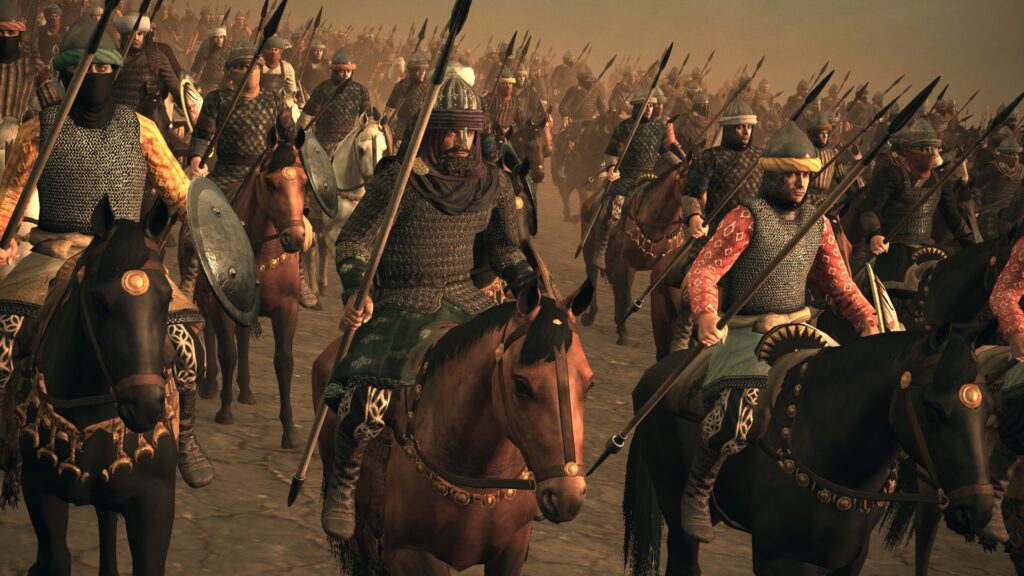
Despite widespread opposition, the fall of the Umayyads was far from inevitable. Marwan’s military ability was considerable. His forces were largely composed of seasoned veterans who had already demonstrated their resilience and effectiveness in campaigns against the Byzantines and in suppressing internal revolts. These troops were under Marwan’s direct command, and although his personal character may have been controversial, his credentials as a military leader were formidable.
As a former governor of the empire’s northern frontier provinces, Marwan had been directly responsible for conducting raids against neighboring Christian powers such as the Byzantines and the kingdom of Georgia. This experience provided him with substantial practical knowledge of commanding armies both on campaign and in battle—an expertise that few Umayyad princes of the time could match.
After crossing the Tigris, he advanced toward the Greater Zab with an army reportedly numbering around 120,000. While this force was impressive in size, it was composed in large part of contingents from Yemeni tribes and Kharijites, whose loyalty and commitment were not always fully reliable.
Khurasani War Machine of the Abbasids
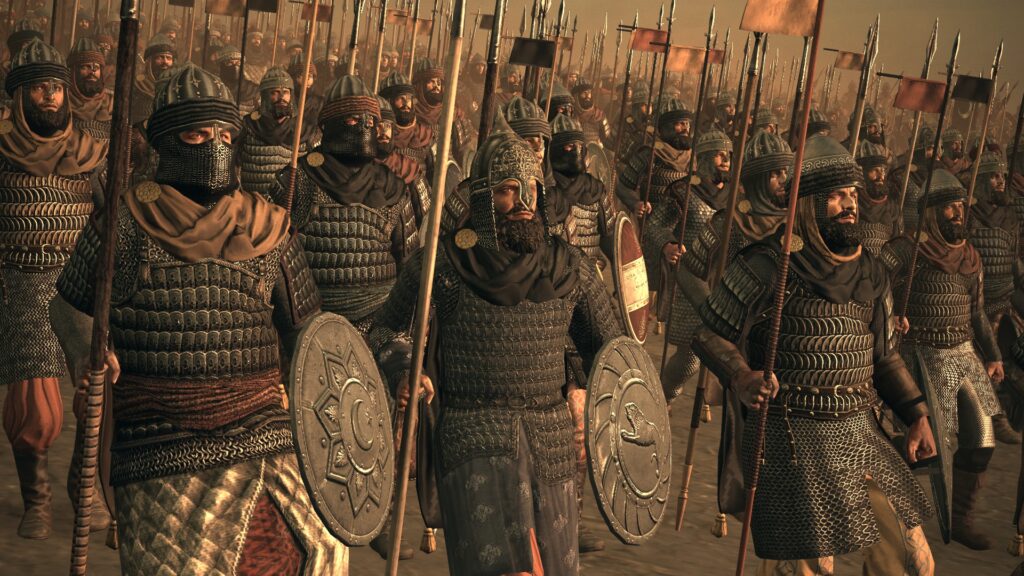
The Abbasids, however, were equally formidable. Their forces were drAun largely from the frontier communities of Khurasan, a region extending across eastern Iran into parts of modern Afghanistan. These populations were accustomed to constant warfare: when not engaged in campaigns to expand their territories into Central Asia, they were defending their gains against counterattacks. As a result, Abbasid troops were highly experienced and battle-hardened.
This army had been organized and mobilized under the leadership of Abu Muslim, who recruited these fighters in support of the Abbasid cause. In its early phase, command in the field was held by Abu Aun. However, in order to lend the movement greater dynastic authority, Abu al-Abbas appointed his uncle, Abdallah ibn Ali, as commander-in-chief. In accordance with this change, Abu Aun relinquished the state pavilion—the symbol of supreme command—to Abdallah.
The Day the Umayyads Fell
Before the main battle, a number of preliminary skirmishes were fought as each side attempted to gauge the strength of the other. On the night of January 16, AD 750, Abdallah ibn Ali inquired about a ford across the Zab River, and one was identified for him. He then ordered Uyaynah ibn Musa to cross the river with a force of five thousand men and advance toward Marwan’s camp. Marwan responded by engaging the Abbasid force, and the fighting continued until nightfall, when fires were lit across the battlefield. With the onset of darkness, the engagement was brought to an end. Uyaynah then withdrew and returned to the camp of Abdallah ibn Ali, recrossing the river at the same ford.
At dwan, Marwan secured the pontoon bridge and dispatched his son, Abdallah, to dig a defensive trench further downstream from the camp of Abdallah ibn Ali. In response, Abdallah ibn Ali sent al-Mukhariq ibn Ghifar with a force of four thousand men. Advancing approximately five miles from the main Abbasid camp, al-Mukhariq halted his troops. Marwan’s son then sent al-Walid ibn Mu‘awiyah to confront them. In the ensuing engagement, al-Walid defeated al-Mukhariq’s force, routing his men; many were killed, while others were captured. When Abdallah ibn Ali learned of this setback, he grew concerned that such losses, though limited, might undermine the morale of his army. Fearing a decline in confidence among his troops, he resolved to initiate a full-scale battle before their resolve weakened.
However, it was Caliph Marwan II who took the initiative. On January 25, AD 750, he constructed a bridge across the river and moved his army to the southern bank. Meanwhile, the Abbasid commanders grew increasingly concerned about the morale and discipline of their own troops, and Abdallah ibn Ali was advised to bring on a decisive engagement without delay. Acting on this counsel, he organized his forces and appointed Muhammad ibn Sul as a field commander. Abu Aun was placed in command of the right wing of the Abbasid army. On the opposing side, Marwan’s left wing was commanded by al-Walid ibn Mu‘awiyah. Marwan himself retained a core force of approximately three thousand troops, including elite units such as the Dhakwaniyyah, the Sahsahiyyah, and the Rashidiyyah.
Marwan II initially intended to adopt a strategy of delay. However, one of his commanders, al-Walid ibn Mu‘awiyah —who was also his son-in-law—launched an attack without waiting for orders. This action enraged Marwan, who openly rebuked him. Al-Walid then engaged the Abbasid right wing, commanded by Abu Aun. During the fighting, Abu Aun was forced to retreat and withdrew toward the position of Abdallah ibn Ali.
At this stage, Musa ibn Ka‘b advised Abdallah ibn Ali to order his troops to dismount. Acting on this counsel, the command was given, and the soldiers dismounted, forming a compact defensive line with their lances leveled as they crouched low to the ground. From this position, they advanced deliberately to meet the enemy. Abdallah ibn Ali himself moved among the ranks on foot, urging his men forward and invoking both faith and vengeance. He is reported to have cried out, “Men of Khurasan, avenge Ibrahim! O Muhammad! O Mansur!” His words stirred the troops, and the intensity of the fighting rose sharply.
This unconventional tactic soon proved effective. According to a later Khurasani account, “The Syrians attacked us like mountains of iron, but when we knelt down and prepared our spears, they turned from us like a cloud.” The disciplined formation disrupted the momentum of the Syrian charge, blunting its impact at the moment of contact. Behind the front line, archers maintained a steady barrage, directing their fire at the advancing horses and further weakening the enemy assault.
What followed was a brutal and chaotic struggle. The ground shook under the force of repeated charges, yet each advance lost cohesion as it met the wall of spears. Horses faltered, riders were thrown into confusion, and the carefully maintained Abbasid formation held firm. Amid the noise of clashing weapons and shouted commands, the battle steadily turned in favor of Abdallah’s forces, as the initial strength of the Syrian attack gave way to hesitation and disorder.
As the Abbasids pressed their advance, the Umayyad lines began to collapse. Marwan II attempted to restore order by urging his troops to dismount and reform their ranks, but his commands went largely unheeded as cohesion broke down and many began to flee.
In a final effort to rally his forces, Marwan called upon individual tribal contingents. He ordered the Quda‘ah to dismount, but they deflected the command, urging him to direct it instead to the Banu Sulaym. He then instructed the Saksakis to attack, yet they responded by shifting responsibility to the Banu ‘Amir. Similarly, when he commanded the Sakiin to charge, they told him to call upon the Ghatafan. Even his own chief of security refused to comply when ordered to dismount, reportedly declaring that he would not make himself an easy target.
These exchanges reveal the extent to which discipline had deteriorated within the Umayyad army. Tribal divisions and mutual distrust undermined any coordinated response, and what had once been a formidable force rapidly disintegrated under pressure, allowing the Abbasids to intensify their assault and drive the battle toward its decisive conclusion.
In a final, desperate attempt to stabilize his collapsing army, Marwan opened his treasury and offered gold to any soldiers willing to continue the fight. Rather than restoring discipline, this measure produced confusion, as many troops began scrambling for the coins. The disorder quickly spread, and other units, misinterpreting the situation as a signal of retreat, started to withdraw toward the river.
As panic set in, the Umayyad forces broke and fled. In his urgency to escape, Marwan ordered the destruction of the bridge, leaving a large number of his own men stranded on the opposite bank. The rout turned into a disaster, and in the chaos that followed, more soldiers perished by drowning in the river than were killed in combat.
The End of a Dynasty
The Abbasid victory was decisive and is widely regarded as the event that sealed the fate of the Umayyad dynasty. In its aftermath, Marwan II was forced to flee through Syria into Egypt, while Abbasid forces advanced steadily, and Umayyad-held cities surrendered one after another. Damascus fell to the Abbasids in April, marking a major turning point in the campaign.
By August, Marwan II and members of his family were located in Egypt and killed by a small Abbasid force led by Abu Aun and Salih ibn Ali, the brother of Abdallah ibn Ali. Meanwhile, resistance persisted in some regions. At Wasit, the Umayyad commander al-Fazari continued to hold out even after Marwan’s defeat in January. Although the Abbasids offered him amnesty in July, they executed him shortly after he surrendered and left the fortress.
In the aftermath of their victory, the Abbasids carried out a systematic effort to eliminate the Umayyad legacy. The tombs of the Umayyad caliphs in Syria were desecrated, with the notable exception of that of Umar II. Surviving members of the Umayyad family were pursued and, in most cases, executed.
Although the Abbasids at one point proclaimed an amnesty for the remaining Umayyads, this proved deceptive. Around eighty members of the family reportedly gathered in expectation of pardon, only to be massacred. One notable exception was Abd al-Rahman I, a grandson of Hisham, who managed to escape across North Africa and eventually established an independent emirate in al-Andalus, which endured for several centuries.
© 2026 History and War
Author: Jishu Roy
Unauthorized reproduction of this content is prohibited.