Copyright © Cyowari
From Peace to Rebellion
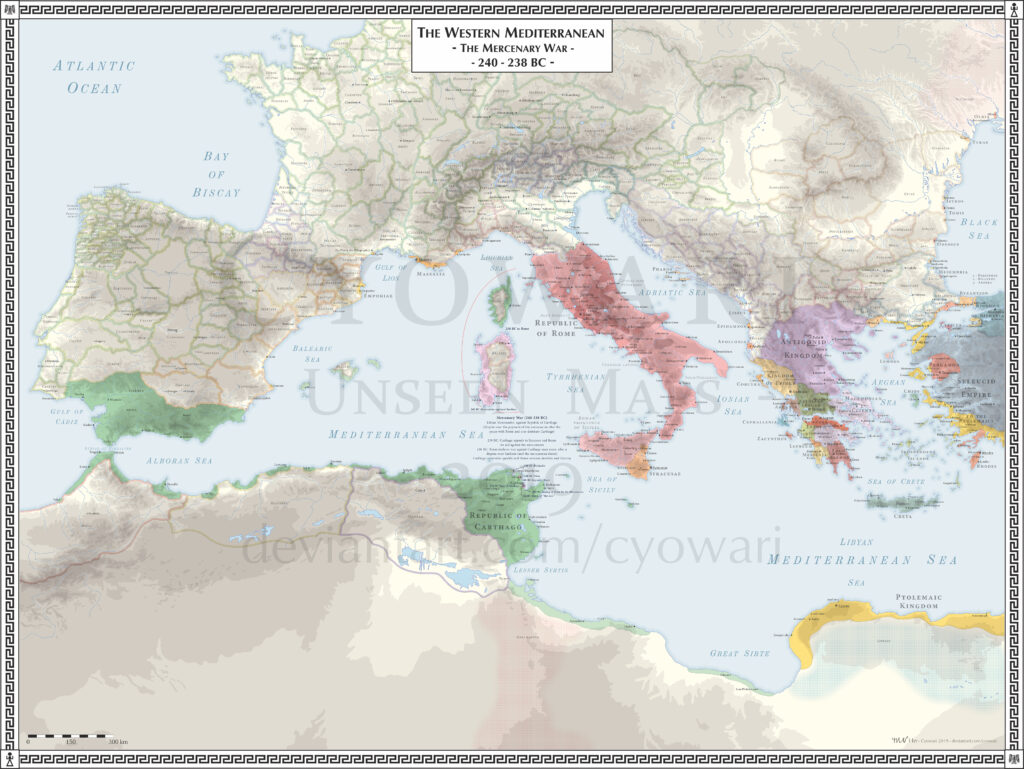
The Mercenary War (241–237 BC), known to ancient historians as the Truceless War, was one of the most dangerous crises ever faced by the Carthaginian Republic. Fought immediately after the conclusion of the First Punic War, the conflict arose from Carthage’s inability to meet its financial obligations to the mercenaries who had served in Sicily. What began as a dispute over unpaid wages quickly escalated into a widespread rebellion that drew in much of Carthage’s North African territory, placing the republic itself under imminent threat.
This article examines the origins of the Mercenary War, the breakdown of relations between Carthage and its former soldiers, and the events that culminated in the Battle of Utica. Drawing primarily upon the account of Polybius and supported by modern scholarship, it reconstructs the political background, military operations, and strategic consequences of the opening campaign of one of the most brutal conflicts of the Hellenistic world.
From the First Punic War to the Mercenary Revolt
Although the Treaty of Lutatius between Lutatius Catulus and Hamilcar Barca, which ended the First Punic War in 241 BC, introduced an era of reconciliation between Carthage and Rome, it did not usher in a period of peace for either side. Both soon found themselves engaged in intense conflicts with other adversaries. For Carthage, this meant a life-and-death struggle with its mutinous mercenaries and the subsequent establishment of an empire in Spain. For Rome, it entailed a renewed and prolonged conflict with the Gauls and an expansion of its power across the Adriatic into Illyria. The twenty-three years that separated the First from the Second Punic War were marked by significant activity and change for both states, involving territorial expansion and constitutional adjustments. These developments ultimately led to renewed open conflict between Carthage and Rome.
After the conclusion of the peace treaty, Hamilcar led his army from Eryx to Lilybaeum and entrusted its command to Gisco, the governor of the city. Anticipating the potential challenge of repatriating the mercenaries, Gisco sent them to Carthage in manageable groups over several months. He aimed to settle the pay arrears of each group and dispatch the different national contingents to their respective countries before the next group arrived, which was a well-thought-out plan to keep the resettlement issue under control. However, the Carthaginian authorities had a different perspective. They chose to quarter the mercenaries in the city, hoping to avoid further draining the already depleted treasury, and intended to entertain them so well that they would forgo at least part of the money owed to them. This decision was naive and short-sighted.
After years of strenuous campaigning, where their desires were either unmet or forcibly fulfilled, the mercenaries eagerly indulged in all the delights the city had to offer. Concerned about the resulting chaos and unruly behavior that persisted day and night, the Carthaginians decided to take a different approach. They approached the officers of the mercenaries and requested that they relocate their men to the remote town of Sicca, which was conveniently distant from Carthage. In exchange, they offered to provide an advance of gold to cover the mercenaries’ immediate expenses, with the remainder to follow as soon as possible. The proposal was accepted, and the move was carried out. However, once the soldiers were settled in Sicca and no longer constrained by discipline, idleness and boredom led to discontent. Speculation arose among the troops concerning the amount owed to them. It was not just a matter of unpaid wages; significant rewards had been promised by senior Carthaginian officers during periods of extraordinary difficulty and danger. Just when expectations were at their peak, Hanno the Great, who was responsible for affairs in Africa, arrived at Sicca. Instead of making the expected payments or providing an update on the arrangements being made, he explained the dire state of the Carthaginian economy and offered a settlement on greatly reduced terms. This announcement ignited the already intense atmosphere. The mercenary army included Spaniards, Gauls, slingers from the Balearic Islands, and a few Greek fugitives and slaves. However, the majority were Africans. Meeting together first as tribes and national contingents, the men found their general resentment breaking through language barriers, expressing their anger in collective assemblies.
Hanno faced the challenge of pacifying the angered mercenaries and reducing their demands. He attempted to convince their officers to act as mediators, but due to differences in education, intelligence, and bias among the officers, his message became distorted. Rumors spread and suspicion turned into outright distrust, especially because the negotiator was not one of their own generals, but a stranger who had not served in Sicily. Disregarding Hanno’s authority and mistrusting their officers, over 20,000 mercenaries marched on Carthage and settled at Tunis, just fourteen miles south of the city. The Carthaginians realized they had made two significant errors. First, they should not have gathered such a large group of mercenaries in one place without a citizen force to oppose them. Second, they should have kept the mercenaries’ wives and children as hostages to ensure good behaviour and use them as bargaining chips in the pay negotiations. Despite the growing mistrust, both sides sought a compromise, and it’s possible that the mercenaries’ exaggerated claims were a strategic move to secure the best deal possible. The Carthaginians therefore appointed commander Gisco to solve this crisis.
Gisco sailed to Tunis with the intention of mitigating the growing unrest among the mercenaries. He first addressed their officers and then the soldiers, speaking to each group according to their national affiliations. Gisco explained the dire financial straits of the Carthaginian republic and appealed to their loyalty. He then began distributing the funds he had brought, which were sufficient to cover the arrears of pay but not the additional claims for items such as corn and horses. Gisco assured them that these additional claims would be settled at a later date. The majority of the mercenaries might have accepted this arrangement if not for the influence of two agitators with personal stakes in opposing the Carthaginian terms. The first was Spendius, a Roman fugitive slave who, despite his valor as a soldier, feared certain death by torture if returned to the Romans. The second was Matho, an African who had been a principal instigator of the current troubles and was acutely aware that he would likely face a similar fate if captured by the Carthaginians. Together, Spendius and Matho exploited the anxieties and suspicions of their fellow mercenaries. They particularly incited fear among the African contingent by suggesting that, once the other nationalities were repatriated, the Africans would be left to face Carthaginian retribution alone. This stirred up a mob mentality, and those who tried to advocate for moderation, whether they were officers or soldiers, were attacked and stoned to death.
The Outbreak of the Truceless War
As expected, the argument ended in their favor. Spendius and Mathos were appointed as generals of the mercenary force, and immediately ordered the capture of Gisco and his staff. They further solidified their authority by using the funds brought by Gisco to pay the arrears themselves. This led to the declaration of a relentless war against Carthage, as described by Polybius. Messengers were sent to all occupied cities, urging them to join the revolt and regain their freedom. While Utica and Hippo Diarrhytus refused, most cities readily consented, sending troops and supplies, bolstering the mercenaries by an additional 70,000 men. Spendius and Matho then divided their army: with Matho launching attacks on Utica and Hippo Diarrhytus while firmly holding their camp at Tunis, and Spendius laying siege to Carthage, cutting off the city and confining the garrison within its walls. What started as a pay dispute escalated into a full-scale revolt, known as the Mercenary War, which threatened the existence of Carthage as a state over the following three years.
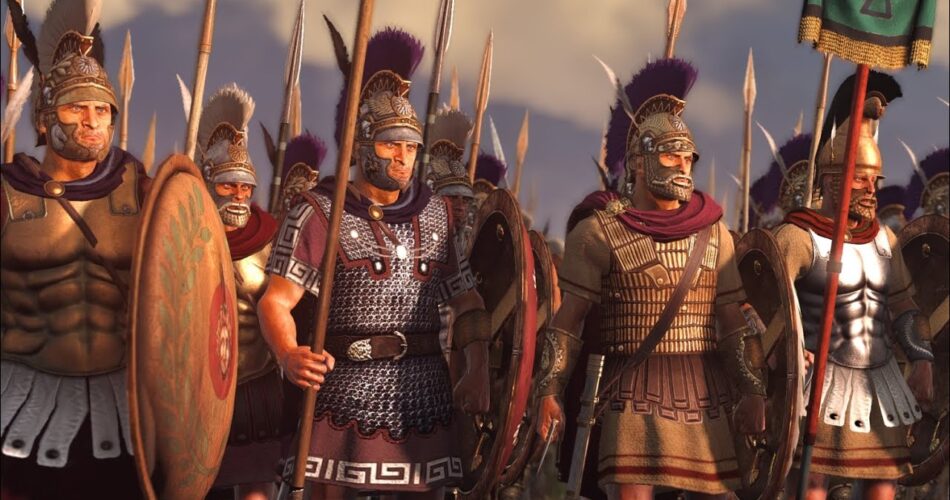
During challenging times, drastic actions were necessary. Hanno, as the commander of Carthage’s African army, took the field. Most of the African soldiers in his force remained loyal, as they were accustomed to acting against their fellow Africans. The non-African contingent, which had remained quartered in Carthage following the expulsion of the Sicilian army, also remained loyal. The few troops still stationed in Sicily were promptly paid and redeployed under Hanno’s command. Additionally, funds were raised to hire fresh troops. Carthage undertook extensive preparations to strengthen their military capabilities. The surviving triremes and fifty-oar vessels were refitted, and all able-bodied citizens were armed. A fresh cavalry unit was formed, and the remaining hundred elephants in their possession were mustered. By the time Hanno had assembled this reinforced force, the rebels had already blockaded Utica and Hippo Diarrhytus. It is likely that both the Carthaginian and rebel armies consisted of similar types and proportions of troops, with the exception that the rebels did not have elephants.
Hanno’s Strategy and the Relief of Utica
At the start of 240 BC, Hanno finally initiated his campaign against the mercenary rebels. He deliberately avoided the Tunis area and instead targeted the besiegers of Utica. Polybius does not provide a specific reason for this decision, but it can be inferred that Hanno deemed it too risky to confront the main rebel forces directly. Nevertheless, he recognized the necessity of taking action to maintain the morale of both his fellow citizens and his own army. Additionally, avoiding the rebels entirely posed the risk of being cut off from supplies and ultimately being defeated. Utica was the central point of the rebels’ extended strategic front. Hanno likely calculated that if this position could be broken and the attackers of Utica defeated, Carthage would gain two strategic bases from which to launch further operations. This would force the remaining enemy forces into a defensive posture and disrupt their coordination. Moreover, the reopening of the seas in spring would re-establish Carthage’s vital contact with the outside world. Consequently, Hanno first moved to aid the besieged city of Utica, aiming to strike fear into the enemy with the presence of his elephants. He set sail from Carthage and landed near Utica undetected. Hanno then established a camp outside Utica without opposition and made contact with the defenders. This detail indicates that the rebels did not have the town surrounded by entrenchments but were blockading it from their own fortified camp instead.
The Battle of Utica
Soon, the defenders of Utica used their siege engines to intimidate the rebels. Meanwhile, Hanno ordered his entire army to charge at the rebel camp. The Carthaginian elephants quickly broke through the encircling entrenchments and devastated the camp, forcing the mercenaries to flee into the surrounding hills. Although Polybius does not mention them, it is clear that Hanno’s other troops followed the elephants in the assault. Here, the narrative takes an unusual turn. Instead of pursuing the fleeing enemy, Hanno called off his army. This decision might have been due to the exhaustion of his troops, who may have marched a considerable distance at a vigorous pace to make their surprise appearance. Alternatively, Hanno’s own “treatment of his body” suggests he might have sustained some injury, albeit not a severe one. Consequently, his men returned to the captured camp, seemingly taking it for themselves. Hanno, ignoring all precautions for their safety, entered Utica to attend to his own needs. He appeared to believe that he had achieved a complete victory and finished the war. Polybius attributes this behavior to Hanno’s limited military experience, noting that his previous opponents, “Numidians and Libyans,” typically continued fleeing for several days once routed. However, it is unlikely that Hanno genuinely believed that a victory at Utica, no matter how decisive, had concluded the war. The enemy forces at both Hippo Diarrhytus and Tunis remained undefeated and were, in fact, growing stronger. Despite this, Hanno might have been convinced by the rebels’ panic and disorder that they posed no immediate threat to his army in their annexed camp. This camp was now guarded by its own defenses, including timbers, palisades, brushwood, and the elephant corps. Hanno may have planned to renew hostilities after tending to his own needs and allowing his troops some rest. Confident after their success, Hanno’s men relaxed their guard. Many left the camp, presumably to visit Utica and the surrounding farms to procure or seize fresh food and goods. This lapse in vigilance occurred the day after their success, or possibly even on the same day if the rebel camp had been taken in the morning.
Hanno underestimated the enemy’s resilience, a mistake that would prove costly. Among the rebels were veterans well-versed in Hamilcar Barca’s hit-and-run guerrilla tactics from the Sicilian campaigns, as Polybius notes. These seasoned fighters, accustomed to retreating only to strike back with renewed vigour, now saw their opportunity. The new recruits among the rebels needed little encouragement to join the counterattack. They had retained their armour and weapons, as demonstrated by their swift response. As Hanno’s men relaxed their guard and streamed out of their camp, the rebel army, bolstered by both veterans and new recruits, descended from the hills in force. The sudden and powerful counterattack caught the Punic army off guard, plunging them into panic. The rebels killed many of Hanno’s soldiers and forced the rest to flee disgracefully up to the walls and gates of Utica. In this fierce engagement, the rebels not only recaptured their camp but also dealt a sharp retaliation for Hanno’s earlier success. The rebels’ counteroffensive was executed with precision, and they managed to seize all the Punic baggage and artillery. The once-confident Carthaginian forces were now on the defensive, their earlier gains nullified by the loss of their camp and critical military supplies. The artillery now fell into enemy hands, effectively turning Carthage’s own weaponry against them. Polybius adds a caustic remark that Hanno, in effect, had transported Utica’s artillery only to hand it over to the rebels.
Despite their setback, Hanno’s troops, like the rebels before them, lived to fight another day. Although now without their camp and war machines, and sheltering under the town walls, they were not as vulnerable as they appeared. Surprisingly, the victorious rebels did not press their advantage. Polybius does not provide an explanation for this missed opportunity. At this juncture, he loses interest in the campaign’s details, summarizing the remainder of it in just a few lines after having devoted a considerable amount of attention to its opening phase. It is clear that the Punic army remained intact, as Hanno soon resumed operations. It is plausible that the elephants played a significant role in preventing a total rout and that some of Utica’s garrison may have come out to support Hanno’s army. Hanno himself might have emerged to rally his troops. What is certain is that his army did not seek refuge within Utica. Had they done so, the rebels, now armed with captured siege engines, could have besieged the city indefinitely. Instead, Hanno was found operating in the countryside only a few days later, indicating that his forces had regrouped and were still a formidable presence.
Aftermath
The outcome had little impact on Carthage’s situation. The rebels maintained their siege of Utica, Hippo Diarrhytus, and Carthage. The Carthaginian field army withdrew from Utica and regrouped. Throughout the remainder of the year, Hanno engaged in skirmishes with Spendius’s forces, failing to capitalize on opportunities to engage or out-maneuver them. Renowned military historian Nigel Bagnall criticized Hanno’s performance as a field commander, citing his incompetence. Additionally, another Carthaginian army, led by Hamilcar in 240 BC, clashed with rebel leader Spendius at the Battle of Bagradas River.
© 2026 History and War
Author: Jishu Roy
Unauthorized reproduction of this content is prohibited.