France on the Eve of Valmy
20 September 1792. Near the small village of Valmy in north-eastern France, two armies stood facing each other. On one side was the army of revolutionary France. On the other stood the powerful Prussian army, advancing into French territory with the aim of crushing the Revolution. Just three years earlier, France had been an absolute monarchy. Now its king had been overthrown, the country was at war with Europe’s major powers, and a foreign army was marching toward Paris. In August, the Prussian army under the Duke of Brunswick invaded France. Longwy fell on 23 August, and Verdun on 2 September. The road to Paris seemed open. The revolutionary government now faced a critical question: could the French army stop the invasion before the Revolution itself was destroyed? The answer would come at Valmy. But how did France reach this point? To understand the Battle of Valmy, we need to go back briefly to 1789, when the French Revolution began.
From Revolution to War
By the late eighteenth century, France was experiencing a combination of political, social, and financial difficulties that increasingly undermined the stability of the Bourbon monarchy. French society remained formally divided into three estates: the First Estate (clergy), Second Estate (nobility), and Third Estate, which comprised the overwhelming majority of the population. Although the Third Estate included prosperous merchants and professionals as well as peasants and urban workers, it carried much of the direct tax burden while the privileged estates enjoyed important exemptions.
The monarchy’s financial position had also deteriorated severely. France had accumulated substantial debts through previous wars, most notably its intervention in the American War of Independence. At the same time, the royal government struggled to reform an inefficient and unequal taxation system. Attempts by ministers such as Turgot, Necker, Calonne, and Brienne to address the financial crisis encountered resistance from privileged groups and political institutions.
The situation became more serious in 1788, when poor harvests and rising bread prices increased economic hardship. The monarchy, facing an increasingly unmanageable fiscal crisis, was eventually compelled to summon the Estates-General, which had not met since 1614.
On 5 May 1789, the Estates-General assembled at Versailles. What began as an attempt by the monarchy to resolve its financial difficulties soon developed into a much broader political crisis. Disputes over representation and voting led the deputies of the Third Estate to challenge the traditional structure of the monarchy.
On 17 June 1789, the Third Estate declared itself the National Assembly, claiming to represent the nation. Three days later, after being excluded from their usual meeting hall, its deputies gathered at an indoor tennis court and took the Tennis Court Oath, vowing not to disband until France had a constitution. The political crisis had now become a revolution.
On 14 July 1789, an armed crowd in Paris attacked and captured the Bastille, a royal fortress and prison. After negotiations and fighting around the fortress, its governor, Bernard-René Jordan de Launay, surrendered. The Bastille itself had limited military importance, but its capture became a powerful symbol of the Revolution and of the weakening authority of the Bourbon monarchy.
The capture of the Bastille was followed by a rapid transformation of the political and social order. During the night of 4 August 1789, the National Assembly abolished the legal privileges associated with the feudal system, fundamentally weakening the traditional privileges of the nobility. On 26 August, it adopted the Declaration of the Rights of Man and of the Citizen, which articulated principles of individual liberty, legal equality, and national sovereignty. These measures represented a fundamental challenge to the institutional foundations of the Ancien Régime.
The authority of the monarchy continued to decline during the following months. On 5–6 October 1789, a large demonstration originating in Paris marched to Versailles, demanding action over food shortages and high bread prices. The royal family was subsequently compelled to leave Versailles and establish its residence in Paris, placing the king increasingly under the political influence of the revolutionary authorities.
The position of Louis XVI deteriorated further in June 1791. On the night of 20–21 June, the king and his family attempted to leave Paris and reach the eastern frontier, where they hoped to obtain support for the monarchy. They were recognized and arrested at Varennes before reaching their destination and were subsequently returned to Paris. The Flight to Varennes severely damaged the remaining confidence in the king and strengthened the belief among many revolutionaries that the monarchy could not be relied upon to uphold the constitutional settlement.
At the same time, the Revolution was becoming an international concern. European monarchies viewed the transformation of France with growing apprehension, particularly because of the potential threat posed by revolutionary principles to the existing political order. On 27 August 1791, Austria and Prussia issued the Declaration of Pillnitz, expressing concern for the position of Louis XVI and indicating their willingness to consider measures against the revolutionary government under certain circumstances. Although the declaration did not amount to a declaration of war, it contributed to the deterioration of relations between revolutionary France and the European powers.
Despite this crisis, the revolutionary authorities attempted to preserve a constitutional monarchy. On 3 September 1791, the Constitution of 1791 was adopted, establishing a new political system in which the king retained executive authority while legislative power was vested in an elected assembly. The settlement, however, failed to resolve the fundamental tensions between the monarchy, the revolutionary movement, and the increasingly polarized political forces within France.
By early 1792, tensions had intensified considerably. Within France, political divisions had deepened, while revolutionary leaders increasingly regarded the European monarchies as a threat to the survival of the Revolution. At the same time, the question of war divided political opinion for different reasons. The Girondins, led by figures such as Jacques Pierre Brissot, increasingly supported war against the European monarchies. They believed that war could expose opponents of the Revolution and potentially lead to the removal of Louis XVI. Constitutional monarchists, meanwhile, believed that a successful war could strengthen the constitutional monarchy and consolidate the political settlement established in 1791. Support for war also existed among royalist circles, although for very different reasons, with some hoping that foreign intervention might ultimately restore the authority of the monarchy.
Maximilien Robespierre and a small number of his supporters remained among the principal opponents of war. Robespierre feared that an international conflict could destabilize the Revolution and allow a successful military commander to acquire excessive political power. Despite these disagreements, support for war became increasingly dominant within the Legislative Assembly.
On 20 April 1792, Louis XVI formally requested that the Assembly declare war on the “King of Hungary and Bohemia,” referring to the Habsburg ruler Francis II, who was also Holy Roman Emperor. The Assembly approved the declaration, and France entered the Revolutionary Wars against Austria. The French government presented the conflict as a defensive struggle for the nation’s liberty and independence, while accusing the Austrian court of supporting French émigrés and conspiring with other European powers against the Revolution.
The conflict soon expanded beyond Austria. Prussia aligned itself with Austria and subsequently entered the war against revolutionary France, while other European powers expressed varying degrees of diplomatic or financial support for the wider effort against the Revolution. Among them were Spain, Sweden, Savoy, and Russia, although their involvement differed considerably from that of Austria and Prussia.
The French Army in 1792: Strengths, Weaknesses, and Transformation
The French army was in a deeply weakened condition at the beginning of the war. More than half of its officers had emigrated from France, largely because of their opposition to the Revolution, creating a serious shortage of experienced military leadership. Some vacancies could be filled by promoting non-commissioned officers and appointing officers from among the newly formed volunteer units, but developing an effective command structure would take time. The army was also divided between the regular troops of the former royal army and the volunteers raised during the Revolution, whose different backgrounds and political loyalties often produced distrust and friction. At the same time, revolutionary ideas had transformed relations between officers and soldiers. Many troops had become suspicious of aristocratic officers and were increasingly reluctant to accept orders from commanders whose loyalty to the Revolution was uncertain. These problems significantly weakened the army’s cohesion and effectiveness just as France entered a major European war.
Despite these weaknesses, the French army also possessed several important advantages. A significant number of the officers who remained in service, together with the non-commissioned officers who increasingly assumed greater responsibilities, were capable and experienced soldiers. The army also retained one of the most effective artillery arms in Europe, whose personnel largely remained loyal to the revolutionary government. These surviving strengths of the former royal army were reinforced by a new source of military power: popular support for the Revolution. Many French citizens regarded the political and personal freedoms introduced since 1789 as worth defending and were therefore willing to take up arms in their protection.
This transformed the character of the French military. Instead of relying primarily on a relatively small professional force, France increasingly drew upon volunteers and citizen soldiers motivated not only by military service but also by patriotism and the defense of the Revolution. However, enthusiasm and manpower could not immediately compensate for the army’s lack of cohesion and battlefield experience. The revolutionary forces still had much to learn before they could effectively confront the more experienced armies of Austria and Prussia.
The Opening Campaigns of 1792: French Failures in the Austrian Netherlands
At the beginning of the war, France deployed three principal armies along its northern and north-eastern frontiers: the Army of the North, the Army of the Centre, and the Army of the Rhine. The Army of the North was commanded by Marshal Jean-Baptiste Donatien de Vimeur, comte de Rochambeau, and was positioned along the Belgian frontier. To its east stood the Army of the Centre under the Marquis de Lafayette, while Marshal Nicolas Luckner commanded the Army of the Rhine.
Following advice from General Charles François Dumouriez, Louis XVI’s government ordered the Army of the North to advance into the Austrian Netherlands. Rochambeau warned that his forces were not adequately prepared for offensive operations, but nevertheless carried out the order. Columns were subsequently sent forward from positions around Lille, Valenciennes, and Dunkirk.
On 28 April 1792, a French column of about 2,300 men under General Count Théobald Dillon advanced from Lille toward Tournai in the Austrian Netherlands. After marching roughly 10 miles, the force encountered Austrian hussars near Baisieux. The appearance of the Austrian cavalry triggered panic among the French troops. French cavalrymen retreated through their own infantry, throwing the formation into confusion and causing a disorderly withdrawal toward Lille. Dillon attempted to restore discipline and rally his men, but the retreat continued on 29 April. He was subsequently shot by his own troops, dragged into Lille, and killed.
On 28 April 1792, a second French column under the Duc de Biron advanced from Valenciennes toward Mons with approximately 15,000 troops. After driving away a small force of Austrian Uhlans, Biron’s troops encountered Austrian forces occupying the heights near Jemappes. The French opened fire with their artillery but halted their advance and established a camp for the night.
Later that evening, rumors spread through the camp that Austrian cavalry was approaching. Two French cavalry regiments suddenly panicked, shouting that they had been betrayed, and fled toward Valenciennes. Biron and his officers managed to bring some of the fugitives back, but the troops proved difficult to control the following morning, and Biron eventually allowed them to return to Valenciennes.
The incident further demonstrated the serious problems of discipline and morale within the French army during the opening weeks of the war. Similar episodes of panic and disorder occurred elsewhere along the frontier, reinforcing the impression that the revolutionary army was not yet prepared to conduct sustained offensive operations against the experienced coalition forces.
On paper, the French forces possessed a considerable numerical advantage and appeared capable of achieving a rapid victory. In practice, however, the campaign exposed the severe weaknesses of the revolutionary army. The first encounters with Austrian forces produced panic among many French troops, leading to disorderly retreats and the abandonment of the offensive. The initial failure demonstrated that France’s numerical strength could not yet compensate for its problems of discipline, organization, and military leadership.
Meanwhile, the coalition powers were assembling a substantial force along the Rhine for an invasion of France. The army consisted largely of experienced and well-disciplined troops, supported by capable commanders and adequate equipment. The coalition’s objective was to advance rapidly into France and threaten the revolutionary government at its center. The principal advance was planned through the Ardennes toward the interior of France, with the ultimate objective of reaching Paris. With the French army weakened by its early failures and internal divisions, the coalition commanders initially expected relatively little resistance to their advance.
Following the failures of the opening offensive, Marshal Rochambeau decided to resign from his command. Dumouriez then offered command of the Army of the North to Biron, but Biron declined, reportedly expressing his preference for dying as a soldier rather than facing execution as a defeated general. Dumouriez subsequently arranged for Marshal Nicolas Luckner to take command of the Army of the North.
Luckner, then about seventy years old, was a veteran of the Seven Years’ War and had originally served against France before entering the French army in 1783. Although he was respected by his soldiers for his personal courage and military experience, he had little confidence in his own ability to command such a large and politically divided army. He was also not fluent in French. Nevertheless, he accepted the command at a moment when the French army urgently required experienced leadership.
Luckner subsequently travelled to Valenciennes, the headquarters of the Army of the North, where he sought the advice of Rochambeau and Lafayette. In May 1792, the three generals formulated a second plan for an invasion of the Austrian Netherlands. Under the proposed operation, Luckner would attack the Austrian right while Lafayette advanced against its left. Once the plan had been established, Rochambeau withdrew from active service and retired to his estates. Luckner, however, preferred to adopt a defensive posture rather than launch another major offensive. The government in Paris rejected this approach and insisted that the army take the offensive.
On 9 June 1792, Luckner advanced into the Austrian Netherlands with approximately 20,000 troops. The French forces captured Menin and Courtrai by 19 June, but the advance was soon checked by an Austrian counterattack under General Johann Peter Beaulieu. By 30 June, Luckner’s forces had withdrawn toward Lille, bringing the second French offensive into the Austrian Netherlands to an end. The operation had achieved only limited territorial gains and failed to produce a decisive breakthrough.
Following the failure of the second offensive, Louis XVI dismissed the Girondin ministers and replaced them with ministers associated with the constitutional monarchist camp. Meanwhile, Dumouriez remained determined to secure Austrian Netherlands, an objective that had both strategic and personal importance for him. He travelled to Lille without official orders, arriving after the French offensive had already ended. Luckner nevertheless gave him nominal command of the left wing of the Army of the North, with its headquarters at the Camp de Maulde, where Dumouriez served alongside General Pierre Riel de Beurnonville.
France in Crisis: The Fall of the Monarchy
Meanwhile, the military setbacks in Belgium intensified political tensions in Paris, where many revolutionaries blamed Louis XVI for the defeats. On 20 June 1792, a large crowd entered the Tuileries Palace and confronted the king. Louis XVI was forced to wear a red liberty cap and publicly acknowledge the Revolution, but the demonstration ended without physical harm to him.
Lafayette, who was still serving as a senior military commander, travelled to Paris and called upon the Legislative Assembly to take action against those responsible for the invasion of the palace. Radical deputies, however, accused Lafayette himself of abandoning his army by leaving the front. The Assembly rejected the attempt to censure him and instead allowed him to return to his command.
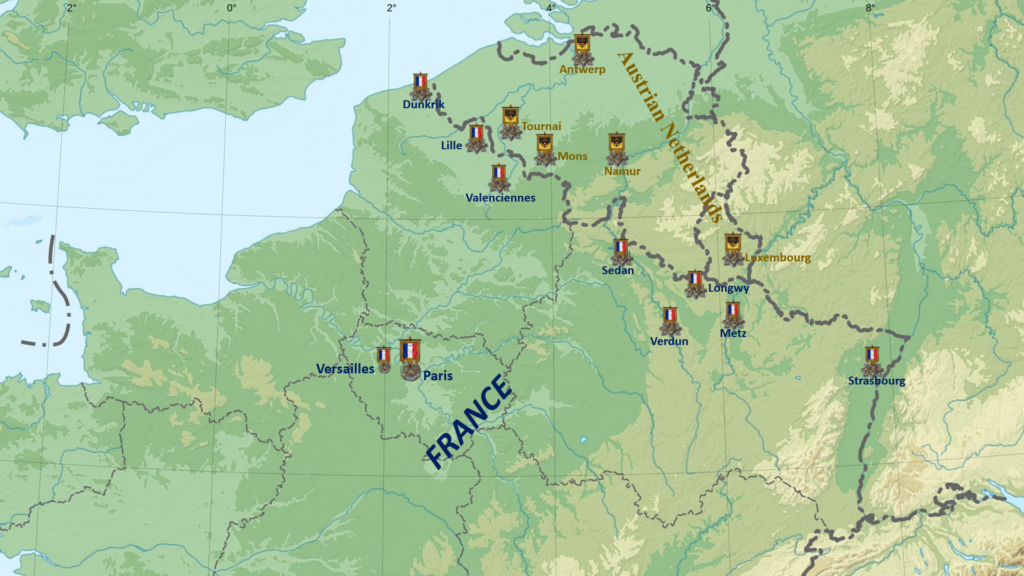
The political crisis further weakened the French military position. Lafayette’s departure from his command, combined with the rapid changes in senior leadership, added to the instability already affecting the army. Along the route through which the coalition forces were expected to advance, the French had two principal field forces: approximately 23,000 troops around Sedan, formerly under Lafayette, and another force of about 20,000 near Metz.
The frontier defenses were also in poor condition. Three fortresses—Sedan, Longwy, and Verdun—were particularly important because they stood along the principal routes of advance. Their fortifications had suffered from inadequate maintenance, while their supplies and military stores were insufficient for a prolonged defense. The coalition therefore expected that, once these frontier positions had been neutralized, its forces could advance toward Châlons with comparatively little resistance. From there, the road toward the interior of France and ultimately Paris appeared open.
By July 1792, the political and military crisis had become increasingly severe. Lafayette, still determined to protect the constitutional monarchy, proposed a redistribution of the French armies that would place his forces closer to Paris. He moved much of his army toward Sedan and had his troops swear loyalty to the “nation, the law, and the king.” He also offered Louis XVI protection with his army, but the king declined, distrusting Lafayette and believing that accepting such protection would place him in a vulnerable position.
Meanwhile, popular hostility toward the monarchy continued to grow. The memory of the Flight to Varennes, the military defeats, and Lafayette’s controversial intervention in Paris had deepened political divisions. Economic hardship, unemployment, and food shortages further increased public unrest. On 11 July 1792, the Legislative Assembly declared the nation in danger and called for additional National Guard units to come to Paris. Despite Louis XVI’s veto, thousands of volunteers arrived, including forces from Marseille.
The crisis intensified when news spread that a Prussian army under the Duke of Brunswick was advancing toward Paris. On 1 August, Brunswick’s manifesto was published in the capital. It threatened severe reprisals against Paris if any harm came to the royal family. Intended to intimidate the revolutionaries, the manifesto had the opposite effect. It strengthened the widespread belief that Louis XVI was cooperating with France’s enemies and increased demands for his removal.
During the night of 9–10 August 1792, radical leaders in Paris replaced the existing municipal government with a revolutionary Commune. On the morning of 10 August, the commander of the Paris National Guard, Marquis de Mandat, was removed and subsequently killed. Command of the Guard passed to Antoine Santerre, who had strong support among the Parisian sans-culottes.
Later that morning, an armed crowd advanced on the Tuileries Palace, where Louis XVI and his family were staying. The palace was defended mainly by Swiss Guards and royalist volunteers. However, the king and his family withdrew to the Legislative Assembly for protection, leaving the defenders without clear orders. Fighting soon broke out, and hundreds of Swiss Guards were killed.
Under pressure from the revolutionary Commune and the crowds gathered in Paris, the Legislative Assembly suspended Louis XVI and placed the royal family under guard. It also called for the election of a new National Convention, chosen by universal male suffrage, to determine France’s future political system. The monarchy had effectively fallen, and France was moving rapidly toward the establishment of a republic.
Following the fall of the monarchy, Lafayette’s position became untenable. On 15 August, he reviewed his troops at Sedan and asked them to renew their earlier oath of loyalty to “the Nation, the Law, and the King.” The soldiers refused, making it impossible for Lafayette to use his army in support of the monarchy. On 19 August, he left France with a small group of followers and crossed into coalition territory. He was arrested by Austrian authorities and imprisoned at Olmütz in Moravia.
Reorganizing the Revolutionary Army
The French army also underwent another series of command changes. Luckner was recalled to Paris amid suspicions of disloyalty, although he was subsequently given command of the Army of the Centre. The Army of the Rhine was placed under the Duc de Biron, while Dumouriez assumed command of the Army of the North. These changes further disrupted an already unstable French command structure just as the coalition invasion was beginning.
Dumouriez believed that Austria could be forced to negotiate through a rapid offensive into the Austrian Netherlands. The Austrian government was at the time also preoccupied with the impending partition of Poland, in which Austria, Prussia, and Russia were seeking territorial gains. Dumouriez further believed that the recent Belgian revolt against Austrian rule might encourage the local population to support a French advance.
The Fall of Longwy and Verdun: The Coalition Advances into France
By the end of July 1792, the coalition army had completed its preparations for the invasion of France and moved from its cantonments around Luxembourg toward the French frontier. The main force was composed of approximately 60,000 Prussian troops, many of whom had been trained in the military tradition established under Frederick the Great. Around 45,000 Austrian troops, including many veterans of the recent war against the Ottoman Empire, supported the Prussian advance on its flanks. Additional contingents, including Hessian forces, also participated in the invasion.
The coalition was accompanied by French émigré forces composed largely of officers, nobles, and other supporters of the former monarchy who had left France during the Revolution. Their motives differed from those of the German armies. They hoped that the invasion would overthrow the revolutionary government, secure the release and restoration of Louis XVI, and allow them to return to France and recover their estates and former social position.
The coalition army was placed under the overall command of Charles William Ferdinand, Duke of Brunswick. While news of the invasion caused considerable alarm in Paris, Brunswick proceeded cautiously rather than advancing immediately into France. Between 19 and 23 August 1792, the coalition forces crossed the Rhine near Koblenz and continued their advance toward the French frontier.
Brunswick was an experienced and methodical commander who favored careful planning and limited risk. His approach contrasted with that of King Frederick William II of Prussia, who accompanied the army and was more inclined toward an aggressive advance. This difference in temperament would influence the conduct of the campaign as the coalition army moved deeper into France.
The coalition army advanced into France with deliberate caution, reflecting Brunswick’s preference for a methodical campaign rather than a rapid assault. The first significant French position encountered was at Longwy. Before reaching it, the small French garrison at Fontoy offered no resistance and withdrew.
On 20 August 1792, the Prussian forces appeared before Longwy, an important fortified town on the frontier. The garrison, approximately 2,600 men under Lieutenant-Colonel Louis-François Lavergne-Champlorier, was drawn largely from National Guard units and was poorly prepared to withstand a prolonged siege. The Prussians subjected the town to sustained artillery bombardment, gradually damaging its defenses and forcing the local authorities to press for surrender. Longwy capitulated on 23 August, providing the coalition with its first major success on French soil.
News of the fall of Longwy reached Paris on 26 August 1792, intensifying fears of a wider invasion. At the same time, reports of unrest in the Vendée reinforced the perception that the Revolution was facing threats both from foreign armies and from internal opponents. The revolutionary authorities responded by expanding measures for national defense. The Paris Commune supported the construction of defensive works around the capital, ordered the production of additional pikes, encouraged further recruitment into the armies, and sought to disarm individuals considered politically suspect so that their weapons could be redistributed to volunteers. These measures reflected the growing sense that the survival of the Revolution depended upon the mobilization of the population for war.
On 29 August 1792, Brunswick’s forces invested Verdun, one of the principal fortresses guarding the route into France. The garrison was poorly supplied and lacked sufficient artillery and small arms to sustain a prolonged defense. The coalition artillery therefore subjected the town to bombardment, while negotiations over its surrender followed. On 2 September, the fortress capitulated. Its commandant, Lieutenant-Colonel Nicolas-Joseph Beaurepaire, died shortly afterward, having apparently taken his own life rather than surrender the position. Beaurepaire was a veteran of the former royal army who had risen from the ranks to become a lieutenant-colonel. His death symbolized, in a personal sense, the profound transformation that had overtaken the French military and political order since the Revolution began.
On 2 September 1792, news that Verdun was under siege and close to capitulation reached Paris, producing widespread alarm. With Longwy already lost, Verdun represented the last major fortified position between the advancing coalition army and the capital. Its threatened fall therefore made the possibility of an invasion of Paris appear immediate.
The Paris Commune responded by calling the population to arms and ordering the city to prepare for defense. Alarm signals were sounded, the city gates were secured, and able-bodied citizens were summoned to the Champ-de-Mars to join newly organized battalions. The authorities also urged the population to remain vigilant against suspected internal enemies whom they believed might assist the invading forces.
The combination of military defeat, fear of invasion, and widespread suspicion of counter-revolutionary activity created an atmosphere of extreme tension in Paris. This crisis contributed directly to the September Massacres, in which revolutionary crowds attacked prisons and killed hundreds of prisoners whom they suspected of being enemies of the Revolution.
Meanwhile, the French government reorganized its military command in response to the advancing coalition army. War Minister Joseph Servan de Gerbey had already placed Dumouriez in command of the Army of the North. On 2 September, command of the Army of the Centre was transferred to Lieutenant-General François Kellermann, who brought approximately 5,000 troops from the Army of the Rhine to Metz, raising the strength of his force to around 15,000.
Marshal Nicolas Luckner was appointed commander-in-chief of the three armies—the North, Centre, and Rhine—with his headquarters at Châlons. In practice, however, the senior commanders exercised considerable independence, limiting Luckner’s ability to coordinate the French forces as a unified army.
At this stage, Brunswick’s coalition army had advanced into a position between Kellermann’s forces to the west and the French forces around Sedan, which had been left without effective leadership following Lafayette’s departure. The French armies were therefore divided and vulnerable, and the coalition appeared to have an opportunity to defeat them separately before advancing toward Paris.
The situation changed with the arrival of Dumouriez near Sedan. Recognizing the danger, he began reorganizing and concentrating the scattered French forces. Through a series of strategic movements, Dumouriez sought to prevent the coalition army from exploiting the divisions between the French armies and to establish a defensive position that could block its advance toward the capital. These movements would ultimately bring the opposing armies together in the Argonne and lead to the confrontation at Valmy.
The Argonne Campaign
The fall of Longwy and Verdun opened the way into France, but the coalition advance was soon confronted by a major natural obstacle: the Argonne. In 1792, this heavily wooded region was characterized by steep ground, streams, and marshes, with only a few practical routes through it. Dumouriez recognized its defensive value and moved quickly to occupy its principal passes.
On 3 September, Dumouriez established his headquarters at Grandpré, where he expected the main Prussian advance. He sent General Arthur Dillon to secure the important positions at La Chalade and Les Islettes, while other detachments occupied the crossings at La Croix-aux-Bois and Le Chesne. Dumouriez intended to use these positions to block the coalition advance while additional French forces concentrated farther south.
Dumouriez was confident that the Argonne could serve as a natural defensive barrier. From Grandpré, he informed War Minister Servan that Verdun had fallen and that he was awaiting the Prussians, describing Grandpré and Les Islettes as the French equivalent of the Thermopylae passes, where he hoped to achieve a better fate than Leonidas.
The coalition army, however, gradually began to outmaneuver him. Brunswick initially directed forces toward Les Islettes and Grandpré to keep the French dispersed. On 12 September, Austrian troops under General Franz von Clerfayt, supported by Prussian forces, attacked the lightly defended passage at La Croix-aux-Bois. The French had concentrated much of their strength at Grandpré, leaving this position comparatively weak. After overcoming the initial resistance, the Austrians forced their way through the pass.
With his defensive line threatened from the flank, Dumouriez was forced to withdraw his forces from Grandpré before they could be surrounded. The coalition had succeeded in breaking through the Argonne, but Dumouriez’s army had avoided destruction and remained capable of further resistance. The French commander now sought another position from which to block the coalition advance toward the interior.
Brunswick did not immediately attack Dumouriez at Grandpré. Instead, the coalition army halted at Landres from 15 to 17 September. Disease, particularly dysentery, had weakened many of the Prussian troops, while the difficult conditions of the campaign further reduced their effectiveness.
Dumouriez used this pause to withdraw his forces toward Sainte-Menehould. During the movement, a division of French volunteers encountered a Prussian cavalry patrol on 15 September and briefly panicked, shouting “Treason!” before fleeing. Dumouriez and his officers managed to stop the retreat near Dommartin, where the exhausted troops halted and rested.
By 16 September, Dumouriez had concentrated his forces around Sainte-Menehould. Reinforcements under Beurnonville brought his strength to approximately 35,000 men, most of them inexperienced volunteers. Meanwhile, Kellermann commanded a force containing many of the French regulars, experienced volunteers, and much of the army’s artillery. He was concerned that Dumouriez’s inexperienced troops might panic again and disrupt his own formations. Kellermann therefore proposed withdrawing toward Châlons and establishing defensive positions there. The government rejected this proposal and ordered him to join Dumouriez at Sainte-Menehould.
Kellermann advanced toward Dumouriez and reached Dampierre-le-Château on 18 September, with approximately 16,000 troops from the Army of the Centre. On 19 September, his army joined Dumouriez’s forces near Sainte-Menehould.
Meanwhile, Brunswick resumed his advance on 18 September, intending to confront Dumouriez at Sainte-Menehould. However, King Frederick William II received reports suggesting that Dumouriez was withdrawing toward Paris. Believing that the French army could be cut off from its line of retreat, the king ordered the coalition army to move toward the road to Châlons. Brunswick, as the king’s subordinate, followed the new plan, and Hohenlohe-Kirchberg ‘s forces, which had crossed the Aisne, were recalled to join the main army.
By the night of 19–20 September, the Prussian army had reached the area around Valmy, where it halted along the road between Suippes and Valmy. Heavy rain and strong winds accompanied the movement, and the coalition forces spent the night in difficult conditions. The following morning, the two armies would finally come within sight of each other.
The Cannonade of Valmy: The Coalition Advance Halted
By the morning of 20 September 1792, the opposing forces were relatively similar in strength. The coalition army under Brunswick numbered approximately 34,000 men with 54 guns, while Kellermann commanded around 36,000 French troops supported by approximately 40 artillery pieces.
The French army was positioned southeast of the Prussian forces and did not directly block their route toward Châlons. The change in the coalition’s route had also altered the expected battlefield. Instead of confronting Dumouriez’s largely inexperienced, Brunswick now found himself facing Kellermann’s more experienced Army of the Centre.
The positions were unusual. The Prussian army was facing toward Germany, with Paris behind it, while the French army faced toward Paris, with Germany behind it. The opposing forces were now in position for the confrontation that would become the Battle of Valmy.
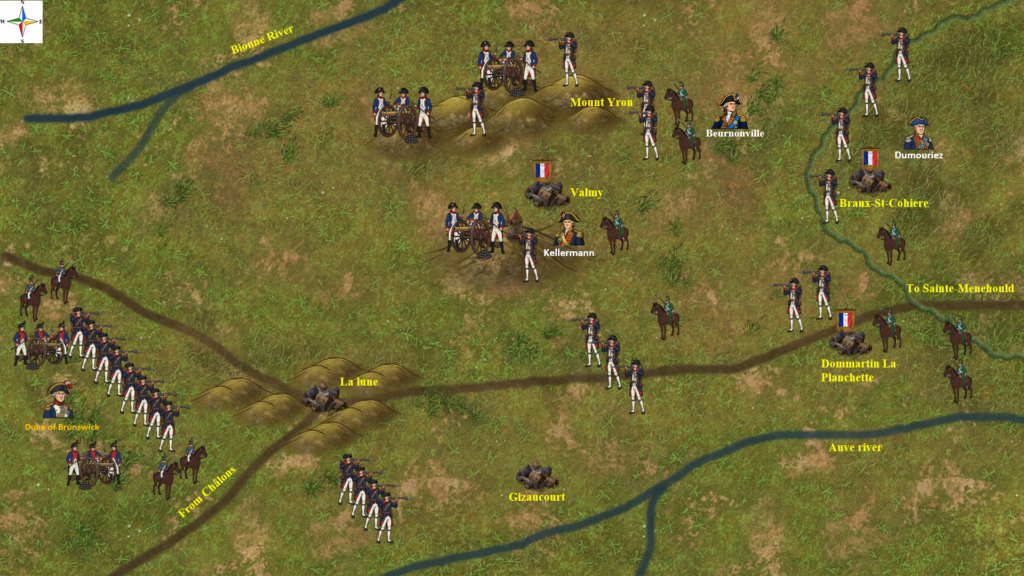
At dawn on 20 September, the coalition forces began moving against Kellermann’s position. The coalition right wing advanced toward the French left in an attempt to threaten Kellermann’s flank and rear and cut his line of retreat toward Châlons. At the same time, the main body moved forward from the heights around La Lune, intending to attack the French position directly and prevent Kellermann from receiving support from Dumouriez.
An early clash between French and coalition cavalry in the low ground alerted Kellermann to the approaching attack. Dumouriez had already recognized the danger of Kellermann’s isolated position and ordered additional troops forward to support both flanks. These reinforcements, however, were slow to arrive, leaving Kellermann’s army largely on its own during the opening phase of the battle.
Shortly after 6 a.m. on 20 September, the Prussian advance guard under Prince Hohenlohe-Ingelfingen moved south from the area around Somme-Bionne toward the Châlons road. The weather was poor, with cold drizzle and thick fog covering the battlefield. After advancing only a few hundred yards, the Prussians came under artillery fire from French guns whose positions they could not yet see. The Battle of Valmy had begun.
The fire came from French canons positioned on the slopes of Mount Yron, a prominent hill overlooking the battlefield. Kellermann’s Army of the Centre occupied a broad semi-circular defensive position, with its right anchored on Mount Yron, its centre around the windmill south of Valmy, and its left extending toward the road between Châlons and Sainte-Menehould.
Behind Kellermann’s position were forces under Beurnonville, while Dumouriez’s main army was positioned farther to the east. Still farther east, near the edge of the Argonne, troops under Arthur Dillon were deployed to prevent the Austrian forces under Hohenlohe-Kirchberg from joining Brunswick’s main army. This deployment allowed the French to maintain a defensive line while preventing the coalition forces from concentrating their strength against Kellermann.
Hohenlohe-Ingelfingen’s advance guard continued toward the Châlons road despite the initial French artillery fire, which was made less effective by the poor visibility. Before reaching the road, however, the Prussian troops came under fire from another French battery positioned near the road junction at the inn of La Lune. They were forced to halt, and an artillery exchange followed. The French battery was eventually driven from its position at approximately 8:30 a.m.
Meanwhile, Brunswick’s main force began arriving on the battlefield and deploying opposite the French positions. The movement continued throughout the morning, accompanied by intermittent artillery fire. As the fog gradually lifted around 10 a.m., the French troops on the heights near Valmy could see the coalition army emerging from the mist. Prussian infantry, cavalry, and artillery were taking up their positions, while Austrian light troops appeared alongside them. By around noon, the coalition deployment was complete.
The sight that emerged from the clearing mist was very different from what the coalition commanders had expected. Instead of a poorly organized revolutionary force, they found the French army deployed in good order on the heights. Kellermann had concentrated much of his strength in the centre, including regular artillery commanded by experienced officers, veteran infantry, and cavalry positioned to support and steady the infantry. The French position was clearly prepared to resist the approaching coalition army.
The Prussian command hesitated before committing its infantry to the attack. Despite the apparent strength of his army, Frederick William II did not immediately order an assault. Shortly before 1 p.m., however, the decision was finally made to advance directly against the French position.
To the sound of fifes and drums, the Prussian infantry formed into two lines and began moving forward in disciplined formation. As the advance began, Kellermann rose in his stirrups, placed his hat bearing the tricolour cockade on the tip of his sword, and called out, “Vive la Nation!” His troops responded with cries of “Vive la Nation! Vive la France! Vive notre général!”
The sound was deafening. Thousands of voices rose together from the French ranks, their cry rolling across the heights and crashing into the advancing Prussian columns. The Prussians had marched into France expecting to scatter a revolutionary army. Instead, they found thousands of French soldiers standing before them in good order, refusing to give way.
For the Prussian soldiers, there was something unsettling in that sound. It was no longer the voice of a regiment or even of a single army. It seemed to rise from the very depths of France itself—from thousands of men united by the same conviction.
Again, the cry swept across the heights.
“Vive la Nation! Vive la France!”
Then the French artillery answered.
The artillery on the heights of Valmy erupted. One battery after another opened fire, and the battlefield was suddenly filled with the thunder of cannon. French gunners worked their pieces with relentless speed, loading, firing, and loading again. Round shot tore into the advancing Prussian formations, while clouds of smoke spread across the heights.
The Prussian columns continued their advance, maintaining their disciplined formations despite the growing artillery fire. Through the smoke and thunder, the voices of the French soldiers continued to rise:
“Vive la Nation! Vive la France!”
The Prussian advance was becoming increasingly difficult. The French artillery continued to pound the approaching formations, while the revolutionary army held its position on the heights. The Revolution was no longer merely defending itself. It was fighting back. And in that moment, the Revolution had found its army.
The exact reason for the Prussian halt cannot be determined with certainty. It may have been the powerful cries of the French soldiers, the sustained artillery bombardment, or the prospect of confronting a French bayonet charge from the heights. Whatever the cause, after advancing only about 200 paces, Brunswick ordered his troops to halt.
The Prussian troops fell back, and the battle soon developed into an artillery duel. The French inflicted heavier casualties, although Prussian fire struck and destroyed three French ammunition wagons, apparently by chance. Brunswick later ordered his infantry forward again, hoping that the French position had been disrupted. Kellermann responded by bringing another artillery battery into action and rallying his infantry. The Prussians advanced several hundred yards but came under heavy French artillery fire and were forced to withdraw once more. Neither side attempted another major infantry assault. The artillery continued firing intermittently until darkness brought the fighting to an end.
After further reconnaissance from the heights at La Lune, Brunswick became convinced that the French army was in good order and that its morale remained strong. As darkness approached, he called a council of war with King Frederick William II and his senior officers.
Brunswick reportedly summarized the situation with the words, “Hier schlagen wir nicht”— Meaning “Here we will not fight.” The council agreed that another infantry assault would be too costly. Under cover of darkness, the French army withdrew from the immediate battlefield. Although the Prussians technically remained in possession of the field, the outcome was already clear: the coalition army had failed to break the French position or open the road toward Paris. Valmy had become a strategic setback for the invasion.
The Aftermath of Valmy: Revolution, Republic, and War
At almost the same moment that the coalition forces began their advance at Valmy, the newly elected National Convention was meeting in Paris to debate the future of France’s political system. The debate focused on whether the monarchy should be abolished and France should become a republic.
The timing was significant. While French soldiers were confronting the coalition army at Valmy, the Convention was beginning the political process that would end the monarchy. The Republic was not formally proclaimed on 22 September. However, the Convention decided that official documents would henceforth be dated from Year I of the Republic. On 25 September, the Convention formally declared that the French Republic was “one and indivisible.”
On the morning of 22 September, Kellermann moved his forces south of the Châlons road, leaving the Prussians a possible route of withdrawal. After the Battle of Valmy, Dumouriez assumed command of the combined French forces and began negotiations with the Prussians while continuing to reinforce his army, which eventually reached about 72,000 men.
The casualties at Valmy had been relatively light: the Prussians lost around 164 men, while French losses were approximately 300. Brunswick had never been enthusiastic about the invasion and had originally favored securing a strong position east of the Argonne before undertaking a larger campaign the following year. King Frederick William II, however, had pressed for a more ambitious advance toward Paris. After the failure at Valmy, Brunswick used the situation as grounds for withdrawing. The Prussian army remained in the area for several more days before beginning its retreat. By late September, the coalition forces began withdrawing eastward, and the Prussians eventually recrossed the French frontier in October.
Dumouriez ordered Kellermann to pursue Brunswick with 16,000 troops from the Army of the Rhine and Army of the Centre, supported by Dillon and another 16,000 men from the Army of the Ardennes. Their orders were to follow the Prussians but avoid a major engagement. Once they reached the frontier, Dillon left the pursuit and joined Dumouriez near the Belgian border.
Dumouriez then turned his attention to his main objective: the conquest of the Austrian Netherlands. After Brunswick and Kellermann had moved away, he sent the remaining 40,000 troops under Beurnonville to reinforce the Army of the North on the Belgian frontier.
The government in Paris subsequently authorized Dumouriez to invade the Austrian Netherlands. On 6 November, his forces defeated the Austrians at the Battle of Jemappes, opening much of the Austrian Netherlands to French occupation. The Battle of Valmy had a significance that extended beyond its immediate military result. It demonstrated that the revolutionary government could mobilize large numbers of citizens to defend the new political order, marking an important transition from the traditional dynastic armies of Europe toward mass armies increasingly driven by national and political loyalties.
Although casualties at Valmy were relatively light, the battle carried enormous historical significance because of the circumstances in which it was fought. The French victory halted the coalition invasion and helped secure the survival of the Revolution at a critical moment. Rather than being crushed by foreign intervention, revolutionary France emerged from the crisis with greater confidence and a stronger determination to continue the war.
Johann Wolfgang von Goethe, who accompanied the Prussian army as an observer, later recalled the mood among the Prussian officers after the battle. When some of his comrades approached him in disappointment, he is said to have told them: “From this place and from this day forth begins a new era in the history of the world, and you can all say that you were present at its birth.” Whether Goethe used these exact words at Valmy is debated, but the quotation has become closely associated with the battle and its historical importance.
Valmy did not end the conflict; instead, the survival of revolutionary France ensured that the war would continue and eventually develop into more than two decades of conflict across Europe. General François Kellermann, the French commander at Valmy, was later honored by Napoleon Bonaparte. He was appointed Marshal of the Empire in 1804 and given the title Duke of Valmy in recognition of his role in the historic battle.
Bibliography
1) THE FRENCH REVOLUTION 1787–1799 | Albert Soboul
2) THE FRENCH REVOLUTIONARY WARS 1787–1802 | T. C. W. Blanning
3) THE WARS OF THE FRENCH REVOLUTION AND NAPOLEON | Owen Connelly
4) THE BATTLE 100: THE STORIES BEHIND HISTORY’S MOST INFLUENTIAL BATTLES | Michael Lee Lanning
5) THE FIFTEEN DECISIVE BATTLES OF THE WORLD, FROM MARATHON TO WATERLOO | Edward Shepherd Creasy
6) BATTLES THAT CHANGED HISTORY: AN ENCYCLOPEDIA OF WORLD CONFLICT | Spencer C. Tucker
© 2026 History and War
Author: Jishu Roy
Unauthorized reproduction of this content is prohibited.