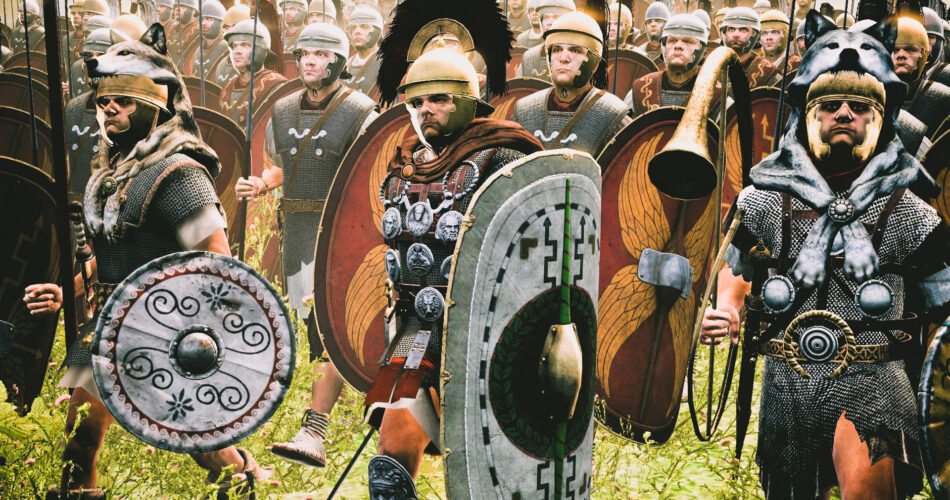
The Last Flames of Gallic Resistance
The Siege of Siege of Uxellodunum in 51 BC marked the final major military confrontation of Julius Caesar’s conquest of Gaul and effectively brought the Gallic Wars to an end. Following the collapse of the great Gallic revolt led by Vercingetorix at Alesia in 52 BC, isolated centers of resistance continued to challenge Roman authority across Gaul. Among the most significant of these was the rebellion centered at Uxellodunum, where Gallic leaders including Lucterius and Drappes attempted to sustain armed opposition against Rome.
This article examines the campaigns conducted by Roman commanders such as Gaius Caninius Rebilus and Gaius Fabius, the development of the siege itself, and Caesar’s increasingly severe measures designed to force the surrender of the town. Particular attention will be given to Roman siegecraft, the strategic importance of water denial during the operation, and the harsh punishment imposed upon the defenders after the fall of the settlement. Finally, the article will consider how the capture of Uxellodunum completed the Roman pacification of Gaul.
Dumnacus and the Revolt in Western Gaul
While Julius Caesar was occupied with suppressing the Bellovaci in northern Gaul, another dangerous situation was developing in the south. Gaius Caninius Rebilus received urgent reports from Duracius, a pro-Roman leader of the Pictones tribe who had remained loyal to Rome even as part of his people revolted. Through letters and messengers, Duracius warned that a large enemy force had gathered within the territory of the Pictones. In response to the growing threat, Caninius swiftly marched toward the town of Limonum.
As Caninius advanced toward Limonum, prisoners captured along the way informed him that Duracius had been trapped inside the town by several thousand warriors commanded by Dumnacus, leader of the Andes tribe. They also reported that Limonum was already under siege. Recognizing that his relatively small force was too weak to confront the enemy directly, Caninius avoided an open battle and instead established his camp in a strongly defended position.
When Dumnacus learned of Caninius’s arrival, he redirected his entire army against the Roman legions and prepared to assault their camp. For several days, his forces repeatedly attacked the Roman defenses but failed to break through the fortifications, suffering heavy losses in the process. Unable to penetrate the camp’s defenses, Dumnacus eventually abandoned the assaults and turned his attention once more to the siege of Limonum.
At the same time, Gaius Fabius was restoring Roman authority across several Gallic states, securing their loyalty by demanding hostages as guarantees of submission. During these operations, he received letters from Caninius describing the situation among the Pictones and the siege of Limonum. Realizing the seriousness of the crisis, Fabius immediately marched to assist Duracius.
The Relief of Limonum and the Loire Pursuit
When Dumnacus learned that Fabius was approaching, he abandoned hope of maintaining the siege safely. He realized that he could not simultaneously face a Roman army advancing from outside the town while also guarding against a possible attack from Duracius and the defenders within Limonum. As a result, Dumnacus hastily withdrew from the area with all his forces. However, he did not believe his army would be truly safe until it had crossed the Loire River, whose deep waters made it difficult to cross anywhere except by bridge.
Although Gaius Fabius had neither seen the enemy nor linked up with Caninius, he relied on information provided by local guides familiar with the terrain and correctly concluded which route the retreating forces would most likely take. Acting on this judgment, he marched his army toward the bridge across the Loire. At the same time, he instructed his cavalry not to ride too far ahead of the legions, ensuring that they could return to the same camp by nightfall without exhausting their horses.
Following Fabius’s instructions, the Roman cavalry advanced in pursuit and caught up with the rear of Dumnacus’s retreating army. The Gallic forces, already demoralized, burdened with baggage, and attempting to flee, were unable to organize an effective defense. Seizing the opportunity, the Roman horsemen launched a sudden attack, killing many of the enemy and capturing considerable booty. After successfully carrying out the operation, the cavalry returned safely to camp.
On the following night, Gaius Fabius once again sent his cavalry ahead of the main army, ordering them to engage the enemy and slow their retreat until the legions could arrive. Determined to carry out these orders effectively, Quintus Atius Varus, commander of the cavalry and a man noted for his courage and tactical ability, rallied his horsemen and aggressively pursued the enemy. He positioned part of his force in strategically favorable locations while leading the remainder into direct combat against the retreating Gauls.
The enemy cavalry responded with unexpected determination, making a strong stand against the Roman horsemen. At the same time, the Gallic infantry repeatedly halted their retreat in order to support their cavalry, turning the engagement into a larger and more intense battle. Fierce fighting soon developed on both sides.
The Roman cavalry fought with exceptional confidence and aggression. Having defeated the enemy the previous day and knowing that the legions were close behind them, they were driven both by the shame that retreat would bring and by a desire to finish the battle through their own courage before the infantry arrived. As a result, they fought fiercely even against enemy infantry forces.
Meanwhile, the Gauls believed that no additional Roman troops were approaching, since only cavalry had confronted them the day before. Convinced that they had found an opportunity to destroy the Roman horse entirely, they committed themselves fully to the struggle.
After the battle had raged fiercely for some time, the Roman legions finally appeared in close formation and suddenly came into view of the enemy. Their arrival immediately changed the course of the engagement, as the advancing infantry signaled that the full Roman army had now entered the battle.
At the sight of the approaching Roman legions, the Gallic cavalry was struck with panic, while the infantry became completely demoralized. In confusion, the fleeing troops broke through their own baggage train and scattered in disorder, raising loud cries as they attempted to escape.
The Roman cavalry, which shortly before had been fiercely engaged in combat against a resisting enemy, now became even more aggressive as victory appeared certain. Shouting triumphantly from every side, they surrounded and pursued the retreating Gauls. The slaughter continued for as long as the Roman horses had the strength to chase and their riders could still strike with their weapons. By the end of the battle, more than twelve thousand enemy warriors had been killed, including many who discarded their arms in fear while fleeing. The Romans also captured the entire enemy baggage train.
Drappes, Lucterius, and the Revival of Revolt
With the Andes defeated and the region pacified through the destruction of its fighting force and military resources, Caninius was ordered to move toward the Provence in pursuit of a force of roughly five thousand men. This group was made up largely of bandits, runaway slaves, and other desperate elements under the leadership of Drappes and Lucterius. Lucterius was already well known to the Romans. During the great Gallic revolt of 52 BC, he had acted on the orders of Vercingetorix and led a raid into Transalpine Gaul in an attempt to spread the uprising beyond central Gaul and threaten Roman territory directly.
Caninius advanced with two legions, determined to prevent a small but dangerous force of desperate men from threatening the Provence. Roman commanders feared that continued raids and acts of plunder by such bands could not only damage the region itself but also bring serious embarrassment to Roman authority and prestige.
The Pacification of the Carnutes and the Armoricæ
Meanwhile, Fabius marched with the remainder of the army against the Carnutes and the other Gallic states whose troops had supported Dumnacus in the recent campaign. Fabius believed that these tribes, weakened and discouraged by their recent defeat, would now be more willing to submit to Roman authority. However, he also understood that if they were given time to recover, they could easily be stirred into rebellion once again through the influence and appeals of Dumnacus.
On this occasion, Fabius acted with remarkable speed and success in restoring Roman control over the rebellious states. The Carnutes, despite having endured repeated Roman campaigns and never previously seeking peace, now surrendered and provided hostages as guarantees of their submission.
The example set by the Carnutes also influenced the more distant coastal tribes of Gaul, collectively known as the Armoricæ. These peoples, living along the Atlantic regions in the far west of Gaul, submitted to Roman authority almost immediately after Fabius arrived with his legions, obeying his demands without resistance. Meanwhile, Dumnacus, driven from his own lands and left without support, was forced to wander in hiding and eventually seek refuge in the remotest regions of Gaul.
The Occupation of Uxellodunum
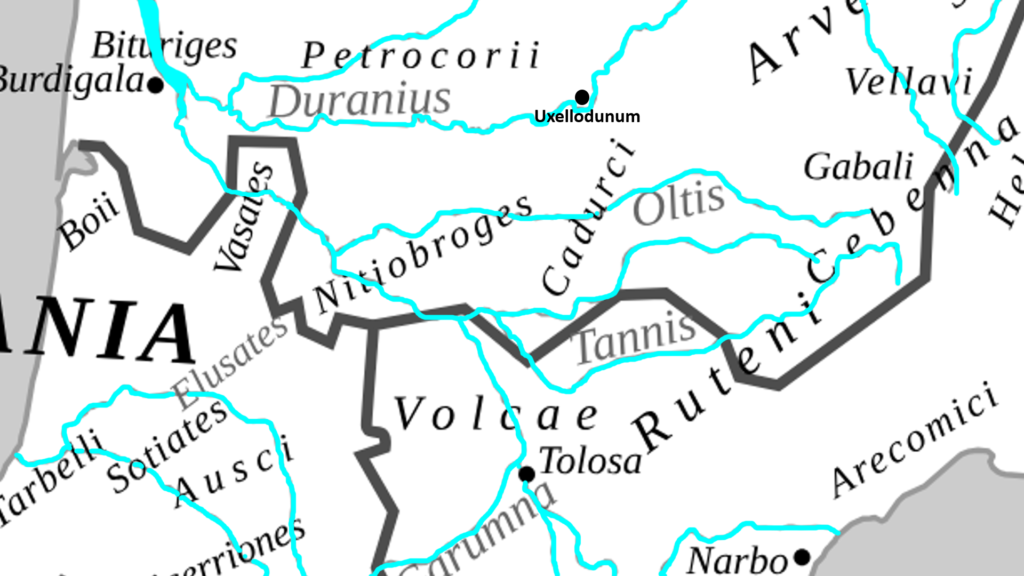
Meanwhile, Drappes and Lucterius realized that Caninius and the Roman legions were closing in on them. They understood that attempting to enter the Provence while a Roman army was in pursuit would almost certainly lead to their destruction. At the same time, they were no longer free to roam across the countryside carrying out raids and plundering settlements.
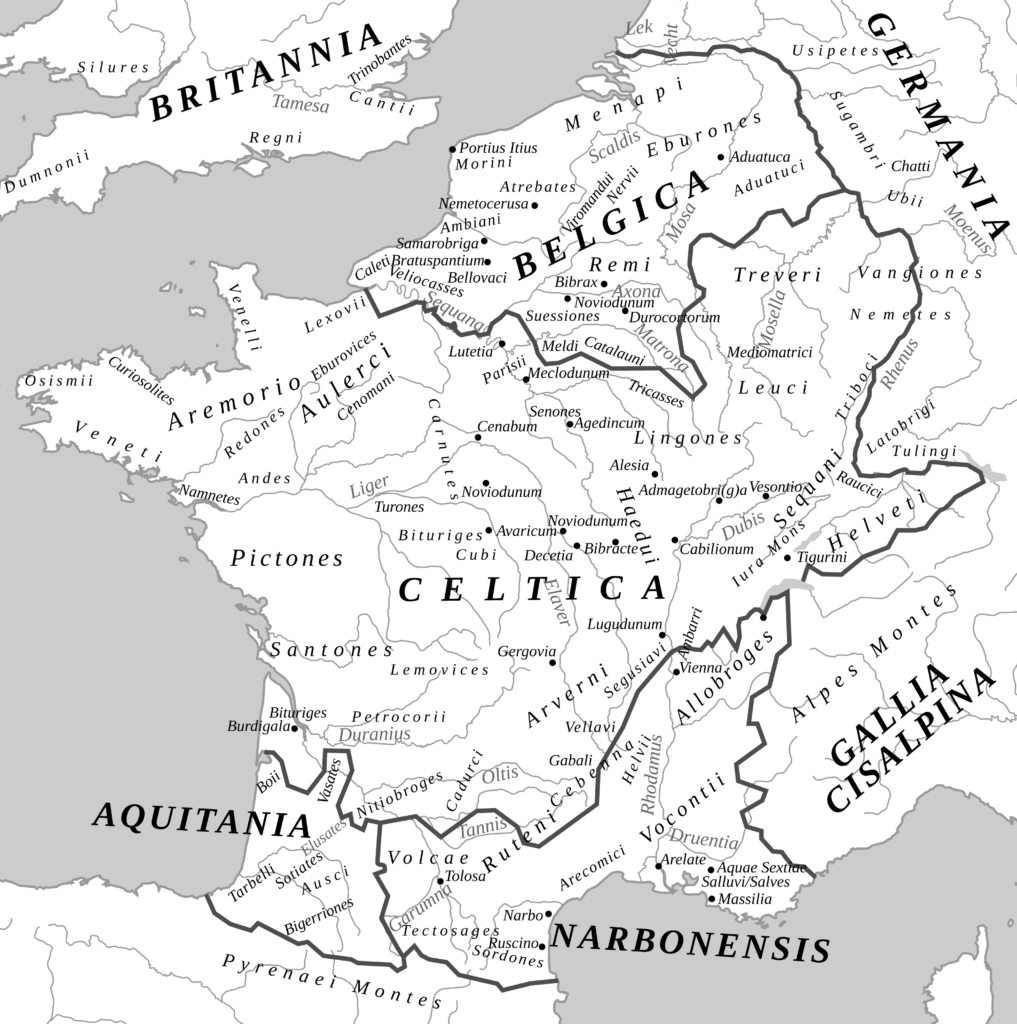
As a result, they halted in the territory of the Cadurci, the native tribe of Lucterius. In earlier years, Lucterius had possessed considerable influence among his countrymen and had earned a reputation among the Gauls as a constant instigator of rebellion and new military ventures. Using this influence, he and Drappes gathered their forces and seized the stronghold of Uxellodunum, a town that had once been under his authority and was naturally well fortified by its terrain. Lucterius then persuaded the inhabitants to join their cause against Rome.
Opening of the Siege
After Caninius arrived at Uxellodunum, he quickly recognized the strength of the town’s defenses. The settlement was protected on all sides by steep and rocky heights that would have been extremely difficult for armed troops to climb, even without enemy resistance. He also observed that the inhabitants possessed large quantities of supplies and valuables, yet any attempt to secretly remove them from the town would likely fail, since Roman cavalry and legions closely controlled the surrounding area.
Realizing that a direct assault would be costly, Caninius adopted a methodical strategy. He divided his army into three separate forces and established three camps on elevated ground around the town. From these positions, he planned gradually to construct siege lines encircling Uxellodunum as far as his troops could endure the labor.
Gallic Preparations and the Search for Supplies
When the inhabitants of Uxellodunum realized what Caninius intended, they became alarmed by memories of the terrible siege of Alesia. Fearing that they might suffer the same fate, they grew increasingly anxious about the possibility of starvation during a prolonged blockade.
Among them, Lucterius was especially influential, since he had personally witnessed the disaster at Alesia. Drawing on that experience, he strongly urged the defenders to secure an adequate supply of grain before the Roman siege lines were completed. Acting on this advice, the defenders agreed to leave part of their force behind to hold the town, while the lighter and more mobile troops departed to gather provisions from the surrounding countryside.
Once the plan had been approved, Drappes and Lucterius departed from Uxellodunum during the following night, leaving behind a garrison of two thousand men while taking the remainder of their forces with them. Over the next several days, they operated throughout the territory of the Cadurci. Some local inhabitants willingly assisted them by supplying grain, while others lacked the strength to resist their demands. In this way, the rebels succeeded in gathering a substantial quantity of provisions.
At the same time, the defenders of Uxellodunum launched occasional night time sorties against the smaller Roman outposts surrounding the town. Because of these repeated attacks, Caninius postponed the construction of a complete line of fortifications around the settlement. He feared that once the siege works were fully extended, he might not have enough troops to defend every section effectively. Dispersing his soldiers across too many positions, he believed, would dangerously weaken his forces.
The Destruction of the Rebel Relief Force
After gathering a large supply of grain, Drappes and Lucterius established a camp roughly ten miles from Uxellodunum. From this position, they intended to transport the provisions gradually into the besieged town in order to avoid attracting Roman attention. The two commanders then divided their responsibilities. Drappes remained behind in the camp with part of the army to guard the supplies and protect the position, while Lucterius personally escorted the wagon train carrying the grain toward the town.
After placing guards at intervals along the route, Lucterius set out around the tenth hour of the night, leading the supply convoy through narrow forest paths toward Uxellodunum. However, the movement of the column was detected by Roman sentries, while scouts sent out from the camp quickly reported the enemy’s activities to Caninius.
Reacting immediately, Caninius dispatched nearby cohorts that were already armed and prepared for action from the nearest watch posts. At dawn, the Romans launched a sudden assault on the convoy. Shocked by the unexpected attack, the Gauls scattered in confusion and attempted to flee in different directions toward their guards.
As soon as the Roman soldiers realized that the enemy was breaking apart, they attacked with great ferocity and gave no quarter. Almost none of the escort survived the assault. Lucterius himself managed to escape with only a small number of followers, but he did not dare return to the rebel camp afterward.
Following this successful attack, Caninius learned from captured prisoners that another portion of the rebel force remained encamped nearby with Drappes, less than ten miles away. After receiving confirmation of this information from several sources, he concluded that the enemy would probably be shaken and demoralized by the defeat of Lucterius’s detachment and could therefore be overcome with relative ease.
Caninius also considered himself fortunate that none of the fleeing Gauls had managed to escape back to Drappes’s camp after the massacre. As a result, Drappes still remained unaware of the disaster that had struck his allies and was unprepared for an immediate Roman attack.
Seeing little risk in taking immediate action, Caninius sent forward all his cavalry along with the German infantry, against the enemy camp. He left one legion divided among the three Roman camps surrounding Uxellodunum, while personally leading the other legion forward without baggage in order to move as quickly as possible.
As he approached the enemy position, scouts reported that the rebels had established their camp in low ground beside a river, following a common Gallic practice, while the nearby high ground had been left undefended. They also informed him that the German cavalry and infantry had already launched a sudden assault on the camp and that fighting had begun.
After receiving this report, Caninius rapidly advanced with his legion drawn up in battle formation. At a sudden signal, Roman troops moved simultaneously to seize the surrounding high ground, cutting off the enemy’s position near the river. When the German cavalry saw the Roman standards approaching, they renewed the attack with even greater determination. Soon afterward, the Roman cohorts closed in from every direction and overwhelmed the rebels. The enemy force was almost entirely destroyed, with many killed and the rest captured. The Romans also seized a large amount of booty from the camp. During the battle, Drappes himself was captured alive.
Having achieved such a decisive success with scarcely any Roman casualties, Caninius returned to continue the siege of Uxellodunum. With the enemy forces outside the town now destroyed, the danger that had previously prevented him from fully extending his siege works no longer existed. He therefore ordered the fortifications and encirclement lines around the town to be completed on every side. On the following day, Fabius arrived with his forces to reinforce the operation and assumed responsibility for maintaining the siege on one section of the encirclement.
Caesar’s Arrival and Strategic Intervention
Meanwhile, Julius Caesar left Mark Antony with fifteen cohorts in the territory of the Bellovaci to maintain Roman control, while he himself travelled across Gaul to restore stability after the recent uprisings. Moving from region to region, Caesar combined calculated generosity with selective acts of severity in order to secure the loyalty of the tribes.
Among the Carnutes, he ordered the arrest of Guturvatus, who was believed to have played a leading role in the recent rebellion. Responding to the demands of his soldiers, Caesar had him executed more majorum — “according to ancestral custom” — by scourging him to death and then beheading him. According to later accounts, Caesar chose to punish Guturvatus personally in order to avoid imposing collective punishment on the entire Carnute people.
After receiving reports from Caninius regarding the situation at Uxellodunum, Julius Caesar placed Quintus Calenus in command of the two legions that remained with him and ordered him to follow at a normal marching pace. Caesar himself, however, took only his cavalry and rode ahead rapidly to support Caninius as quickly as possible.
By this stage, Caesar believed it was essential to crush all remaining resistance without delay. The Gauls were well aware that his command in Gaul would last only one more summer, and he feared they might conclude that if they could continue resisting a little longer, Roman rule might eventually collapse. For that reason, Caesar resolved to make a harsh example of the rebels gathered at Uxellodunum, particularly the bands of armed outlaws and insurgents who continued to challenge Roman authority.
When Julius Caesar arrived unexpectedly at Uxellodunum, he found that the town had already been effectively enclosed by Roman siege works, leaving the defenders with no realistic chance of escape. However, deserters also informed him that the inhabitants still possessed abundant supplies of grain, meaning that the town could potentially endure a lengthy siege unless more decisive measures were taken.
Caesar therefore decided to cut off the defenders’ access to water. Beneath the mountain on which Uxellodunum stood ran a river through the valley, almost encircling the steep and rocky height occupied by the town. Because the river flowed deep below the mountain, the terrain made it impossible for the Romans to divert its course by digging channels or drains.
However, access to the river from the town was extremely difficult. The paths descending toward the water were steep and dangerous, and Caesar realized that if Roman troops controlled these approaches, the defenders would struggle to reach the river safely or return to the town without exposing themselves to attack.
Recognizing this advantage, Julius Caesar stationed archers and slingers overlooking the descent routes and positioned siege engines at the more accessible approaches. By doing so, he attempted to prevent the townspeople from collecting water from the river. The pressure became so effective that the defenders were eventually forced to rely on a single remaining water source.
Near the walls of Uxellodunum there was a powerful natural spring on the one side of the hill that was not protected by the river for a distance of roughly three hundred feet. While most of the Roman commanders merely wished that the defenders could somehow be cut off from this vital water source, Julius Caesar alone believed it could actually be achieved, despite the considerable danger involved.
To accomplish this, Caesar ordered siege galleries (vineae) to be advanced toward the mountain opposite the spring while a large earthwork mound was constructed at the same time. The work required enormous effort and was carried out under constant skirmishing, as the defenders repeatedly attempted to disrupt the Roman engineers and laborers.
At the same time, Julius Caesar ordered another group of engineers to construct a tunnel system directed toward the source of the same spring. Working underground, the Romans aimed to cut off or divert the water supply feeding the spring, thereby depriving the defenders of their last reliable source of fresh water.
Fire Attacks and the Final Gallic Resistance
Once the Roman siege engines began bombarding the approaches leading to the spring, the defenders of Uxellodunum could no longer collect water without exposing themselves to extreme danger. As access to the spring became increasingly restricted, thirst spread throughout the town. Not only did many of the animals kept for food and labor begin to die, but a large number of the inhabitants also perished from lack of water.
Driven to desperation by the worsening water shortage, the defenders of Uxellodunum attempted a dangerous countermeasure against the Roman siege works. They filled barrels with tallow, pitch, and dry wood, set them ablaze, and rolled them down the steep slopes onto the Roman fortifications below.
At the same time, the townsmen launched fierce attacks against the Roman positions in order to prevent the soldiers from extinguishing the spreading fires. The flaming barrels crashed into the siege galleries and earthworks, quickly setting large sections of the siege structures ablaze. Everything in their path caught fire as the burning material rolled down the hillside.
Despite fighting under extremely hazardous conditions and from a difficult position, the Roman troops maintained remarkable discipline and courage. The battle took place on elevated ground in full view of the army, and loud cries rose from both sides as the struggle intensified. In the midst of flying missiles and spreading flames, Roman soldiers deliberately exposed themselves to danger with conspicuous bravery, eager for their valor to be witnessed and remembered by their comrades.
Seeing that many of his soldiers were being wounded in the struggle around the burning siege works, Julius Caesar devised a diversion to relieve the pressure. He ordered cohorts to advance up the mountain on all sides and, while pretending to prepare an assault on the walls, raise loud battle cries.
The defenders, alarmed by the sudden commotion and uncertain about what was happening elsewhere around the town, feared that a full-scale assault had begun. In response, they withdrew many of their fighters from the attacks on the Roman siege works and repositioned them along the walls to defend the town. This gave the Romans enough time both to extinguish the fires that had spread through their fortifications and to repair the damaged sections of the siege lines without risking a major engagement.
Even after suffering terribly from thirst and losing much of their strength to the drought, the defenders of Uxellodunum continued to resist stubbornly. Eventually, however, the Roman mining operations succeeded in cutting through the underground channels feeding the spring and diverting the water away from its source. The spring, which had flowed constantly until then, suddenly dried up.
The inhabitants were so overwhelmed by this event that they believed it could not have been achieved by human skill alone, but only through the will of the gods. Broken by necessity and despair, the defenders finally surrendered to the Romans.
From Uxellodunum to the Rubicon
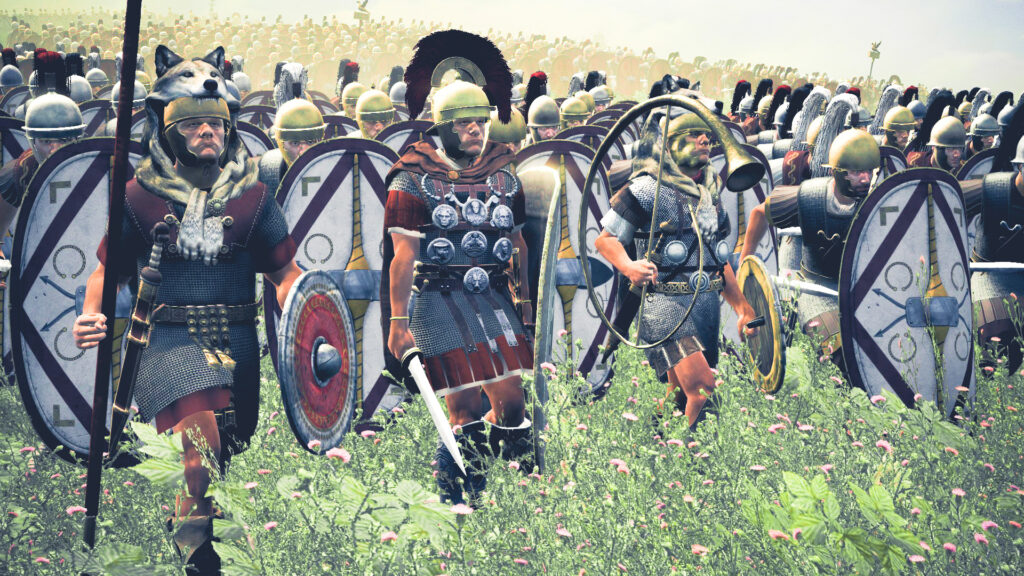
After the fall of Uxellodunum, Julius Caesar accepted the surrender of the defenders. However, determined to ensure that this would become the final major rebellion in Gaul, he imposed a punishment intended to serve as a permanent warning to all other tribes. Rather than executing the survivors or selling them into slavery, which was common practice in ancient warfare, Caesar ordered that the hands of all surviving men of military age be cut off while sparing their lives. The mutilated survivors were then dispersed throughout Gaul as a visible reminder of the consequences of rebellion against Rome.
Some modern historians argue that Hirtius’s comments on Caesar’s policy may reflect concerns connected more closely with the coming Roman Civil War than with the Gallic campaigns themselves. Yet such interpretations can overlook the broader political strategy Caesar had already pursued in Gaul. Earlier in the narrative, Hirtius repeatedly describes Caesar showing leniency toward tribes that surrendered willingly, encouraging other communities to submit peacefully rather than continue resistance. Caesar’s aim after achieving military victory was not simply conquest, but the creation of a stable political order by convincing influential Gallic leaders that cooperation with Rome was more beneficial than rebellion.
The effectiveness of this strategy became clear shortly afterward, when Lucterius, who had escaped after the siege, was handed over to the Romans by another Gallic noble from the Arverni. This showed that many Gallic leaders now preferred cooperating with Rome rather than continuing to fight it.
After suppressing the final pockets of revolt, Caesar took two legions and marched into Aquitania, a region he had not previously visited in person during his campaigns. Concluding that Gaul had finally been pacified, with no further uprisings emerging, Caesar departed with the Legio XIII Gemina for Italy. Soon afterward, in December of 50 BC, Caesar crossed the Rubicon River, an act that initiated the Great Roman Civil War and transformed the history of the Roman Republic.
© 2026 History and War
Author: Jishu Roy
Unauthorized reproduction of this content is prohibited.