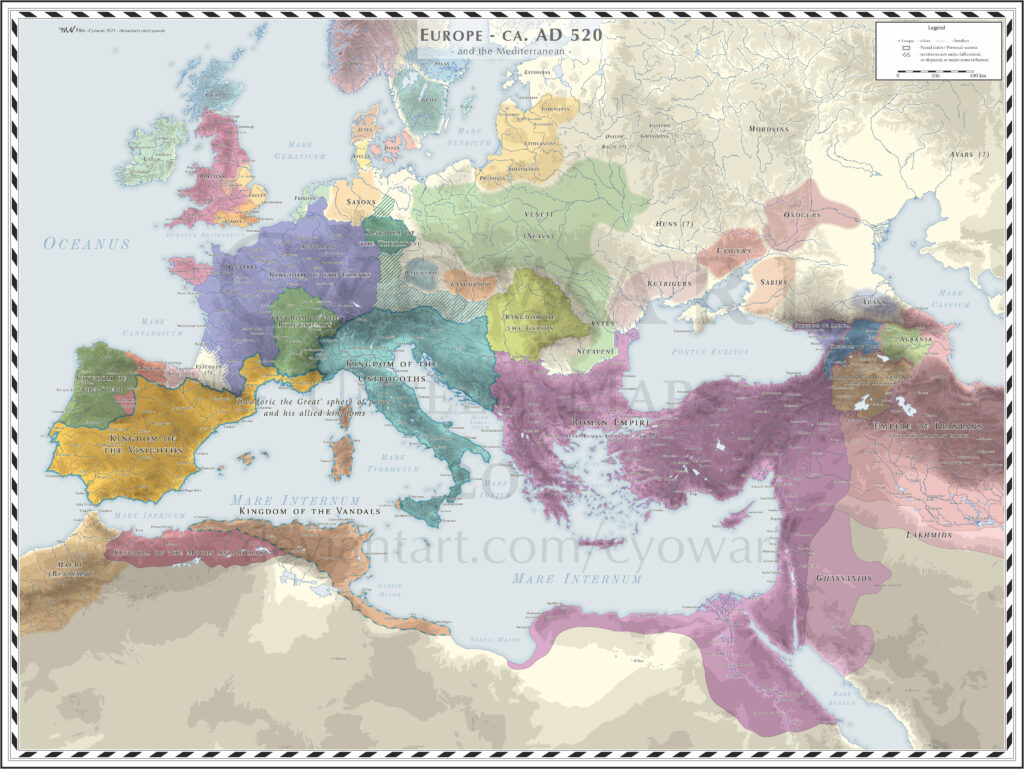
Map © Cyowari
Imperial Détente and the Breakdown of Byzantine–Sasanian Relations
Following the conclusion of the Anastasian War, the Byzantine Empire and Sassanian Persia agreed to a seven-year truce. Remarkably, this agreement endured for nearly two decades. In AD 526 or 527, the aging Kavadh requested that Emperor Justin adopt his son Khusrow in a manner akin to the previous century’s adoption of Arcadius and Yazdigerd. However, Justin, after consulting legal experts, offered only a limited form of adoption. This version, consistent with Roman traditions regarding non-citizens, did not grant Khusrow the full privileges associated with Roman adoption, such as the potential to inherit the empire. Kavadh perceived this as a deliberate affront, particularly since Yazdegerd’s earlier relationship with the Byzantines had been marked by loyalty.
Religious dynamics further exacerbated tensions in the region during this period. Lazica, a kingdom traditionally aligned with the Sassanian Empire, converted to Christianity and shifted its allegiance to the Byzantine Empire. This change was symbolized by the Lazic king’s ceremonial adoption of Emperor Justin as his godfather. Lazica’s defection encouraged other Christian kingdoms in the Caucasus, such as Iberia, to reconsider their own political alignments. Iberia, firmly under Persian control since the late fourth century, grew increasingly dissatisfied with King Kavadh’s attempts to impose Zoroastrian practices. Procopius, the sole source for these events, describes how Iberian ruler Gourgenes sought and received assurances from Justin that the Byzantine Empire would protect Iberia. Emboldened by these promises, Gourgenes renounced Persian authority and aligned his kingdom with the Byzantines. As part of his strategic efforts to consolidate power in the East, Emperor Justinian, who succeeded Justin, took measures to fortify the empire’s eastern frontiers. He incorporated key Armenian provinces into the Byzantine domain and stationed Roman garrisons in strategic locations to consolidate control and defend against potential Persian retaliation.
Peripheral Wars and the First Escalation of Roman–Persian Hostilities
Violence escalated at various points where the influences of the two empires collided. In AD 525, a Roman fleet transported an Aksumite army to conquer Himyarite Yemen. During the same period, from AD 525 to 526, Persia’s Arab allies, the Lakhmids, conducted raids on Roman territories bordering the desert. The Romans sought to extend their influence in Yemen, both to protect Christian interests and to dominate the spice and silk trade routes to India, which were under Persian control.
Collapse of Iberia and the Struggle for the Transcaucasian Frontier
By 526 to 527, direct conflict had erupted between the two empires in the Transcaucasus region and upper Mesopotamia. In response, Justin dispatched Peter, his former secretary, to Lazica along with some Huns, while Kavadh countered by assigning a substantial army to a certain Boes. The Persian campaign was highly effective; they swiftly overran Iberia, compelling King Gourgenes and the Iberian nobility to seek refuge in Lazica. Ultimately, Gourgenes and his court relocated to Constantinople. The initial Persian assaults were remarkably successful. To alleviate the pressure on Iberia, a diversionary operation was launched. The first Byzantine offensive took place in Persarmenia in AD 526. Following established protocols, Sittas and Belisarius led a force into Persarmenia, where they conducted widespread plundering and returned with spoils and captives. This incident is notable as it marks the first appearance of Belisarius as an individual military leader, who would later become one of Byzantium’s most celebrated generals. Given the success of the expedition, a subsequent invasion was initiated. However, by this point, the Persians had made adequate preparations for defense. In an unnamed battle, Sittas and Belisarius were defeated by the Persians under the command of Narses and Aratius. Unfortunately, no details of this encounter have survived.
Following Peter’s inability to defend Iberia effectively, he was recalled to Constantinople, either by Emperor Justin or by both Justin and Justinian. In response to the crisis, three magistri militum—Iranaeus, Cerycus, and Gilderich—were sent to retake Iberia. However, the division of command among the three generals led to operational disarray, culminating in a significant defeat for the Byzantine forces in 528. As a result of this failure, Justinian reinstated Peter as commander of the campaign in the Caucasus. Peter adopted a more centralized approach, consolidating all available Byzantine forces in one location and withdrawing troops from Iberia. This strategy culminated in a decisive victory over the Persian forces. Following this success, Peter fortified his position by garrisoning two key frontier forts, Sarapanis and Scanda, with Roman troops. The Roman strategy emphasized controlling critical strongholds to secure the frontier. However, logistical difficulties in supplying the garrisons soon undermined this approach. By approximately 529, the Byzantines were compelled to abandon the forts, which were subsequently occupied by the Persians.
The successful defense of Lazica, however, necessitated the formation of alliances, and Justinian excelled in this aspect. In 527, he successfully brokered an alliance with Boa, the queen of the 100,000 Sabiri Huns. This alliance proved highly beneficial in 527 or 28 when Boa annihilated 20,000 other Huns who were en route to support the Persians. As a result, Peter was spared from having to confront these Huns in Lazica. Following this, there were no significant developments in the region during the war: the Romans, with the backing of Lazica, maintained control over the remainder of the territory, while the Persians had reclaimed Iberia. This effectively marked the division of influence in the Transcaucasus and the entrenchment of the two empires in open conflict. The Persian offensive against Lazica alarmed both Justin and Justinian, as it introduced the possibility that the Persians could seize control of the Lazican coastline and conduct naval operations in the Black Sea against Constantinople.
Frontier Raids, Roman Reorganisation, and the Dara Sector Crisis
In AD 527, the Byzantines launched a series of diversionary and pre-emptive incursions into Persian territory, utilizing forces stationed near the border. This strategy included the construction of two fortresses along the frontier to strengthen defensive positions. To support this effort, the Magister Militum per Orientem, Libelarius, led a diversionary campaign intended to draw Persian attention away from these activities. Libelarius first advanced on Nisibis but failed to capture the city. He then moved against Thebetha, but this effort also proved unsuccessful. Both sieges were conducted with minimal determination, as Libelarius’s primary objective was not territorial conquest but rather the distraction of Persian forces. After these inconclusive operations, he withdrew his army to Dara. However, the retreat proved disastrous, as many byzantine Infantry succumbed to the intense summer heat, highlighting significant logistical mismanagement. Libelarius’s performance was widely regarded as inept, as such losses should have been avoidable with better planning and leadership. Recognizing this failure, Justinian dismissed Libelarius and replaced him with Hypatius, a seasoned commander tasked with curbing ongoing Arab raids and restoring effective control over the eastern frontier.
Around this time, the dux Mesopotamiae, Timostratus, died, and Belisarius was promoted to replace him, likely by order of Emperor Justinian. As a result, Belisarius assumed command at the strategic headquarters in Dara. A key component of Roman strategy against the Persians involved establishing and maintaining fortified posts along the frontier, with Dara being one of the most important. The region south of Dara, however, had long been vulnerable to raids by both Arabs and Persians, and it was recognized that the defenses in this area needed strengthening. To address this vulnerability, the Byzantines attempted to fortify a desert site at Thannuris, south of Nisibis. The Persians, perceiving this as a direct threat, warned the Byzantines to halt construction or face invasion. In response, Justinian reinforced Belisarius’s forces with a substantial contingent of commanders and troops. This included the duces of Phoenicia, Coutzes and his brother Boutzes, along with Sebastian, some Isaurians, the dux of Phoenicia Proclianus, Vincent the comes Basil, and the Ghassanid Arabs under their king Tapharas. The scale of this force was considerable. Even if each commander brought only half their available troops, the force would have included approximately 7,000 infantry and 15,000 Cavalry, supplemented by the Arabs and bucellarii. However, given the demands of fort construction in close proximity to enemy territory, a larger infantry presence—likely around 10,000, including Isaurians—was required to protect the workers. The cavalry force was probably the largest component of the army, with at least 25,000 Limitanei horsemen, alongside bucellarii and Arab allies. This brings the estimated total force to approximately 30,000 Cavalry, in addition to the infantry. Such a formidable force indicates the Byzantines anticipated a major confrontation and likely outnumbered the Persians. However, a critical flaw undermined their command structure: Belisarius, as a dux, held a rank that limited his authority over the other commanders, such as the duces and comes Basil. This lack of centralized authority would later have serious consequences for the coherence and effectiveness of the Roman forces in the field.
Persian Strategy and the Luring of the Byzantine Field Army
As the Persian army advanced against the Romans to halt the construction of the fort, they were met with the unsettling realization that the Romans outnumbered them. The Persians had only managed to assemble 30,000 troops under the command of Peroz Mihran and Xerxes, son of Cabades. Malalas explains that this limited number was due to the Persians simultaneously deploying a large force in Lazica. However, they did possess a crucial advantage over the Romans: Mihran was undoubtedly the overall commander.
Based on the account of Zachariah Rhetor, we know that the battle occurred near Thannuris. In this engagement, the Persian general Mihran employed a double stratagem to outmaneuver the Byzantine forces. First, he led his army near Mindous, deliberately provoking the Romans into action. Once the Byzantines were drawn in, Mihran feigned a retreat, drawing them further south to Thannuris, where he had set a trap. Confident in their numerical superiority, the Romans pursued the Persians. However, once they reached the vicinity of Thannuris, Mihran executed a tactic reminiscent of one used by the Hepthaelites against the Persian Shahanshah Peroz in 485. The Persians had dug concealed ditches among their trenches, leaving several strategically placed openings through which their troops could retreat.
The Battle of Thannuris: Encirclement and Catastrophic Roman Defeat
When Belisarius and the Roman army arrived, the Persians strategically positioned their cavalry in front of the concealed ditches. They then pretended to flee, deliberately luring the Roman forces into pursuit. Two impulsive young brothers, Coutzes and Boutzes, took the bait and charged after the retreating Persians. Their reckless pursuit encouraged the rest of the Roman cavalry to follow suit. The Roman cavalry, eager to capitalize on their numerical advantage, galloped at full speed without caution. However, this haste proved disastrous, as the cavalry charge led them straight into the hidden ditches. The horses and riders fell into the pits, causing significant confusion and chaos in the Roman ranks. This trap severely disrupted the Roman cavalry’s cohesion, giving the Persians a strategic advantage.
During the battle, the Persians inflicted significant casualties on the Roman forces. The rash actions of the cavalry commanders led to the death or capture of several high-ranking officers. Coutzes was wounded and captured, while Proclianus was killed outright. Sebastian and Basil were also captured, and Tapharas, the Ghassanid ruler who fought as a Byzantine vassal, was thrown from his horse and killed by the Persians. The remaining Roman cavalry, likely composed of troops from the second line, retreated to Dara, accompanied by Belisarius. However, the Roman infantry was left behind, either slaughtered or taken captive. The infantry’s morale was insufficient to conduct an organized retreat in a defensive formation, such as the hollow square or oblong formation, which would have been essential to defend against the Persian cavalry. At this point in the battle, it is clear that the Persian cavalry had a numerical advantage over the Roman infantry. Moreover, the Isaurian infantry, ill-equipped for combat against cavalry, contributed to the Roman defeat. While better-equipped infantry might have been able to put up more resistance, the lack of morale and proper equipment led to the collapse of the infantry’s effectiveness. The loss of the majority of the Roman forces in the East was a devastating blow, the consequences of which were still felt in subsequent battles, such as those at Dara and Satala two years later. In light of this disastrous defeat, Belisarius was promoted to Magister Militum per Orientem in AD 529, indicating that he was not held personally responsible for the failure. As dux, Belisarius lacked sufficient authority over the other commanders, which weakened his ability to control the situation. It is likely that he did not approve of the rash cavalry charge and the pursuit of the Persians from Mindous to Thannuris, but he may have been pressured into following these orders by his subordinates. His promotion to a higher rank was necessary to grant him the authority to command more effectively in future operations.
Strategic Collapse and Imperial Response on the Eastern Frontier
The defeat at Thannuris not only necessitated the abandonment of the fortification project but also exposed the eastern front to the potential of enemy invasion. In response, the emperor was compelled to implement emergency measures. Justinian dispatched several high-ranking officials, along with their bucellarii and regular units from the Balkans, to secure the cities. These forces were placed under the command of Pompeius, the brother of Hypatius and nephew of Anastasius. Fortunately for the Romans, an exceptionally harsh winter arrived, halting further military operations until the end of the year.
© 2026 History and War
Author: Jishu Roy
Unauthorized reproduction of this content is prohibited.