The Bronze Age Collapse and the rise of the Sea Peoples
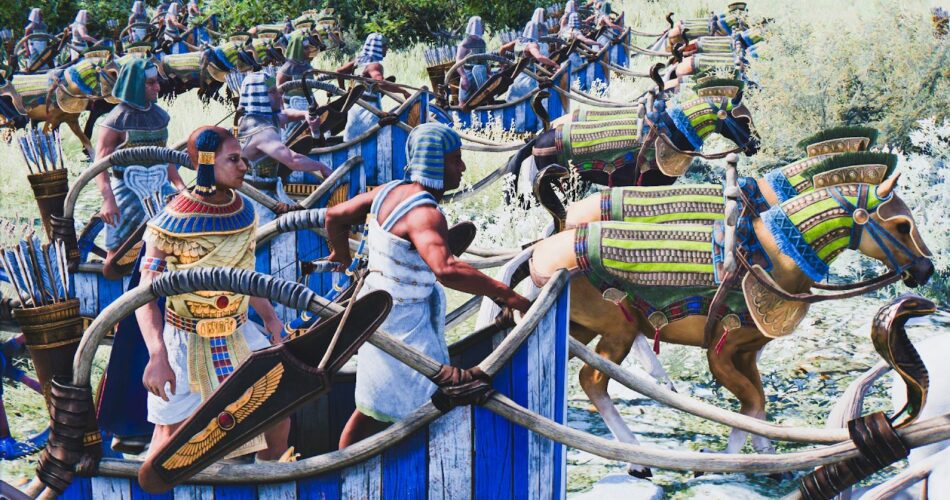
In the late twelfth century BC, the Bronze Age world was crumbling—cities burned, kingdoms fell, and waves of invaders swept across the eastern Mediterranean. From the sea came a confederation of warriors—fierce, relentless, and hungry for conquest. Egypt called them the Sea Peoples. But on the banks of the Nile, Pharaoh Ramesses III stood ready. The fate of his empire—indeed, the survival of Egypt itself—rested on this battle. What followed at Djahy was no mere skirmish, but a decisive clash between civilization and chaos. A battle that would determine whether Egypt would endure… or fall into the darkness that consumed so many others. This is the Battle of Djahy.
The Calm Before the Clash
During the twelfth century before Christ, the great civilizations of the Bronze Age world began to crumble. The Hittite Empire vanished, the palaces of Mycenaean Greece lay in ruins, the kingdom of Alashiya on Cyprus disappeared, and the thriving city of Ugarit was reduced to ashes. Across the eastern Mediterranean, the old order collapsed, and with it the stability that had endured for centuries.
At the heart of this upheaval were the Sea Peoples and other migrating groups. Restless and relentless, they swept along the coasts of Anatolia, Cyprus, Syria, and Canaan, plundering cities and toppling kingdoms. In the eleven-eighties, their gaze turned toward Egypt—a land of irrigated fields, abundant harvests, and gold, a beacon of prosperity in a time of scarcity. But these invaders sought more than treasure; they came as settlers, determined to claim the fertile Nile valley for themselves.
Egypt had already weathered such storms. In the days of Pharaoh Merneptah, Libyans and Sea People allies struck deep into the Delta. At Perire, around 1208 BC, they were defeated—but the threat endured. A generation later, under Pharaoh Ramesses III, the danger returned. In his fifth year, Libyans and Sea Peoples marched once more into Egypt—and were once again repelled.
Yet these victories were fleeting. The wider storm of the Bronze Age Collapse continued to rage, consuming kingdoms, cities, and civilizations alike. Egypt alone remained standing, poised on the edge of an even greater trial. The decisive confrontation—the battle that would test the very survival of the Nile kingdom—was about to unfold at Djahy in 1178 BC.
Location
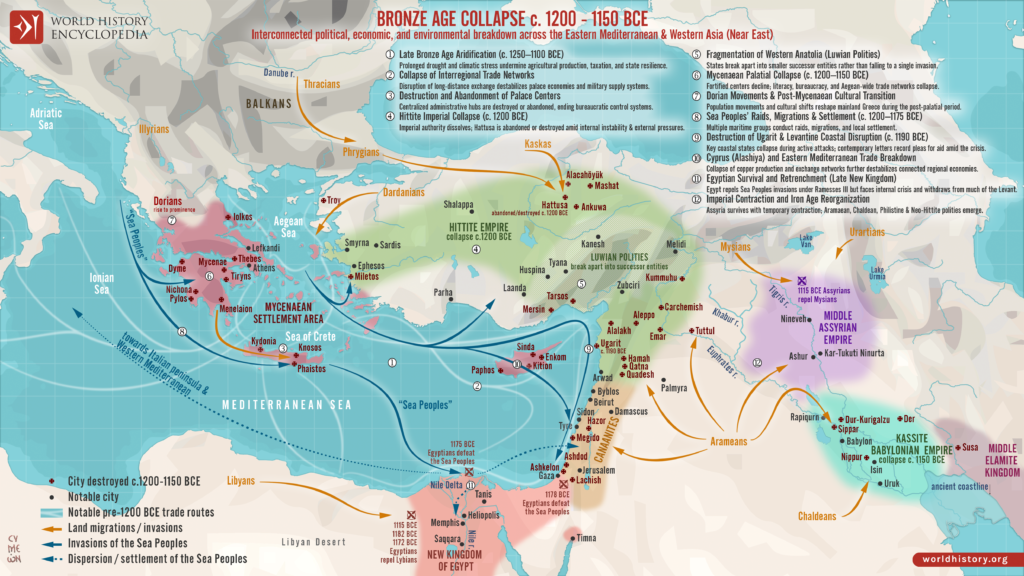
Image credit- Simeon Netchev
The Battle of Djahy took place along Egypt’s eastern frontier, in a region corresponding to southern Lebanon today. This area, part of the Levant, held significant strategic importance, serving as a key connection between Egypt and the trade routes and territories of neighboring states. Its geographic position made Djahy a critical buffer zone, protecting Egypt from invasions coming from the north and northeast, where the Sea Peoples’ confederation was actively raiding and plundering. Djahy itself was a coastal region with access to both land and sea routes, providing the Sea Peoples with an ideal launching point for their assault on Egypt. The Levantine coastline, characterized by rocky cliffs, narrow inlets, and stretches of coastal plains, presented both challenges and opportunities for the combatants. These natural features allowed the Egyptian army to monitor enemy movements along the coast while preparing defensive formations inland.
Source
The primary historical account of the Battle of Djahy is preserved in the inscriptions at the mortuary temple of Ramesses III at Medinet Habu. These hieroglyphic texts provide one of the most detailed records of an ancient Egyptian military campaign, vividly describing the confrontation with the Sea Peoples. The inscriptions portray Ramesses III as a powerful defender of Egypt, emphasizing his role in protecting the nation from invaders who had already devastated other civilizations across the Mediterranean. The temple walls recount not only the tactics and outcome of the battle but also the identity and appearance of the Sea Peoples. They list the various groups within the confederation, including the Peleset, Tjeker, Shekelesh, Denyen, and Weshesh. The Medinet Habu reliefs visually capture the intensity of the conflict, depicting bound prisoners, Egyptian chariots, and enemy warriors in intricate detail.
Strategy of the Battle of Djahy
Before advancing into Egypt, the Sea Peoples had sacked the Hittite vassal state of Amurru, located near Egypt’s northeastern frontier. This incursion gave Ramesses III crucial time to prepare for the impending invasion. As he records in an inscription at his mortuary temple in Medinet Habu: “I equipped my frontier in Djahy, prepared before them.” The strategy employed by Ramesses III demonstrates both his tactical foresight and military skill. Aware of the Sea Peoples’ advance through the Levant after the destruction of nearby territories, he preemptively fortified Egypt’s eastern borders. Egyptian forces, including chariots and infantry, were deployed in carefully chosen positions along the frontier, creating a strong defensive line. The region’s coastal terrain—with its cliffs, narrow inlets, and plains—enabled him to confront the enemy on multiple fronts, simultaneously defending against both land and naval forces. Leveraging these geographic advantages, the Egyptians were able to mount a coordinated, multi-front defense, ensuring a decisive stand against the Sea Peoples.
The clash itself: Egypt vs the Sea Peoples
When the Sea Peoples reached the plains of Djahy, they encountered the full might of the Egyptian army, solid and unbroken. Unlike previous targets, they were not facing a fragmented garrison or scattered detachments—they confronted an entire kingdom prepared for war. The invaders, fierce and determined, launched a brutal charge against the Egyptian lines, seeking to break through by sheer force. But the Egyptians were ready.
The infantry formed the first line, ready to absorbe the enemy charge. Behind them, the archers unleashed volley after volley of arrows, cutting down warriors, disrupting formations, and reducing the momentum of the Sea Peoples’ assault. The Sea Peoples, fierce and determined, were met with a storm of projectiles. Each arrow that fell into the enemy ranks sapped their strength and scattered their cohesion. Each arrow that struck a warrior sent shockwaves through their ranks, slowing their advance and sowing confusion among leaders and soldiers alike. Their formations wavered, cohesion broke, and the sheer weight of their charge lost much of its force before it even collided with the Egyptian front.
Then the deadly contact came. The Egyptian infantry, forming the first line, absorbed the weakened but still violent charge. Spears and shields met swords and axes in a brutal, grinding melee, the battlefield echoing with the cacophony of bronze clashing against bronze and shields. The Sea Peoples, relying on raw strength and fury, attempted to break through by sheer force, but the disciplined Egyptian army held firm. Archers continued to fire from behind, their relentless volleys targeting any gaps, further disrupting enemy formations and preventing the invaders from regrouping.
Hours passed as the melee dragged on. Every step forward by the Sea Peoples was contested; every thrust met with counter-thrust. Dust rose from the plains, mingling with the sounds of war—the clash of bronze, the screams of warriors, the relentless pounding of feet on earth. The Egyptians rotated their soldiers as fatigue set in, maintaining the integrity of the front line.
Then came the decisive moment. At the Pharaoh’s signal, the Egyptian chariot corps, previously held in reserve to fill any gaps the Sea Peoples might create, surged into battle. With the infantry holding firm and archers keeping the enemy disorganized, the time for their intervention had arrived. Ramesses III led the charge, standing at the forefront as his chariots cut fiercely into the Sea Peoples’ ranks. Light, swift, and highly maneuverable, the Egyptian chariots struck where the enemy was weakest, their speed and precision allowing them to outflank and encircle exhausted warriors. The Sea Peoples, already battered by the relentless infantry resistance and volleys of arrows, could not withstand this fresh onslaught.
Chaos rippled through the invaders’ ranks. Thousands fell before they could comprehend the attack; others fled in disorder, leaving the battlefield to the Egyptians. Many perished, while the most unfortunate were captured, becoming part of Egypt’s great spoils of war. The battle at Djahy demonstrated the brilliance of Egyptian combind arms strategy. Through coordination, discipline, and the tactical genius of Ramesses III, Egypt secured its eastern frontier and decisively repelled one of the most formidable threats of the Bronze Age.
Aftermath: The cost of victory and the decline of the New Kingdom
Although the Battle of Djahy ended in a decisive Egyptian victory, the conflict with the Sea Peoples was far from over. The invaders returned, this time with their naval fleet, targeting Egypt itself near the mouth of the Nile. In the subsequent Battle of the Delta, the Sea Peoples were again defeated. Many were struck down by Egyptian archers, while others were dragged from their boats and slain along the riverbanks by the Pharaoh’s forces. Despite these remarkable military successes, Egypt’s triumph came at a considerable cost. The campaigns against the Sea Peoples placed immense strain on the Egyptian economy and military resources. While the homeland was defended and the invasion repelled, the heavy expenditures and depletion of manpower weakened the empire, signaling the beginning of a gradual decline in New Kingdom power. Over the following decades, Egypt’s ability to project influence over neighboring regions diminished. By the reign of Ramesses XI, less than a century later, the empire’s dominance had waned significantly, marking the end of the New Kingdom era.
© 2026 History and War
Author: Jishu Roy
Unauthorized reproduction of this content is prohibited.