The War Awakens
Welcome everyone. Today, we journey back over three thousand years, to the dawn of recorded military history. Beneath the burning sun of Canaan, two great powers clashed in a struggle that would echo through the ages. It was here, at Megiddo, that Pharaoh Thutmose III led his forces against a vast coalition of rebellious Canaanite kings. Not only was this battle one of Egypt’s greatest victories, but it also became the first ever recorded in detail, marking the beginning of military history as we know it.
The Young Pharaoh Rises
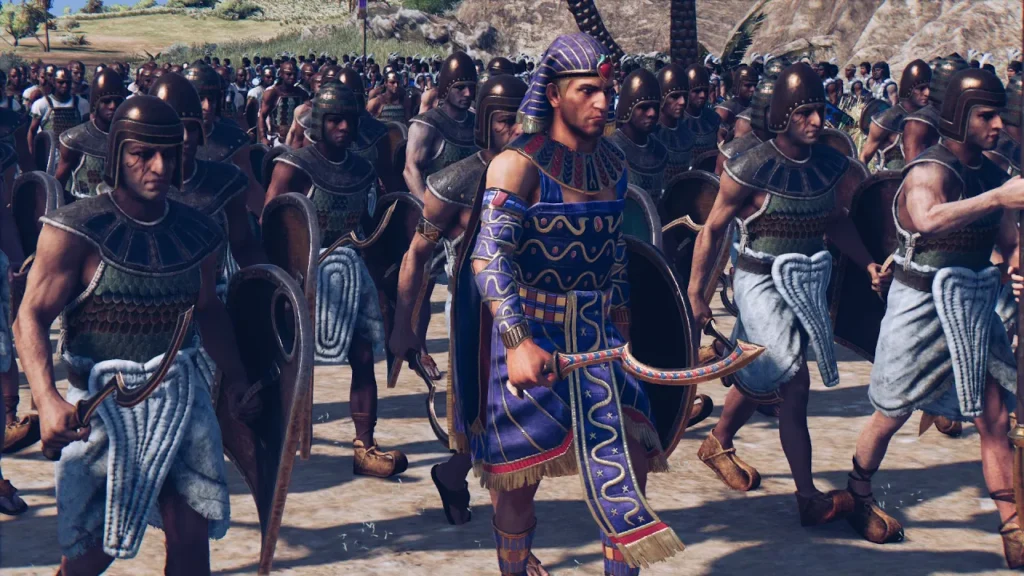
According to the Low Chronology, after the death of Thutmose II around 1479 BC, his son Thutmose III ascended the Egyptian throne. However, he was only about three years old at the time, and so his stepmother, Hatshepsut, initially ruled as regent. Because of his youth, she eventually assumed the throne as pharaoh in her own right, effectively ruling Egypt for over two decades. It took many years for Thutmose III to assert full control over the throne. Once he became the sole ruler, he embarked on an ambitious program of construction and military campaigns. During his reign, he conducted seventeen campaigns in Syria & Palestine over just twenty years, demonstrating his military prowess and consolidating Egypt’s influence in the region. In his early years, Thutmose III was educated at the court of Thebes, receiving rigorous military training and the broad education expected of a prince of the New Kingdom. This preparation laid the foundation for his later achievements as one of Egypt’s most successful warrior pharaohs.
Sources
Thutmose III’s first campaign, culminating in the capture of Megiddo in 1457 BC, was the most important of his military expeditions and is the best documented. This battle is the first in history for which we have a detailed record, though it was only after Champollion deciphered Egyptian hieroglyphs in 1823 that modern scholars could fully understand the strategy involved.
The campaign is recorded in detail in the Annals of Thutmose III, inscribed on the walls of the Temple of Amun at Karnak. These inscriptions were based on a daily journal kept by the king’s scribe, Tjaneni, originally written on parchment. The journal consisted of brief, factual entries, which were later transformed into the more elaborate and descriptive text carved into the temple walls. Later campaigns are recorded in a similar style, though generally with fewer details. Additional information about Megiddo comes from three other inscriptions on stelae found at Armant, Gebel Barkae, and Karnak, which mention different aspects of the campaign. Together, these sources provide a remarkably detailed account of the battle and Thutmose III’s military operations.
Canaan on Fire
Following the death of Hatshepsut around 1458 BC, Thutmose III assumed full control of the Egyptian throne. This transition, however, created instability along Egypt’s eastern frontier. At the time, the Canaanite rulers of Syria and Palestine were vassals of the Egyptian Empire and paid regular tribute to their overlords. Sensing a potential weakness during the pharaoh’s succession, the king of Kadesh, a city on the Orontes River in Syria, led a revolt against the young Egyptian ruler, forming a coalition of Canaanite kings.
The rebel army gathered in the Jezreel Valley, at the city of Megiddo, and included forces from regions as distant as Mesopotamia, northern Syria, and southern Anatolia. The exact size of the coalition is unknown, but estimates suggest it numbered between 10,000 and 15,000 men, comprising both chariotry and infantry. The alliance attracted other groups dissatisfied with Egyptian rule, who joined the rebels outside Megiddo in late 1458 or early 1457 BC, setting the stage for one of the earliest and most significant recorded battles in history.
The Relentless March
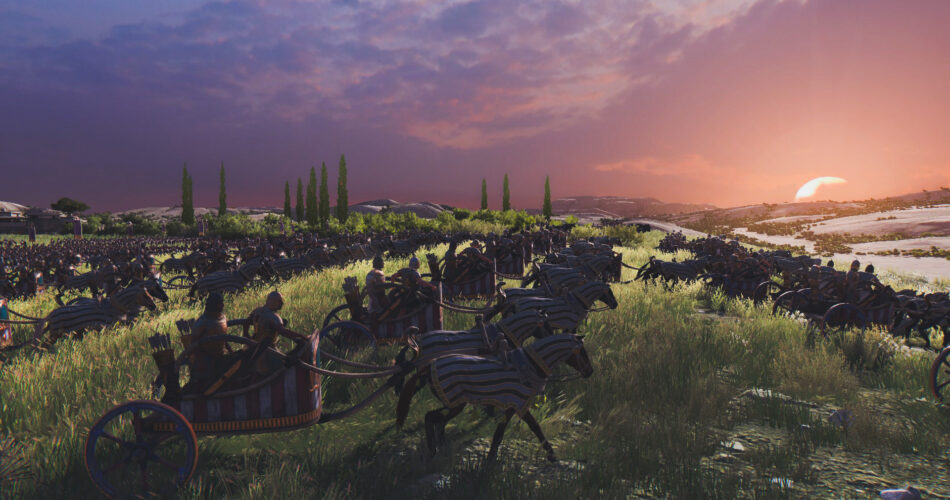
In response, Thutmose III assembled his army at Tjaru, a fortress on Egypt’s eastern Delta frontier, and then marched rapidly to Gaza, covering a distance of approximately 240 kilometers in just ten days. This forced march was remarkable, considering the size of the army, the number of horses, and the amount of equipment involved. Estimates suggest that the Egyptian force numbered between 10,000 and 12,000 men. The army was composed largely of infantry, supported by a contingent of chariots. The infantrymen were equipped with swords, axes, and shields, while the nobility and elite warriors fought from the chariots, likely serving as archers.
Thutmose III’s army continued its march northward for another ten days, reaching Yemma, a town on the southern slopes of the Carmel mountain range, likely on 6 April 1457 BC. The distance from Gaza to Yemma was approximately 128 kilometers, roughly half the distance from Tjaru to Gaza, yet it required the same amount of time. This slower progress suggests that the pharaoh may have paused to subdue rebellious cities along the route, such as Joppa and Gezer, securing Egypt’s lines of communication and supply as his forces advanced toward Megiddo.
Council of War: A Dangerous Choice
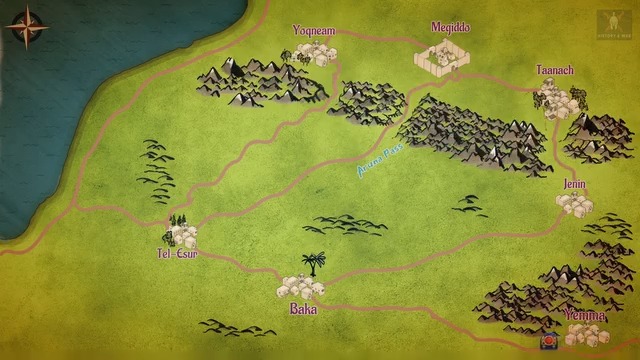
Thutmose III’s army appears to have rested for several days at Yemma while reconnaissance operations continued. On 11 April 1457 BC, a council of war was convened to decide the best route for the advance on Megiddo. The options included a curving northern route leading to the plain near present-day Mishmar HaEmek, several miles north and west of Megiddo; another curving southern route through the Valley of Dothan, emerging on the plain near Taanach, south and east of Megiddo; and a straight central route through the Aruna Pass, which led directly onto the plain near Megiddo itself.
The key question was whether to take the direct but narrow central pass or one of the longer, less risky alternatives. Although the central route was the shortest, it was also the narrowest and therefore highly vulnerable to a Canaanite ambush. The generals advised Thutmose III to take either the northern or southern route, arguing that the enemy was likely waiting at the end of the Aruna Pass. They also warned that progress through the narrow pass would be slow, with the vanguard reaching the battlefield while the rearguard was still on the march, creating serious logistical and tactical challenges.
Thutmose III considered the advice of his council but ultimately disagreed with their assessment. Anticipating that the Canaanite leaders would think like his generals and expect the Egyptian army to advance through either the northern or southern route, he decided to take the unexpected course and ordered the army to advance through the perilous central pass. By choosing this most direct but narrow route, Thutmose III relied on speed, surprise, and audacity to gain a decisive tactical advantage.
Through the Narrow Pass
The following day was devoted to final preparations. On 13 April, the army marched to Aruna, where it spent the night. Early on 14 April, the advance toward Megiddo began in earnest. The pharaoh himself was at the head of the army, which is estimated to have stretched nearly 22 kilometers in length. The Aruna Pass was extremely narrow, measuring only about thirty feet wide at one point, so it likely took the Egyptian army at least twelve hours to traverse the pass and reach the Jezreel Valley at the other end.
As events unfolded, Thutmose III’s decision proved correct. The rebel Canaanite army had not anticipated an advance through the central pass and had concentrated their forces at the northern and southern routes, leaving only a small contingent to guard the Aruna Pass. In the early hours of 15 April, the Egyptians launched their attack, taking the rebels by surprise. Egyptian light infantry and mounted archers swiftly engaged and neutralized any forward enemy pickets, clearing the way for the main army. Consequently, the Egyptian forces faced an unobstructed route to Megiddo, while the bulk of the rebel army remained positioned to the northwest and southeast, unable to intervene immediately. Throughout the night, Thutmose III personally reviewed sentry reports, issued orders for the provisioning of the troops, and organized their positions for the battle on the following day.
Clash of Titans: Triumph and Chaos
Next morning the Egyptian army cross Qina brook stream and attack the Cannite army. The tension was palpable as both sides prepared for the impending battle. The Canaanites held the advantage of elevation but had been caught by surprise, and it remained uncertain whether they could fully organize their forces in time.Thutmose III, a skilled tactician, arranged his army in a concave formation, dividing it into three divisions. The right wing was positioned on a hill above Qina Brook, while the left wing occupied a rise to the northwest of Megiddo. Thutmose III personally commanded the central division, maintaining control over the core of his forces. This strategic deployment allowed the Egyptians to threaten both flanks of the Canaanite army. With roughly 1,000 chariots and 10,000 infantrymen on each side, the battle commenced.
The Egyptian left wing moved rapidly, attempting to envelop the Canaanite right flank and cut off any route of retreat. When the Canaanite right wing saw this maneuver, they panicked and tried to reorganize. However, this attempt at reorganization only created an opportunity for Thutmose III, who, personally commanding the central division, decided to exploit it. Launching a ferocious assault, he disrupted and scattered the enemy ranks. Meanwhile, the Egyptian right wing held the opposing Canaanite left in check, preventing them from reinforcing their beleaguered right wing. In a masterful tactical maneuver, the Egyptian center pressed through the gap between the Canaanite right flank and the fortress of Megiddo, effectively splitting the enemy forces. The Canaanite army became encircled, trapped between the advancing Egyptians and the city’s fortifications, leaving them with no viable escape route.
The battle raged with fierce intensity. The Egyptians pressed forward relentlessly, their disciplined advance driving the Canaanite forces into confusion and disarray. Spears collided, chariots thundered across the plain, and a hail of arrows darkened the sky. Despite their elevated positions and initial resistance, the Canaanites could not withstand the overwhelming Egyptian assault. The pressure mounted on all sides, and one by one, their formations began to crumble. By the end of the engagement, the outcome was undeniable. The exact casualty numbers are unknown for both sides. As the defeated army, the Canaanites likely suffered heavy losses. The Egyptians, for their part, also experienced casualties, though the records do not provide exact figures. Despite these uncertainties, the Egyptian victory at Megiddo was decisive.
As the surviving Canaanite soldiers retreated in desperation, many sought refuge within the city of Megiddo, only to find the gates quickly closed behind them, leaving the remnants of the army trapped outside. Although the Egyptians had achieved a tactical victory in the Battle of Megiddo, the triumph was not as complete as it might have been. Thutmose III’s forces paused to pillage and loot the Canaanite army camps, including the royal tent of the king of Kadesh. This delay gave the inhabitants of Megiddo sufficient time to secure the city, hauling fleeing soldiers over the walls using ropes made from twisted cloth and effectively denying the Egyptians a total victory that day. The Egyptians promptly initiated a siege, constructing a moat and a wooden girdle wall around the city. According to the Jebel Barkal stele, it took seven months before Megiddo finally fell, during which time the king of Kadesh managed to escape, prolonging resistance despite the earlier battlefield defeat.
Spoils of Conquest
The spoils of the campaign brought back to Egypt were extensive, including prisoners of war, slaves, hostages, arms and armor, gold and silver chariots, jewels, precious metals, and livestock, marking the expedition as an overwhelming triumph. Beyond suppressing the rebellion and enriching Egypt’s treasury, the victory also secured Thutmose III’s control over northern Canaan, providing a strategic base for further military operations into Mesopotamia. The great princes of the Mesopotamian cities that had not joined the coalition sent tribute voluntarily to Egypt, seeking favor—and protection—from the warrior-king whose renown had been solidified at Megiddo. Thutmose III’s fame spread rapidly, and in the subsequent years, he extended his campaigns to conquer Syria and the lands of the Mitanni, both of which had been involved in the Megiddo uprising. He later turned his attention to Egypt’s southern borders, defeating the Nubians and expanding Egyptian holdings in that region. These further campaigns, however, are tales for another time.
Bibliography
1) THE ENCYCLOPEDIA OF MILITARY HISTORY FROM 3500 B.C. TO THE PRESENT | R. Ernest Dupuy and Trevor N. Dupuy
2) THE WARS IN SYRIA AND PALESTINE OF THUTMOSE III | Richard A. Gabriel
3) THE BATTLE: 100 STORIES BEHIND HISTORY’S MOST INFLUENTIAL BATTLES | Michael Lee Lanning
4) 100 DECISIVE BATTLES: FROM ANCIENT TIMES TO THE PRESENT | Paul K. Davis
5) THUTMOSE III’S BATTLE OF MEGIDDO INSCRIPTION | Joshua J. Mark / World History Encyclopedia
© 2026 History and War
Author: Jishu Roy
Unauthorized reproduction of this content is prohibited.