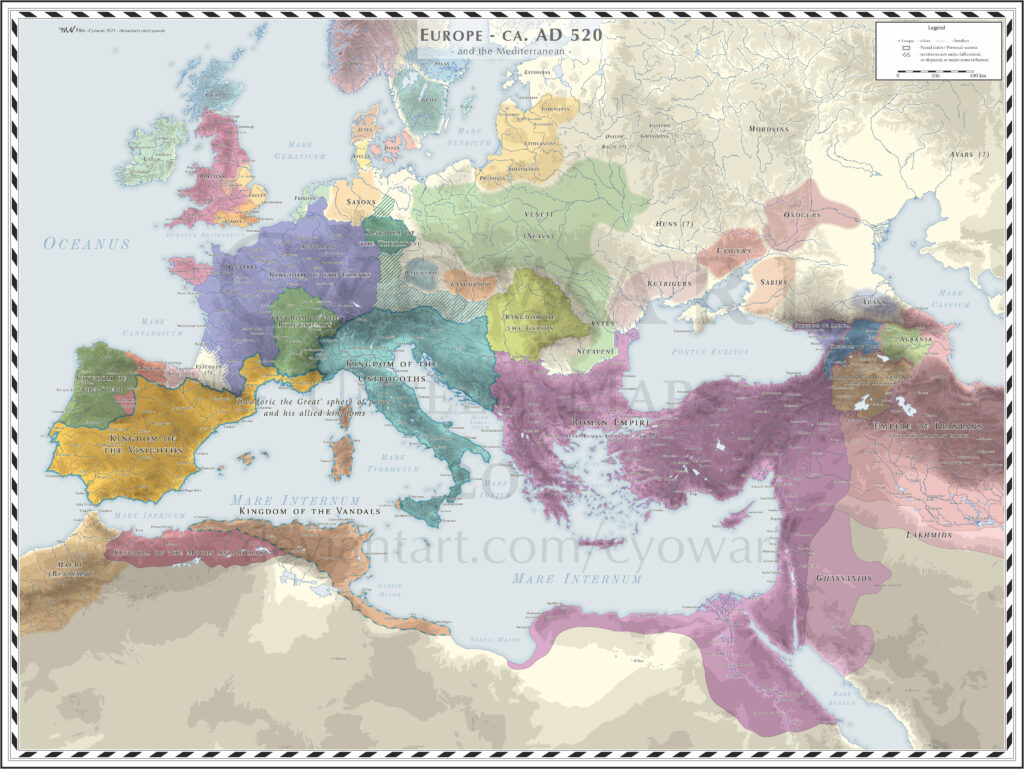
Map © Cyowari
The Strategic Situation on the Eve of War
In AD 528, the Byzantine Empire faced mounting challenges on multiple fronts. Following their defeats at Thannuris and Mindoues, the Byzantines were still recovering when a crisis erupted in the Crimea. In either 527 or 528, the king of the Crimean Huns converted to Christianity and aligned himself with the Byzantine Empire. However, this decision proved controversial among his pagan subjects. Opposition to the king’s conversion culminated in his assassination, along with the slaughter of the Roman garrison stationed at Bosporus. This event likely occurred during the summer of 528. Emperor Justinian recognized the urgency of the situation and swiftly organized a military response. A substantial force of Gothic federates, commanded by John, the Comes of the Pontic Straits, was dispatched. They were joined by the Magister Militum per Thracias, Godilas, and the Magister Militum of Scythia, Badourios, in late 528. Confronted by the steady Byzantine advance, the Huns retreated, leaving the region vulnerable. The Byzantines capitalized on this opportunity, securing the Crimea permanently for the empire. This victory had significant strategic implications. By securing the Crimea, the Byzantines enhanced their ability to monitor the steppes and influence the alliances formed by nomadic tribes, particularly those with the Sassanian Persians. This development strengthened Byzantine control over the region and improved their position in the broader geopolitical struggles of the era.
The transfer of troops to the east and the temporary garrisoning of Crimea in 528 inadvertently created a power vacuum in Lower Moesia and Scythia. This left the regions vulnerable to invasion, and the Bulgarians seized the opportunity to strike. They inflicted a significant defeat on the Roman commanders Badourios and Justin, subsequently advancing deep into Thrace. This incursion strained Byzantine resources, as the empire could no longer spare troops for the eastern frontier. In response to this crisis, Emperor Justinian was compelled to negotiate with the warlord Mundus, who commanded a force of mercenaries. By 529 or 530, Mundus was appointed Magister Militum per Illyricum. Around the same time, Justinian also elevated Childbudius to the position of Magister Militum per Thracias. Mundus swiftly took action, achieving decisive victories against both the Goths and the Huns. These Hunnic forces included a coalition of various barbarian tribes. Mundus not only recovered significant amounts of booty but also captured one of their kings. According to the historian Marcellinus, 500 Bulgars were killed in these campaigns, although it is likely that this figure does not account for casualties among the other tribes involved. Together, Mundus and Childbudius successfully restored stability to the Balkans by 530. Their efforts ensured the security of the region, allowing the Byzantine Empire to regain its footing amidst the broader challenges it faced.
The situation on the eastern frontier also deteriorated in early 529. Arab chieftain Alamoundaros launched a swift and audacious raid, advancing from the south through Emesa and Apamea, reaching as far as the gates of Antioch. Before the Byzantine forces could mobilize an effective response, Alamoundaros and his raiders withdrew, leaving the region destabilized. In response, Emperor Justinian implemented a threefold strategy. First, he dispatched reinforcements to the east to retaliate against the raid. However, the results of this campaign remain unclear. Our primary source, the historian Malalas, mentions only that Justinian sent a significant contingent of infantry, referred to as the Lykokranitai from Phrygia, against Saracen and Persian territories. Secondly, Justinian addressed the failures in military leadership. He dismissed Hypatius, the Magister Militum per Orientem, for his inability to prevent Alamoundaros’ incursion. In his place, Justinian appointed the capable general Belisarius, whose leadership marked a significant shift in the management of the eastern frontier. Lastly, the raid exposed the southern section of the frontier as inadequately defended. To address this vulnerability, Justinian appointed Ghassanid sheikh Arethas as phylarch of the Arab tribes. This move unified the Byzantine-aligned Arab tribes under a single leader, creating a counterbalance to the Persian-aligned Saracens and enhancing the empire’s defensive and offensive capabilities in the region.
Diplomacy and the Failure of Peace Negotiations
Given the challenging circumstances, it is unsurprising that Emperor Justinian sought to negotiate peace with the Sassanian Empire. To this end, he dispatched Hermogenes, the trusted Magister Officiorum, as an ambassador to the Persian court. However, the negotiations ultimately failed due to a combination of internal and external factors. At the same time, the Samaritan population, who faced religious persecution, launched a widespread revolt, further complicating Byzantine efforts to stabilize their realm. Meanwhile, Sassanian King Kavadh had, by 528 or 529, decisively crushed the last remnants of Mazdakite resistance within his empire. This victory solidified Kavadh’s authority, placing him in a strong negotiating position. Exploiting this advantage, Kavadh issued two significant demands: the Byzantines were to either demolish the strategically critical walls of Dara or provide gold to fund the garrison stationed at the Caspian Gates. In response, Justinian employed a calculated strategy of delay. In July 529, he agreed to a one-year truce, aiming to buy time to strengthen his position. During this interval, he moved decisively to suppress the Samaritan revolt, restoring order in the affected regions. By June 530, Justinian believed the remaining month of the truce would provide an opportunity to negotiate further. However, King Kavadh had different plans, signaling the fragility of the temporary peace.
Preparations for Campaign: Roman and Persian Mobilization
King Kavadh planned to strike before the truce with the Byzantine Empire ended in July 530. By June, he had assembled two large armies to invade Roman territory. One army, stationed in Persarmenia, aimed to sever Roman support for Lazica, while the other, based at Nisibis, was poised to attack the strategically significant fortress city of Dara. This impending threat was not unexpected, as the Byzantines, despite the truce, had been preparing for renewed hostilities. According to Procopius, Emperor Justinian appointed Belisarius as Magister Militum per Orientem, entrusting him with leading a campaign against the Persians. Belisarius gathered a force of approximately 25,000 men, which Procopius describes as substantial. This force marched to Dara, likely intending to either attack or pose a threat to Nisibis. Malalas reports that the army encamped outside Dara, awaiting further developments. To ensure unity of command, Justinian also dispatched Hermogenes, the Magister Officiorum, to assist Belisarius. Hermogenes’ presence was critical, as it compelled other commanders, who had previously refused to follow Belisarius, to obey him. Additionally, Justinian sent Rufinus as an ambassador, although he was instructed to remain at Hierapolis until further notice. While the army under Belisarius was considered large, it likely included many inexperienced soldiers, a consequence of the heavy Roman losses—particularly among infantry—suffered in earlier battles, such as the defeat at Thannuris. The Roman force is estimated to have included approximately 7,500 cavalry and 17,500 Infantry. Previous campaigns had demonstrated a tendency for Roman commanders to act impulsively, launching attacks without orders. Hermogenes’ role in this campaign was, therefore, essential to maintain discipline and coordination. Opposing the Romans was a Persian army of 40,000 men led by General Peroz Mihran, who was stationed at Nisibis. His mission was to capture Dara, and he advanced his forces to Ammodius, a location 7.7 km south of Dara. Ammodius was strategically chosen due to its abundant water supply, which was vital for the Persian horses. The Romans reached Dara just in time, learning upon their arrival that the Persian invasion of Roman territory was imminent.
Procopius of Caesarea, serving as Belisarius’ military secretary, provides a detailed, though occasionally ambiguous, eyewitness account of the Battle of Dara. From his description, the engagement lasted two days and unfolded with methodical precision on the Roman side. The Persian army broke camp and began its advance just before sunrise on the first day. In response, the Roman forces, under the command of Belisarius and Hermogenes, assumed a carefully prearranged defensive formation. Belisarius had fortified his position by constructing a series of defensive trenches across the main road between Dara and Nisibis. This system included a recessed central section flanked by two longer trenches on either side, connected by transverse trenches, and featured multiple narrow crossing points to allow Roman troops to maneuver. The Roman infantry formed the core of the defense, positioned in a single deep line behind the central trench. Belisarius and Hermogenes commanded this section, likely leading their personal bucellarii—who may have numbered several thousand. Interestingly, Procopius does not mention the deployment of light infantry skirmishers along the front, suggesting the defense relied heavily on the prepared trenches and disciplined heavy infantry. The Roman left wing consisted of several distinct units. On the far left, a detachment of Herul cavalry, commanded by Pharas, held the flank. To their right was a stronger cavalry contingent under the commander Bouzes. In the angle formed by the trench and the left-center, two units of 300 Hunnic cavalry, led by Sunicas and Aigan, were positioned for swift offensive or defensive action. The right wing mirrored the left in composition. A smaller force of around 600 Hunnic cavalry, commanded by Simmas and Ascan, held the far right. Adjacent to them and likely stationed behind the trenches was a larger cavalry force under John, son of Nicetas, supported by subordinate officers Cyril, Dorotheus, Marcellus, and Germanus. The precise positioning of the Roman wings relative to the trenches is unclear in Procopius’ account. However, based on subsequent descriptions of the battle, it is evident that the central division was stationed behind the trench, with the wings likely arranged similarly. The trench system was strategically designed to counter the numerical superiority of the Persian cavalry. By positioning their forces behind the trenches, the Romans could utilize the narrow crossing points to launch attacks or pursue retreating enemies without compromising their defensive posture. Placing the Roman troops in front of the trenches would have introduced significant risks. In the event of a powerful Persian assault necessitating a rapid retreat, the trenches—intended to impede the enemy—could have become a dangerous obstacle for the Roman forces themselves. Belisarius’ deployment exemplified a calculated strategy to neutralize the Persian numerical advantage, using terrain and prepared defenses to enhance the cohesion and effectiveness of his forces. This careful arrangement ensured that Roman troops could act flexibly while minimizing the risk of being overwhelmed.
Procopius states that the Roman trench was constructed approximately a stone’s throw from the pulê facing the city of Nisibis. This term, pulê, has led to two differing interpretations among historians. The majority, following Dewing’s translation, interpret pulê as “gate,” suggesting that the battle took place immediately in front of the city of Dara. However, Christopher Lillington-Martin has proposed an alternative interpretation, arguing that pulê refers to a geographical gap located just east of Ambar, approximately 2–3 km south of Dara. This interpretation is supported by Malalas, who mentions that the Roman forces had encamped outside Dara, implying a location slightly removed from the city itself.The evidence is inconclusive, as both interpretations have merit.
The Persian commander Peroz approached Dara with such confidence that he reportedly sent a message to Belisarius, instructing him to prepare the baths, claiming he intended to use them the following day. However, upon arriving within sight of the Roman forces and observing their well-prepared formation, his confidence appears to have wavered. In response, Peroz arranged his forces in a formation similar to that of the Romans, with infantry positioned in the center and cavalry on the flanks. He took direct command of the Persian center, while the left wing was led by General Baresmanes and the right wing by Pityaxes. Although the exact size of the Persian forces remains uncertain, the elite Immortals were held in reserve to reinforce the line or exploit breakthroughs. The Persian army was deployed in two ranks, a tactic designed for sustained combat. As the front rank suffered casualties or depleted their arrows, the rear units could rotate forward to maintain pressure on the enemy. This arrangement highlighted the Persians’ emphasis on endurance and adaptability in battle, complementing their numerical superiority.
The Opening Engagement: The First Day at Dara
On the morning of the second day, both the Byzantine and Persian forces arrayed themselves in their respective battle formations, with the Byzantines taking the positions described earlier and the Persians forming deep ranks. Once in position, both armies halted, each awaiting the other’s move. The Persians adopted a calculated strategy, believing that delaying their assault until the afternoon would work to their advantage. They reasoned that the Byzantine troops, accustomed to eating before midday, would become hungry and fatigued as the day progressed, thereby weakening their resolve. In contrast, the Persians, who traditionally ate later in the day, expected to maintain their strength and gain the upper hand. It was only in the afternoon that the Persian forces initiated their assault. General Peroz began the battle by probing the Roman left flank with a cavalry detachment. After a brief clash, the Byzantine troops under Bouzes retreated, allowing the Persians to advance. However, the Persian advance soon stalled, as their commanders feared a potential counter-attack from the Hunnic cavalry positioned in the Roman center. Sensing the hesitation, Bouzes ordered his forces to counter-attack. The Persian cavalry, caught off guard, retreated hastily, reportedly losing seven men in the withdrawal, according to Procopius. This exchange demonstrated the effectiveness of the Byzantine defensive strategy and their ability to exploit even momentary lapses in Persian confidence.
After the initial clash, both armies returned to their formations, with the Persians’ attempt to provoke the Romans into breaking their ranks having failed. At this point, a young Persian warrior issued a challenge to the Romans for a duel. The challenge was accepted by Bouzes’ bath attendant, Andreas, a skilled wrestler and trainer from Constantinople. Acting without orders, Andreas charged forward on horseback, striking the Persian in the right breast with his spear, knocking him to the ground. He then dismounted and, using a short sword, quickly ended the confrontation with a swift and decisive action. In response, the Persians sent out a more experienced duelist, showing signs of age with gray hair. At this point, Hermogenes ordered that no Roman should accept further challenges. However, Andreas defied orders again and faced the Persian in another duel. The two warriors charged at each other, their spear thrusts being deflected by armor, and their horses collided head-on, sending both men flying to the ground. Despite the shock of the fall, Andreas recovered more quickly, owing to his agility and training, while the Persian’s larger size slowed him down. Andreas struck first, knocking the Persian down again, and then killed him. The Roman forces, both those on the walls and in battle formation, erupted in a victorious cheer. The Persians, demoralized by the defeats in the duels, retreated to Ammodius. Meanwhile, the Romans raised their battle hymn and withdrew behind their fortifications. Understandably, Peroz Mihran, having seen the failure of the duels and recognizing the strength of the Roman position, hesitated to commit his forces to an attack on the well-defended Roman line, especially given the added protection of the field fortifications.
Reinforcements and Diplomatic Exchanges
The following day was marked by a cessation of hostilities, allowing both sides a brief period of respite. During this lull, the Persian forces were reinforced with an additional 10,000 troops dispatched from Nisibis, bolstering their strategic position. In the absence of immediate combat, diplomatic exchanges took place between the two factions. The Romans extended a formal request for negotiations, seeking to establish a dialogue aimed at reaching a settlement. In contrast, the Persians, through their response, accused the Romans of treachery and deceit, asserting that their adversaries had proven themselves untrustworthy in past dealings. This exchange of messages reflects the deep-seated mistrust and the complex diplomatic dynamics that characterized the interaction between the two empires during this period of conflict.
The Decisive Battle: The Third Day at Dara
On the third day, both commanders delivered motivational speeches to their troops, preparing for the upcoming confrontation. The armies formed up once again outside the walls of Dara, just as they had during their initial meeting. During the deployment, Pharas, the Herule commander, proposed to Belisarius that he detach his 300 cavalry and position them behind a hill on the far-left flank. This positioning would allow for a surprise attack on the Persian cavalry’s flank, potentially inflicting significant damage. Belisarius, recognizing the tactical advantage, quickly agreed to the suggestion. However, once the armies were fully deployed and faced each other, no immediate action was taken. As historian Adrian Goldsworthy notes, the Roman formation was primarily designed to withstand a frontal assault, and with the walls of Dara so close behind them, the Persians would have no choice but to attack head-on if they intended to capture the city. Thus, Belisarius had no intention of initiating any offensive maneuvers, choosing instead to wait for the Persian attack. Meanwhile, the Persian commander, Peroz, sought to delay the battle until noon, hoping to exhaust the Roman forces by preventing them from having their midday meal. However, this tactic did not appear to have the intended effect, as the Roman soldiers remained in their positions, undeterred by the delay.
The battle began with an exchange of arrows, but this mainly occurred on the flanks, as Procopius does not mention any significant fighting in the center of the battlefield. The Persians, benefiting from a numerical advantage and the ability to rotate fresh archers to the front, were able to fire volleys that, as Procopius describes, darkened the sky—evoking comparisons to the battle of Thermopylae. However, the Romans had a strong wind at their backs, which helped reduce the impact of the Persian archery. As the Persian archers ran low on arrows, Procopius notes that they resorted to using their spears in close combat. It is likely that the Persian cavalry had followed their standard tactic, where the first line consisted of lightly armed mounted archers, and the second line was made up of heavily armored cavalry. When the Persians decided to charge, they typically merged these two lines, with the heavily armored cavalry forming the front ranks in a unified charge. This tactic was designed to exploit both the range of the archers and the shock value of the heavily armored cavalry when they engaged in close combat. The battle on the Roman left flank became increasingly intense. The Roman soldiers there were not facing the usual Persian troops, but rather the Kadishaye, a fierce tribe from Beth Arabia. After a brutal struggle, the Roman left was pushed back and began to falter. At this critical moment, the Heruls, commanded by Pharas, appeared over a hill and launched a charge into the Persian flank and rear. This sudden attack caused confusion among the Persian forces, with their lines wavering. At the same time, two other Roman commanders, Sunicas and Aigan, with 600 huns, launched an assault on the opposite flank. The combined pressure led to the collapse of the Persian cavalry, which retreated in disarray toward the safety of their infantry, leaving approximately 3,000 dead behind them. The Romans, however, did not pursue the fleeing Persians, instead returning to their previous positions.
Following a brief pause, during which both sides regrouped, Peroz, the Persian commander, made a strategic move by transferring the Immortals to the left wing with the aim of overwhelming the vulnerable Roman right flank. This flank was exposed, as it lacked any natural terrain features for protection. Belisarius and Hermogenes quickly recognized the threat and responded by ordering Sunicas and Aigan to position themselves at a right angle to the main Roman line, with Simmas and Ascan reinforcing them. Behind them, Belisarius positioned additional reserves to provide further support. The final phase of the battle began with a general assault, focusing heavily on the Roman right wing. The pressure was intense, forcing the cavalry under John to retreat in disarray. However, the Persian forces, focused on the retreating Roman cavalry, were caught off guard by a counter-attack from the Huns, who struck the Persian flank. This Byzantine counter-charge proved highly effective, cutting through the Persian line and splitting it into two sections. The larger portion of the Persian force continued its pursuit of the retreating Roman cavalry, but the smaller section, now isolated from both the main Persian line and the advancing units, found itself in a perilous position. The battle then devolved into a chaotic melee. Amidst the confusion, the Persian standard, carried by Commander Baresmanes, fell. Realizing their vulnerable position, the advancing Persian units attempted to wheel around and attack the Romans from the rear. At this critical moment, Belisarius ordered his bucellarii nearest to the threat to engage the Persians. Simultaneously, John’s retreating forces rallied, turned to face the advancing Persians, and counter-attacked, striking the Persian left flank from behind. This maneuver marked the turning point of the battle. In the ensuing melee, Baresmanes was killed, and the Persian Immortals began to falter and retreat. The disintegration of the Persian forces in this sector resulted in the loss of approximately 5,000 Persian troops.
At this point, the Persian center abandoned the battlefield, fleeing in disarray, followed closely by the remnants of their right flank. Many Persian soldiers were killed in the ensuing pursuit. However, Belisarius and Hermogenes chose not to continue the chase for long. The Persians were well-known for their ability to recover from a rout and often turned the tide against their pursuers. Belisarius, aware of the potential for a cornered army to fight with desperation and possibly turn defeat into victory, was cautious not to risk such a scenario. Instead, he opted for a decisive victory, ensuring that his troops could capitalize on their success and enjoy the morale boost that came with a clear and uncontested triumph.
Consequences and Significance of the Battle of Dara
As Procopius observes, the Battle of Dara represented a significant turning point in the protracted conflict on the eastern front. It marked the first time in several years that a Roman force—one that was numerically inferior—was able to decisively defeat the Persians in battle. This outcome had a profound impact on the morale of both the Roman and Persian forces. From a tactical standpoint, it is notable that the battle primarily involved the cavalry of both sides. The Roman infantry remained in a strong defensive position at the center, protected by the central ditch, while the Persian infantry, likely positioned in the center, played little to no role in the battle until the final stages of the rout. According to Procopius, the Persians suffered heavy losses, with more than half of their forces being killed or incapacitated. As a result, they were reluctant to engage the Romans in direct combat again. Despite this defeat, the Persians retained around 25,000 men, a force large enough to prevent the Romans from attempting to capture Nisibis. Consequently, the remainder of 530 saw a shift to skirmishing warfare along the frontier, where the Romans typically emerged victorious, although the larger strategic situation remained unresolved.
© 2026 History and War
Author: Jishu Roy
Unauthorized reproduction of this content is prohibited.