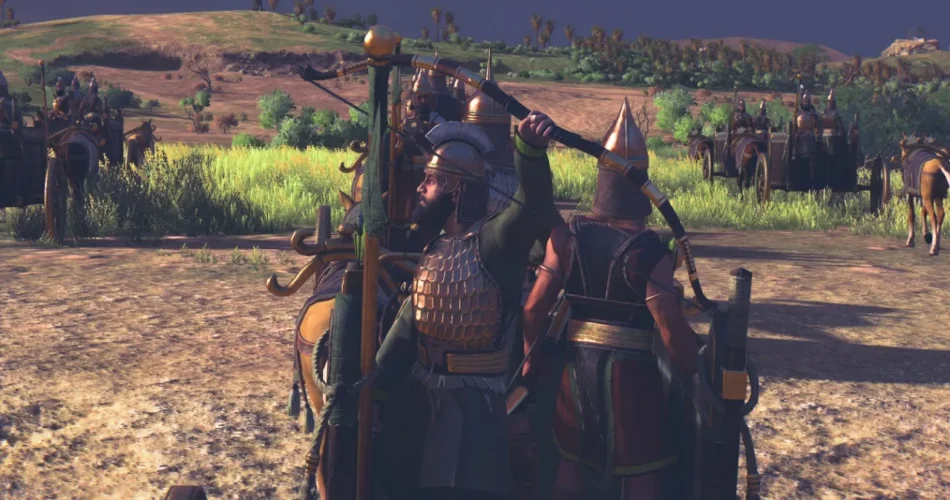
Clash of Bronze Age Titans
Our story takes us to circa 1243 BC, to a battlefield almost forgotten by time, yet one that forever altered the balance of power in the ancient Near East — the Battle of Nihriya. Here, the mighty Hittite Empire, lords of Anatolia, faced the surging might of the Assyrian kings, whose ambitions stretched far beyond their heartlands. Two great powers… two armies bound for collision… and a single strip of contested land where their destinies would be decided. Over the next minutes, we will unravel the political intrigues that drew these titans to war, follow the dusty roads that led to the battlefield, and witness the furious clash of heavy Hittite chariots against the disciplined spear walls of Assyria. By the end, you will see how this battle marked the first cracks in a great empire — and the birth of a new rising power. This is the Battle of Nihriya.
The Fall of Mitanni
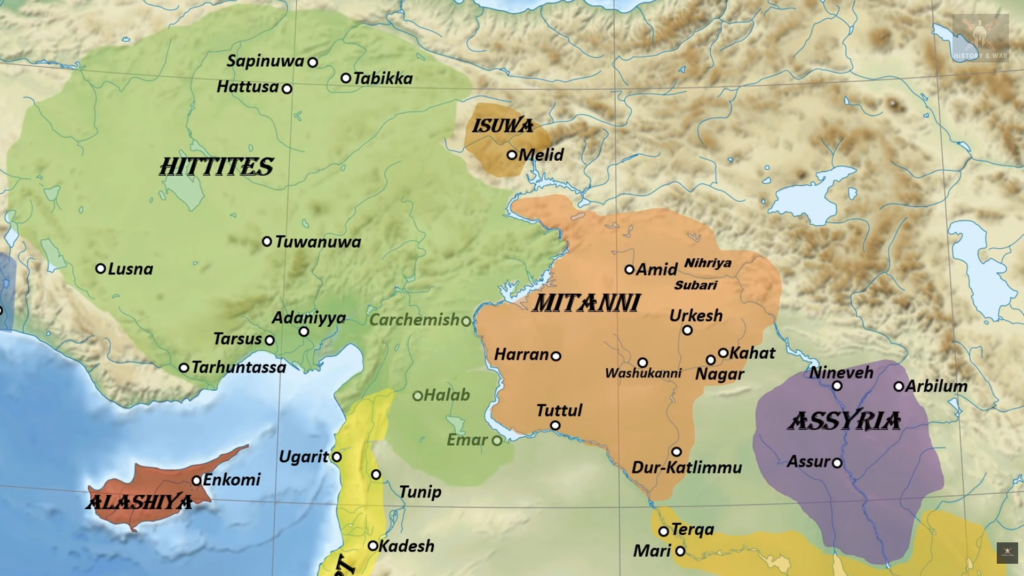
When the Hittite king Šuppiluliuma I conquered the kingdom of Mitanni, he reorganized its lands by creating two provinces: Halab and Carchemish. He also distributed much of Mitanni’s territory among his allies. The remaining part of the former Mitanni kingdom continued to exist as an independent vassal state under Hittite control, known as Ḫanigalbat. During the reign of the Hittite king Muršili III, the region of Ḫanigalbat was conquered by the Assyrians under King Adad-nirari I, who pushed Assyrian control to the east bank of the Euphrates River. Later, when Hattusili III overthrew his nephew Muršili III and took the Hittite throne, he had to accept the permanent loss of Ḫanigalbat to the Assyrians, despite its previous status as a Hittite vassal. Despite this, the Assyrians faced ongoing resistance from the kings of Ḫanigalbat, who naturally remained loyal to the Hittites. Hattusili III likely sought to maintain peaceful relations with the Assyrian king Shalmaneser III until the end of his reign. However, his successor Tudhaliya IV was less inclined to cooperate and more willing to support the continued opposition to Assyrian rule led by the Hanigalbatean king Shattuara II.
Despite Shattuara’s declared loyalty to the Hittite king Tudhaliya, suspicion lingered over his true intentions. Whispers and accusations claimed that he was dealing with Assyria in ways that undermined his allegiance to Hatti. These charges came not from distant enemies, but from two of Tudhaliya’s most powerful regional vassals — Halpa-ziti, king of Halab, and Ehli-Sharrumma, king of Isuwa. There is reason to believe their words carried some truth, for Shattuara himself seemed to partially admit to them. His position was perilous — caught between two mighty empires teetering on the brink of war. In his defense to Tudhaliya, Shattuara drew a telling comparison: that of a man beset by two creditors, compelled to yield to the one who posed the most immediate threat.
The conflict was abruptly and violently resolved when Shalmaneser launched a decisive campaign against the rebellious kingdom. He claimed a crushing victory, capturing and sacking numerous cities and settlements and taking thousands of prisoners. Any military support that Tudhaliya may have provided to Shattuara was ruthlessly defeated and eliminated.
Our knowledge of this event comes primarily from an Assyrian royal inscription, in which Shalmaneser declares:
“When, by command of the great gods and with the exalted strength of Ashur, my lord, I marched to the land of Hanigalbat, I opened up the most difficult paths and passes. Shattuara, king of Hanigalbat, with the support of the armies of the Hittites and the Ahlamu, seized control of the passes and watering places along my route. When my army was thirsty and fatigued, their forces launched a fierce and powerful attack. But I struck back and defeated them decisively. I slaughtered countless soldiers of their vast army. As for Shattuara, I pursued him westward at arrow-point, slaughtered his hordes, and blinded 14,400 survivors whom I carried off. I conquered nine of his fortified cult centers, as well as the city from which he ruled, and reduced 180 of his cities to ruin-hills. I slaughtered like sheep the armies of the Hittites and Ahlamu, his allies.” While some details of this account may be exaggerated or open to question, there is little doubt that Shalmaneser was responsible for delivering the final blow to the kingdom of Hanigalbat.
A New King in Assyria
Following this campaign, Assyrian power was firmly established up to the east bank of the Euphrates River. It appeared inevitable that the Hittites would soon face a major Assyrian offensive west of the river. However, news soon arrived of Shalmaneser’s death and the accession of his young son, Tukulti-Ninurta, around 1243 BC (according to the Middle Chronology). Tudhaliya was likely both relieved and hopeful that full-scale conflict with Assyria might still be avoided. In response, Tudhaliya wrote a conciliatory letter to the new king, congratulating him on his accession and praising the military achievements of his father, Shalmaneser. He urged Tukulti-Ninurta to uphold the frontiers established by his predecessor—thereby implicitly acknowledging that Hanigalbat was now under Assyrian control. Tudhaliya also offered his assistance in the event of any rebellion among Tukulti-Ninurta’s subjects and made explicit offers of friendship.
Diplomacy and Deception
The conciliatory gestures were not entirely one-sided, at least not openly. Tukulti-Ninurta wrote: “My father was your enemy … but I am the friend of my brother.” In an obvious attempt to redirect Assyrian aggression elsewhere, Tudhaliya urged his correspondent to attack a land “three or four times weaker than you,” clearly referring to Babylonia. Interestingly, Hattusili had used similar language in a letter to Kadašman-Enlil II of Babylonia, trying to draw him into conflict with Assyria.
The Hittites soon grew doubtful of the Assyrians’ true intentions. Despite ongoing peace talks, Tukulti-Ninurta launched a strong military campaign against the northwestern Hurrian lands under Hittite influence. After quelling rebellions by the Qutu and Uqumeni tribes in the north and northeast, he targeted the Subari lands between the Tur ‘Abdin region and the Upper Tigris Valley, including Katmuhi, Alzi, Amadani, and Paphi.
The Road to War
With the conquest of the Subari lands, the Assyrians secured control over key routes crossing the Euphrates into Anatolia, as well as the strategic copper mines at Ergani Maden. The Hittites’ last significant stronghold east of the Euphrates, Isuwa, was now under serious threat. While maintaining his claims of friendship toward the Assyrian king, Tudhaliya warned the Assyrian chancellor Babuahu-iddina about the risks of sending an army into the rugged mountains of Paphi. Tukulti-Ninurta, however, clearly understood the true intent behind the warning and dismissed it with contempt.
With diplomatic efforts clearly exhausted, Tudhaliya began openly preparing for the inevitable conflict with Assyria. He reinstated Ugarit’s obligation to provide military support when called upon, reversing a previous cancellation of this duty in exchange for a payment of 50 minas of gold. It was likely in this context that he concluded a treaty with the Amurrite king Shaushgamuwa. The instructions given to Shaushgamuwa regarding Assyria were explicit: the Assyrian king was now officially declared an enemy of the Hittite king.
Attempts to impose commercial sanctions on Assyria were likely as ineffective then as similar efforts have been in later times. In fact, these sanctions may have only strengthened Assyria’s resolve to gain unrestricted access to the Mediterranean ports it had long desired—using force if necessary. As a result, military conflict seemed the only practical way to stop Assyrian aggression. A prayer by Tudhaliya, in which he sought divine help against the Assyrian king and promised to dedicate three stelae as a thanksgiving offering if victorious, likely signaled the approaching war between the two powers.
The Battlefield of Nihriya
After conquering the Land of Subari, Tukulti-Ninurta might have turned westward toward the territories across the Euphrates. However, his immediate focus was on the Nairi lands, located beyond the northern frontier he had established. These lands were likely to pose a continuing threat to the security of this new border. Nairi can be confidently identified with Nihriya, mentioned in Mesopotamian, Hittite, and Urartean sources. It probably lay in the region north or northeast of modern Diyarbakır. The campaign against Nairi presented significant challenges due to its mountainous terrain and the expected fierce resistance from local tribes and the forty kings who ruled them.
The Final Confrontation
This may have been the moment when Tudhaliya became directly involved. A letter from Tukulti-Ninurta to the king of Ugarit provides evidence of the conflict, reporting that Hittite forces had fortified Nihriya. Tukulti-Ninurta issued Tudhaliya an ultimatum demanding the withdrawal of his troops. Despite this firm demand, Tukulti-Ninurta still sought to preserve peace with Hatti, clearly wishing to avoid a conflict with the Hittite king while simultaneously engaged in war against the kings of Nairi. Tudhaliya refused to withdraw his forces, but Tukulti-Ninurta continued to pursue diplomatic efforts to maintain peace.
Tudhaliya ordered his troops to advance against the Assyrian forces, likely reasoning that there was no better moment to challenge the Assyrian king than while he was preoccupied with the difficult campaign in Nairi. However, this was a significant risk. Although some support from the embattled Nairi kings might have been expected, Tudhaliya’s forces were operating far from their base, near the territories controlled by a powerful enemy and likely without assistance from auxiliary troops of the Syrian vassal states. With most of the lowlands south of the Tigris already under Assyrian control, the Hittites reportedly descended from the eastern Taurus Mountains in a wide flanking maneuver, reminiscent of Suppiluliuma’s sudden assault on WasSukkanni a century earlier.
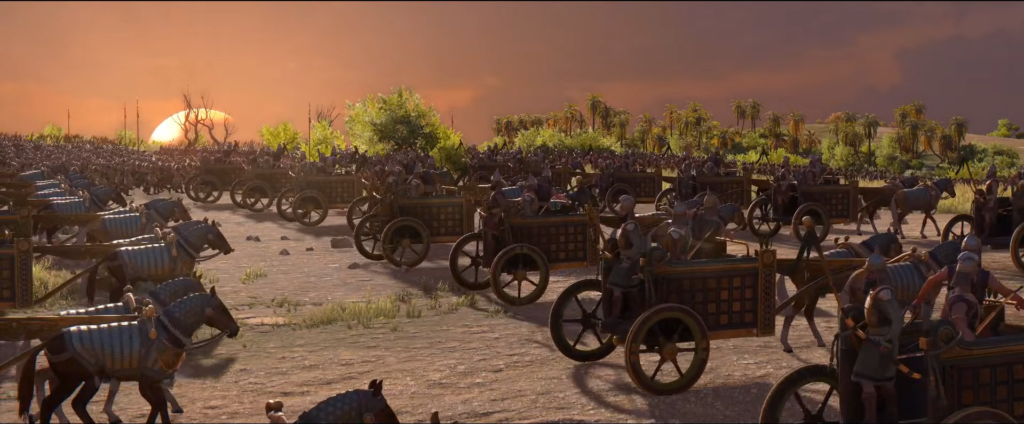
The Hittite and Assyrian armies clashed in the region between Nihriya and the Assyrian base at Surra. Upon receiving urgent news from a fleeing scout that the Hittites were advancing, Tukulti-Ninurta quickly prepared for battle. He ordered his troops to arm themselves and mount their chariots. Armor was secured, bronze plates fastened tightly, and warhorses harnessed. The sounds of hooves and the clatter of leather straps filled the air as the Assyrian king took his place in his chariot—a heavy, two-man war vehicle with wheels reinforced for the rough frontier terrain. From the north, the Hittite forces appeared, Tudhaliya’s banners snapping in the wind and his chariots arranged in disciplined formation. The two armies met near the plains of Nihriya.
Tukulti-Ninurta led the charge, shouting across the battlefield, “The King of Hatti comes ready for battle!” The initial clash was intense, with chariots colliding violently and arrows flying through the air. Assyrian archers, mounted on chariots, fired volleys into the dense Hittite formations, while Assyrian infantry advanced protected by shields. The Hittites responded with skilled charioteers who penetrated the Assyrian lines by driving wedges into their formations. In turn, the Assyrians utilized greater mobility, employing lighter chariots to harass the enemy flanks while their infantry maintained a firm position in the center.
For hours, the battle shifted back and forth, the plain resonating with the cries of soldiers and the neighing of wounded horses. However, the discipline of the Assyrian forces, combined with their superior mobility, gradually gained the upper hand. Tukulti-Ninurta personally commanded the reserve chariots to strike the Hittite flank. This maneuver disrupted the Hittite formation, leaving their chariots encircled and vulnerable.
Tudhaliya personally rallied pockets of resistance, his voice cutting through the chaos of battle. However, the tide gradually turned in favor of the Assyrians. They adapted to the terrain of Niḫriya, systematically breaking the Hittite lines. Chariots were overturned, their crews either killed or forced to flee. The Hittite infantry, confined within shield walls, were unable to break free. By the end of the day, the Assyrian banners flew over the former site of the Hittite camp. Tudhaliya withdrew with the remnants of his army, battered but alive, his chariot wheels stained with dust and blood. The battlefield at Niḫriya had fallen to Assyria, marking a decisive shift in the regional balance of power.
Aftermath – The Decline of Hatti
Following his victory, Tukulti-Ninurta completed the conquest of the Nairi lands and asserted his authority over the forty local kings who had resisted him. Emboldened by this success and with his Hittite rival temporarily weakened, he likely turned his attention to the conquest of Hittite territories west of the Euphrates. His letter to the king of Ugarit may have been aimed at persuading this key Syrian vassal to abandon Hittite allegiance in preparation for a campaign in the region. Two later inscriptions from Tukulti-Ninurta’s reign appear to describe a major offensive against the Hittites’ Syrian holdings, claiming the capture of 28,800 Hittites from beyond the Euphrates. However, these figures are probably greatly exaggerated, and the episode may represent little more than a minor border skirmish.
Nevertheless, Tudhaliya suffered a severe humiliation at the hands of the Assyrians and feared a full-scale Assyrian invasion of his kingdom—an eventuality he was largely powerless to prevent. However, relief came when Tukulti-Ninurta abruptly changed course. Rather than invading west of the Euphrates, he turned his attention to his southern neighbor, Babylon, and spent much of his remaining reign engaged in conflict there. As a result, Hatti was spared the devastation of an Assyrian invasion. The victory at Nihriya significantly shifted the balance of power in the northern Near East, securing Assyrian influence over contested territories and revealing the increasing vulnerability of the Hittite Empire. Although Hatti would remain a significant power for another generation, this battle marked the beginning of a decline that, within decades, culminated in the empire’s collapse during the upheavals of the Bronze Age.
© 2026 History and War
Author: Jishu Roy
Unauthorized reproduction of this content is prohibited.