Egypt’s Military Legacy and Western Threats
The 19th and 20th Dynasties witnessed some of the most significant battles in ancient Egyptian history, including Ramesses II’s famous chariot charge at the Battle of Kadesh, the frequent and often large-scale Libyan incursions during the reigns of Merneptah and Ramesses III, and the latter’s naval conflict with the Sea Peoples. Detailed hieroglyphic inscriptions describing these events are accompanied by massive reliefs that often depict the battles and their aftermath. Ramesses II’s defensive fortifications, while effective during his lengthy reign, did not last long after his death in 1213 BC. Soon after, the Sea Peoples—including the Sherden—reappeared in Egyptian records, this time in the reign of Ramesses’ son and successor, Merneptah. By the Ramesside Period, Egypt faced new challenges on its western frontier. Alongside the natural difficulties posed by the Sahara Desert, hostile populations were migrating toward the fertile Nile Delta. In Merneptah’s fifth regnal year, around 1208 BC, a coalition of tens of thousands of Libyans and Sea Peoples launched an incursion from the west, even managing to hold part of the western delta for a month, intensifying the threat to Egypt. This conflict is recorded in both the Athribis Stele and the monumental Great Karnak Inscription. Merneptah’s records list five groups involved in the invasion: the Sherden, Ekwesh, Shekelesh, Teresh, and Lukka, with all except the Lukka described as “of the sea.” In the Karnak inscription, these five tribes are referred to as “northerners from all lands.” Additionally, the Karnak inscription notes that the Libyan leader, Meryey, was accompanied in battle by his wife and sons.
Libyan Tribes and the Sea Peoples
For much of its early history, Egypt’s primary threat from the west came from the tribes of Libya. In terms of appearance, the Libyans likely resembled the Egyptians; they were probably native Berbers from North Africa. Although there is little archaeological evidence from Libya itself, Egyptian texts and reliefs attest to the military strength of Late Bronze Age Libyan clans. These Egyptian sources provide insights into rock carvings found in Tassili-n-Ajjer and other isolated Saharan locations, many of which may date to the New Kingdom period and be connected to Libyan raids during the reigns of Merneptah and Ramesses the second. In New Kingdom Egyptian art, Libyans are depicted as a loosely organized infantry armed with bows and arrows, along with sword-wielding troops. These swordsmen are mentioned in the Karnak Inscription and Medinet Habu texts. Early encounters with the Sea Peoples, around the beginning of the 13th century BC, are believed to have contributed to the increased use of swords by Libyan soldiers. Just as the Libyans may have adopted the slashing sword from the Sea Peoples, their skills as archers could have been honed through mercenary service in the Egyptian army prior to their invasions during Merneptah’s reign. Though there is no conclusive evidence that these Libyan auxiliaries were captured during previous Libyan expeditions, they appear to have been particularly prominent during the reign of Akhenaten. However, under Ramesses the second, it is clear that Libyan soldiers serving in the Egyptian army were taken as prisoners of war. One notable addition to the Libyan arsenal as a result of their contact with Egypt was the chariot. Although the artistic depictions of chariots drawn by two horses in a “flying gallop” pose are traditionally dated to the late second millennium BC, the chronology of the chariot in Libya remains a topic of debate. Egyptian textual evidence, particularly accounts of invasions during the reigns of Merneptah and Ramesses the third, supports this timeline. For example, the Heliopolis Victory Column reports the capture of 42 horses, and the loot list from the Karnak Inscription records the seizure of 12 spans of horses from Meryey and other Libyan leaders. The various tribes the Egyptians collectively referred to as the “Sea Peoples” caused widespread devastation across the eastern Mediterranean before settling in the southern Levant. With the support of the Libyans, the Sherden launched attacks on Egypt from the west. Following their defeat, many Sherden were incorporated into the pharaoh’s personal guard. The Lukka, notorious pirates, likely originated in Lycia in southwestern Anatolia. The Peleset, who settled in the southern Levant after being defeated by Ramesses III, are widely believed to be the Philistines. They are mentioned in several Egyptian texts, most notably in Ramesses the third’s mortuary temple at Medinet Habu. The origins of the Sea Peoples remain obscure, though they are thought to have come from mainland Greece, the Aegean islands, and eastern Anatolia. The Sea Peoples represent an exceptional case of reliance on infantry tactics, particularly in the Battle of Perire, where the contingents of Sea Peoples recruited by the Libyan chief Meryey would have fought exclusively as heavily armored infantry. The substantial number of swords captured from the Libyans, in contrast to the relatively small number of chariots, provides strong evidence that the primary Libyan forces were also deployed as infantry. This reliance on foot soldiers, rather than chariots, indicates a tactical approach more suited to heavily armored, close-combat engagements, characteristic of both the Libyan and Sea Peoples’ forces during this period.
The Egyptian Army: Power and Tactics of the Ramesside Military
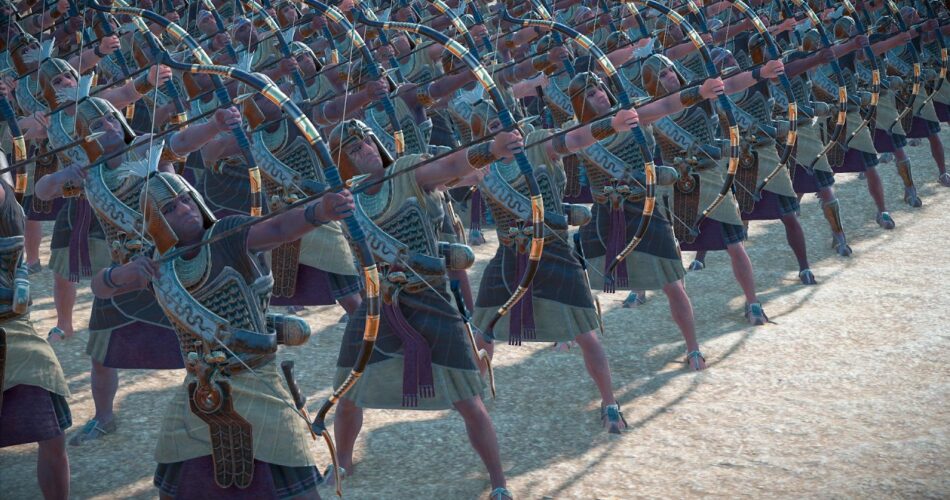
During the 18th, 19th, and 20th Dynasties, Egypt engaged in numerous conflicts with the Canaanites, Mitanni, and Hittites to assert control over the Levant. The Egyptian military reached its peak strength during this period, with prominent pharaohs such as Akhenaten, Ramesses, and Tutankhamun leading these efforts. A key development in Egyptian warfare was the introduction of the composite bow by the Hyksos, which transformed the traditional bow and arrow into a much more powerful weapon for the Egyptian army. By the 19th Dynasty, Egyptian archers were equipped with double-recurved bows, highly effective against lightly armored enemies. Combined with the war chariot, these bows allowed the Egyptian military to engage in rapid, long-range attacks. Egyptian archers were especially effective against nomadic tribes on Egypt’s eastern and western borders, often succeeding without the need for additional military support. In addition to archers and charioteers, the Egyptian army included the mtrw and mnfyt units. The mtrw likely functioned as scouts and reconnaissance forces, while the term mnfyt, frequently used to describe the Egyptian military, appears by the 19th Dynasty to have referred primarily to infantry soldiers. Significant advancements in military technology occurred during the 18th Dynasty, including helmets and tunics made from leather or fabric reinforced with metal scales, as well as improved bronze casting and body armor. During the New Kingdom, the Egyptian military evolved from a force of levy infantry into a professional standing army. By approximately 1300 BC, the Egyptian army is estimated to have exceeded 100,000 soldiers. The composition of this army included Libyans, Nubians, Canaanites, and Sherden warriors. While these foreign soldiers are sometimes described as mercenaries, it is more likely that many were prisoners of war who opted for military service over enslavement. The structure of the New Kingdom army, as attested by both textual and pictorial sources, was divided into two major branches: the infantry and the chariotry. However, these groups were not homogenous. A Ramesside infantry force, for example, would have included archers, close-combat warriors, and various foreign components. Similarly, the chariotry employed both chariot warriors and runners. Units serving in these roles were often flexible in function. For instance, the foreign Sherden warriors, who fought as heavy infantry equipped with metal armor and long slashing swords or spears, could serve as both infantry and chariot runners. Although most Late Bronze Age battles between major powers were dominated by chariotry, Egyptian infantry played a critical role in conflicts against semi-nomadic populations, which tended to rely on foot soldiers and guerilla tactics.
Strategic Situation: Meryey’s Coalition and the Looming Invasion
In the late 13th century BC, a famine in Libya forced various local tribes to unite under the leadership of a chief named Meryey. These tribes intended to invade Egypt collectively, although their exact objectives remain uncertain. It is likely that they sought either to establish a new state within Egyptian territory or to create a Libyan monarchy in Egypt. The Libyans, benefiting from their control over trade routes stretching from Central Africa to the Mediterranean, hired the Sea Peoples—who at the time operated as mercenaries and pirates—to bolster their forces. The Libyans first captured what is believed to be the Siwa Oasis, located to the west of Egypt. Around the same time, there are indications of a possible Nubian invasion in southern Egypt, leading to speculation about a potential Nubian-Libyan alliance, though this alliance did not ultimately materialize. After securing the oasis, the Libyan army advanced into Egypt proper. They were met by the Egyptian pharaoh Merneptah at Perire, a location that is likely a city in the Nile Delta. This confrontation marked a significant episode in Merneptah’s reign as he defended Egypt against the combined forces of Libyans and Sea Peoples.
Battle of Perire: The Clash of Archers and Armored Infantry
The strategic maneuvers of the Egyptians and Libyans culminated in the notable six-hour Battle of Perire. Although Merneptah’s historical texts do not explicitly detail the deployment of Egyptian forces, certain tactics can be inferred based on the relative strengths and weaknesses of the Egyptian army compared to the Libyan and Sea Peoples’ troops. These inferences can also be corroborated by drawing parallels with other historical battles. The Karnak Inscription, a crucial source on the conflict, does not provide precise information about the tactics used by either side. Consequently, the events that transpired on the third day of the third month of Shomu, probably 1208 BC must be reconstructed through indirect evidence, combining insights from other sources and historical contexts to form a plausible picture of the battle’s dynamics.
The Battle of Perire can be summarized as a confrontation between Egyptian archers, both on foot and mounted in chariots, and the close-combat infantry of the Libyans and Sea Peoples. While specific details about the deployment of these two forces are limited, the Karnak Inscription offers two crucial insights regarding the use of foot archers and chariotry during the battle. First, it states that the “bowmen” spent six hours inflicting damage on the enemy. Second, it notes that the chariotry pursued the fleeing adversaries. These clues suggest that the Egyptian forces relied heavily on their archers for sustained ranged attacks, while their chariots played a critical role in exploiting the enemy’s retreat. The initial prominence of foot archers over chariots at the Battle of Perire can be attributed to the difficulty of using chariots against massed infantry formations. Although the Egyptians could have fielded a significant number of chariots, these light vehicles would have had limited effectiveness against the heavily armored infantry of the Sea Peoples and the large Libyan forces. While not explicitly stated in the texts, it is plausible that an initial chariot maneuver was employed to harass the enemy’s front lines, potentially causing damage to the less-armored Libyan troops, who likely wore only long leather cloaks. This tactic might have provoked Meryey’s forces into charging the Egyptian army. However, had the Sea Peoples and Libyans successfully engaged in a melee with the Egyptians, they could have overwhelmed the lightly armored Egyptian infantry, who would have been ill-equipped to defend against the long slashing swords and heavy armor of their opponents. Contrary to this potential scenario, the Karnak Inscription indicates that it was, in fact, the bowmen who inflicted heavy losses on the enemy. This suggests that rather than allowing Meryey’s forces to engage directly with his own infantry, Merneptah may have strategically positioned his archers in two massed units on either flank of his infantry. As the enemy charged, the archers could have delivered concentrated fire into the ranks of the Libyans and Sea Peoples. Unable to effectively employ their close-combat fighting techniques under such conditions, the Libyans and Sea Peoples may have attempted several charges against the Egyptian formation. Those few who managed to breach the arrow storm would have been quickly outnumbered by the Egyptian infantry and subsequently cut down. After enduring multiple charges and witnessing the retreat of their leader, Meryey, the enemy likely fled the battlefield. At this point, Merneptah would have deployed his chariot corps to maximize the destruction of retreating forces, capitalizing on their disarray.
Comparative Analysis: Similar Battles and Tactical Parallels
Battles throughout history where armies with large numbers of archers faced forces that relied primarily on close-order combat support this reconstruction of the Battle of Perire. The consistent success of archers in similar conflicts also bolsters the credibility of Merneptah’s account regarding the high number of enemy casualties and captures following the battle. One notable example is the battle in AD 552, where the Byzantine general Narses confronted a Gothic army on a plain near the village of Taginae. Like the Egyptians at Perire, Narses recognized that his greatest strength lay in his archers, while his infantry, composed of Lombard and Heruli foederati, served as bait to draw the enemy into close combat. This battle illustrates the same strengths and weaknesses exhibited by the opposing forces at Perire. Although the Goths had cavalry, unlike the Sea Peoples, both armies relied on weapons primarily designed for close-order engagement. To effectively utilize their long slashing swords, the Sea Peoples at Perire would have needed to engage Merneptah’s infantry in close combat. However, Merneptah and his generals likely deployed the Egyptian archers on the wings, as Narses did at Taginae, to inflict significant casualties on the Libyans and Sea Peoples before the enemy could capitalize on their advantages as close-combat infantry. This strategic positioning of archers allowed the Egyptians to maintain distance and leverage their ranged capabilities, thereby undermining the effectiveness of the enemy’s infantry tactics.
The tactics used by Narses and likely by Merneptah’s forces at Perire were echoed nearly 900 years later at the battles of Crécy and Agincourt during the Hundred Years War. In both, English longbowmen devastated the French cavalry by positioning archers on the flanks of their infantry, shooting at the charging knights. Despite being heavily outnumbered, the English secured decisive victories, demonstrating the effectiveness of archers against armored opponents. The comparison between the Battle of Perire and the battles of the Hundred Years War is further substantiated by the similarities in weapon capabilities. Egyptian archers, equipped with composite bows, could have approached the piercing power and effectiveness of their English longbow counterparts. Notably, three of the composite bows discovered in Tutankhamun’s tomb are comparable in length to the English longbow. Although their range would have been approximately three-quarters that of the longbow, the Egyptian bows would have still provided formidable firepower in battle, capable of penetrating enemy defenses.
The account of the Battle of Perire, as described in the Karnak Inscription, likely represents one of the earliest recorded examples of an army achieving victory by relying primarily on massed archers against armored infantry. While the exact details of the battle in 1208 BC may never be fully known, a careful examination of comparative military history provides valuable insights into the possible tactics employed by Merneptah’s forces, as well as those of the Libyan and Sea Peoples. This approach allows for a more plausible reconstruction of the strategies used by both sides on the battlefield.
Aftermath: Victory, Punishment, and the Shadow of Future Invasions
Merneptah ordered many of the captured enemies to be impaled south of Memphis, a particularly severe form of punishment that was rarely used in Egyptian history. This suggests that the pharaoh intended to send a powerful warning to any future Libyan invaders. While the victory at Perire temporarily halted Libyan incursions, further invasions occurred during the reign of Ramesses the third. Additionally, the threat posed by the Sea Peoples intensified, contributing to the broader collapse of the Late Bronze Age. A significant foreign invasion occurred around 1174 BC, but Ramesses the third managed to repel the Sea Peoples at the twin battles of Djahy and the Nile Delta. Despite these successes, Egypt entered a period of decline soon after.
© 2026 History and War
Author: Jishu Roy
Unauthorized reproduction of this content is prohibited.