The Crusade at a Crossroads
In the summer of AD 1097, the First Crusade stood at a crossroads. The capture of Nicaea had delivered the expedition its first major victory, but the most difficult part of the journey still lay ahead. Beyond the recently recovered Byzantine territories stretched the vast plains and rugged mountains of Anatolia, lands dominated by the Seljuq Turks. To reach their ultimate destination of Jerusalem, the crusaders would first have to survive a long march through hostile territory.
For Sultan Kilij Arslan, the loss of Nicaea was a serious setback, but it was far from a decisive defeat. Determined to halt the Frankish advance before it penetrated deeper into Anatolia, he gathered a coalition of Turkish forces and prepared to strike. Meanwhile, buoyed by their recent success, the crusaders marched eastward towards Antioch, unaware that a powerful enemy was already moving to intercept them. The confrontation that followed near Dorylaeum would become one of the most important battles of the early crusade, testing the endurance, leadership, and resolve of both sides.
Beyond Nicaea: The Road Into Anatolia
With the capture of Nicaea on 18 June of AD 1097, the crusaders had successfully achieved their initial military objective. In light of this victory, Emperor Alexios I Komnenos convened a meeting with the leading Frankish princes at Pelekanum on 22 June to discuss the next phase of the campaign. Most of the crusade’s senior nobles attended, although Raymond IV of Toulouse and Stephen of Blois remained behind to help safeguard the Latin encampment. By this stage, a powerful sense of shared purpose had emerged within the Crusader army. Having secured their first major success, many crusaders were now firmly focused on advancing toward Jerusalem, driven by the goal of restoring the Holy City to Christian control.
Emperor Alexios I Komnenos likely had little appreciation of the extraordinary achievements this largely western European army would eventually accomplish. Up to this point, however, the crusaders had effectively advanced Byzantine interests, giving him every reason to continue supporting their campaign. As before, Alexios appears to have provided the Frankish leaders with important guidance regarding the political landscape and strategic challenges that lay ahead.
During these discussions, the crusaders identified the vast and historically significant city of Antioch as their next major objective on the route to Palestine. Following the emperor’s recommendations, they also sent envoys by sea to the Fatimid Caliphate in Egypt to explore the possibility of a diplomatic agreement. Although these negotiations initially showed promise, they ultimately failed to produce a lasting alliance.
Choosing the Route to Antioch
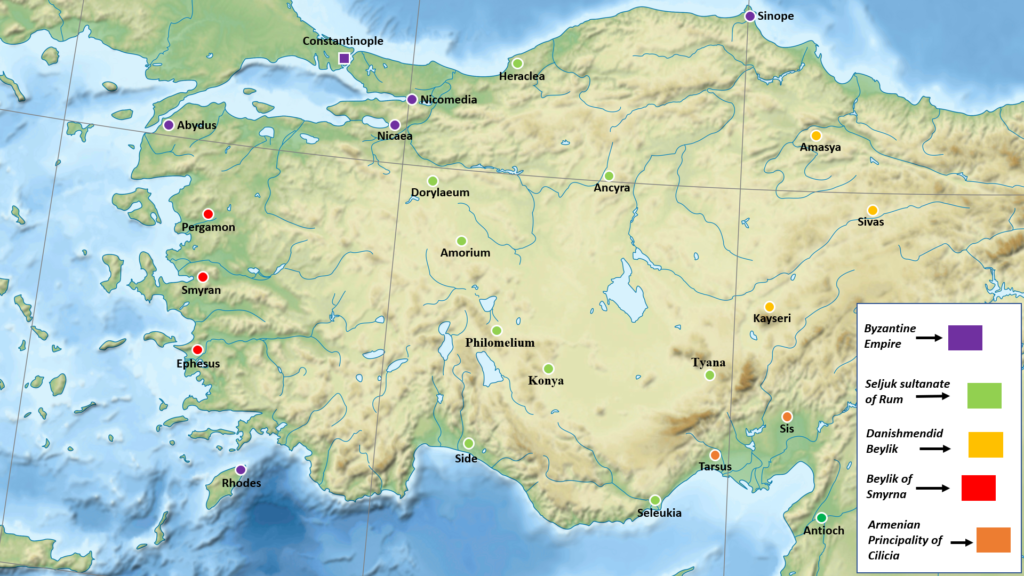
The next challenge facing the crusaders was determining the safest and most practical route across Anatolia. The principal Byzantine military highway extended eastward from Nicaea to the Sangarius River valley before turning southeast toward Dorylaeum, near modern Eskişehir. From there, it continued through central Anatolia toward Caesarea Mazaca, crossed the Anti-Taurus Mountains, and eventually led to Antioch. However, this route was effectively closed to the crusaders because the stretch between Dorylaeum and Caesarea remained under Turkish control.
An alternative postal road ran from Dorylaeum through Amorium and then directly across the salt desert toward the Cilician Gates. Although it offered the shortest path, the route crossed extensive arid terrain with few reliable water sources, making it unsuitable for a large army accompanied by pilgrims, baggage, and livestock.
A third option followed a more southerly course around the salt desert, passing through Philomelium and Iconium before reaching Tyana. There the road divided, with one branch heading through the Cilician Gates and the other reconnecting with the military highway near Caesarea. The crusaders appear to have chosen this route, likely influenced by the advice of Emperor Alexios, although the surviving sources do not allow historians to determine with complete certainty which road they actually followed. If they did take this route, it would have offered several important advantages. It passed through regions where Turkish control was less firmly established and benefited from a network of wells and cisterns that provided a more reliable supply of water, making it better suited to the needs of a large army advancing across Anatolia.
Regardless of which route was ultimately chosen, the crusaders first needed to reach Dorylaeum, which served as the gateway to the interior of Anatolia. On 26 June, the vanguard of the crusader army departed from Nicaea, and over the following two days the remaining contingents gradually followed. Accompanying them was a Byzantine force led by Tatikios, whose primary responsibility was to provide guidance and assist the army as it crossed unfamiliar territory.
Not all crusaders joined the advance. A small number, most likely men still recovering from injuries sustained during the siege, remained behind at Nicaea in the service of Emperor Alexios I Komnenos. These troops were assigned to help repair the city’s defenses and form part of its permanent garrison, ensuring that the recently captured fortress remained securely under Byzantine control.
Emperor Alexios appears to have had little doubt that the crusaders remained, at least formally, under his authority. A member of the contingent led by Stephen of Blois later noted that the Crusader army departed from Nicaea only after receiving the emperor’s permission to do so. Alexios also used the assembly at Pelekanum to reaffirm his position as the expedition’s overlord. The oaths of allegiance previously sworn at Constantinople were renewed, and prominent crusader leaders who had not yet formally submitted, including Tancred and Baldwin of Boulogne, were encouraged to pledge their loyalty.
The emperor’s broader strategy was clear. While supporting the crusaders in their advance across Asia Minor, he intended to re-establish Byzantine control over territories recovered from Turkish rule. To facilitate this policy, Alexios instructed the Byzantine general Tatikios and the troops who had accompanied him to Nicaea to continue with the crusading army. According to a contemporary Greek source, Tatikios was tasked with assisting and protecting the crusaders while also taking possession, on behalf of the empire, of any cities they captured during the campaign.
Despite this close cooperation, there is little evidence that Alexios made any definite promise to lead a large Byzantine army in person to support the crusade. Nevertheless, many of the Frankish leaders appear to have expected that substantial Byzantine reinforcements would join them at some point later in the expedition.
Alexios’ strategy of using the First Crusade to advance Byzantine interests contained an inherent weakness. While the crusaders remained near Constantinople and during the siege of Nicaea, the emperor exercised considerable influence over the expedition and its leaders. However, as the Crusader army advanced deeper into Anatolia and moved farther from the empire’s political and military centre, Byzantine control inevitably began to diminish.
Dividing the Crusader Host
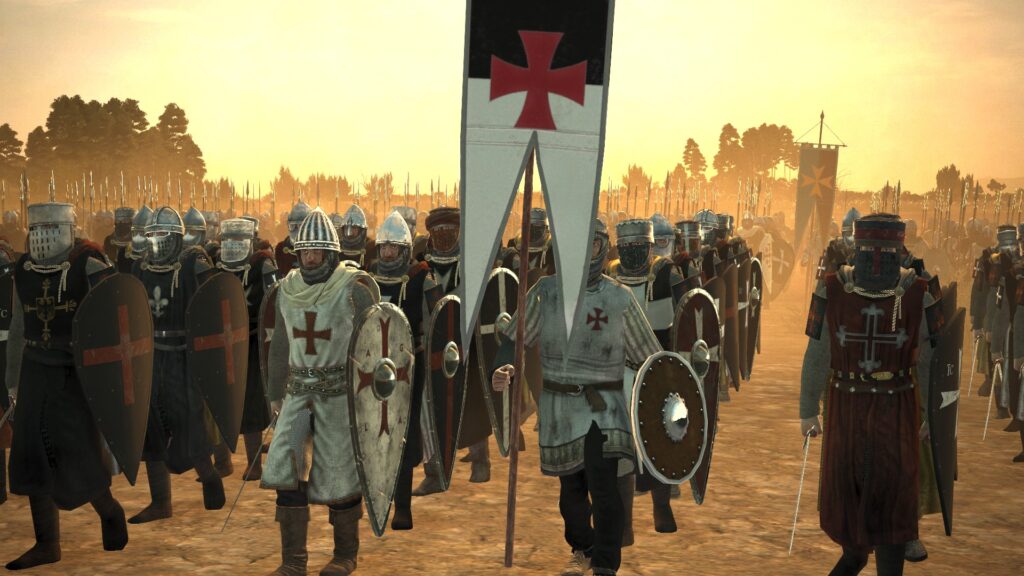
At a village called Leuce, near the crossing of the Sangarius River, the crusader princes met to consider the next phase of their campaign. Their objective was Antioch, a major city located hundreds of kilometres away, but reaching it would require overcoming significant logistical and military challenges.
The first problem stemmed from the sheer size of the crusading host. Numbering perhaps around 50,000 people, the expedition had become so large that it could take several days for the entire army to pass a single point on the road. Advancing as one enormous column would have been slow and difficult, while also placing considerable strain on local resources. This was particularly important because the crusaders continued to rely heavily on foraging to supplement their food supplies. Under such circumstances, dividing the army into smaller contingents, as they had done during the journey to Constantinople, appeared to be the most practical solution.
Yet this strategy carried significant risks. Although the Seljuq Turks had suffered a setback with the loss of Nicaea, their military power had by no means been destroyed. The crusaders had every reason to believe that Sultan Kilij Arslan would seek an opportunity to strike back. By separating into smaller forces, the Franks would sacrifice much of the overwhelming numerical strength that had contributed to their earlier success, potentially leaving individual contingents vulnerable to a determined Turkish counterattack.
Confronted with the competing demands of security and logistics, the crusader leaders adopted a compromise solution. Rather than continue as a single massive army or disperse into numerous independent groups, they chose to divide the expedition into two large contingents while ensuring that the two forces remained within supporting distance of one another during the march.
This arrangement was intended to reduce the strain on local food supplies and make movement across Anatolia more manageable. The plan called for one army to travel approximately a day’s march ahead of the other, allowing each contingent to forage more effectively without exhausting the resources of a single area.
The vanguard force was composed primarily of the Norman contingents from southern Italy and northern France, together with the troops of the Counts of Flanders and Blois. Accompanying them was the Byzantine detachment led by Tatikios, whose men served as guides and maintained the empire’s link with the crusading host as it advanced into the interior of Asia Minor.
The second contingent consisted primarily of the southern French forces, the Lorrainers, and the troops of Count Hugh of Vermandois. Overall command of the two divisions appears to have been informally divided between Bohemond, who led the vanguard, and Raymond of Toulouse, who headed the second force.
29 June, the Norman troops from southern Italy, together with the army of Robert of Normandy crossed the Göksu River and advanced eastward. Following behind at a greater distance were the forces led by Godfrey of Bouillon, Robert of Flanders, Hugh of Vermandois, and the southern French contingents.
The two divisions planned to maintain contact throughout the march and eventually reunite at Dorylaeum, an abandoned Byzantine military encampment located roughly four days’ journey to the south-east. There, the crusaders intended to regroup before continuing their advance deeper into Anatolia toward Antioch.
Kilij Arslan’s Return
Following his unsuccessful attempt to relieve Nicaea, Kilij Arslan withdrew eastward to regroup his forces and strengthen his position. Recognising the growing threat posed by the crusaders, he negotiated a peace agreement and military alliance with the Danishmend Turks, setting aside previous rivalries in favour of a common defence.
The fall of Nicaea had deeply concerned the sultan. Beyond the strategic loss of the city itself, the capture of his treasury by the crusaders and Byzantines represented a significant financial setback. Nevertheless, the Seljuq Turks retained important advantages. Their political and military system remained heavily influenced by nomadic traditions, and their power was not tied to a single urban centre. In many respects, the sultan’s true seat of authority was wherever his army and camp were located.
By the end of June, Kilij Arslan had returned westward with a substantial force. He was accompanied by his own troops, by his vassal Hasan, emir of the Cappadocian Turks, and by the army of the Danishmends. Having assembled this coalition, the sultan prepared to confront the advancing crusaders before they could penetrate deeper into Anatolia.
The first two days of the march toward Dorylaeum proceeded without any significant difficulties for the forces led by Bohemond and Robert of Normandy. As evening approached on 30 June, crusader scouts reportedly detected the presence of Turkish troops in the surrounding area. However, the Frankish commanders appear to have concluded that these were merely a small reconnaissance or raiding force rather than the advance elements of a larger army.
As a result, no urgent warning was sent to the second crusader contingent marching behind them. This assessment would soon prove to be a serious miscalculation. Unbeknownst to the crusaders, a much larger Turkish force was gathering nearby, and the decision not to alert their allies left the vanguard dangerously exposed at a critical moment in the campaign.
On 30 June, the army of Sultan Kilij Arslan was camped in the valley of the Tembris River (modern Porsuk) when scouts brought news that Bohemond’s crusader force had descended into the nearby valley of the Bathys, located only a few miles away on the opposite side of a low range of hills. That evening, the crusaders established their camp on the plain, apparently unaware of the proximity of the Turkish army.
For Kilij Arslan, this development presented the ideal opportunity to strike. Having waited for the crusaders to separate their forces and expose a vulnerable target, he now found Bohemond’s contingent isolated from the rest of the expedition. Under the cover of darkness, Turkish troops quietly crossed the hills during the night, positioning themselves for an attack at dawn.
The main Seljuq army under Sultan Kilij Arslan had deployed across the Nane valley, positioning itself directly along the crusaders’ route to Dorylaeum. The Turkish army was likely arranged in its customary battle formation, with a central force supported by two wings on either flank. This deployment allowed the Seljuqs to block the crusaders’ advance while retaining the flexibility needed for their preferred style of mobile warfare.
The Battle of Dorylaeum
At dawn on 1 July, the crusader vanguard resumed its march toward Dorylaeum. As the column approached the confluence of the Kara Su and Nane rivers, the crusaders were confronted with an alarming sight. To their right stood the main army of Sultan Kilij Arslan, which had taken up positions across the valley during the night.
Moments later, large numbers of Turkish cavalry swept into view. Contemporary Frankish eyewitnesses claimed that the enemy numbered as many as 360,000 men, although such figures are clearly exaggerated and far beyond any realistic estimate. Nevertheless, the Seljuq army was undoubtedly substantial and may have matched or even outnumbered the crusader vanguard facing it.
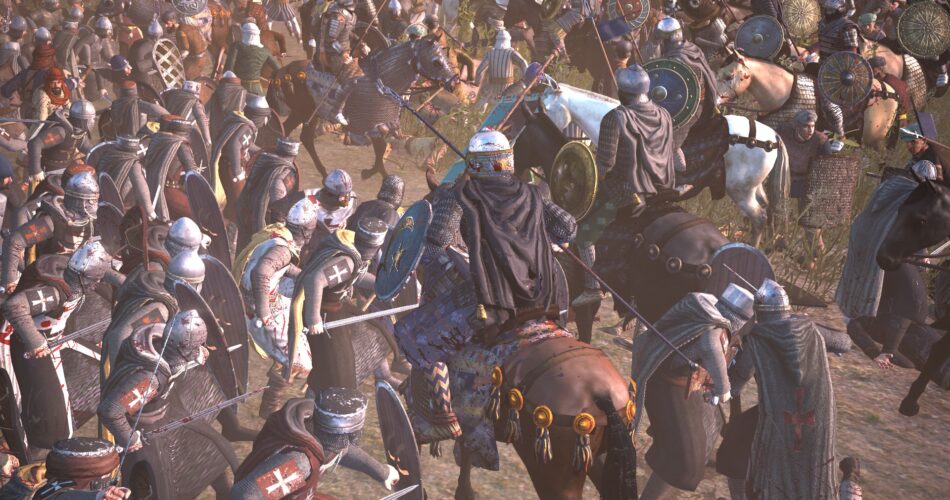
The situation was extremely dangerous. Separated from the main body of the crusading army and caught in exposed terrain, the Crusaders suddenly found themselves confronting the full power of Seljuq mounted warfare for the first time. What followed would provide a harsh introduction to the speed, mobility, and striking power of Turkish horse archers in battle.
The sudden appearance of the Turkish cavalry caused shock and alarm among the crusaders. One eyewitness from Bohemond’s army later recalled how the Turks erupted into loud cries and war chants, producing a deafening noise that seemed terrifying and unfamiliar to the Frankish soldiers. To many crusaders, the experience was deeply unsettling, heightening the sense that they were facing a formidable and alien enemy.
Confronted by the unexpectedly large size of the Turkish army, Bohemond reacted quickly and decisively. Recognising the danger posed by the approaching enemy, he ordered the infantry, clergy, and other non-combatants to establish a fortified camp that could serve as a defensive stronghold. The position chosen was less than ideal, as its rear was bordered by marshy ground, limiting both movement and opportunities for retreat.
Having secured the camp as best he could, Bohemond took the offensive. Accompanied by Robert of Normandy, he led approximately 3,000 mounted knights forward to engage the Turks. This decision reflected both the urgency of the situation and the crusaders’ reliance on heavily armed cavalry as their principal battlefield force, even as they faced a highly mobile enemy skilled in mounted archery.
The main Turkish army now launched its attack against the crusader cavalry. The engagement quickly turned against the Franks, whose mounted forces were driven back towards the defensive camp, where the infantry had formed a protective perimeter around the non-combatants.
Contemporary accounts indicate that the crusaders were initially bewildered by the Seljuqs’ style of warfare. As Fulcher of Chartres later recalled, the Turks advanced while shouting loudly and continuously showering their opponents with arrows. Unaccustomed to such tactics, many crusaders found themselves overwhelmed by the speed and intensity of the attack, suffering significant casualties and disorder in their ranks.
In many respects, the battle echoed the Turkish tactics employed during the attempt to relieve Nicaea. However, the circumstances were now far more favourable to the Seljuqs. Instead of fighting in the restricted terrain around a besieged city, they operated on open ground where their mobility could be fully exploited. This allowed Turkish horse archers to manoeuvre freely around the crusader forces, maintain their distance, and subject the Franks to a relentless barrage of missiles while avoiding close combat.
Contemporary crusader accounts emphasise the effectiveness of Turkish missile tactics during the battle. The author of the Gesta Francorum noted that the Turks continually harassed their opponents, skirmishing at a distance while launching a steady barrage of arrows, darts, and javelins from remarkable range.
At the same time, part of the Turkish force appears to have moved away from the main engagement in an effort to locate the remainder of the crusader army. Given the reports available to Sultan Kilij Arslan, it is likely that he knew the Frankish host had been divided into separate contingents and would have sought to prevent them from uniting on the battlefield. However, this detachment seems to have encountered groups of stragglers and followers caught between the widely separated vanguard and rear divisions of the crusading column, possibly mistaking them for a larger body of crusaders.
According to the sources, one Frankish knight, Robert of Paris, attempted to come to the aid of these vulnerable groups. Breaking away from the main force, he charged towards the attackers, but was almost immediately struck by an arrow and killed. The isolated individuals caught between the two crusader contingents suffered heavily, and many appear to have been overwhelmed and slain during the Turkish assault.
Meanwhile, the situation within the crusader camp was becoming increasingly critical. After failing to halt the Turkish advance in the open field, the Frankish cavalry withdrew behind the protection of the camp’s defensive perimeter. Recognising that further attempts to pursue the highly mobile enemy would only lead to greater losses, the crusader commanders adopted a more cautious strategy.
Within the camp, the non-combatants were gathered around the springs at its centre, while the women took on the vital task of carrying water to the soldiers defending the perimeter. Tents were hastily erected to strengthen the defensive position, and many knights were ordered to dismount and fight on foot rather than risk being drawn into ineffective cavalry actions against the elusive Turkish horse archers. At the same time, messengers were dispatched to the rear contingent, urging it to advance with all possible speed.
Fresh orders were issued instructing the army to maintain a tight defensive formation and resist any temptation to engage in open battle. Instead, the crusaders relied upon their superior armour, discipline, and numerical strength to withstand the Turkish assault while they waited for reinforcements from the second crusader army. It was a desperate gamble, as their survival depended upon holding their ground long enough for help to arrive.
Throughout the morning, the crusaders endured relentless pressure. Turkish horse archers attacked from every direction, advancing to loose volleys of arrows before withdrawing and making way for fresh warriors who repeated the process. To the exhausted defenders, the enemy seemed endless in number. As the heat of the July morning intensified, many began to wonder how long they could survive under such a constant barrage of missiles.
Amid this growing crisis, Bohemond played a crucial role in maintaining morale. Riding continuously along the defensive lines, he encouraged his men to remain steadfast, reminding them that escape was impossible and that surrender would almost certainly condemn them to a lifetime of captivity. His leadership helped sustain the crusaders during the most dangerous phase of the battle, as they awaited the arrival of the second army.
To many of the crusaders, the scale of the Turkish assault appeared overwhelming. One eyewitness later recalled that the enemy seemed to fill the entire landscape, covering the surrounding hills, valleys, and open plains in every direction. Whether exaggerated or not, such descriptions reflect the sense of encirclement and danger felt by the Crusader defenders as they faced continuous attacks from highly mobile Turkish horsemen.
Religious support also played an important role in sustaining the army’s resolve. Priests moved among the soldiers, offering prayers, hearing confessions, and reminding the crusaders of the spiritual significance of their struggle. Meanwhile, women within the camp contributed to the defence by carrying and distributing water to the front lines, helping the exhausted defenders endure both the intense summer heat and the relentless Turkish attacks.
As the morning wore on, the fighting became increasingly intense. Much of the combat took place at close quarters around the crusader camp, where the Frankish knights appear to have been concentrated along its southern perimeter, struggling to contain repeated Turkish attacks. Although natural obstacles, including a marsh bordering part of the position, hindered the attackers, and the crusader infantry offered determined resistance, the defenders were unable to seal every approach.
Within the camp, fear and uncertainty spread among the non-combatants. One contemporary cleric later described how men, women, and children crowded together in terror, feeling completely surrounded by enemy forces and uncertain where safety could be found. For many, the battle appeared to be turning into a disaster.
At one stage, Turkish warriors succeeded in breaking through sections of the camp’s defences. Once inside, they attacked the crowded areas occupied by pilgrims and other non-combatants. Contemporary accounts describe scenes of chaos and heavy casualties as arrows struck men, women, children, and the elderly alike. The breach exposed the vulnerability of those sheltering behind the lines and underscored how close the crusader army came to collapse during the most critical hours of the battle.
Despite the relentless pressure, the crusader line did not break. For nearly five hours, the Crusader vanguard endured repeated attacks, sustained by a combination of religious conviction, determination, and the knowledge that defeat would likely mean death or captivity. Throughout this ordeal, the steadfast leadership of Bohemond and Robert of Normandy played a crucial role in maintaining order and morale among the defenders.
The Arrival of the Second Crusader Army
Around midday, the first elements of the second crusader army finally came into view. Leading the relief force were Godfrey of Bouillon and Hugh of Vermandois, with Raymond of Toulouse following closely behind. Their arrival marked a decisive turning point in the battle. Until that moment, the Turks appear to have believed that they were confronting the entirety of the crusader host and were on the verge of overwhelming it. The sudden appearance of fresh Crusader forces therefore came as an unwelcome surprise.
Godfrey’s contingent succeeded in breaking through to the besieged camp, providing much-needed support to the exhausted defenders. Shortly afterwards, as additional reinforcements arrived, the crusaders were able to reorganise and assume the offensive. The reunited army formed an extended battle line, with Bohemond, Robert of Normandy, and Stephen of Blois holding the left wing; Raymond of Toulouse and Robert of Flanders occupying the centre; and Godfrey of Bouillon together with Hugh of Vermandois commanding the right. Having endured hours of defensive fighting, the crusaders could now bring the full weight of their combined forces to bear.
The arrival of the second crusader force dramatically altered the course of the battle. The Turks, who had expected to destroy an isolated enemy, suddenly found themselves facing a coordinated counterattack from a reunited crusader army. Caught off guard by this change in circumstances and likely beginning to exhaust their supply of arrows and other missiles after hours of continuous fighting, their resistance began to weaken.
The situation deteriorated further when Bishop Adhemar of Le Puy appeared on the hills overlooking the Turkish position with a contingent of southern French troops. This manoeuvre had been deliberately planned by Adhemar, who had secured local guides to lead his force along mountain paths and around the enemy’s flank. The unexpected appearance of crusader troops in their rear threatened the Turks with encirclement and transformed uncertainty into panic.
With the momentum of the battle now shifting decisively in the crusaders’ favour, Bohemond and Robert of Normandy seized the opportunity to launch a cavalry attack. There was little time to organise a carefully coordinated offensive, but such preparations proved unnecessary. The Turkish army, already shaken by the arrival of fresh crusader forces and the threat posed by Adhemar’s flanking manoeuvre, offered only limited resistance.
Faced with attacks from multiple directions and the prospect of being trapped, the Turkish army’s cohesion rapidly collapsed. What had begun as a carefully prepared ambush now turned into a disorderly retreat, as Kilij Arslan’s forces abandoned the battlefield and withdrew from the fight.
The withdrawal soon developed into a rout. Crusader cavalry pursued the fleeing Turks across the countryside, inflicting further casualties and capturing large quantities of supplies and livestock. One participant in Bohemond’s army later recalled with satisfaction that the Turks abandoned their camp and continued their flight as the crusaders chased them for the remainder of the day. The victors seized considerable booty, including gold, silver, horses, donkeys, camels, cattle, sheep, and other valuable goods.
The Road to Antioch
The Battle of Dorylaeum proved to be a harsh lesson for the crusaders. Sultan Kilij Arslan came close to victory, as Turkish forces successfully penetrated the crusader camp before the arrival of the second Crusader army. As at Nicaea, however, the Turks ultimately became engaged in close combat against a numerically superior opponent, a situation that favoured the crusaders. The battle demonstrated both the resilience of the Frankish forces and a major weakness within the crusading host: the absence of a unified command structure. It was the division of the army that had created the opportunity for the Turkish attack, a problem that would continue to affect crusading campaigns for generations.
Despite coming close to disaster, the crusaders emerged with a significant victory. The defeat dealt a severe blow to the morale of the Seljuq Turks, and from this point onward Kilij Arslan largely avoided direct confrontation with the Crusader army. Retreating eastward, he adopted a scorched-earth strategy, destroying crops and supplies in an attempt to hinder the crusaders’ advance across Anatolia.
The battle was costly for both sides, leaving thousands dead, including William Marchisus, the brother of Tancred. After spending several days burying their fallen and recovering from the ordeal, the crusaders gained a newfound respect for the skill and effectiveness of Turkish warriors.
On 3 July, the Crusader army resumed its march through Anatolia, heading towards Philomelium and Iconium on the long road to Antioch. Although the journey across the Anatolian plateau would take almost three months under the intense summer heat, the crusaders now advanced with relatively little opposition. By October, they had reached Antioch and begun one of the most famous sieges of the First Crusade—which we will discuss another day.
Bibliography
1) THE DEEDS OF THE FRANKS AND OTHER JERUSALEM-BOUND PILGRIMS : THE EARLIEST CHRONICLE OF THE FIRST CRUSADES | Nirmal Dass (trans.)
2) A HISTORY OF THE EXPEDITION TO JERUSALEM 1095-1127 | Fulcher of Chartres / Frances Rita Ryan (trans.)
3) A HISTORY OF THE CRUSADES VOLUME I: THE FIRST CRUSADE AND THE FOUNDATION OF THE KINGDOM OF JERUSALEM | Steven Runciman
4) VICTORY IN THE EAST: A MILITARY HISTORY OF THE FIRST CRUSADE | John France
5) THE CRUSADES AND THE EXPANSION OF CATHOLIC CHRISTENDOM, 1000-1714 | John France
6) THE FIRST CRUSADE: A NEW HISTORY | Thomas Asbridge
7) GOD’S WAR: A NEW HISTORY OF THE CRUSADES | Christopher Tyerman
8) ARMIES OF HEAVEN: THE FIRST CRUSADE AND THE QUEST FOR APOCALYPSE | Jay Rubenstein
9) THE FIRST CRUSADE 1096–99: CONQUEST OF THE HOLY LAND | David Nicolle
10) WESTERN WARFARE IN THE AGE OF THE CRUSADES, 1000–1300 | John France
© 2026 History and War
Author: Jishu Roy
Unauthorized reproduction of this content is prohibited.