The Cilician Campaign
On 1st July AD 1097, the armies of the First Crusade emerged victorious from the Battle of Dorylaeum. But the road to Antioch remained long and perilous. As the Crusaders advanced across Anatolia, they faced harsh terrain, dwindling supplies, and uncertain political conditions. Survival would depend not only on military strength, but also on the support of Armenian Christians and Byzantine allies.
As the main army pushed eastward through Anatolia, a separate expedition led by Baldwin of Boulogne and Tancred struck south into Cilicia. What began as a strategic effort to secure allies, supply routes, and the approaches to Syria soon developed into one of the most dramatic episodes of the campaign, marked by rivalry, political intrigue, and even violence between Crusaders themselves.
Together, these operations transformed the strategic situation in northern Syria. Through a combination of military success, diplomacy, and cooperation with local Armenian communities, the Crusaders gradually secured the routes leading to Antioch and laid the foundations for its coming isolation. This is the story of the march from Dorylaeum to Antioch—a campaign of endurance, diplomacy, ambition, and survival that prepared the way for one of the most famous sieges of the Middle Ages.
Beyond Dorylaeum: The March Across Anatolia
Following their victory at the Battle of Dorylaeum, the Crusaders halted for two days before resuming their advance toward Antioch on 3 July AD 1097. Determined to avoid the dangers they had faced at Dorylaeum, the army marched thereafter as a single, unified force rather than in separate contingents. Despite the confidence expressed by Stephen of Blois, Antioch remained approximately fifteen weeks and several hundred miles away. The Crusaders were entering unfamiliar territory marked by political instability, uncertain alliances, and limited access to supplies. Under such conditions, the experience and guidance of Tatikios, the representative of Emperor Alexios, were likely of considerable importance to the expedition, even though many Crusaders may have resented relying on Byzantine advice.
The attitudes of many Crusaders toward religious outsiders were shaped by a broad sense of hostility that often made little distinction between Muslims, Jews, and Christian heretics. To them, all were regarded as equally abhorrent and as adversaries of the Christian faith. Yet the realities of the campaign soon challenged these assumptions. As the army advanced toward Jerusalem, it became increasingly reliant on diplomatic cooperation with various Eastern Christian communities that Western Europeans considered schismatic, particularly the Armenians. Thus, despite the dramatic demonstration of military and religious zeal at Dorylaeum, the success of the crusade continued to depend not only on warfare but also on the cultivation of political alliances. For some Crusaders, adapting to this more complex and pragmatic situation proved difficult.
The opening stages of the march proved particularly challenging for the Crusaders. Having overcome the threat posed by Turkish armies in battle, they now confronted a different and equally formidable adversary: the harsh environment of central Anatolia. As they advanced across the region’s arid plains, they encountered a landscape devastated by Kilij Arslan’s scorched-earth retreat. Combined with the intense heat of the midsummer sun, these conditions left the Crusaders struggling through a territory described by contemporaries as desolate, lacking water, and scarcely fit for habitation.
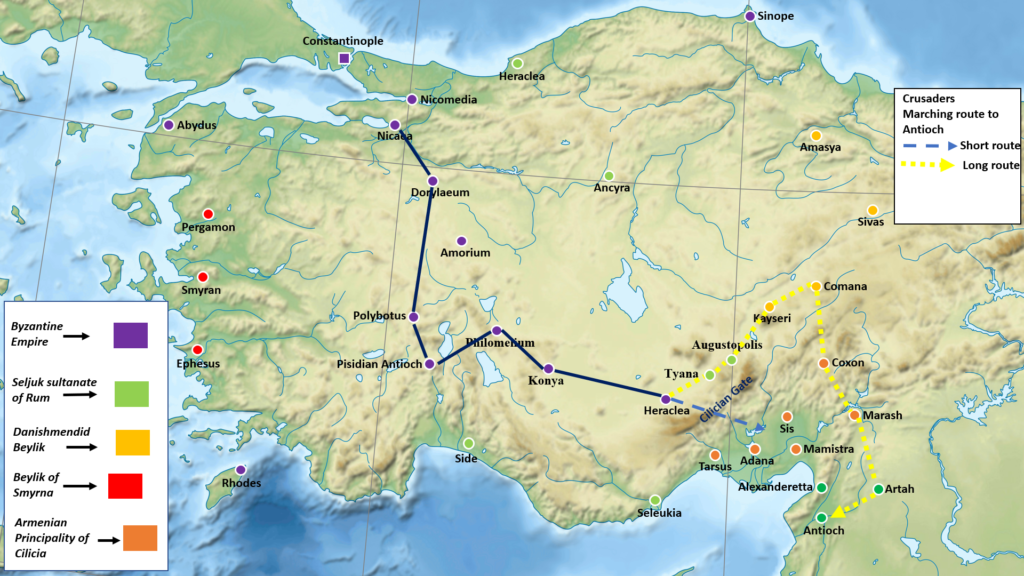
The historical sources provide only limited information about this early stage of the march. Most chroniclers wrote their accounts years later, by which time memories of these initial hardships had been overshadowed by the far greater ordeals and dramatic events that followed. Nevertheless, the available evidence suggests that the Crusaders may have travelled along a route passing through Nacolia. According to Albert of Aix, the army reached a place known as the Malabranias Valley on the fourth day of its march after enduring severe thirst. There, many Crusaders reportedly died after drinking excessive amounts of water. Although the exact location of Malabranias cannot be identified with certainty, Nacolia (modern Seyitgazi), situated on the Seydi River approximately eighty kilometres from the battlefield of Dorylaeum, lies at a distance consistent with a four-day march. As a result, it remains a plausible candidate for the site mentioned by Albert, though the evidence is far from conclusive.
After passing through Polybotus, the Crusaders appear to have diverted southward toward Pisidian Antioch. Unlike many settlements along their route, the city had likely escaped Turkish devastation and thus offered an opportunity to obtain much-needed provisions. From there, the army crossed the barren passes of the Sultan Mountains before rejoining the main road at Philomelium.
Beyond Philomelium, the Crusaders entered an increasingly inhospitable landscape, travelling through a desolate region situated between the mountains and the edge of the desert. The intense heat of the Anatolian summer placed enormous strain on both men and animals. Armoured knights, infantrymen, and their horses endured severe hardship as water became scarce. Apart from the saline marshes scattered across the desert, there were few reliable water sources, while vegetation was limited largely to thorny shrubs. Contemporary accounts suggest that some Crusaders chewed on these branches in a desperate attempt to relieve their thirst. Although remnants of Byzantine cisterns could still be seen along the route, they had been systematically destroyed by the Turks, depriving the army of what might otherwise have been vital sources of water.
The horses were among the earliest victims of the harsh conditions. As large numbers of animals died from exhaustion, thirst, and lack of forage, many knights were compelled to continue the journey on foot. Others resorted to riding oxen, while sheep, goats, and even dogs were pressed into service to haul the baggage trains. Despite these severe difficulties, the morale of the Crusader army remained remarkably resilient. Writing of the expedition, Fulcher of Chartres was particularly struck by the sense of unity that existed among the Crusaders. Men drawn from numerous regions, speaking different languages and possessing diverse backgrounds, nonetheless cooperated in pursuit of a common goal. To Fulcher, this extraordinary solidarity appeared to be evidence of divine inspiration guiding the army.
Allies on the Road to Antioch
In early August, the Crusaders entered the region of Pisidia and were relieved to find a landscape far more hospitable than the harsh terrain they had recently crossed. Contemporary accounts describe the area as fertile and abundant, offering plentiful food and supplies that allowed the army a much-needed opportunity to rest and recover its strength.
During this respite, some of the Crusader princes turned to one of the favourite pursuits of the medieval aristocracy: hunting. The excursion nearly ended in tragedy when Godfrey of Bouillon was attacked by a bear and severely injured. The animal mauled him badly before it was driven off, and the wounds he sustained required a lengthy period of recovery. Given Godfrey’s prominent role within the crusading host, the incident served as a reminder that the dangers facing the expedition extended beyond the battlefield.
The Crusaders next advanced toward Iconium, one of the principal strongholds of Seljuq power in central Anatolia. Although the city was well fortified and might have posed a serious obstacle to their progress, the Turks abandoned it before the Crusaders arrived in mid-August. As a result, the army was able to pass through Iconium without resistance or significant delay.
Before continuing their march, the Crusaders benefited from the advice of the local Armenian Christian population living in the region. Familiar with the difficult terrain ahead, the Armenians warned them of the scarcity of water on the next stage of the journey. Heeding this counsel, the Crusaders gathered sufficient supplies of water before departing. This precaution proved invaluable, enabling the army to endure the arid march and eventually reach the more fertile valley of Heraclea.
By the end of August, the Crusader army had reached Heraclea, where it encountered a Turkish force commanded by Emir Hasan and a leader of the Danishmendids. Concerned about protecting their territories in Cappadocia, the two emirs appear to have hoped that their presence would pressure the Crusaders into abandoning the direct inland route and instead crossing the Taurus Mountains toward the Mediterranean coast.
The Crusaders, however, showed no inclination to alter their course. Upon sighting the Turkish forces, they immediately launched an attack, with Bohemond taking a leading role in the engagement and reportedly seeking out the Danishmend emir himself. The Turks, unwilling to risk a major pitched battle against the advancing Crusader host, quickly withdrew northward. Their retreat left the surrounding towns undefended, allowing the Crusaders to occupy them without significant resistance and continue their advance into southeastern Anatolia.
The Roads Divide
At Heraclea, the leaders of the First Crusade faced an important strategic decision regarding the route into Syria through Armenian-controlled territories. The most direct path lay to the south and east, passing through the narrow Cilician Gates, across the fertile plains of Cilicia, and then over the Belen Pass, a natural corridor through the Amanus Mountains, before reaching Antioch. Although this route was shorter and more efficient, it carried significant risks, as both mountain passes could potentially be blocked or defended by Muslim forces.
An alternative route led northward through Cappadocia before turning east around the imposing Anti-Taurus Mountains. While considerably longer, this road reduced the danger of being trapped in narrow mountain defiles and offered a safer passage for the main army.
Ultimately, the bulk of the Crusader host chose the northern route. At the same time, a smaller force was detached to advance through Cilicia. This expedition was led by two younger and less prominent princes: Baldwin of Boulogne, the brother of Godfrey of Bouillon, and Tancred, the nephew of Bohemond. Their mission would soon have important consequences for the Crusader presence in the region.
By advancing into Syria along two separate routes, the Crusaders effectively adopted a strategy that allowed them to approach the region from multiple directions. This arrangement enabled them to establish contact with Armenian Christian communities in both Cappadocia and Cilicia, creating opportunities for cooperation with local allies who shared their religious affiliation.
Such alliances offered significant practical advantages. In addition to assisting fellow Christians, the Crusaders could secure valuable sources of provisions, intelligence, and logistical support for the advance into Syria. Armenian settlements had the potential to serve as supply bases and staging points, helping to sustain the army during its long campaign.
The Crusader leaders were also anticipating reinforcements from both the Byzantine Empire and subsequent waves of pilgrims and warriors travelling east. In this context, the expedition into Cilicia assumed additional importance, as it helped secure the most direct route to Antioch and improved communications between the advancing Crusader forces and any troops that might follow.
The Cilician Adventure
Around 10 September, Tancred and Baldwin departed Heraclea by separate routes, heading toward the passes of the Taurus Mountains, while the main Crusader army marched northeast toward Caesarea approximately four days later. With the Crusader forces now advancing along different paths, it is helpful to first turn our attention to the smaller expedition.
Baldwin of Boulogne departed with a force of approximately 300 to 500 men, accompanied by several notable members of Godfrey of Bouillon’s contingent, including Reinhard of Toul and Baldwin of Le Bourcq. Tancred, by contrast, commanded a smaller detachment, likely numbering between 100 and 200 troops, among whom was his brother-in-law, Richard of Salerno.
Despite its smaller size, Tancred’s force made more rapid progress. This was probably due in part to the guidance of an Armenian local who accompanied the expedition and helped lead it through the unguarded Cilician Gates. Taking advantage of this route, Tancred successfully crossed the Taurus Mountains ahead of Baldwin and became the first Crusader leader to reach Tarsus, an important walled town situated south of the pass.
Tancred reached the important city of Tarsus on 21 September AD 1097. As his forces approached, the town’s Turkish garrison rode out to confront the Crusaders. However, after a brief show of resistance, the defenders lost confidence and withdrew behind the safety of Tarsus’ walls.
Recognising that a direct assault would be costly, Tancred instead relied on psychological pressure. His men established a loose blockade around the city while he carefully cultivated the impression that a much larger Crusader force was close behind. He openly warned the defenders that his contingent represented only the vanguard of the crusading army and that Bohemond himself would soon arrive with substantial reinforcements. At the same time, he made a conspicuous display of preparations for an attack, seeking to intimidate the garrison and undermine its morale.
The strategy proved highly effective. During the night, many of the Turkish defenders abandoned the city and fled. By the following morning, those who remained were prepared to negotiate terms of surrender. Tancred’s banner was soon raised over the citadel, symbolising his claim to possession of the town. Although his troops had not yet fully occupied Tarsus, the operation appeared to be a significant success and marked an encouraging beginning to the Cilician expedition.
Later that same day, Baldwin of Boulogne arrived outside Tarsus with his contingent. Initially, both commanders were relieved by the encounter, as each had briefly mistaken the other’s force for a Turkish army. With the misunderstanding resolved, Baldwin and Tancred met amicably and shared a celebratory feast beneath the town’s walls, seemingly united by their recent success.
By the following morning, however, tensions had begun to emerge. Baldwin appears to have become increasingly conscious of the advantages Tancred had gained by reaching Tarsus first. As the commander who had secured the town’s surrender, Tancred claimed the right to its possession and the rewards associated with its capture. While he may have been prepared to share some of the profits and spoils that could be obtained from Tarsus, he was unwilling to relinquish his authority over the city itself. This refusal sowed the seeds of rivalry between the two leaders, a dispute that would soon escalate and reveal the growing competition for power and influence among the Crusader princes.
The capture of Tarsus quickly led to a serious dispute between Baldwin of Boulogne and Tancred. Both possessed arguments that appeared legitimate. Tancred maintained that his troops alone had forced the town’s surrender and that, according to contemporary western custom, the banner flying above the citadel symbolised his lawful claim to the city. Baldwin, however, argued that the Cilician expedition had been launched as a joint enterprise and that any territory or wealth acquired should therefore be shared equally.
Although Tancred’s legal claim was stronger, his military position was far less secure. Baldwin had arrived with a force perhaps twice the size of his own, while Tancred had not yet managed to place any soldiers inside Tarsus. Recognising this weakness, Baldwin opened secret negotiations with the Turkish garrison. Through an interpreter, he convinced the defenders that his connection to Godfrey of Bouillon, one of the most powerful leaders of the crusade, offered greater security than Tancred’s association with Bohemond. The argument proved persuasive. The Turks removed Tancred’s banner, threw it into a nearby marsh, and raised Baldwin’s standard in its place.
When Tancred saw Baldwin’s banner flying over Tarsus, he understood that he had been politically outmanoeuvred. Although deeply offended, he recognised that any attempt to challenge Baldwin by force would likely end in defeat. Choosing prudence over pride, he gathered his followers and withdrew eastward.
Even after Tancred’s departure, Baldwin’s control of Tarsus remained incomplete. Initially, he was granted access to only two of the city’s towers while negotiations continued. His own force was too small to dominate the town outright, and the Armenian inhabitants remained fearful of the Turkish garrison still present within the city.
The situation became more complicated when approximately 300 Norman reinforcements from Bohemond’s contingent arrived on 24 September. Sent originally to support Tancred, these weary soldiers requested permission to shelter inside Tarsus. Baldwin refused, fearing that their presence might weaken his authority. The decision proved disastrous. During the night, most of the Turkish garrison secretly slipped out of the city and launched a surprise attack on the sleeping Normans camped outside the walls. The assault was swift and brutal, leaving many dead before the attackers disappeared into the darkness.
The following morning, news of the massacre threw Tarsus into turmoil. Baldwin’s enraged followers hunted down and killed the remaining Turkish defenders. At the same time, rumours circulated that Baldwin had somehow been involved in the disaster. Fearing retaliation, he temporarily barricaded himself inside a tower until tempers cooled. Although he eventually convinced his supporters of his innocence and restored order, but the accusations damaged his reputation.
Over the following days, the town was thoroughly searched for booty, though Armenian property appears to have been largely respected. A substantial Frankish garrison was installed to secure Tarsus, after which Baldwin resumed his march eastward.
Meanwhile, Tancred had found new opportunities elsewhere. Shortly after leaving Tarsus, he arrived at Adana, where the local Armenian population had recently overthrown the Turkish garrison. The town’s new ruler, an Armenian noble named Oshin, welcomed him warmly. Since Tancred had played no role in Adana’s liberation, he could not legitimately claim the town for himself. Oshin, however, recognised the potential for conflict and offered a practical solution. In return for an alliance, he promised to guide Tancred to the wealthy town of Mamistra, which was said to be only lightly defended. The agreement was strengthened when Oshin provided approximately 200 Armenian troops to support the Crusaders.
In the final days of September, Tancred advanced on Mamistra, an important commercial centre located on the Pyramus River. Oshin’s information proved accurate. The Turkish defenders, intimidated by the growing reputation of the Crusaders, offered only limited resistance. Tancred was welcomed by the Armenian inhabitants and accepted as the town’s ruler. For the first time during the expedition, he was able to reward his followers generously with food, clothing, gold, and silver.
A few days later, Baldwin arrived in the area and established a camp on the opposite bank of the Pyramus. Memories of the dispute at Tarsus remained fresh, and tensions quickly resurfaced. Among Tancred’s followers, Richard of Salerno openly called for revenge. Baldwin may have hoped to repeat the success he had achieved at Tarsus, but circumstances had changed dramatically. Supported by his Armenian allies and firmly in control of Mamistra’s defences, Tancred was no longer in a position of weakness.
Under these conditions, conflict became almost unavoidable. A brief but violent clash erupted between the rival groups. Both sides later blamed the other for starting the fight. Although the confrontation may have begun as a spontaneous brawl rather than a planned battle, several men were wounded, a few were killed, and prisoners were taken by both camps. Peace was restored the following day, and the captives were exchanged. Nevertheless, the incident was deeply troubling. For the first time during the crusade, Crusaders had shed the blood of fellow Crusaders. Personal ambition and competition for power had disrupted the unity that the expedition sought to maintain.
After the confrontation at Mamistra, Baldwin and Tancred permanently separated. Baldwin was soon approached by an Armenian noble named Bagrat, whom he had met earlier at Nicaea. Tempted by the prospect of further conquests in the east, he left Cilicia behind. Tancred, meanwhile, left a garrison of fifty knights in Mamistra and continued toward the Belen Pass. Crossing into Syria without difficulty, he secured access to the port of Alexandretta and eventually rejoined the main Crusader army as it advanced toward Antioch.
The Main Army’s Advance
Having followed the fortunes of Baldwin and Tancred in Cilicia, we can now return to the main Crusader army as it advanced through the Armenian regions of Cappadocia and the Anti-Taurus Mountains.
At Augustopolis, the Crusaders caught up with the Turkish forces of Emir Hasan and inflicted another defeat upon them. Eager to maintain their momentum toward Syria, however, they chose not to besiege one of Hasan’s nearby fortresses. Instead, several smaller settlements along the route were occupied and entrusted to a local Armenian noble named Symeon, who agreed to hold them on behalf of the Byzantine emperor.
By the end of September, the Crusaders reached Caesarea, which had already been abandoned by its Turkish defenders. Rather than remaining there, the army continued to Comana, an important Armenian town that was under siege by the Danishmend Turks. The arrival of the Crusader host immediately forced the besiegers to withdraw. Bohemond attempted to pursue the retreating Turks but failed to bring them to battle.
The inhabitants of Comana welcomed the Crusaders as liberators. In a significant demonstration of continuing cooperation between the Crusaders and Byzantium, the city’s administration was placed under imperial authority. Tatikios appointed Peter of Aulps, a Provençal knight who had long served the Byzantine Empire, as governor. The arrangement showed that, despite occasional tensions, the alliance between the Crusader princes and Emperor Alexios was still functioning effectively.
From Comana, the army marched southeast to Coxon (modern Göksun), a prosperous Armenian town situated in a fertile valley beneath the Anti-Taurus Mountains. The Crusaders remained there for three days, receiving a warm welcome from the local population and gathering much-needed provisions for the difficult journey ahead.
During their stay, rumours spread through the camp that Antioch had been abandoned by its Turkish defenders. With Bohemond absent on campaign against the Danishmends, Raymond of Toulouse acted on his own initiative and dispatched 500 knights under Peter of Castillon to seize the city before anyone else could claim it. The force advanced rapidly, but upon reaching the region of the Orontes River, they discovered that the reports were false. Not only was Antioch still in Turkish hands, but reinforcements were reportedly arriving to strengthen its defences. Although Raymond’s original intention may simply have been to secure prestige and rewards by being first to reach Antioch, the episode increased suspicions among the Crusader leadership. Bohemond, in particular, viewed the move with distrust, and it highlighted the growing rivalry between the principal commanders.
While, most of the detachment returned to the main army, but one knight, Peter of Roaix, continued operating independently with a small band of followers. Assisted by local Armenians, he captured several villages and fortifications in the valley of Ruj near Aleppo.
After leaving Coxon, the Crusaders faced what was arguably the most difficult stage of their entire journey to Antioch. It was now early October, and autumn rains had transformed the mountain roads into treacherous tracks of mud. The route across the Anti-Taurus Mountains was steep, narrow, and badly maintained, often running alongside dangerous precipices.
The crossing proved devastating. Horses frequently lost their footing and plunged into ravines. Pack animals, tied together in long lines, sometimes dragged one another over the edge when a single beast slipped. Conditions became so severe that many knights abandoned riding altogether and continued on foot. Burdened by heavy armour and equipment, some attempted to sell their weapons to lighter-armed companions, while others simply discarded them in frustration. Contemporary observers regarded the mountains as more deadly than any Turkish army they had yet encountered.
Only after enduring these hardships did the Crusaders finally descend into the fertile valley around Marash. Their arrival there brought immense relief, marking the end of one of the most gruelling phases of the march from Anatolia into northern Syria.
Upon reaching Marash, the Crusaders found that the Turkish garrison had already abandoned the town. They were warmly received by its Armenian ruler, Tatoul, a supporter of Emperor Alexios who remained in control of the settlement. Having successfully crossed the Anti-Taurus Mountains, the Crusader army now stood at the northern end of the broad Amuq Valley, a fertile plain stretching southward toward Antioch and the Mediterranean coast. Their policy of cooperating with Armenian communities had proven highly successful, securing friendly territory throughout the mountain regions and providing a secure base for the final advance into Syria.
Before continuing their march, the Crusader leaders learned that the nearby fortress of Artah (Artasia in Crusader sources) was favourably disposed toward them but still contained a substantial Turkish garrison. The Crusaders dispatched approximately 1,000 knights under Robert of Flanders to secure Artah. Some contemporary sources, however, attribute the operation to Baldwin of Boulogne and Tancred. Since Baldwin was already moving east toward the Armenian territories beyond Cilicia at this time, the exact leadership of the expedition remains uncertain.
The capture of Artah was followed by a severe test. Soon after occupying the town, the Crusaders faced a large Turkish relief force. The Turks employed tactics that would become familiar during the campaign. Small groups of lightly armed horsemen approached the walls and deliberately provoked the defenders before feigning retreat. Many crusader cavalry and infantry pursued them, only to be drawn into a carefully prepared ambush and cut off from the city.
A serious defeat was avoided only when Robert of Flanders led a counterattack from Artah and rescued the trapped Crusaders. Even so, the engagement resulted in heavy losses of both men and horses. Other accounts similarly describe how numerous Crusaders were lured from the safety of the town and suffered severe casualties in fierce fighting with Turkish forces. The survivors eventually withdrew behind the walls, where they faced a close siege.
The situation improved with the arrival of approximately 1,500 reinforcements, forcing the Turks to abandon the siege. A permanent Crusader garrison was then installed at Artah to secure this strategically important position. The fierce fighting around the fortress highlighted its significance, a fact later reinforced when Kerbogha made it one of his objectives during the campaign to relieve Antioch.
By this stage, the main Crusader army had advanced down the Amuq Valley and was approaching the great lake north of Antioch. Here the road divided. One route turned westward through the Belen Pass and approached Antioch from the direction of the Bridge Gate, while the Crusaders prepared for the final phase of their long march toward one of the most formidable objectives of the entire expedition.
Preparing the Siege of Antioch
The capture of Artah formed an important part of the Crusaders’ preparations for the siege of Antioch. By securing the fortress, they gained control of the city’s eastern approaches and helped sever one of its most important lines of communication and support. More broadly, the cultivation of alliances with Armenian communities created a friendly hinterland from which the Crusaders could operate. This process was reinforced by the expeditions of Tancred and Baldwin into Cilicia, which expanded Crusader influence across the region and further contributed to Antioch’s isolation.
According to Albert of Aachen, these operations were not merely the result of individual ambition but were undertaken with the approval of the Crusader leadership as a whole. This agreement likely included the Byzantine representative Tatikios, whose influence was already evident in cities such as Comana, where administration had been entrusted to a governor loyal to Emperor Alexios. The evidence therefore suggests a coordinated strategy aimed at securing the region before the assault on Antioch rather than a series of unrelated acts of conquest.
The re-establishment of Byzantine influence along the Syrian frontier served the interests of both Emperor Alexios and the Crusader leaders. For Byzantium, it offered an opportunity to restore imperial authority across parts of southern Asia Minor and strengthen its position in territories recently recovered from Turkish control. For the Crusaders, it advanced one of the expedition’s central objectives: the liberation and protection of Eastern Christian communities. At the same time, a secure Byzantine frontier provided a valuable strategic base, safeguarding lines of communication and supply as the Crusaders advanced toward their ultimate goal—the capture of Jerusalem.
With the march through Anatolia complete, the Crusaders now stood before Antioch. Protected by immense walls and defended by a determined garrison, the city represented the greatest challenge the expedition had yet faced. Capturing it would demand every ounce of endurance, faith, and determination the Crusaders possessed. The long road from Dorylaeum had come to an end. The Siege of Antioch was about to begin.
Bibliography
1) THE DEEDS OF THE FRANKS AND OTHER JERUSALEM-BOUND PILGRIMS : THE EARLIEST CHRONICLE OF THE FIRST CRUSADES | Nirmal Dass (trans.)
2) A HISTORY OF THE EXPEDITION TO JERUSALEM 1095-1127 | Fulcher of Chartres / Frances Rita Ryan (trans.)
3) A HISTORY OF THE CRUSADES VOLUME I: THE FIRST CRUSADE AND THE FOUNDATION OF THE KINGDOM OF JERUSALEM | Steven Runciman
4) VICTORY IN THE EAST: A MILITARY HISTORY OF THE FIRST CRUSADE | John France
5) THE CRUSADES AND THE EXPANSION OF CATHOLIC CHRISTENDOM, 1000-1714 | John France
6) THE FIRST CRUSADE: A NEW HISTORY | Thomas Asbridge
7) GOD’S WAR: A NEW HISTORY OF THE CRUSADES | Christopher Tyerman
8) ARMIES OF HEAVEN: THE FIRST CRUSADE AND THE QUEST FOR APOCALYPSE | Jay Rubenstein
9) THE FIRST CRUSADE 1096–99: CONQUEST OF THE HOLY LAND | David Nicolle
© 2026 History and War
Author: Jishu Roy
Unauthorized reproduction of this content is prohibited.