Copyright © Cyowari
Nicaea and the First Crusade
The Siege of Nicaea in AD 1097 marked the first major military operation of the First Crusade and represented a significant turning point in the struggle for control of Anatolia. Following their arrival in Byzantine territory, the Crusader armies advanced against Nicaea, the capital of the Seljuk Sultanate of Rum and one of the most important political and military centers in the region. The city’s strategic location, strong fortifications, and symbolic importance made it a primary objective for both the Crusaders and the Byzantine Empire.
The siege brought together a complex coalition of forces. The Crusader princes sought to secure a foothold in Asia Minor and advance toward their ultimate goal of Jerusalem, while Emperor Alexios Komnenos aimed to recover territories that had been lost to the Seljuk Turks following the Byzantine defeat at the Battle of Manzikert in AD 1071. As a result, the campaign combined military operations with diplomatic negotiations, revealing both the cooperation and tensions that existed between the Crusaders and their Byzantine allies.
This article examines the Siege of Nicaea within the broader context of the First Crusade, exploring the strategic importance of the city, the conduct of the siege, the role of Byzantine support, and the consequences of the city’s surrender. The events of AD 1097 not only secured the Crusaders’ first major victory in the East but also shaped the relationship between the Crusader states and the Byzantine Empire for years to come.
Background: The First Crusade
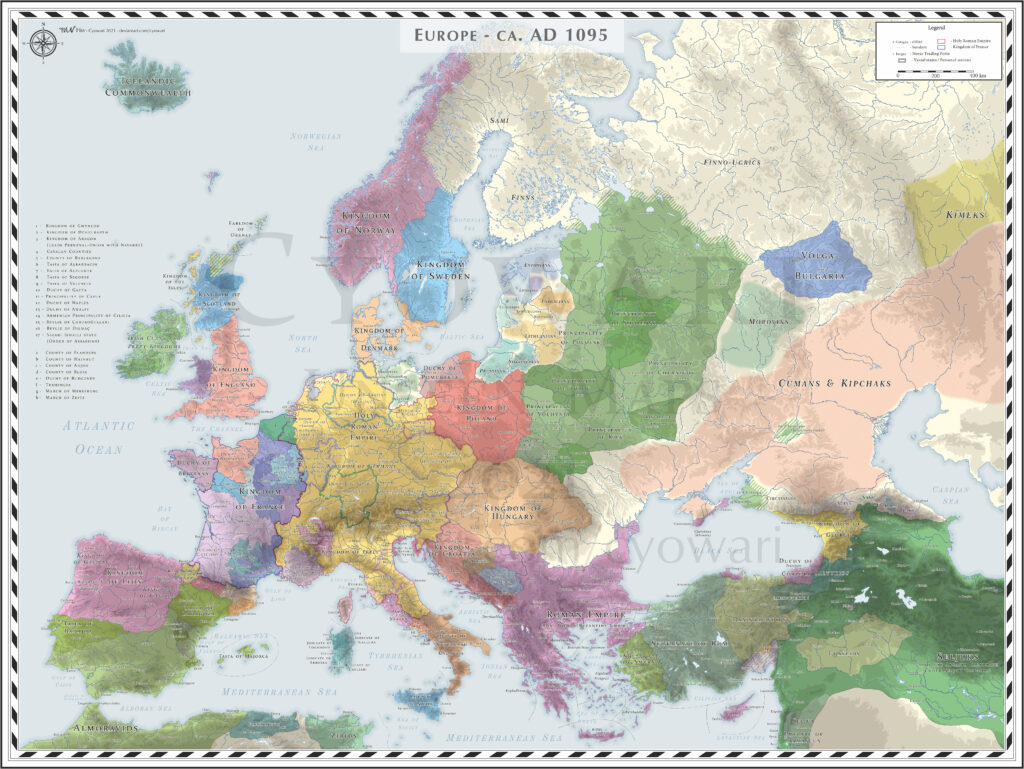
During the Council of Clermont in AD 1095, Pope Urban the Second proclaimed what became known as the First Crusade. But the great French nobles and their trained armies of knights were not the first to march toward Jerusalem. Instead, a number of unexpected bands of peasants, townsfolk, and petty nobles took the cross almost immediately, stirred to action by the fiery sermons of a charismatic preacher — Peter the Hermit. This mass movement, known as the People’s Crusade, was poorly armed and undisciplined. It pushed deep into Anatolia but ended in disaster at the Battle of Civetot, where it was destroyed by the forces of Sultan Kilij Arslan the First. The true strength of the Crusade, however, came later, with the arrival of Europe’s great lords and their professional armies of knights. This second wave, remembered as the Princes’ Crusade, was the real beginning of the First Crusade — a force of seasoned warriors, led by some of the most powerful noble houses of Christendom.
The combined strength of the armies of the Princes’ Crusade is estimated at around 40,000 men. Of these, roughly 4,500 were nobles and knights, the professional warrior elite of medieval Europe. Unlike the ragged masses of the People’s Crusade, the majority of this host consisted of trained soldiers, with only about one in five being non-combatants such as priests, servants, or camp followers. The army’s composition reflected the balance of medieval warfare. There were just under 5,000 cavalry, heavily armed knights and mounted retainers, supported by about 30,000 infantry — a mixture of spearmen, archers, and lightly armed foot soldiers. In broad terms, this meant a ratio of about one mounted warrior for every seven infantrymen at the outset of the expedition.
From the lands of Lorraine came Godfrey of Bouillon, Duke of Lower Lorraine, marching with his brothers Baldwin and Eustace of Boulogne. From southern Italy rode Bohemond of Taranto, the Norman prince of Apulia, accompanied by his ambitious nephew Tancred, whose name would echo throughout the Crusades. From the south of France came Raymond the Fourth, Count of Toulouse and Marquis of Provence, one of the wealthiest and most formidable lords of Christendom, driven by both piety and ambition. From the north came Robert Curthose, Duke of Normandy, eldest son of William the Conqueror, and Robert the Second, Count of Flanders, both bringing large contingents of seasoned knights and men-at-arms. And from the Rhineland, many German nobles and knights also took the cross, swelling the ranks of this vast host. Together, these princes and their followers formed what became known as the Princes’ Crusade — the true strength of the First Crusade. It was not a crusade of peasants, but of nobles and their armies: disciplined companies of knights and foot soldiers, bound together by faith, rivalry, and the promise of glory beneath the banner of the Cross.
Arrival at Constantinople and Relations with Byzantium
The four principal crusader armies departed Europe at the scheduled time in August 1096, each taking distinct routes toward Constantinople. Some traveled overland through Eastern Europe and the Balkans, while others crossed the Adriatic Sea. The armies assembled outside the ancient Roman walls of Constantinople between November 1096 and April 1097. Hugh of Vermandois arrived first, followed by Godfrey of Bouillon, Raymond of Toulouse, and Bohemond of Taranto.
The crusader armies arrived in Constantinople with limited supplies, expecting provisions and support from Emperor Alexios. However, Alexios was understandably cautious, given his prior experience with the unpredictable People’s Crusade and the presence of Bohemond, a longstanding Norman adversary who had previously invaded Byzantine territory alongside his father and may have even planned an attack on Constantinople while camped nearby. On this occasion, Alexios was better prepared to receive the crusaders, and as a result, there were fewer incidents of violence during their approach to the city.
The crusaders may have hoped that Emperor Alexios would take an active leadership role in their campaign, but he was primarily focused on transporting them into Asia Minor as efficiently as possible. In exchange for food and supplies, Alexios required the crusader leaders to swear an oath of fealty and to promise that any territory recovered from the Turks would be returned to the Byzantine Empire. Godfrey of Bouillon was the first to take this oath, and nearly all the other leaders followed suit, although tensions in Constantinople nearly erupted into open conflict between the citizens and the crusaders, who were eager to seize supplies. Raymond of Toulouse alone refused to swear the oath, pledging instead only that he would cause no harm to the empire. Before arranging the transport of the various armies across the Bosporus, Alexios also provided strategic guidance to the leaders on how to confront the Seljuk forces they would soon face.
The Opening Campaign in Asia Minor
In February 1097, the first contingent of the main crusading army took a significant step on their journey toward Jerusalem. Godfrey of Bouillon led his forces across the Bosporus Strait and established a camp on the northern shore of the Gulf of Nicomedia. The remaining Frankish contingents were scheduled to follow in the spring and early summer.
In practice, Godfrey of Bouillon encountered little or no resistance upon crossing into Asia Minor, and despite initially being isolated from the rest of the crusading forces, his army remained largely unharmed. This was a fortunate circumstance; under similar conditions, the earlier People’s Crusade had been almost completely destroyed. Had Kilij Arslan, the Seljuq sultan and the region’s principal Muslim ruler, chosen to attack the crusaders in smaller, isolated groups as they landed, the entire Crusader expedition might have collapsed.
Kilij Arslan, however, committed a serious strategic error. Having defeated the People’s Crusade with relative ease, he greatly underestimated the strength of this second wave of crusaders. Instead of confronting them directly, he first chose to resolve a relatively minor territorial dispute in the eastern part of his realm—a decision that would prove costly. In the meantime, Godfrey of Bouillon and the other Latin princes were able to consolidate their forces on the mainland of Asia Minor and focus their attention on Nicaea, the prized capital of Kilij Arslan’s sultanate.
The March to Nicaea
In early May 1097, approximately two-thirds of the crusading army set out for Nicaea. The forces under Godfrey of Bouillon, Robert of Flanders, Hugh of Vermandois, and the southern Italian Normans, then under the command of Tancred, first gathered at the town of Nicomedia. There they were joined by Peter the Hermit, the beleaguered leader of the People’s Crusade, who had been struggling to survive in the regions around Constantinople and Bithynia since October 1096. Peter likely welcomed the opportunity to approach Nicaea from the north, rather than retrace the disastrous route from Civetot—a path later taken by another group of crusaders, who were shocked to find “many severed heads and bones of the dead lying on the plains near the sea,” the grim remains of Peter’s earlier followers. From Nicomedia, the main army followed the ancient Roman road south over the mountains toward Nicaea. Although direct, the route was heavily overgrown, so a contingent of 3,000 men was sent ahead to clear the path using axes and swords, marking the route with crosses to establish a defined line of communication back to Constantinople. On 6 May, Godfrey and his companions reached Nicaea. Yet even at this late stage, the crusaders were still poorly prepared. The expedition remained a loosely organized conglomeration of Latin armies, with minimal coordination or overall structure.
Godfrey of Bouillon, Hugh of Vermandois, Tancred, and Robert of Flanders appear to have approached Nicaea without a coherent plan of action, and their arrival was poorly timed. Upon reaching the city on 6 May, their forces remained camped outside, isolated and inactive, for eight perilous days. It was not until 14 May, when Bohemond of Taranto arrived to resolve the initial logistical challenges of supplying the army, that the crusaders were able to commence the siege of Nicaea. Even then, they operated below full strength, and it would take another two weeks before the complete contingents of the First Crusade could be brought into action. This fragmented and piecemeal deployment was highly risky; only Kilij Arslan’s continued absence prevented the delay from escalating into a potential disaster. The crusaders’ lack of coordinated strategy and decisive leadership was, in part, a consequence of their complex relationship with the Byzantine Empire.
In besieging Nicaea, the crusaders were effectively carrying out Emperor Alexios’ objectives. They had arrived in Constantinople with vague plans to aid the eastern Churches and march on Jerusalem, perhaps expecting the emperor to lead them. Alexios, however, was primarily focused on recovering Nicaea, the Seljuq capital dangerously close to Constantinople, which had resisted all his previous attempts at capture. Viewing the crusaders as unpredictable and potentially dangerous, he avoided direct command, instead using them as a tool to take the city while he observed from a safe distance. This approach also allowed him to maintain a façade of neutrality, preserving the option of diplomacy with Kilij Arslan should the siege fail. Alexios established his camp at Pelekanum, west of Nicomedia, to oversee the operation.
Although Alexios did not personally participate in the siege, he had a strong interest in the crusaders’ success at Nicaea and sent military advisers to assist them. Manuel Boutoumites, one of his most experienced lieutenants, accompanied Godfrey and the first crusaders, initially entering the city to negotiate a surrender. When negotiations failed, he helped organize the Latin siege. A few weeks later, Taticius arrived with 2,000 Byzantine troops to command the campaign and later became Alexios’ chief representative among the crusaders. A member of the imperial household and an experienced soldier, Taticius—despite being a eunuch—was highly knowledgeable about Nicaea’s defenses, having led the last Byzantine assault on the city more than a decade earlier.
Alexios also ensured that the crusaders had reliable access to food and supplies. On his orders, poorer soldiers received money and provisions, while merchant ships from across the Mediterranean were brought to Civetot to establish markets offering corn, meat, wine, barley, and oil. Traffic along the road to Nicomedia was nearly constant, maintaining the flow of goods. The Byzantine’ careful logistical support meant that, despite the large size of the crusader army, reports of severe shortages or starvation were rare.
Even with Byzantine support, Nicaea’s defenses were formidable. The city lay in a fertile basin on the eastern shore of the large Askanian Lake, over forty kilometres long, and was protected on three sides by a five-kilometre-long wall, up to ten metres high, with more than a hundred towers and a double ditch. Capturing it was no easy task, but the crusaders had the advantage of superior numbers. When the siege began in mid-May, they could blockade only the northern and eastern gates, but by early June, with most of the crusading army assembled, it became possible to encircle the city completely.
The pope’s legate, Adhemar of Le Puy, held spiritual authority, but overall strategic command was contested by several powerful crusader princes. At Nicaea, this lack of clear leadership became apparent. Although Emperor Alexios was the nominal head of the campaign, he remained absent, and his lieutenant Taticius, though officially in command, never exercised complete control. The crusaders therefore developed a new organizational structure through trial and error. Within weeks, they established a council of princes, where senior leaders such as Raymond of Toulouse and Bohemond of Taranto met to make collective decisions. This system proved effective, with one of its first measures creating a common fund to collect and redistribute plunder.
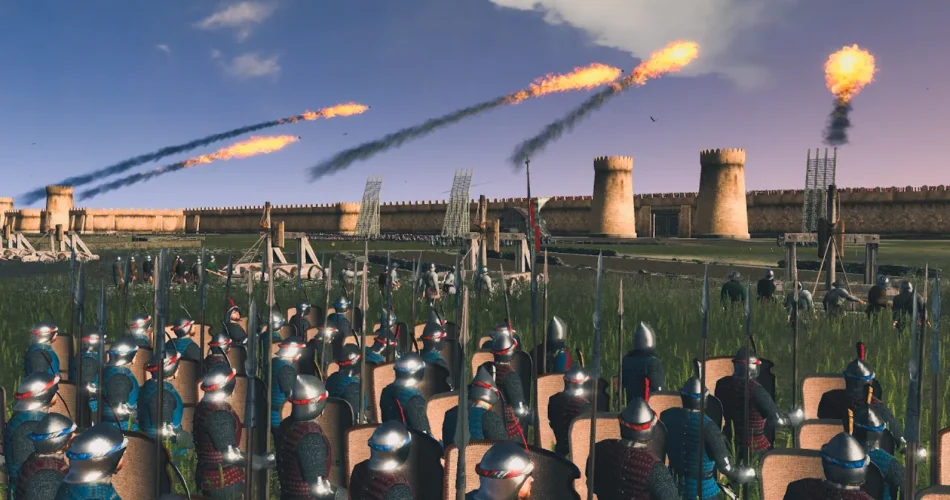
The council of princes decided on a combined siege strategy to overcome Nicaea’s defenses. The crusaders employed two approaches simultaneously: a blockade to isolate the city and force surrender, and an assault using siege engines such as catapults, battering rams, and protective screens to breach the walls directly. On 14 May 1097, Bohemond and the southern Italian Normans camped at the northern gate, while Godfrey of Bouillon and Robert of Flanders took position to the east, beginning construction of the siege engines.
The crusaders’ arrival struck fear into Nicaea’s Turkish garrison, likely numbering only a few thousand men, aware that the city offered rich rewards to the vastly larger Crusader army. As the sultan’s capital and treasury, Nicaea was of great strategic and political importance. Realizing the crusaders would commit all their resources to the siege, the garrison initially considered negotiating with Manuel Boutoumites, the emperor’s envoy. However, in the second week of May, they abruptly rejected the talks and expelled him from the city.
On 15 May, the Franks discovered the reason for the Turkish garrison’s sudden change of heart when two spies, disguised as Christians, were captured in their camp. One was killed, while the other, under threat of torture, quickly revealed that Kilij Arslan had returned from the east with a large army and was now camped in the steep hills south of Nicaea, planning a counterattack the following day. The spies had been sent to observe the crusader forces and deliver final instructions to the garrison. Kilij Arslan intended to attack from the southern hills at the third hour after dawn, enter the city through the unguarded south gate, regroup, and launch a coordinated counteroffensive.
The crusader princes reacted swiftly to this alarming intelligence. They knew that Raymond of Toulouse and the Provençal army were already marching toward Nicaea from the north, perhaps less than a day away. As dusk fell, messengers were sent to urge haste, and the Frankish forces kept vigilant watch through the night. At dawn on 16 May, Raymond’s troops arrived along the well-marked Roman road, their timely arrival proving crucial. His army was still setting up camp at the southern gate when, just as the captured spy had predicted, Kilij Arslan’s forces surged down from the hills.
Kilij Arslan’s Relief Attempt
Kilij Arslan had come prepared for a decisive victory, with ropes intended to bind captured crusaders, but even without the arrival of Raymond of Toulouse and the Provençal reinforcements, his forces would have faced serious difficulty against the vastly larger Latin army. With Nicaea’s southern gate effectively blocked, his troops were both outnumbered and isolated. The sultan commanded a typical Seljuq Turkish force: thousands of lightly mounted, fast-moving archers equipped with powerful bone-and-horn composite bows. The Turkish attack encountered stiff resistance from the Provençals, led by Raymond and Baldwin of Boulogne, and was further constrained by the natural barrier of the lake to the west. To the east, Godfrey of Bouillon and Bohemond of Taranto launched a fierce cavalry charge against the flank, compounding Kilij Arslan’s difficulties. Facing overwhelming opposition and recognizing the futility of continued engagement, the sultan ultimately fled south, abandoning the field. This would prove to be his only attempt to break the siege of Nicaea. The encounter marked the crusaders’ first battle against a Muslim force, and it ended in a resounding success. Even Anna Comnena, typically reserved in her praise of the Franks, described the engagement as “a glorious victory.” Although the crusaders’ defense had been well-coordinated, Kilij Arslan nevertheless escaped with most of his army intact. The greatest consequences were not material losses but the severe damage to his military prestige and the demoralization of Nicaea’s garrison, which would have profound implications for the remainder of the siege.
The Siege of Nicaea
With the immediate threat from Kilij Arslan repulsed, the crusaders sought to launch a direct assault on Nicaea’s defenses. Such attacks were both dangerous and exhausting for both attackers and defenders, and contemporary accounts note that “often, some of the Turks, often, some of the Franks, struck by arrows or by stones, died” in the course of the fighting. When initial attempts to scale the walls using ladders proved unsuccessful, the crusaders shifted their focus toward creating a physical breach in the city’s fortifications. Several methods could achieve this, the safest yet most technologically demanding being long-range bombardment. The Franks constructed stone-throwing engines, known as petraria or mangonella, which used torsion or counterweights to hurl missiles. While large, powerful machines could theoretically collapse walls, the crusaders at Nicaea lacked the craftsmen and expertise to build engines capable of seriously damaging the city’s stout defenses. Consequently, their bombardment primarily served to harass the Turkish garrison and provide covering fire for the deployment of a secondary assault technique.
When long-range bombardment proved insufficient, the only alternative for the crusaders was to approach the walls directly and attempt to undermine the city’s defenses by hand. This, however, was an extremely perilous undertaking. The Turkish garrison defended Nicaea with ballistae—large crossbow-like machines that hurled stones—and a large contingent of archers. Contemporary accounts describe the defenses as so effectively arranged that “no one could move near them without peril,” and any who advanced could easily be struck down from the towers above. Crusaders paid a heavy price: Baldwin of Calderun, after several “daring and rash” attempts, was killed when a hurled stone broke his neck, while Baldwin of Ganz fell to an arrow during a careless assault. Even those who survived to reach the base of the walls faced further danger, as defenders on the battlements dropped stones and a burning mixture of grease, oil, and pitch upon them.
The Franks experimented with a variety of devices to address the hazards of direct assault, with mixed results. Two notable leaders, Henry of Esch, from Godfrey’s contingent, and Count Hartmann of Dillingen, who had previously participated in the Jewish pogrom at Mainz, took a particularly active role in these efforts. Pooling their resources, they constructed a device referred to by contemporaries as a vulpus, or fox, designed as a type of bombardment screen. Made of oak beams, it was intended to allow infantry to approach the walls while being shielded from Turkish missiles. Henry and Hartmann prudently refrained from participating in the first test, witnessing with horror as twenty of their men were killed when “the beams, the uprights, and all the bindings came to pieces” and the vulpus collapsed at the foot of the walls.
The Provençals took a more professional and methodical approach to the siege. Raymond of Toulouse employed a master craftsman to design and construct a testudo, or tortoise, a sturdier, sloping-roofed bombardment screen. Under this protection, southern French crusaders were sent to undermine a tower on Nicaea’s southern walls. An eyewitness described how, upon reaching the fortification, “sappers dug down to the foundations of the wall and inserted beams and pieces of wood, to which they set fire.” If executed correctly, the technique of sapping—digging a tunnel beneath a wall, supporting it with wooden beams, then filling it with kindling and setting it alight—could bring down the structure above. Raymond’s sappers succeeded in collapsing a small section of one tower by nightfall around 1 June. However, the Turkish garrison worked through the night to repair the damage, so that by daybreak “there was no chance of defeating them at that point.”
Ultimately, the crusaders’ attempts to assault Nicaea were frustrated by the city’s formidable fortifications and the determined defense of its Turkish garrison. Even Raymond of Aguilers, chaplain to the Provençal army, acknowledged the defenders’ courage, noting, for instance, one soldier who continued fighting despite being struck by twenty arrows. By 3 June 1097, the Latin army had been reinforced by the arrival of northern French contingents under Stephen, Count of Blois, and Robert, Count of Flanders, yet the city remained unconquered.
By the second week of June, the crusaders recognized the need for a new strategy. While they had successfully encircled Nicaea’s three landward walls, the fourth side, facing the vast Askanian Lake to the west, remained open and undefended. The size of the lake made its shores difficult to patrol, allowing Turkish boats to supply the city with little risk. If this continued, the garrison might be able to hold out indefinitely. Around 10 June, the crusader princes convened to address the problem and quickly sent a bold proposal to Emperor Alexios. They decided that control of the Askanian Lake was essential, but since no navigable river provided access, the vessels would have to be transported overland. In practice, portaging large boats nearly thirty kilometres from Civetot to the lake was a formidable challenge. Alexios agreed to provide the ships, placing them under the command of Manuel Boutoumites and manned by Turcopoles, well-armed Byzantine mercenaries of mixed Greek and Turkish descent. Special oxen-drawn carts were constructed to carry the vessels through the hills of Bithynia.
Late on 17 June, the crusaders reached the Askanian Lake, but delayed their departure until dawn to coordinate a combined land- and water-based assault on Nicaea. The objective was to intimidate the Turkish garrison, emphasizing their isolation and the futility of continued resistance. To enhance this psychological effect, Alexios outfitted the small Greek flotilla with an unusually large number of standards to create the illusion of greater numbers, and provided trumpets and drums to produce an imposing noise.
The psychological impact of the combined land and lake assault broke the will of Nicaea’s Turkish garrison, and after five weeks of resistance, the city surrendered on 18 June. However, it was the emperor’s representatives, Manuel Boutoumites and Taticius, who formally received the capitulation and raised the Byzantine standard. The crusaders, despite their efforts, were left outside the walls, denied the opportunity for plunder. The situation was precarious for Alexios’ envoys: although they held nominal authority over the campaign, they were outnumbered both by the subdued Turkish garrison within the city and the acquisitive Frankish forces outside. Had either side chosen to revolt, the Greeks could have been overwhelmed.
Nonetheless, the crusader princes honored their oath and returned Nicaea to the emperor. The principal members of the Turkish garrison were transported in small, manageable groups to Constantinople. Some lower-ranking Latin soldiers expressed concern that the released Turks might be ransomed and return to fight again, but these complaints were soon quelled by the emperor’s generous distribution of wealth. According to one eyewitness, “because he kept all [the money from Nicaea], the emperor gave some of his own gold and silver and mantles to our nobles; he also distributed some of his copper coins, which they call tarantarons, to the foot soldiers.” Alexios’ largesse ensured the loyalty and satisfaction of the crusading army, maintaining control over this potentially unruly force.
Aftermath and Significance
The fall of Nicaea marked a decisive turning point in the First Crusade, a testament to the careful cooperation between the crusaders and Byzantium. Without the support, guidance, and resources provided by the Byzantine, the Crusaderss would likely have struggled to breach Kilij Arslan’s formidable capital. Yet the victory was not theirs alone: Alexios had relied upon the overwhelming force of the Latin army to wrest the city from the Seljuqs. In this tense alliance of convenience, two very different worlds—the disciplined, politically astute Byzantines and the fiercely determined, impulsive crusaders—had achieved what neither could have accomplished alone. But Nicaea was only the beginning. The road to Jerusalem stretched ahead, fraught with danger, uncertainty, and the promise of further battles. More blood would be spilled, more legends forged, yet that is a story for another day.
Bibliography
1) THE DEEDS OF THE FRANKS AND OTHER JERUSALEM-BOUND PILGRIMS : THE EARLIEST CHRONICLE OF THE FIRST CRUSADES | Nirmal Dass (trans.)
2) THE ALEXIAD | Anna Komnene / E.R.A. Sewter (trans.)
3) A HISTORY OF THE EXPEDITION TO JERUSALEM 1095-1127 | Fulcher of Chartres / Frances Rita Ryan (trans.)
4) A HISTORY OF THE CRUSADES VOLUME I: THE FIRST CRUSADE AND THE FOUNDATION OF THE KINGDOM OF JERUSALEM | Steven Runciman
5) VICTORY IN THE EAST: A MILITARY HISTORY OF THE FIRST CRUSADE | John France
6) THE CRUSADES AND THE EXPANSION OF CATHOLIC CHRISTENDOM, 1000-1714 | John France
7) THE FIRST CRUSADE: A NEW HISTORY | Thomas Asbridge
8) GOD’S WAR: A NEW HISTORY OF THE CRUSADES | Christopher Tyerman
9) ARMIES OF HEAVEN: THE FIRST CRUSADE AND THE QUEST FOR APOCALYPSE | Jay Rubenstein
10) THE FIRST CRUSADE 1096–99: CONQUEST OF THE HOLY LAND | David Nicolle
11) WESTERN WARFARE IN THE AGE OF THE CRUSADES, 1000–1300 | John France
© 2026 History and War
Author: Jishu Roy
Unauthorized reproduction of this content is prohibited.