Prelude to the Campaign
While Caesar was occupied in the south against Vercingetorix, events in northern Gaul threatened to spiral out of Roman control. Earlier in the campaign, Caesar had dispatched his most trusted lieutenant, Titus Labienus, toward the lands of the Parisii to suppress the growing revolt along the River Sequana.
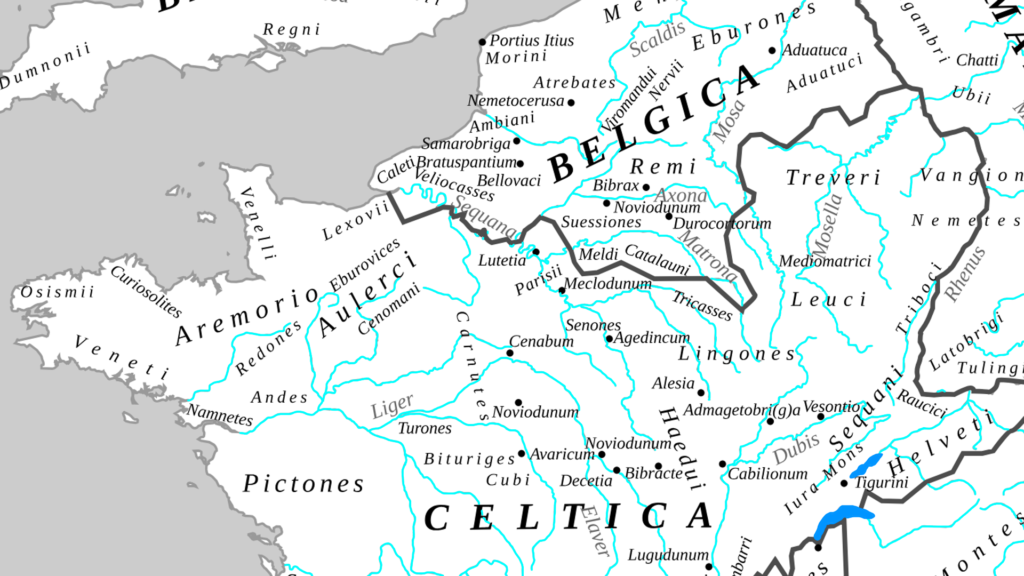
Labienus advanced northward toward the stronghold of the Parisii at Lutetia with four legions. At Agendicum, he left behind the baggage train, supplies, and a defensive force composed mainly of newly arrived recruits from Italy. From there, his army proceeded along the left bank of the Icauna and then toward the Sequana. News of his movement quickly spread across the region, prompting many neighboring Gallic tribes to unite and gather a considerable force to resist his advance.
Lutetia was situated on an island in the River Sequana, the same location where the cathedral of Notre-Dame de Paris stands today. Command of the Gallic forces had been entrusted to an elderly yet highly experienced commander named Camulogenus. Realizing that Labienus was advancing along the left bank of the river, Camulogenus positioned his army near a nearby marshland, preparing to block the Roman advance.
Camulogenus’ position effectively blocked the Roman advance and made a direct assault extremely difficult. At first, Labienus attempted to overcome the obstacle by constructing vineae, filling sections of the marsh with hurdles and clay, and creating a passable route for his troops. However, once he realized that the task would require too much time and effort, he abandoned the attempt. During the third watch of the night, he quietly withdrew from his camp and marched back along the same route by which he had advanced, eventually reaching Melodunum, a town of the Senones located on an island in the Sequana, much like Lutetia itself.
At Melodunum, Labienus seized a number of boats and used them to cross the left branch of the river onto the island. After capturing the town, he repaired the bridge leading to the right bank and then advanced downstream toward Lutetia from the opposite side of the Sequana. Labienus reached the oppidum before Camulogenus fully understood the Roman maneuver, although the Gallic commander soon recognized the situation and moved quickly in pursuit. Upon arriving, Camulogenus ordered Lutetia to be burned and its bridges destroyed in order to hinder the Roman advance. The opposing armies then established their camps on opposite banks of the Sequana, facing one another across the area surrounding the city.
At this point, Labienus received news of Caesar’s setback at Gergovia, while rumors spread among the Gauls that Caesar had been driven back toward the Roman Province by shortages of food. Encouraged by the revolt of the Aedui, the nearby Bellovaci also began gathering forces for war. As a result, Labienus found himself in an increasingly dangerous position. The hostile Bellovaci threatened him from one direction beyond the Isara, while the Parisii blocked him from the other. He was also separated from his supply depots at Agendicum, which lay across the farther bank of the Sequana, along with the route by which he had originally advanced.
Recognizing the unfavorable circumstances, Labienus concluded that continuing operations against the Parisii would serve little purpose. Instead, he decided that the wiser course was to withdraw toward his base and preserve his army for Caesar’s wider campaign. Acting alone, he understood that he lacked the strength necessary to suppress the growing Gallic uprising.
To escape his increasingly precarious position, Labienus needed to recross to the left bank of the Sequana. Accomplishing such a movement while the Gallic army remained nearby and ready to oppose any crossing required careful deception rather than a straightforward retreat. Simply retracing his earlier route would likely allow Camulogenus to block the crossing at Melodunum, while transporting the boats back upriver would be both difficult and time-consuming. A slow withdrawal would only expose Roman weakness and encourage the enemy to press harder against him.
Labienus’ Deception Plan
Labienus, however, was an experienced and aggressive commander who believed that bold action offered greater security than hesitation. After gathering his lieutenants, he carefully explained the plan. He entrusted the boats captured at Melodunum to reliable Roman cavalry officers and ordered them to move quietly downstream during the early hours of the night, covering a distance of roughly four miles. Meanwhile, he left five dependable cohorts behind in camp, while another five cohorts from the same legion were sent upriver with several boats and instructed to create as much noise and activity as possible. This diversion was intended to convince the Gauls that the Romans were attempting a crossing farther upstream.
While the enemy’s attention was fixed on the deception, Labienus personally led his remaining three legions downstream to the hidden boats and crossed the river unnoticed under the cover of a violent storm, likely near the area of modern Point du Jour. The Gallic outposts, seeking shelter from the bad weather, were caught unprepared and were quickly overwhelmed by the Roman troops.
Unable to determine Labienus’ true intentions, the Gauls interpreted the movements of the three separate Roman detachments as an attempt to escape in small groups, with some units sacrificing themselves so that others might survive. Believing they had an opportunity to destroy the Romans completely, they divided their own forces into three groups: one marched upstream, another moved downstream, while a third remained near the camp. Camulogenus personally led the force advancing downstream in pursuit of Labienus.
The Battle
By dawn, however, the Roman army had already completed its crossing. Labienus quickly formed his legions into battle line and launched an immediate attack against the approaching Gauls. The Gallic warriors met the assault with equal determination, and the engagement soon developed into a fierce and hard-fought battle.
At the beginning of the battle, the Roman right wing, held by the Seventh Legion, successfully broke the enemy line and drove the Gauls into retreat. On the left wing, however, where the Twelfth Legion was positioned, the fighting proved far more difficult. Although many of the front ranks were struck down by Roman javelins, the remaining Gallic warriors continued to resist with remarkable determination, and none showed any sign of retreating. Camulogenus personally remained among his men, encouraging them as the struggle intensified.
For a time, the outcome of the battle remained uncertain. When the tribunes of the Seventh Legion learned of the fierce resistance facing the Roman left, they quickly wheeled their troops around and attacked the Gauls from the rear. Even when surrounded on all sides, the Gallic warriors refused to flee and fought until they were cut down where they stood. Camulogenus himself died alongside his men.
Meanwhile, the Gallic force left behind opposite Labienus’ camp advanced toward the battlefield after hearing the sounds of combat. Attempting to support their allies, they moved to seize a nearby hill, but they too were unable to withstand the assault of the victorious Roman soldiers. As the battle turned into a rout, many fleeing Gauls were overtaken and slaughtered by Roman cavalry, especially those unable to escape into the protection of the forests and hills.
After securing victory, Labienus marched back to Agendicum, where the baggage and supplies of the army had been stored. From there, he rejoined Caesar with all of his remaining forces.
© 2026 History and War
Author: Jishu Roy
Unauthorized reproduction of this content is prohibited.