Copyright © Cyowari
The Road to The Saw
Following the failed rebel siege of Carthage, the Mercenary War entered a critical phase. With the rebel army weakened by Hamilcar Barca’s blockade and deprived of effective means of securing a favourable settlement, Spendius and his fellow commanders were compelled to take the initiative against the Carthaginian field forces. The resulting campaign was characterized by prolonged manoeuvre, efforts to disrupt supply routes, and repeated attempts by both sides to gain a positional advantage across the countryside surrounding Carthage.
This section examines the campaign conducted by Spendius, Autaritus, and Zarzas, focusing on their attempts to counter Hamilcar’s increasingly effective operations. Particular attention is given to the strategies employed by both sides, the geographical and logistical conditions that influenced their movements, and the contrasting military capabilities of the opposing forces. The analysis also considers the difficulties involved in reconstructing the campaign from Polybius’ relatively concise account, particularly where his narrative provides limited chronological and geographical information.
The campaign eventually brought the rebel army into a progressively more vulnerable position, culminating in its entrapment at the location known as The Saw. The section examines how Hamilcar exploited the rebels’ isolation and deteriorating supplies before neutralizing their senior commanders through a carefully calculated parlay. It then considers the subsequent destruction of the trapped army, an engagement that dealt a devastating blow to the rebellion and marked a major turning point in the later stages of the Mercenary War, although resistance against Carthage would continue.
After the Siege of Carthage
The unsuccessful siege of Carthage in 238 BC dealt a significant blow to morale, both within the mercenary rebel army and across Libya. Compounding their difficulties, Hamilcar’s relentless blockade continued to deprive them of food and essential supplies. Mathos and Spendius faced two remaining options: either they had to defeat the Carthaginian field forces to have any hope of victory, or they would be forced to seek peace. However, surrender was not a viable choice for the rebel leadership. At best, they could expect a swift execution, but it was far more likely that Hamilcar intended a far grimmer fate—either the elephants or crucifixion. These same fears undoubtedly weighed on their officers and soldiers, all of whom recalled the atrocities committed outside Hippo Diarrhytus, as well as their own mistreatment of prisoners. Ironically, Hamilcar’s policy of executing captured rebels only served to strengthen their resolve, sustaining the movement even in its most desperate hour.
Polybius writes that “after some time, they assembled the best of the mercenaries and the Libyans” and advanced against the Carthaginian field forces. He uses the plural “they” immediately after mentioning Mathos and Spendius. However, as the campaign reaches its climax, Mathos is notably absent, and later, he is explicitly placed at Tunis. Given that the campaign lasted for a considerable period, it is possible that he initially joined the other generals before returning to headquarters. However, this would have left Tunis without a senior commander for weeks or even months, which seems unlikely, especially considering that field operations were not Mathos’ strength. A more plausible interpretation is that he remained in command at Tunis throughout the campaign, while Autaritus, Spendius, and the newly prominent Zarzas led the expeditionary force.
Polybius estimates the rebel forces at 50,000 strong, noting that “with them, too, was Zarzas the Libyan, leading those under his command.” This marks Zarzas’ first appearance in the narrative, and it is clear that he commanded his own division. Polybius’ wording is particularly significant. His phrasing suggests that Zarzas’ forces were in addition to the 50,000 troops and that he distinguished them in a similar manner to how he had previously described Autaritus’ Gauls during the first inland expedition. Zarzas must have possessed considerable military experience to not only command a division but also serve as one of the expeditionary leaders. It is possible that he had served in the Sicilian campaigns but had not been a prominent figure when the mercenary revolt began, instead rising through the ranks over time. However, the way Polybius describes his division suggests a degree of autonomy from the rest of the expeditionary force. An alternative possibility is that Zarzas was a Libyan noble with prior military experience who had recently raised a force independently and brought it to Tunis. The defections of Hippo Diarrhytus and Utica, along with Carthage’s ongoing military failures, would have encouraged such a move. Yet, if he were a Libyan noble, why did he take so long to join the rebellion? One potential factor was the brutal tactics employed by Hamilcar, including mass executions, devastation of the countryside, and the sacking of settlements—measures intended to intimidate the Libyan population. These atrocities may have ultimately driven Zarzas to align with the rebels.
Hamilcar and the War of Manoeuvre
The rebels’ first critical objective was to force Hamilcar to withdraw. Securing the roads from the interior was essential to allow relief supplies to reach both the forces remaining in Tunis and the expeditionary army. Given Hamilcar’s strategic acumen, it is unlikely that he would have allowed himself to be easily dislodged. For the starving troops under Spendius and his fellow commanders, the effort required was undoubtedly immense. Nevertheless, they succeeded, though Polybius provides little detail on how this was achieved. Instead, he describes the subsequent phase of the campaign as an extensive maneuvering contest across hills and valleys, with both sides striving to outflank one another. A plausible reconstruction of events can be proposed. At the beginning of the campaign, the Carthaginian forces were likely positioned to monitor the main routes leading to Tunis. Hamilcar may have controlled the Bagradas Valley from a location such as Thuburbo Minus, while Hannibal held the territory to the southeast, possibly at Inuca or Uthina. Meanwhile, Naravas, regardless of his exact base, was likely patrolling the area between them. These positions would have made it difficult for the rebels to break out. However, a swift and well-executed sortie from Tunis—possibly led by veteran troops and launched at night, similar to Hamilcar’s earlier rapid advance from Carthage to the Bagradas—could have created enough disruption to prevent the Carthaginian commanders from coordinating an immediate response. Faced with this sudden assault, Hamilcar and Hannibal may have been forced to retreat inland to consolidate their forces, as neither could afford to hold his position without the support of the other. Consequently, Naravas would also have had to withdraw with them. In this way, the rebels managed to drive the Carthaginian field forces back into the countryside, after which they focused on wearing them down through continued maneuver warfare.
Polybius outlines the tactical approach employed by the rebels, stating that “they proceeded again to march parallel to the Punic forces on the open ground and shadow Hamilcar. Thus, they avoided level terrain, terrified as they were of his elephants and Naravas’ cavalry, and strove to be the first to occupy the hills and passes.” In essence, they adopted a strategy similar to that of their earlier expedition. Engaging Hamilcar in a single, slow-moving mass would have been futile; he could have easily outmaneuvered, outflanked, and harassed such a force before ultimately trapping it. Instead, the rebels needed to reverse these tactics and impose the same difficulties on him. This was not an unrealistic objective. Previously, Spendius and Autaritus had employed similar methods, successfully cornering Hamilcar. It was only the timely arrival of Numidian cavalry that had saved him on that occasion. At that time, he had been shadowed, harassed, and ultimately encircled by three coordinated enemy forces. Evidently, the rebel commanders sought to replicate this approach once again.
Now, however, the rebels had only their own forces from Tunis at their disposal, whereas Hamilcar commanded a larger army. This suggests that they deployed the majority of their troops in order to maintain a numerical advantage. If they could isolate one division of the Punic forces from the rest, they could concentrate a strong contingent against it while simultaneously positioning enough troops to delay or at least harass the reinforcements attempting to provide support. The isolated division would then face a critical decision: whether to stand and fight or to retreat. If it chose to withdraw, Spendius’ logical response would be to attempt to cut it off from reuniting with the main force. Even if this effort failed, he could still hope to inflict significant losses during the retreat. Conversely, if the Carthaginian army remained united, the rebels would likely attempt to launch attacks from multiple directions to force a fragmentation of its ranks. Whatever cavalry the rebels had at their disposal would need to be deployed against Naravas’ squadrons. However, it is evident that their cavalry was of inferior quality and, almost certainly, was also outnumbered.
The rebels’ tactics were extraordinarily risky, as they had to contend with all three branches of Hamilcar’s forces—infantry, cavalry, and elephants. Naravas and the elephants, in particular, inspired great fear among them. It appears they had no elephants of their own, putting them at a further disadvantage. Moreover, Hamilcar was capable of employing the same strategies and tactics against them, and Polybius confirms that he did so. Yet, in their desperate circumstances, the rebels had little choice but to take these risks. Frustratingly, Polybius’ account once again omits place names, provides no clear indication of the campaign’s duration, and remains largely general in detail. However, he does acknowledge the rebels’ aggressiveness and daring, an unusual compliment that he immediately tempers with criticism. He argues that they lacked “the experience and vigour of generalship,” being constrained by “military unskillfulness and mindless routine.” This assessment is clearly directed at Spendius, Autaritus, and Zarzas in contrast to Hamilcar. As a result, Polybius states, Hamilcar was able to conduct his campaign “like a good draughts-player,” alternately cutting off enemy units, luring them into ambushes, or striking unexpectedly—by day or night—to throw them into panic. His narrative conveys a vivid sense of relentless marches and counter-marches, sudden reversals, and diverse forms of combat, all culminating in Hamilcar’s gradual ascendance. At this stage, Polybius shows little interest in precise geographical or chronological details, instead focusing on the moral and psychological dimensions of the conflict.
Spendius and his fellow commanders maintained the cohesion of their forces, continued to engage in combat, and at times even gained the upper hand in the deadly contest unfolding across Libya’s uplands. Polybius’ acknowledgment of their aggressiveness and daring suggests that their morale remained high—a stark contrast to their first expedition a year and a half earlier, which had completely lost its will to resist following Hamilcar’s and Naravas’ decisive victory. This renewed resilience would have been deeply frustrating for Hamilcar. His own forces suffered losses and, at times, must have faced shortages of supplies, which had to be sourced either from territories still loyal to Carthage—wherever they were located—or from communities compelled by force. In fact, much of the maneuvering on both sides likely centered on securing provisions while denying them to the enemy. However, the strategic objectives of the rebels and those of Hamilcar were not necessarily aligned. The rebels did not need to win a decisive battle; their primary aim was to harass and exhaust the Carthaginian forces, drive them away from the coast, and cut off their supply lines. If they could achieve this, Hamilcar’s army would gradually weaken, desertions would increase, and he would find himself isolated from Carthage. A pitched battle was precisely what the rebels sought to avoid, as Spendius and his fellow generals understood that they would almost certainly lose. Hamilcar, on the other hand, needed to force them into open battle, as a war of attrition favored the rebels, who could afford greater losses. Confident in his ability to win a decisive engagement, Hamilcar sought to bring them to bay. At the same time, he could not afford to stray too far from Carthage—certainly not as far as Theveste or even Sicca. Such a move had been viable earlier when he had near-total freedom of movement, but with the rebels persistently shadowing his forces, an extended absence from Carthage could prove disastrous for morale at home. Worse still, if Spendius gained enough confidence, he might even detach some of his forces to renew the assault on the city itself.
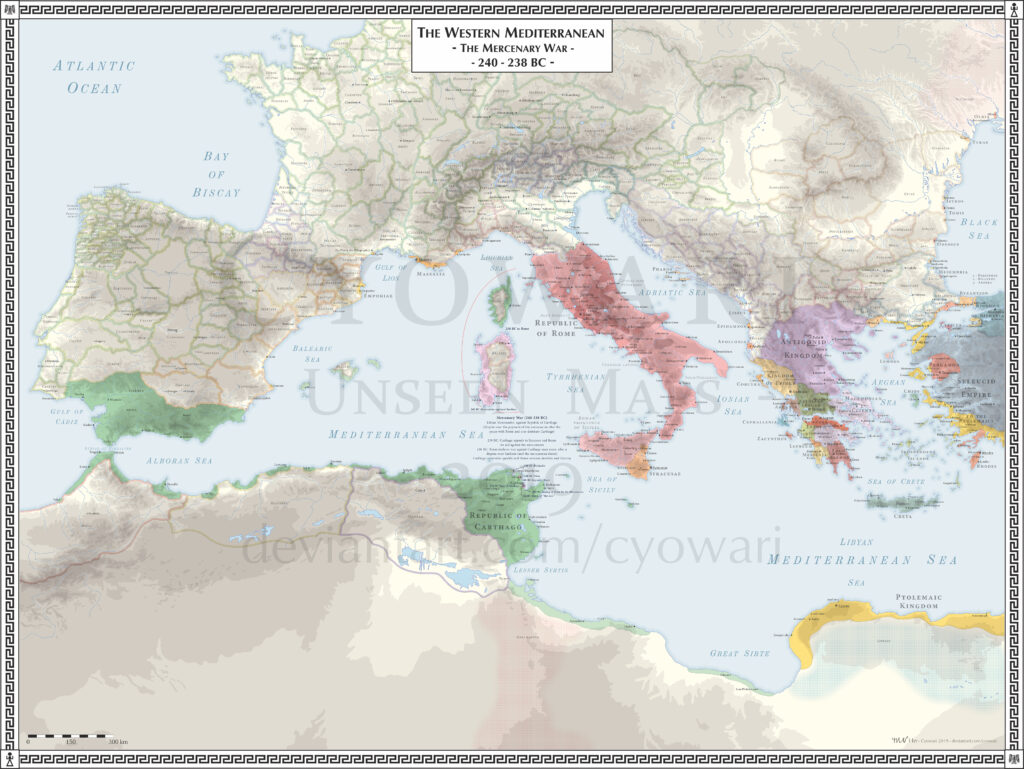
As both sides depended on supplies from the countryside, the conflict likely unfolded across the valleys and uplands between the Bagradas, Siliana, and Mellane rivers. Byzacium is another possible theater of operations, though it seems less likely due to its greater distance from the rebel strongholds. The north coast, with its sparse settlements between the vicinity of Hippo Diarrhytus and Hippo Regius, offered little strategic appeal. Likewise, prolonged campaigning in desert or semi-desert regions would have been unsustainable, though the armies may have traversed such terrain at times. Given these geographical and logistical constraints, the most probable outcome was a series of maneuver-based engagements—characterized by zigzag movements, feints, counterfeints, skirmishes, and clashes—unfolding over a period of two months or more. However, no large-scale battles took place. Polybius describes “full combats,” but these primarily took the form of “unexpected ambushes” or panicked retreats triggered by Hamilcar’s sudden appearances. If significant pitched battles had occurred, they would likely have received more detailed treatment in his account and, more importantly, would have yielded more decisive outcomes. Despite the narrative’s generally favorable stance toward Hamilcar, it primarily recounts intermittent skirmishes, ambushes, and strategic maneuvers—many of which did not escalate into full-scale combat. Moreover, as previously noted, not all of these actions were initiated by Hamilcar, nor did all of them work to his advantage.
After each successful engagement, Hamilcar, as ruthless as ever, executed all prisoners. Spendius and the rebels, however, took a different approach. One possible reason for this leniency was to instill hope among Hamilcar’s troops that, if captured, they might be spared, thereby discouraging them from fighting to the death when faced with inevitable defeat. Additionally, it is possible that the rebel army, having brought only a limited number of slaves from Tunis during its breakout, found captured prisoners useful as additional laborers. In stark contrast, Hamilcar’s brutality likely had the opposite effect, reinforcing the rebels’ determination to resist until the very end of the campaign. His relentless execution of prisoners gave them little incentive to surrender, ensuring that the conflict remained fierce and protracted.
The Rebel Army Encircled
Polybius concludes the campaign by describing how Spendius and his forces found themselves trapped at a location known as The Saw, completely surrounded and unable to advance or retreat. Hamilcar had successfully corralled them, leaving them at his mercy. Frustratingly, Polybius provides no details on how this strategic maneuver was executed. Furthermore, his description of the terrain is notably vague.
A plausible scenario can be reconstructed. After months of marching, countermarching, and intermittent skirmishes, Spendius and his forces arrived in the region of The Saw. It is evident that they had lost contact with Hamilcar, who may have deliberately misled them into believing he had withdrawn to forage elsewhere. With no immediate threat in sight, the rebels established their camp. The location must have seemed strategically advantageous. Whatever natural feature The Saw referred to, it likely provided a sense of security, perhaps preventing an approach from one direction. Additionally, the area had access to water, as Hamilcar relied on starvation rather than dehydration to weaken his opponents—had thirst been a factor, the siege would have ended much more swiftly. This suggests that the surrounding region contained some degree of cultivation, allowing the army to replenish supplies upon setting up camp. It is possible that the rebels remained there for several days, gathering resources while Spendius and his fellow commanders deliberated on their next move in the ongoing struggle against Hamilcar.
Instead, Hamilcar located them. It is likely that he had been tracking the rebel army from a distance, relying on Numidian scouts, who would have been difficult to detect if they wished to remain unseen. Almost certainly, the rebels had grown complacent, neglecting proper vigilance—perhaps even failing to station lookouts on the crest of The Saw. A night march, we may reasonably infer, brought Hamilcar’s forces into position. As dawn broke, the rebels were confronted with an alarming sight: the Carthaginian army had established a camp of its own, directly opposite them.
The logical response for the rebels would have been to march out and attack before the Carthaginians could fully establish their position. But Polybius’ account does not explicitly indicate a direct engagement. Instead, he emphasizes that the terrain was unfavorable for the rebels while advantageous for Hamilcar’s forces. Moreover, he states twice that, throughout the ordeal, the rebels avoided battle entirely. Hamilcar reduced them to such dire conditions that they neither dared to fight nor had any means of escape. Polybius describes their desperation, noting that they were driven to cannibalism, yet still refrained from marching out to engage in combat. He attributes this hesitation to their fear of certain defeat and the brutal consequences of capture—likely heightened by their terror of Hamilcar’s elephants. Thus, Spendius, Autaritus, and Zarzas kept their men confined within the camp, watching helplessly as the Carthaginians methodically enclosed them. Hamilcar’s forces dug a ditch and constructed a palisade around the rebels, effectively sealing them in.
At The Saw, the rebels had access to water but limited food supplies. The fluid nature of the campaign would have made it difficult for either army to maintain a steady supply of provisions or transport large stockpiles. Even if the rebels had managed to secure some fresh supplies before their entrapment, the ensuing stalemate meant that, as these dwindled, they could not be replenished. The season was likely early to mid-summer, meaning increasingly hot days and stifling nights. Spendius’ forces found themselves in a predicament similar to that of the entire rebel army during its earlier siege of Carthage. They exhausted their remaining provisions and soon faced starvation. Driven by desperation and fear of their enemies, they resorted to cannibalism—first consuming their prisoners, then turning on their own slaves. Several messengers were dispatched to Tunis, but it remains unknown whether any reached their destination. The rebels endured, hoping that Mathos would lead a relief force from Tunis to save them. Whether Mathos was ever informed of their plight is uncertain. He may not have received the messages, or he may have felt unable to act, constrained by the presence of the 10,000 defenders of Carthage under Hanno.
The Parley with Hamilcar
The dire situation in the rebel camp led to growing unrest. Spendius, Autaritus, Zarzas, and their lieutenants had managed to maintain control over their men primarily by promising that relief would soon arrive. However, as hope for this dwindled and the food supply continued to deplete, morale faltered. Unsurprisingly, the men began to direct their frustration toward their commanders. Spendius and his colleagues now faced physical threats from their own soldiers, and, like Hamilcar, both the generals and the rank-and-file were all too aware of the fate of Gisco and his fellow commanders. At this point, events unfolded rapidly.
A herald was selected and sent to Hamilcar, an action steeped in irony. These were the same rebels who had once vowed a gruesome death to any herald dispatched to them, yet now they were the ones seeking an audience. Naturally, Hamilcar listened to their message. The rebel generals and their immediate subordinates were requesting permission to approach him for negotiations—an implicit acknowledgment of their defeat. Polybius states that the rebel leaders had “decided to hand themselves over to the enemy and discuss a settlement with Hamilcar.” In essence, they offered to enter his camp in person, placing themselves entirely at his mercy. Not only did Spendius, Autaritus, and Zarzas agree to go, but also their seven chief lieutenants—the entire high command of the army. They appear to have gone unarmed, as Polybius makes no mention of weapons or attendants. The decision for the leadership of the trapped army to place themselves directly in Hamilcar’s hands suggests either an extraordinary naivety, which seems unlikely for seasoned commanders like Spendius and the battle-hardened Autaritus, or an acceptance of their fate as sacrificial victims, willing to sacrifice themselves for the army’s survival.
Hamilcar once again demonstrated his skill as a shrewd political strategist. The terms he offered appeared remarkably lenient: he demanded only the right to select ten men from among the rebels to detain, while the rest would be permitted to depart freely, each with a single tunic. The rebel leaders readily agreed to these conditions, believing them to be fair. However, Hamilcar then exercised his right to choose the hostages—and selected the rebel high command, including Spendius, Autaritus, and Zarzas. In doing so, he effectively neutralized the leadership of the rebel army without violating the sacred rules of parley, which forbade the seizure of enemy envoys.
The Destruction of the Rebel Army
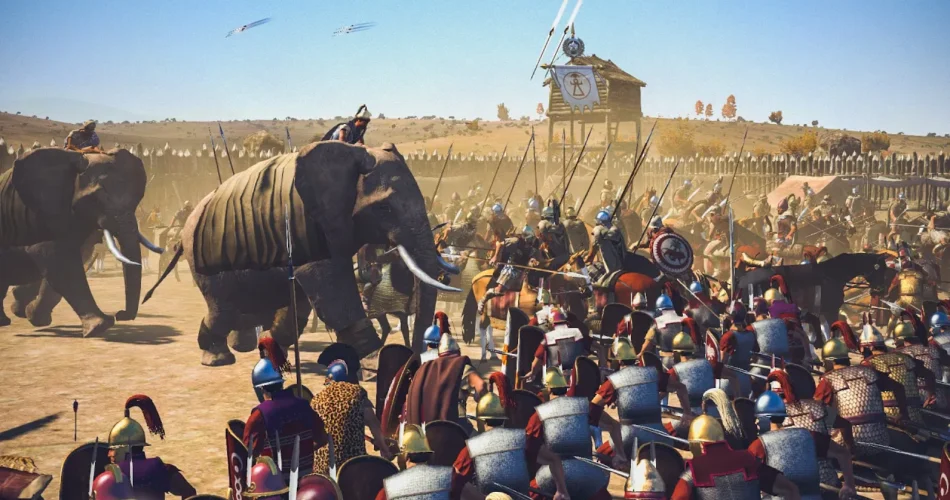
What followed was dramatic, though, once again, Polybius condenses his account. The rebel troops soon learned that their commanders had been arrested, but they were unaware that an agreement had been reached. Suspecting treachery, they armed themselves in preparation for battle. However, they were already too late—the initiative had passed to Hamilcar. Before the now-leaderless rebels could attempt to break out of their encirclement, they found themselves confronted by enemy troops and elephants, ready to strike. It is unlikely that the entire Punic army—especially its elephants and cavalry—had been continuously positioned along the full extent of the ditch and palisade since the beginning of the blockade. Such a deployment would have dangerously dispersed Hamilcar’s forces and does not align with Polybius’ statement that the Carthaginian general now surrounded the rebels “with his elephants and the rest of his army.” More plausibly, a portion of Hamilcar’s troops had been patrolling the perimeter while the majority remained in reserve within the camp, prepared for a decisive engagement. Now, with the moment at hand, Hamilcar deployed his entire force for the final assault. It is also possible that Hamilcar had already positioned his forces in anticipation of this moment. If he had kept Spendius and the other rebel leaders in his camp overnight before presenting them with his terms, he may have used the cover of darkness to move his troops into position, ensuring that when the rebels realized what had happened, they would find themselves entirely at his mercy.
The final outcome becomes more logical if we consider that Hamilcar himself may have ensured that the news of Spendius and the other leaders’ arrest reached the rebel troops. A deserter feigning defection, a slave promised freedom in exchange for delivering the message, or even a shouted declaration from the Punic camp would have sufficed. Polybius describes the rebels as “believing that they had been betrayed,” and it is important to note that their suspicions need not have been solely directed at Hamilcar. The perception of betrayal could have extended to their own commanders, creating further confusion and panic among the rebels.
Even without suspicions of betrayal, the rebel chain of command was shattered, and Hamilcar gave them no time to recover. As dawn broke, his forces surged forward, crossing the barricades and hemming the rebels into an ever-tightening noose. With their commanders absent and fear gripping the ranks, the rebels were slow to react. By the time they realized what was happening, the Carthaginians had already gained the initiative. The encampment, which had once seemed like a refuge, became a death trap. With the Punic forces pressing in from all sides, the rebels had nowhere to run. Desperate men attempted to claw their way out, but they were cut down at the barricades or driven back into the chaos behind them. The confined space turned the battle into a brutal, frenzied melee. Without direction or discipline, the rebels fought like cornered animals, wielding swords, spears, and whatever weapons they could find in a desperate bid to stay alive. Some tried to form defensive lines, but panic spread like wildfire as Carthaginian infantry hacked their way through. Mercy was a luxury neither offered nor requested. The Carthaginians, still seething over the gruesome execution of their beloved commander Gisco and his men, showed no mercy. Their ranks fought with grim determination, eager to exact vengeance. Naravas and his Numidian cavalry patrolled the perimeter, ensuring no one could escape. Any rebels who managed to break through the initial lines were swiftly hunted down and slaughtered. As the rebels faltered, Hamilcar unleashed his war elephants. The massive beasts crashed through the camp, their drivers directing them to trample anything in their path. The rebels who had managed to hold their ground now faced an unstoppable force. Those too weak to fight, wounded or exhausted from starvation, were crushed beneath the elephants’ feet. Others, seeing no way out, threw down their weapons and attempted to surrender, but there was no clemency to be found. The slaughter lasted for hours. Blood ran in rivulets through the camp as the once-defiant rebel army was systematically annihilated. The air was thick with the stench of death, the cries of the wounded drowned out by the relentless advance of the Carthaginian forces. By the end, the battlefield was silent. According to Polybius, the rebel army had still numbered around 40,000 before this final engagement. Now, they were no more. Those who had not been cut down in battle were rounded up and subjected to the same fate as earlier prisoners—trampled beneath the elephants in a grim spectacle of Carthaginian retribution. With the rebel army annihilated and its leaders either captured or slain, the war was now nearing its end. Hamilcar had achieved one of the most decisive victories of his career, proving his tactical brilliance once more. But the rebels were not entirely finished, and though their numbers had been devastated, resistance would continue in isolated pockets. The final reckoning was still to come.
© 2026 History and War
Author: Jishu Roy
Unauthorized reproduction of this content is prohibited.