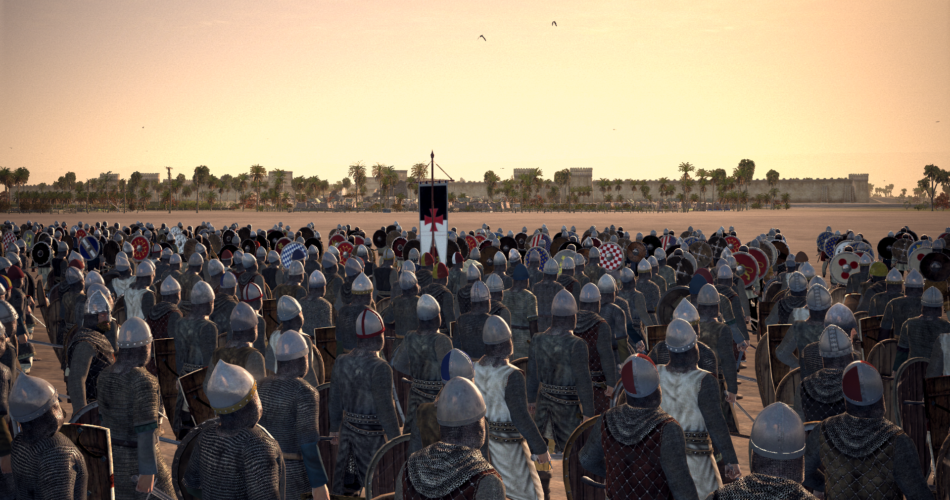
Anatomy of a Campaign: Logistics, Rivalries, and Faith at Antioch
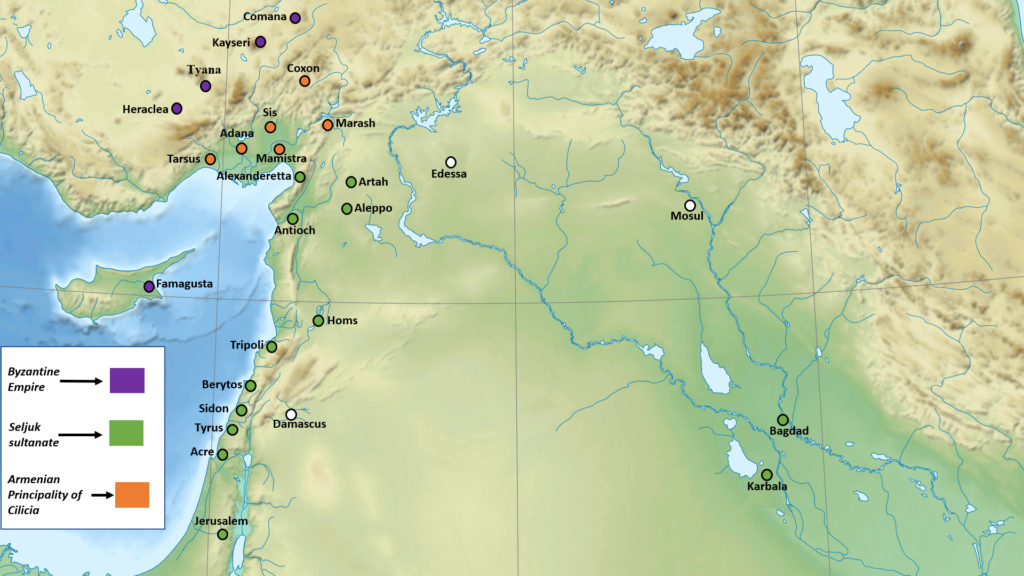
In October 1097, the armies of the First Crusade reached Antioch, one of the most heavily fortified and strategically important cities of northern Syria. Their objective was to continue southward toward Jerusalem, but the city’s formidable defenses, difficult terrain, and ability to receive support from the surrounding region transformed what was expected to be a relatively straightforward advance into a prolonged struggle. What followed was a siege lasting nearly eight months before the city’s capture, followed almost immediately by another siege in which the newly victorious Crusaders found themselves surrounded by a large Muslim relief army.
This article examines the Siege of Antioch in its entirety, from the Crusaders’ approach to the city and the opening operations around the Iron Bridge to the progressive tightening of the blockade, the severe famine and disease that afflicted both sides, and the repeated attempts by Muslim forces to relieve the city. It also explores the military decisions of commanders such as Bohemond, Raymond of Toulouse, Godfrey of Bouillon, and Yaghi-Siyan, as well as the political rivalries and competing interests that shaped the campaign.
The siege was not determined by military force alone. Logistics, intelligence, diplomacy, internal divisions, religious belief, and the struggle for political control all played decisive roles. The eventual capture of Antioch through the cooperation of Bohemond and the defender Firuz was followed by an even greater crisis when Kerbogha of Mosul arrived with a large coalition army and surrounded the Crusaders inside the city. The final battle on 28 June 1098 would determine whether the exhausted expedition survived or was destroyed.
The following account traces these events chronologically, examining the major engagements, strategic developments, hardships, political conflicts, and decisions that ultimately made Antioch one of the most consequential and dramatic campaigns of the First Crusade.
Early History of Antioch
By the late summer of AD 1097, the crusading army had reached northern Syria, arriving at the frontier of the Holy Land. Although Jerusalem—their ultimate objective—was now within relatively close reach, likely only about a month’s march to the south, one formidable challenge remained. The great city of Antioch, one of the most important urban and military centers of the eastern Mediterranean, blocked the road to Palestine.
To continue their advance, the crusaders were forced to besiege Antioch, beginning what became one of the longest, harshest, and most demanding military campaigns of the medieval period. The siege lasted for nearly eighteen months, bringing the entire expedition to a standstill in northern Syria. More than at any other stage of the First Crusade, the outcome of the campaign hung in the balance, as the crusaders faced the constant threat of starvation, defeat, and complete destruction. It was during this prolonged struggle that the very idea of crusading was put to its greatest test.
Located on the banks of the Orontes River, about twelve miles from the Mediterranean Sea, Antioch was founded around 300 BC by Seleucus I, the founder of the Seleucid Empire, who named the city after his father, Antiochus. Thanks to its strategic position and access to major trade routes, Antioch quickly grew into one of the most influential cities of the ancient world. During the Roman Empire, it ranked as the empire’s third-largest city, after Rome and Alexandria, and became a major center of administration, commerce, and culture.
Antioch was equally significant in the history of Christianity. According to the New Testament, it was here that the followers of Jesus were first called “Christians.” The city also became the seat of Saint Peter’s first bishopric, giving it a place of lasting importance in the development of the early Church.
The city’s prosperity declined during the sixth century AD, when a series of powerful earthquakes and the Persian capture and sack of Antioch caused widespread destruction. Its fortunes fell further after the Arab conquest, as political power and commercial activity increasingly shifted to the inland city of Aleppo. Nevertheless, Antioch experienced a revival after the Byzantine Empire recaptured it in the tenth century. It once again became a major commercial hub where Byzantine and Muslim merchants exchanged goods, while its massive fortifications made it one of the strongest defensive positions on the empire’s Syrian frontier.
After Antioch came under Turkish control, the Seljuqs of northern Syria briefly established political unity across much of the region. This cohesion was largely the achievement of Malik Shah, whose military strength and political skill enabled him to bring Baghdad and the surrounding territories under his authority. However, his death in AD 1092 triggered a succession crisis that quickly shattered this unity, dividing the Seljuq Empire into competing regional powers.
The Political Landscape on the Eve of the Siege
By the time the First Crusade reached Syria in AD 1097, the political landscape had become deeply fragmented. Malik Shah’s son was engaged in a struggle to secure control of Baghdad, while his nephews, Ridwan of Aleppo and Duqaq of Damascus, competed for dominance in Syria and sought influence over Antioch. The city itself was ruled by the experienced Turcoman governor Yaghi Siyan, an ambitious leader who carefully balanced his alliances between Aleppo and Damascus in an effort to preserve his own independence. Rather than fully aligning with either ruler, he shifted his loyalties whenever it served his political interests.
The Seljuqs also faced internal divisions along religious lines. Although the Turkish ruling elite largely adhered to Sunni Islam, significant Shi’ite Arab communities remained scattered throughout northern Syria. These political rivalries and sectarian divisions prevented the emergence of a united Muslim response to the approaching crusaders. As a result, Antioch’s Turkish garrison found itself relatively isolated, unable to rely on immediate or coordinated military support from the surrounding Seljuq rulers.
Faced with this unstable political situation, Yaghi Siyan viewed the approach of the large western European crusading army with growing concern. The crusaders were an unfamiliar and unpredictable force, and although Antioch was defended by a strong, well-supplied garrison, he recognized that the city might not be able to withstand a prolonged siege without outside assistance.
To strengthen Antioch’s defenses, Yaghi Siyan dispatched his two sons, Shams ad-Daulah and Muhammad, on diplomatic missions to seek military support from the rulers of Damascus, Aleppo, and Mosul in Mesopotamia. At the same time, fearing that the city’s Christian population might sympathize with the advancing crusaders or assist them from within, he ordered the expulsion of many Christians living inside Antioch’s walls as a precautionary security measure.
Yaghi Siyan’s appeals for help received mixed responses. Ridwan of Aleppo refused to provide assistance, likely because of earlier political conflicts with Antioch’s governor. In contrast, Duqaq of Damascus responded positively after Yaghi Siyan’s son, Shams ad-Daulah, personally requested aid. Duqaq organized a relief force, supported by his atabeg, Toghtekin, and Janah ad-Daulah, the ruler of Homs.
At the same time, another envoy sought assistance from Kerbogha, the powerful atabeg of Mosul. Recognizing that the crusaders posed a serious threat to the Muslim states of the region, Kerbogha assembled a large army to relieve Antioch. He was also motivated by his own political ambitions, as gaining control of Antioch would strengthen his influence over northern Syria. Meanwhile, Yaghi Siyan reinforced the city’s defenses, gathered his forces, and stockpiled supplies in preparation for a long siege.
The Strategic Fortifications of Antioch
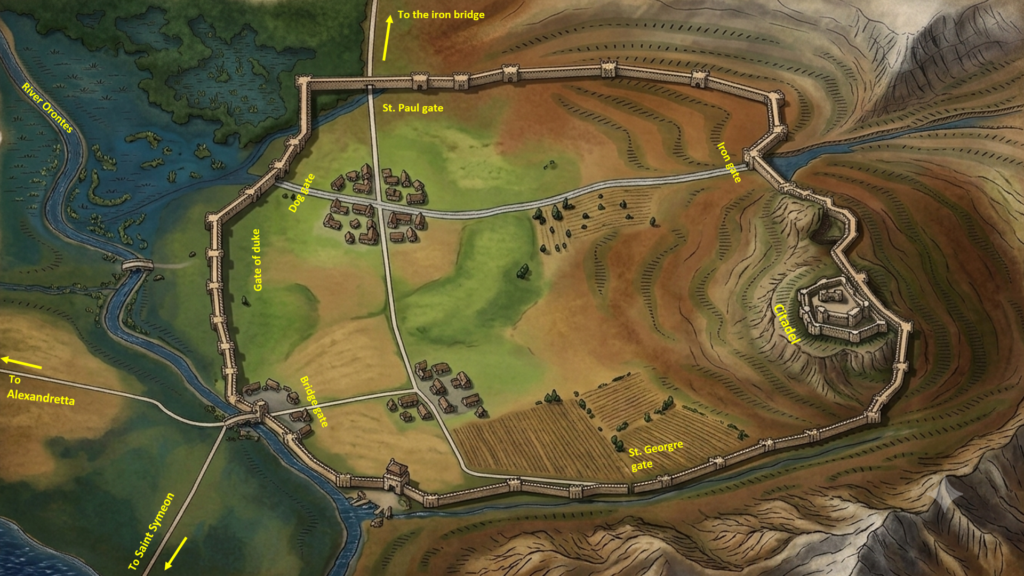
Antioch was among the most formidable fortified cities of the medieval world, and many contemporaries believed it could not be captured by direct assault. Its immense stone walls, constructed with exceptionally strong masonry, were considered virtually impossible to break. The walls were reinforced by hundreds of towers—crusader sources claimed between 360 and 450, though the true number was probably lower. Even so, these accounts illustrate the overwhelming impression the city’s defenses made on western Europeans.
The city’s natural landscape greatly enhanced its fortifications. The Orontes River ran alongside the western walls, limiting the movement of attacking forces. To the north, the walls rose from marshy ground, while to the east and west they climbed steep mountain slopes. The southern defenses followed the crest of a narrow ridge, crossed a deep ravine through the Iron Gate, and ended at a massive citadel that towered nearly 1,000 feet above the city. The closely spaced towers ensured that every section of the walls remained within range of defending archers, making any assault extremely costly.
Access to Antioch was controlled by several heavily fortified gates. The Gate of Saint Paul opened onto the road to Aleppo, while the Gate of Saint George connected the city with Latakia and the Mediterranean coast. A fortified bridge over the Orontes guarded the route to Alexandretta and the port of Saint Symeon, while the smaller Gate of the Duke and Gate of the Dog provided additional access to the river.
Antioch was also well equipped to survive a lengthy siege. The city contained abundant freshwater supplies, gardens, pastureland, and enough space to shelter and provision a large army. It was defended by a Turkish garrison of around 5,000 soldiers and held substantial food reserves. Moreover, the rugged mountains south of the city were too steep for an army to occupy, making it impossible for the crusaders to encircle Antioch completely and cut off all communication or supplies.
For these reasons, many contemporaries believed that Antioch could resist any army as long as its food lasted. Its immense size, strong fortifications, and secure internal resources made a successful blockade extremely difficult. Although these defenses caused immense hardship for the crusaders during the siege, they also inspired admiration. Even hostile observers described Antioch as a magnificent and remarkably beautiful city, whose strength matched its grandeur.
Battle of the Iron Bridge
As the crusading army advanced into Yaghi Siyan’s territory, it first reached the town of Marata, whose Turkish garrison abandoned the settlement without offering resistance. From there, Robert of Flanders led a detachment southwest to the town of Artah, where the local Christian population had already overthrown and killed the Turkish garrison.
On 20 October 1097, the main crusading force arrived at the Iron Bridge, a strategically important crossing over the Orontes River where the roads from Marash and Aleppo converged. The bridge was protected by two fortified towers, but the crusaders launched an immediate assault under the leadership of Bishop Adhémar of Le Puy. After fierce fighting, they captured the crossing, securing a major strategic victory. They also seized a large convoy of cattle, sheep, and grain that had been intended to resupply Yaghi Siyan’s forces inside Antioch.
Medieval accounts, however, differ on how the battle at the Iron Bridge unfolded. French chroniclers describe it as a swift victory, claiming that the Turkish defenders panicked and fled as soon as the crusaders attacked. In contrast, Lotharingian sources portray the engagement as a prolonged and hard-fought battle. According to their version, the crusaders held their ground only after Bishop Adhémar inspired the army with a stirring address, urging them to stand firm and assuring them that God was fighting alongside them. Regardless of these differing accounts, the capture of the Iron Bridge proved to be a decisive success, allowing the crusaders to begin the long and difficult Siege of Antioch.
With the Iron Bridge under their control, the road to Antioch lay open. The crusaders soon caught sight of the city’s towering fortifications, and on the following day Bohemond, leading the vanguard, reached the walls, with the rest of the army arriving shortly afterward. Confident after their recent success, many crusaders believed that Antioch would fall quickly.
Beginning the Siege of Antioch
On 21 October AD 1097, the crusaders formally began the Siege of Antioch. Unlike the earlier siege of Nicaea, however, they were unable to surround the city completely because of its formidable natural and man-made defenses. The Orontes River, steep mountains, and rugged southern terrain prevented a full blockade, leaving parts of Antioch beyond the crusaders’ control.
Instead, the crusaders concentrated their forces along the city’s north-western sector, establishing camps beside the Orontes River to monitor the most accessible sections of the walls. At the same time, they sent out foraging parties to secure food and other supplies from the surrounding countryside. During the opening weeks of the siege, these efforts were successful, as the region still provided enough resources to sustain the army while preparations for what would become a prolonged siege continued.
The army was organized largely by regional groups. Bohemond and most of the southern Italian Normans camped opposite the Gate of Saint Paul, with Tancred’s forces positioned behind them. The northern French, led by Robert of Normandy, Robert of Flanders, Hugh of Vermandois, and Stephen of Blois, occupied the next section of the line. Raymond of Toulouse, together with Bishop Adhémar of Le Puy and the southern French forces, blockaded the Dog Gate, while Godfrey of Bouillon camped near what became known as the Gate of the Duke. The Byzantine contingent under Tatikios remained farther from the walls, likely serving as a reserve force.
These positions were influenced not only by military considerations but also by political ambition. According to the medieval principle of “right by conquest,” those who first gained control of a strategic location could claim valuable rewards after a city’s capture. Since controlling a major gate could provide the first opportunity to enter Antioch, commanders were already thinking about the division of loot, territory, and political authority. Bohemond’s decision to occupy the important Gate of Saint Paul reflected these ambitions, suggesting that some crusader leaders had begun planning for Antioch’s future long before the city itself was conquered.
Turkish Harassment and Skirmishes
During the first two weeks of the siege, the defenders of Antioch remained behind their walls, choosing not to confront the crusaders directly. Instead, they observed the crusaders’ movements while waiting for relief forces from other Muslim rulers. This allowed the crusaders to establish their camps and organize the siege with little interference.
For the crusaders, these early days were marked by relative security and an ample supply of food from the surrounding countryside. However, not everyone viewed this period positively. The crusader chaplain Raymond of Aguilers argued that the army’s comfort led to complacency. Discipline declined, guards were often neglected, and the camps became vulnerable to a surprise attack. He also believed that this peaceful period encouraged selfishness among the crusaders, as many focused on personal gain rather than the success of the expedition as a whole. In his view, this lack of unity threatened the effectiveness of the crusading army even before the real hardships of the siege had begun.
Once the Turkish defenders realized that the crusaders could not launch an immediate assault, they adopted a strategy of constant harassment rather than open battle. Instead of remaining entirely behind Antioch’s walls, small groups of soldiers carried out frequent raids and ambushes against the crusaders whenever opportunities arose.
One of the main threats came from the Iron Gate, which gave the defenders access to Mount Staurin. From this elevated position, Turkish archers fired arrows into Bohemond’s camp, causing casualties even without engaging in direct combat. The defenders also used the unblocked Bridge Gate to cross the Orontes River and launch hit-and-run attacks against the crusader camps. Their mounted archers, lightly equipped and highly mobile, could fire arrows from a distance before quickly retreating behind the city’s defenses. Raymond of Toulouse and Bishop Adhémar, whose forces camped closest to the river, suffered the most from these raids, losing many of their horses to the Turkish archers.
The crusaders also faced attacks from Harim, a nearby Muslim-held fortress about fifteen kilometers east of Antioch. Overlooking the road to the Iron Bridge, Harim allowed Turkish forces to ambush isolated crusaders and threaten the army’s supply routes. As food supplies from the surrounding countryside began to decline by mid-November, these raids became an increasingly serious problem.
To improve their position, the crusaders sought to limit the defenders’ freedom of movement and secure their own communications. One of their first measures was the construction of a temporary bridge across the Orontes River opposite the Gate of the Duke. Built by tying together small boats with ropes, this floating bridge made movement between the two riverbanks easier than relying on a single ferry. However, it remained difficult for heavily armed knights to cross quickly. During one skirmish, the knight Henry of Esch grew impatient with the delay and attempted to swim across the river on horseback. Burdened by his armor, he was nearly swept under the deep waters, but he managed to reach the opposite bank safely, an event that contemporaries regarded as a sign of divine protection.
According to the chroniclers Albert of Aachen and William of Tyre, the defenders of Antioch also used the smaller Dog Bridge to launch raids against the southern French forces led by Raymond of Toulouse and Bishop Adhémar. In response, the crusaders attempted to disable the bridge, leading to one of the few assaults during the siege that employed siege machinery.
The crusaders first tried to demolish the bridge with hammers and picks, but heavy missile fire from the defenders and the bridge’s strong stone construction made this impossible. They then built a mobile armored shelter, known as a mole or talpa, to protect workers as they approached the bridge. However, a sortie by the Turkish garrison forced the defenders of the machine to retreat, and the structure was set on fire and destroyed.
The crusaders next deployed three artillery engines against the nearby gate and curtain wall to keep the defenders occupied. Although the bombardment provided covering fire, it failed to damage Antioch’s fortifications. Unable to destroy the bridge, the crusaders finally blocked it by piling up timber, stones, earth, and other materials, making it much more difficult for the defenders to use it for further raids.
The Genoese Relief Fleet
On 17 November AD 1097, thirteen Genoese ships arrived at the port of Saint Symeon carrying soldiers, craftsmen, and much-needed supplies for the crusaders. Their timely arrival suggests that at least some logistical support for the expedition had been planned before the crusaders left Europe.
Recognizing the importance of these reinforcements, the crusader leaders decided to use the newly arrived manpower and materials to strengthen the siege. They constructed a small fort on the slopes of Mount Staurin near the Gate of Saint Paul. Known as Malregard, this fort helped secure the northern section of the blockade and protected the crusader camps from the frequent raids launched by the defenders of Antioch.
The Elimination of the Fortress of Harim
As autumn gave way to winter, the crusaders’ optimism began to fade. Food supplies were beginning to decline, morale weakened, and frequent Turkish raids made it ever more dangerous to gather provisions. One of the greatest threats came from the Muslim-held fortress of Harim, whose garrison regularly ambushed crusaders traveling between the army and nearby supply areas. These attacks disrupted the vital task of foraging and forced the crusader leaders to take action.
On 18 November AD 1097, one day after the arrival of the Genoese supply fleet, Bohemond was sent east with Robert of Flanders and around 150 knights to deal with the Harim garrison. After locating the fortress, Bohemond employed a classic battlefield tactic used by both the Normans and the Turks. A small group of crusaders advanced to provoke the defenders before deliberately retreating, luring the Turkish force into pursuit. Although two crusaders were killed during the withdrawal, the plan succeeded. The pursuing Turks rode directly into an ambush prepared by Bohemond’s main force. Bohemond then led a decisive counterattack, killing many of the defenders and capturing the survivors. This victory reduced the immediate threat from Harim and temporarily made the crusaders’ supply routes safer.
Following the victory at Harim, Bohemond took a harsh step intended to intimidate the defenders of Antioch. He ordered the execution of the captured Turkish prisoners outside the city gates, and according to later accounts, their severed heads were even hurled into the city using siege engines. This marked one of the earliest examples during the siege of the crusaders deliberately using terror as a psychological weapon against their enemies.
The defenders responded with similar brutality. The Greek Orthodox Patriarch of Antioch was publicly tortured on the city walls to demonstrate that the Muslims remained in control, while captured crusaders were often executed. In one incident, Adelbaro, the Archdeacon of Metz, was captured outside the city, beheaded, and his companion was abused and killed. The following day, their severed heads were launched into the crusader camp as a warning. Although these actions appear exceptionally brutal today, such acts of violence and psychological intimidation were common features of medieval warfare and became a recurring aspect of the Siege of Antioch.
Famine and the Winter Supply Crisis
By the end of November AD 1097, the crusaders faced a far greater enemy than the defenders of Antioch—hunger. The food supplies they had gathered when the siege began were rapidly exhausted, and shortages soon spread throughout the army. Although the Armenian rulers of Cilicia and the monks of the Black Mountain sent provisions to assist the crusaders, these efforts were not enough to meet the army’s growing needs.
As supplies dwindled, conditions deteriorated rapidly. Disease and starvation claimed many lives, with some contemporary sources claiming that as many as one in five crusaders died. By mid-December, the situation had become so severe that the crusader leaders met to discuss how they could obtain enough food to keep the army alive.
The worsening conditions also affected morale. Some crusaders, including senior nobles, temporarily left the siege in search of better conditions or additional supplies. Robert of Normandy traveled to the Byzantine-held city of Latakia, while others abandoned the campaign altogether. Those who remained, including Godfrey of Bouillon, endured increasing hardship, with Godfrey himself falling seriously ill as the siege entered one of its most difficult phases.
By Christmas AD 1097, the crusaders had nearly exhausted their remaining food supplies, and the surrounding countryside could no longer provide enough provisions to sustain the army. In response, the crusader leaders held a council and decided to send a large foraging expedition under Bohemond and Robert of Flanders up the Orontes Valley toward Hama. Their mission was to gather as much food and livestock as possible from the villages in the region. While Bohemond’s force was away, Raymond of Toulouse and Bishop Adhémar of Le Puy were left in command of the siege.
On 28 December AD 1097, Bohemond and Robert of Flanders departed with a large force, reportedly around 20,000 men, to gather food and supplies in the Orontes Valley. Their absence was quickly noticed by Yaghi Siyan, who seized the opportunity to strike the weakened crusader army.
The Midnight Assault
During the night of 29 December, the Turkish garrison launched a major sortie across the bridge and attacked the crusader camps north of the Orontes River, where Raymond of Toulouse’s forces were likely stationed. Although the assault caught the crusaders by surprise, Raymond reacted swiftly, assembling a force of knights and counterattacking. The defenders were driven back toward the bridge, and the crusaders briefly gained a foothold on the opposite side before the city gates were closed. For a moment, it appeared that Antioch itself might be captured by assault.
However, the attack soon descended into confusion. According to Raymond of Aguilers, a Provençal knight was thrown from his horse while attempting to outflank the defenders. As the riderless horse ran away, several knights chased after it to recover the valuable warhorse. The infantry, lacking clear leadership and unable to understand what had happened, mistook the movement for a retreat and fled in panic. The resulting disorder turned a promising assault into a costly failure.
Although casualties were relatively limited—around fifteen knights and twenty infantrymen according to one contemporary source—the psychological impact was severe. Raymond of Aguilers described the defeat as a humiliating setback and interpreted it as divine punishment for the army’s moral failings and growing desire for wealth rather than spiritual devotion. The failed assault damaged morale, disrupted leadership, and deepened the sense of crisis within the crusader camp. Raymond of Toulouse soon fell ill once again, and for many crusaders, the prospect of failure and the collapse of the entire expedition appeared increasingly likely.
The Battle for Food in the Orontes Valley
Meanwhile, The crusaders’ foraging expedition likely traveled south of Antioch before turning east through the Ruj Valley and onto the fertile Jabal as-Summaq plateau. The region provided abundant food, and for several days Bohemond’s and Robert of Flanders’ forces gathered as many supplies as they could carry. By the night of 30–31 December AD 1097, while camped near the town of Albara, they believed their mission had been successfully completed.
However, the expedition had made a serious mistake. Whether because of poor coordination or simple oversight, Bohemond and Robert failed to deploy scouts to monitor the surrounding area. As a result, they were unaware that a Muslim relief army from Damascus was approaching only a few kilometers away.
The army had been assembled by Duqaq of Damascus in response to repeated appeals from Yaghi Siyan’s son, Shams ad-Daulah. Accompanied by his atabeg, Tughtegin, and the emir of Homs, Duqaq marched toward Antioch in mid-December to relieve the city. Although contemporary crusader sources greatly exaggerated its strength, claiming around 60,000 men, the force probably numbered no more than 10,000 soldiers. Even so, it was a powerful army, and if it had reached Antioch without opposition, it could have posed a serious threat to the crusaders and potentially changed the course of the siege.
By chance, the crusaders’ foraging force and Duqaq’s relief army met before either reached Antioch. Early on 31 December AD 1097, while the crusaders were likely still camped near Albara, Duqaq’s army appeared and attempted to surround them. The unexpected encounter placed Bohemond’s and Robert of Flanders’ force in grave danger.
Despite the surprise, the crusader commanders reacted quickly. Robert of Flanders led a frontal cavalry attack against the advancing Muslim troops, while Bohemond kept part of his force in reserve to prevent Duqaq from completing the encirclement. In the fierce fighting that followed, the crusader cavalry succeeded in breaking through the enemy lines, forcing many of Duqaq’s soldiers to withdraw.
Rather than continue the battle, Bohemond and Robert chose to retreat while they still had the opportunity. Their cavalry escaped, but the slower infantry and nearly all the food collected during the expedition were left behind, resulting in heavy losses through death or capture.
Militarily, the battle ended without a decisive victor. Both sides suffered casualties, and neither destroyed the other. However, Duqaq abandoned his march to Antioch and returned to Damascus, ending the immediate threat to the siege. Even so, the expedition was a major setback for the crusaders. Most of their infantry had been lost, the valuable supplies they had gathered were abandoned, and the army at Antioch remained desperately short of food. Although Robert of Flanders later recovered a small amount of provisions by attacking isolated enemy stragglers, it was far from enough to relieve the growing famine. Contemporary chroniclers tried to portray the outcome positively or ignored it altogether, but it was clear that the crusaders had been caught by surprise and had narrowly avoided disaster.
Deteriorating Conditions and Despair
The crusaders’ failed foraging expedition was soon followed by a series of events that many interpreted as signs of divine displeasure. The day after their retreat, a powerful earthquake shook the region. That evening, the northern sky glowed with an unusual red light, and in the weeks that followed, relentless rain and bitter cold made life in the crusader camp even more miserable. Many believed these hardships reflected God’s anger at the army’s growing pride, indiscipline, and plundering. In response, Bishop Adhémar of Le Puy ordered a three-day fast, but with famine already spreading through the camp, the measure offered little relief.
As the new year of AD 1098 began, the crusaders had survived two major crises, but their situation was growing increasingly desperate. Hunger, disease, exhaustion, and constant fighting had pushed the army to the brink of collapse. Inside Antioch, the defenders also faced mounting pressure, yet they remained in a stronger position thanks to their access to supplies and nearby allies. Neither side had gained a decisive advantage, and the siege had become a brutal test of endurance.
Throughout January of AD 1098, the crusaders experienced only a brief and limited sign of hope. During one of the frequent skirmishes outside Antioch, they captured a young Muslim nobleman of high status. After discovering that his family controlled one of the city’s towers, the crusaders attempted to negotiate with them, offering his release in exchange for secret access to the tower. Communication was established, and the plan appeared promising. However, Yaghi Siyan uncovered the conspiracy before it could be carried out and removed the family from their position of authority.
The crusaders responded harshly. Their captive, who had already endured severe torture, was brought before the city walls and publicly executed by beheading in full view of Antioch’s defenders. Although the attempt to gain entry into the city failed, the episode revealed an important vulnerability in Antioch’s defenses: the possibility that betrayal from within could succeed where direct assault had not.
Departure of the Byzantine Commander Taticius
In late January or early February 1098, another important figure left the crusader army. Unlike earlier deserters such as Peter the Hermit and William the Carpenter, Taticius, Emperor Alexios I Komnenos’ Byzantine representative, departed openly. He claimed that he was returning to Asia Minor to gather supplies and reinforcements, and the crusaders initially accepted his explanation. To demonstrate his intention of returning, he reportedly left his personal belongings behind before departing with his men.
Although Taticius later rejoined Emperor Alexios, he never returned to Antioch. His absence was widely viewed by the crusaders as a betrayal, and many contemporary Latin chroniclers condemned his actions. Raymond of Toulouse’s chaplain, for example, accused him of abandoning the army under false pretenses and bringing lasting disgrace upon himself and his followers.
Although the crusaders distrusted Taticius, he was equally suspicious of them, and not without reason. According to his later account at the Byzantine court, Bohemond privately warned him that some crusader leaders believed Emperor Alexios I Komnenos was secretly negotiating with the Seljuks to destroy the Crusader army. Bohemond claimed that these leaders were planning to kill Taticius and advised him to leave the camp for his own safety. Believing the threat to be genuine, Taticius decided to depart. In return for Bohemond’s warning, he reportedly promised him control of the disputed territory in Cilicia, which had previously been contested by Tancred and Baldwin.
The Advance of Ridwan’s Relief Force
Meanwhile, the Muslim forces began organizing another attempt to relieve Antioch. After Duqaq failed to provide the promised support, Yaghi-Siyan once again sought assistance from his former overlord, Ridwan of Aleppo. Recognizing that his earlier inaction had allowed the crusaders to reach Antioch, Ridwan agreed to intervene after Yaghi-Siyan renewed his allegiance. He assembled an army with the support of his cousin, Soqman of the Artuqids, and his father-in-law, the emir of Hama. By early February 1098, these allied forces had reoccupied Harim and gathered there before launching an attack on the crusader camp.
The unexpected clash with Duqaq of Damascus in December 1097 likely convinced the crusaders of the need for better intelligence. By the time Ridwan of Aleppo prepared his relief expedition, they had improved their scouting and local information network, giving them some warning of his approach. Even so, they still faced the serious danger of being trapped between Ridwan’s advancing army and Antioch’s garrison.
As they prepared for another battle, the crusaders faced several critical problems, the most pressing of which was the severe shortage of horses. This had already been a concern during the march across Asia Minor, but the hardships of the winter siege made the situation far worse. Contemporary accounts frequently emphasize the desperate lack of fodder, noting that straw was scarce and grain had become so expensive that even a large sum of money could barely provide enough feed for a single horse for one night.
Bohemond’s Strategy
When news reached the crusaders that Ridwan’s army was approaching, Bohemond believed they had to seize the initiative. He rejected a defensive stand at the Iron Bridge, recognizing that it would likely become a prolonged engagement while leaving the crusader camp vulnerable to attacks from Antioch. With their forces divided and caught between the city’s garrison and Ridwan’s advancing army, the crusaders stood little chance of success.
The crusaders faced an extremely difficult strategic situation, providing Bohemond with an opportunity to demonstrate his military leadership. At a council of the princes, he argued that their limited numbers made it impossible to defend against both Antioch’s garrison and Ridwan’s approaching army at the same time. Instead, he proposed dividing the army into two forces.
His plan called for the infantry to remain in camp to defend it and contain any attacks from Antioch’s garrison, while the mounted knights would accompany him to intercept Ridwan’s approaching army near Harim, beyond the Iron Bridge. The other crusader leaders accepted the proposal and agreed that Bohemond would command the expedition.
One contemporary chronicler, writing in a highly flattering tone, claimed that Bohemond’s followers praised him as a wise and capable commander and urged him to take charge of the operation. However, the crusaders faced severe shortages of both men and horses. Bohemond was able to assemble only about 700 knights, many of whom rode packhorses or mules instead of warhorses. To preserve the element of surprise and avoid alerting Antioch’s defenders, Bohemond decided that the crusader force would depart under the cover of darkness.
As he had done at Dorylaeum, Bohemond sought to prevent the Turks from using their preferred tactic of surrounding the crusader army. He also aimed to achieve surprise. Rather than attempting to block the Turkish advance at the Iron Bridge, where they were likely expecting resistance, he chose to attack after they had crossed the river, when they would probably anticipate an unobstructed march toward Antioch.
Recognizing that his force was too small for a prolonged engagement, Bohemond also sought to exaggerate its apparent strength. According to one eyewitness, the crusader army appeared several times larger than it actually was. To achieve this, he reorganized his roughly 700 knights into multiple cavalry formations before the attack.
Bohemond’s plan carried considerable risk. He did not know the exact size of Ridwan’s army, only that his own force was heavily outnumbered. Contemporary Latin chroniclers estimated the Turkish army at between 12,000 and 30,000 men. Although the lower estimate is generally considered more plausible, it still meant that the crusaders’ remaining knights faced odds of more than ten to one. Despite these daunting circumstances, the crusaders maintained their morale. According to one chronicler, they spent the night singing songs, perhaps recalling the legendary deeds of Roland, and approached the coming battle with remarkable confidence.
In contrast to the earlier Foraging Battle, the crusaders now sought to gain the advantage through surprise. On the night of 8 February of AD 1098, they left Antioch under the cover of darkness and marched quickly toward the Iron Bridge. Bohemond also appears to have concealed the true purpose of the expedition from many of his own soldiers, likely allowing them to believe they were setting out on a foraging mission rather than marching to confront Ridwan’s relief army. About six or seven miles from the city, they halted behind a low hill overlooking an open plain near the Orontes River and a nearby lake.
By choosing the battlefield in advance, the crusaders effectively prepared a large-scale ambush. Although the exact location cannot be identified with certainty, they appear to have selected ground that would restrict the Turks’ ability to carry out their preferred tactic of encirclement. Natural obstacles, including the river, nearby lake, and surrounding hills, likely helped limit the enemy’s freedom of movement while providing some concealment for the crusader cavalry before the attack.
The Battle of Lake Antioch
On the morning of 9 February AD 1098, crusader scouts reported that Ridwan’s army was advancing from the Iron Bridge, with two forward detachments leading the main force. Realizing they could not win a prolonged engagement, the crusaders had to rely on speed, surprise, and the shock of a cavalry charge. Success depended on careful timing.
As Ridwan’s forces approached, Bohemond committed five of the six cavalry squadrons against the enemy vanguard while keeping the sixth in reserve. According to one eyewitness, the battle opened with intense fighting as volleys of missiles filled the sky. Although heavily outnumbered, the crusader cavalry successfully drew Ridwan’s main force into the engagement. As the Muslim army advanced and gradually pushed the crusaders back, it appeared that victory was within Ridwan’s grasp.
Despite Bohemond’s careful planning, the crusaders gradually lost ground during the early stages of the battle as Ridwan’s numerically superior army pressed them back. One contemporary chronicler claimed that Bohemond, seeing his lines begin to falter while his final squadron remained in reserve, was overcome with emotion. He is said to have urged his constable to lead the reserve forward, encouraging his men to fight not only for victory but also in defense of God and the Holy Sepulchre. This was the decisive moment Bohemond had anticipated. With the Muslim army fully engaged and concentrated in the fighting, he committed the reserve—the sixth cavalry squadron—in a powerful charge, striking the enemy at a critical point in the battle.
Bohemond personally led the reserve cavalry into the attack, advancing rapidly at the head of the final squadron. Within moments, his distinctive blood-red banner could be seen above the Muslim ranks. The sudden arrival of these fresh troops appears to have had a significant psychological impact. Whether it was the unexpected reserve charge, Bohemond’s commanding presence, or a combination of both, the Muslim line began to collapse, and what had been an organized withdrawal quickly turned into a disorderly retreat.
A vivid account of the decisive charge is provided by the author of the Gesta Francorum, who was likely present with Bohemond’s contingent. He describes Bohemond leading the assault with great determination, his banner visible above the Turkish ranks as the crusaders renewed their attack. Inspired by his advance, the retreating crusaders rallied and launched a coordinated assault that caught the Muslim forces by surprise, forcing them into a rapid retreat. The crusaders then pursued the fleeing army as far as the Iron Bridge, inflicting heavy casualties.
Bohemond’s carefully timed cavalry charge proved decisive. By committing his reserve at the critical moment, he shattered Ridwan’s battle line and transformed what had appeared to be a losing engagement into a decisive victory. The crusaders pursued the retreating army to Harim, capturing horses and valuable supplies. Soon afterward, the remaining Muslim forces abandoned and burned the castle before retreating eastward, bringing Ridwan’s relief expedition to an end.
While the crusader cavalry secured a decisive victory against Ridwan’s relief force, the infantry left behind at the camp faced a much more difficult struggle. Yaghi-Siyan launched a full-scale sortie from Antioch, and the camp’s defenders gradually began to lose ground. However, later that afternoon, the returning crusader cavalry came into view. Realizing that Ridwan’s army had been defeated, Yaghi-Siyan abandoned the attack and ordered his troops to withdraw behind the city’s walls.
Crusader Negotiations with the Fatimid Embassy
Around 9 February AD 1098, the crusaders received an embassy from the Fatimid Caliphate of Egypt, ruled by the vizier al-Afdal. The mission was likely connected to earlier contacts established after the capture of Nicaea, possibly with Byzantine encouragement. Deep hostility between the Shi’a Fatimids and the Sunni Seljuks meant that Egypt had little interest in assisting the Turkish defenders of Antioch. Like many contemporaries, the Fatimids may also have believed that the crusaders were participating in a limited Byzantine campaign rather than seeking to conquer Jerusalem.
The encounter revealed that both sides had misjudged one another. The crusaders viewed the Muslim delegation with suspicion, while the Egyptians found a starving and exhausted army that bore little resemblance to the well-organized Byzantine force they had expected. Nevertheless, negotiations continued, and some members of the embassy even witnessed the crusader victory over Ridwan’s relief army, an outcome that likely strengthened the crusaders’ position.
The exact details of these negotiations remain unclear because contemporary accounts differ. Most sources agree, however, that the Fatimids proposed some form of agreement. In return for continued crusader pressure against the Seljuks, they appear to have offered the crusaders safe access to Jerusalem and possibly limited rights within the city. Some Latin chroniclers even believed that al-Afdal had expressed an interest in Christianity, though this interpretation is uncertain. The crusaders rejected these proposals, insisting that Jerusalem belonged to them by God’s will, and the embassy departed without reaching an agreement.
The Arrival of the English Fleet
Although the defeat of Ridwan’s relief army greatly boosted crusader morale, it did little to improve their difficult situation. Food remained scarce, even though supplies increasingly reached the nearby port of St. Symeon, many of them arriving from Cyprus through the efforts of Patriarch Symeon and possibly Taticius. Transporting these supplies to the crusader camp, however, remained dangerous because raiding parties from Antioch frequently attacked convoys. At the same time, the city’s defenders continued to receive provisions through the unblocked Gate of St. George and the fortified bridge.
To secure the route to St. Symeon and disrupt Antioch’s supply line, Raymond of Toulouse proposed constructing a fortification on the northern bank of the Orontes near the bridge. The project, however, was delayed by a shortage of building materials and skilled masons.
The crusaders’ fortunes began to improve in early March 1098. On 4 March, a fleet carrying English pilgrims arrived at St. Symeon under the command of Edgar Atheling, the exiled Anglo-Saxon claimant to the English throne. After stopping at Constantinople, the fleet brought much-needed siege equipment and skilled craftsmen provided by Emperor Alexios I Komnenos. Although this assistance proved invaluable, many crusaders chose to overlook the Byzantine emperor’s role in providing it.
Blood on the Riverbank
After learning of the fleet’s arrival at St. Symeon, Raymond of Toulouse and Bohemond traveled there together, each unwilling to leave the other unsupervised. Their objectives were to recruit as many fighting men as possible from the newly arrived pilgrims and to escort the siege equipment, craftsmen, and supplies back to the crusader camp. The journey took several days.
During their absence, Antioch’s garrison launched a series of small attacks against the crusader camp. These raids appear to have been intended mainly as a diversion while Yaghi-Siyan secretly positioned troops outside the city to ambush the returning escort. The plan was designed to strike before the crusaders could strengthen their siege works with the newly arrived materials.
On 7 March 1098, as Bohemond and Raymond returned from St. Symeon with supplies and the English sailors and craftsmen, the hidden Muslim force launched its attack. Having left the city undetected, the defenders achieved complete surprise. The assault was devastating, and contemporary accounts describe heavy crusader losses, with many pilgrims killed and hundreds reportedly beheaded. One Latin chronicler regarded these casualties as martyrs who had died for the faith. According to some sources, Bohemond withdrew from the fighting in confusion, while others claim that he had taken a different route and was unaware of the ambush until it had already begun.
Amid the fierce fighting, a number of crusaders managed to break through the Muslim lines and return to the main camp. They informed the remaining leaders, including the now-recovered Godfrey of Bouillon, that the escort force was in danger of being overwhelmed and that the newly arrived siege equipment and supplies were at risk of being lost.
The news spread rapidly throughout the camp, prompting an immediate response. Inspired by their commitment to the crusade and the goal of reaching the Holy Sepulchre, the crusaders armed themselves, crossed the bridge of boats, and marched out together to rescue their comrades and avenge those who had fallen.
After crossing the bridge, the arriving reinforcements found Godfrey of Bouillon organizing the crusader forces. Messengers from Bohemond soon arrived with reports on the size and movements of the Muslim force, and Bohemond himself rejoined the army with the knights who had escaped the initial ambush. The crusaders quickly regrouped and prepared to counterattack.
Before they could advance, however, another contingent of cavalry suddenly emerged from Antioch through the Bridge Gate and struck the crusaders from the rear. Yaghi-Siyan appears to have intended to trap the Crusader army between two attacking forces while supporting the assault with archers positioned on the city’s walls. After the cavalry had ridden out, the city gates were closed, committing the attackers to the battle. Contemporary chroniclers describe the ensuing fighting as exceptionally fierce, with volleys of arrows darkening the sky and the battlefield resembling the apocalyptic scenes celebrated in medieval epic.
With Muslim forces attacking from two directions and the crusaders either retreating in panic or charging forward in fierce resistance, the battle soon descended into a chaotic mêlée. Although the fighting became disorganized, this type of close-quarters combat ultimately favored the crusaders.
During the engagement, Godfrey of Bouillon won particular praise for his courage and skill in battle. Contemporary chroniclers credited him with killing several Muslim warriors and recounted a famous, though likely exaggerated, episode in which he supposedly split a mounted opponent in two with a single sword stroke. According to the story, the rider’s horse continued galloping toward the city with the lower half of its rider still in the saddle. Whether historical or legendary, the account illustrates the heroic reputation that Godfrey acquired among the crusaders and in later medieval tradition.
As the battle continued, the other crusader leaders, especially Robert of Normandy and Raymond of Toulouse, launched a coordinated attack against the Muslim troops that had emerged through the Bridge Gate. The crusaders pushed the attackers back toward the river and the walls of Antioch, compressing them into a narrow space where movement became almost impossible. Contemporary accounts describe the violence of the fighting in dramatic terms, claiming that the bridge and the Orontes River were filled with the bodies of the fallen.
The battle continued until nightfall, when the remaining Muslim forces managed to clear a path near the Bridge Gate and retreat safely inside the city. The crusaders then gathered the spoils of war and gave thanks through prayer, believing that their victory demonstrated divine favor. According to Latin chroniclers, the defeat greatly weakened Antioch’s defenders, who were no longer able to challenge the crusaders with the same confidence as before.
The day after the battle, a small group of Antioch’s defenders left the city to bury their dead. The crusaders allowed them to do so peacefully, suggesting that despite months of conflict, some limited restraint still existed between the two sides. However, this brief moment of tolerance soon ended.
After learning that the dead had been buried, some crusaders entered the burial area, destroyed the graves, and removed the bodies. They collected the severed heads of the fallen as proof of their victory, with estimates of the number taken ranging from 1,500 to 7,000, not including those lost in the Orontes River. The heads were later sent to St. Symeon, reportedly as a display of triumph to the Egyptian envoys.
The incident was controversial even among medieval writers. Some claimed the act was intended to frighten the defenders of Antioch, while others believed it was motivated by greed or the desire for trophies. Later chroniclers criticized the destruction of the graves, viewing it as a shameful act. Nevertheless, in the immediate aftermath of the battle, many crusaders saw it as a symbol of their victory and a way to demonstrate the scale of their defeat of the enemy.
Months of hardship, starvation, disease, desertion, and constant fighting had transformed the crusader army. Those unable to endure the siege had either died, deserted, or fallen in battle, leaving behind a smaller but more experienced and resilient force. Of the roughly 100,000 crusaders who had departed Europe, no more than about 30,000 are thought to have remained. Despite their recent victories, however, the siege of Antioch was still far from over. With these events, the siege entered its final phase.
Tightening the Noose
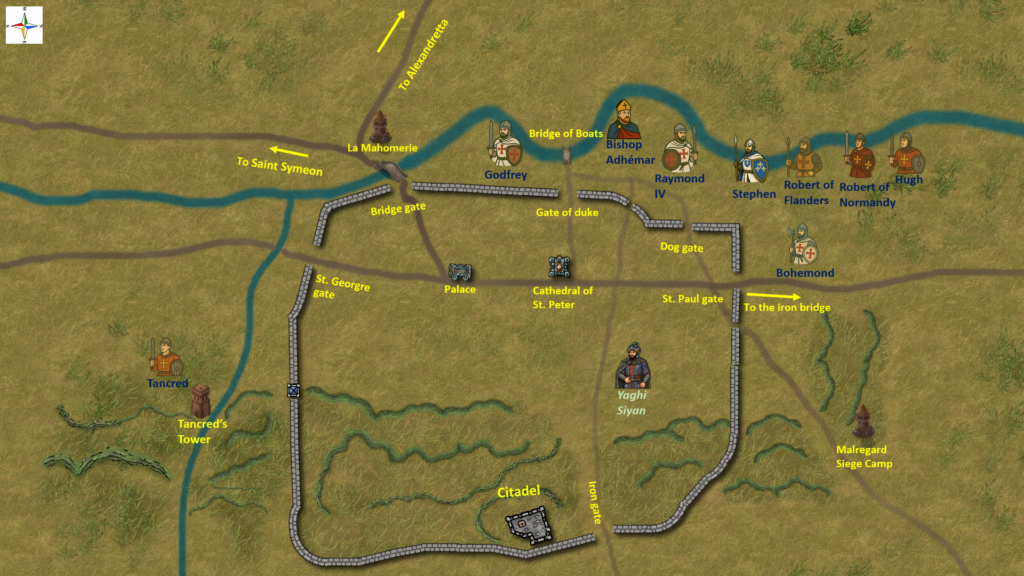
With the second Turkish army defeated and the newly arrived siege equipment now available, the crusaders were finally in a position to blockade the Bridge Gate. Around 10 March of 1098, work began on fortifying the abandoned mosque overlooking the crossing. Rather than constructing a permanent or technically sophisticated fortress, they opted for a simple defensive position that could be erected quickly. Although recent Crusader successes had weakened Muslim morale, the Antiochene garrison still retained the ability to launch a sortie before the work was completed, making rapid construction essential.
Over the following several days, the fortification was built through a collective effort, with the crusader princes themselves helping to carry stones alongside their men. Meanwhile, a detachment of archers maintained watch over the Bridge Gate to guard against any attack from the city. The completed stronghold consisted of a double ditch surrounding the mosque, a rough curtain wall built of stone and lime mortar, and two hastily constructed stone towers flanking the structure.
Upon its completion, the new fortress was named La Mahomerie. When the crusader leaders debated who should assume command of the stronghold, Raymond of Toulouse claimed it on the grounds that its construction had been his initiative. His claim was accepted, and the fortress subsequently became known as Raymond’s Castle.
Toward the end of March 1098, Yaghi-Siyan succeeded in restoring the morale of Antioch’s defenders sufficiently to launch a surprise attack at dawn through the Bridge Gate, targeting the newly constructed fortress of La Mahomerie. The assault underscored the strategic importance of the gate, as the defenders fought fiercely in an attempt to eliminate the crusaders’ new position. During the engagement, Raymond of Toulouse reportedly distinguished himself in the fighting.
Raymond of Aguilers, who was probably stationed within La Mahomerie at the time, later described how the garrison came close to being overwhelmed. He attributed their survival to divine intervention, recalling that heavy rain on the previous day had filled the defensive ditch surrounding the fortress, making it far more difficult for the attackers to cross.
Despite successfully repelling the assault, the crusader leaders understood that La Mahomerie was never intended to withstand a prolonged or large-scale attack. Constructed rapidly as a temporary field fortification, its primary purpose was to provide Raymond of Toulouse’s men with sufficient protection until reinforcements could cross the Bridge of Boats and support the defenders.
With the Bridge Gate effectively blockaded, the defenders of Antioch increasingly relied on the Gate of St. George as their principal route for communication and supply. However, growing crusader control over the surrounding countryside soon made this route equally vulnerable. According to one Latin eyewitness, a group of crusaders—probably Provençals—captured a large herd of horses that had been taken outside the Gate of St. George to graze on the slopes of Mount Silpius. Although the reported figure of 2,000 horses is almost certainly exaggerated, the incident illustrates the increasing difficulty faced by the city’s defenders in operating beyond the walls.
Recognizing the importance of sealing Antioch’s remaining access point, the crusader leaders moved to blockade the Gate of St. George as well. During the first week of April, the council of princes appointed Tancred, Bohemond’s nephew, to fortify and garrison a nearby monastery. In return, he received 300 marks of silver, to which Raymond of Toulouse contributed a substantial sum.
The establishment of this new position completed the encirclement of Antioch. Food convoys could no longer enter the city, while the defenders were also prevented from sending their livestock beyond the walls to graze, as they had previously done. Although small groups could still leave the city by climbing down the slopes of Mount Silpius or passing through the narrow Iron Gate, the defenders were no longer capable of mounting large, organized sorties.
The crusaders’ position improved further when Baldwin of Boulogne, by then firmly established as the ruler of Edessa, sent generous supplies of horses and weapons to the besieging army. Their strength was reinforced again in May with the return of crusader detachments that had previously been stationed in outlying forts and foraging posts.
As the siege tightened, the situation within Antioch steadily deteriorated. Food shortages became increasingly severe among the defenders, while conditions in the crusader camp gradually improved. The arrival of spring made foraging easier and reduced the risk of sudden Turkish attacks. At the same time, merchants who had previously sold their goods to the besieged city at inflated prices increasingly shifted their trade to the crusader camp, ensuring a more reliable supply of provisions and boosting the army’s morale.
Shortly after establishing his position near the Gate of St. George, Tancred intercepted a large convoy of food intended for Yaghi-Siyan. The supplies were being transported by Syrian and Armenian Christian merchants, and their capture further weakened the city’s already strained food reserves. Such successes convinced many crusaders that Antioch could eventually be forced to surrender through starvation rather than by direct assault.
By May 1098, signs began to emerge that the morale of Antioch’s defenders was weakening. In a letter written around 20 May, the crusader knight Anselm of Ribemont reported that an offer of surrender had been received from within the city. According to his account, contact was established between representatives of both sides, with several crusaders entering Antioch while some of the city’s inhabitants came out to meet them. The negotiations, however, ended in tragedy. Among those who entered the city was Walo II of Chaumont-en-Vexin, constable to the King of France and a member of Hugh of Vermandois’ contingent, who, together with the other envoys, was killed inside Antioch.
Anselm regarded the incident as a deliberate deception designed to lure the crusaders into a trap. However, another plausible interpretation is that a faction within the garrison genuinely sought to surrender the city to Hugh’s forces without the knowledge or approval of Yaghi-Siyan. If so, the governor may have uncovered the plot before it could be carried out and responded by executing the crusader envoys. From this point onward, the siege entered its most dramatic phase.
Whispers at the two Sister tower
The capture of Antioch has long been remembered as one of the most dramatic episodes of the First Crusade, largely because it was ultimately achieved through betrayal rather than direct assault. The crusaders may have been aware that the city had previously fallen through similar acts of treachery, both during its Byzantine recapture in 969 and its conquest by the Seljuk Turks in 1086.
The most widely accepted account of these events comes from the anonymous author of the Gesta Francorum. According to his narrative, Firuz, who commanded three towers along Antioch’s walls, secretly established contact with Bohemond. Confident of Firuz’s cooperation, Bohemond proposed to the other crusader leaders that a single commander should be appointed to take possession of the city once it was captured. Anna Komnene presents a similar version, stating that Bohemond suggested the city should be awarded to whichever leader first secured its capture, while the Muslim chronicler Kemal al-Din records a comparable tradition. The proposal, however, was rejected, as the other princes argued that the hardships of the siege had been shared collectively and that any reward should likewise be shared.
By the middle of May, there was still little sense of urgency within the crusader camp. The balance of the siege had shifted in the crusaders’ favour, the blockade was steadily tightening, and alternative efforts to secure the city’s surrender—such as the failed negotiations that ended with the deaths of Walo II of Chaumont-en-Vexin and the other envoys—were still being pursued. In these circumstances, Bohemond’s initial proposal attracted little support, as the crusaders did not yet consider themselves to be in a desperate position. That situation, however, was about to change.
Shadow of the Atabeg
Only a few days after Walo II’s death, probably around 25 May 1098, Armenian scouts—most likely dispatched by Baldwin of Edessa—brought alarming intelligence to the crusader camp. They reported that the third and largest Turkish relief army was advancing rapidly toward Antioch under the command of Kerbogha of Mosul.
Kerbogha’s intervention was driven by ambitions that extended well beyond the relief of Antioch. The arrival of the First Crusade presented him with an opportunity to expand his own influence across northern Syria. By presenting his campaign as a united Muslim effort to destroy the Crusader invaders, he also hoped to bring Antioch and much of Syria under his authority. Success in this enterprise would significantly enhance his political standing and could even strengthen his claim to power within the Abbasid capital of Baghdad.
Over the preceding six months, Kerbogha had carefully prepared for the campaign through both military planning and diplomatic negotiations. He assembled a formidable coalition drawn from across the Seljuk and Abbasid realms, securing contingents from Damascus, Harran, Homs, Mardin, Samosata, Sinjar, and several other regions. Many of these rulers joined the expedition not out of religious zeal or deep hostility toward the crusaders, but because they feared Kerbogha’s growing power and preferred to align themselves with him rather than risk becoming his future rivals. Ridwan of Aleppo was the principal exception, refusing to participate and determined to preserve his independence.
Some contingents gathered at Mosul before setting out, while others marched separately to rendezvous with the main army near Antioch. Once united, Kerbogha’s force represented the largest Muslim army the crusaders had yet faced. Contemporary estimates varied wildly, with an Armenian chronicler from Edessa claiming the army numbered 800,000 cavalry and 300,000 infantry, while one Muslim chronicler simply described it as “countless.” These figures are clearly exaggerated, but modern estimates suggest that Kerbogha probably commanded more than 35,000 troops. As long as his campaign continued successfully, he could expect the coalition to remain united. However, because the army was composed of numerous regional contingents bound together largely by political calculation, any sign of military failure or weakness in his leadership risked undermining their loyalty and cohesion.
Rather than acting immediately on the reports, the crusader leaders decided to verify the intelligence before making any decisions. Reconnaissance parties under commanders such as Reinhard of Toul and Drogo of Nesle were dispatched to survey the surrounding regions, including Artah to the east, the Ruj Valley to the south, and the approaches to Cilicia in the north. Their observations confirmed the princes’ worst fears. Muslim forces were reported to be advancing along multiple routes in overwhelming numbers.
On 28 May, the scouts returned to the crusader camp with their alarming reports. After enduring nearly eight months before the walls of Antioch, the crusaders now faced the prospect of being trapped between the city’s garrison and Kerbogha’s approaching relief army. Recognizing that such news could seriously damage morale, the princes resolved to keep the information from the rank and file while they assessed their options. An emergency council was therefore convened on 29 May to determine the course of action.
The approaching relief army also transformed the political calculations within the crusader camp. Emperor Alexios I Komnenos was then campaigning in Asia Minor, and an urgent appeal was sent requesting him to march to Antioch with all possible speed. For Bohemond, the situation was particularly pressing. If Alexios arrived before the city fell, or if Antioch could only be secured with Byzantine assistance, any claim he hoped to make over the city would almost certainly be lost, as it would be expected to revert to imperial control in accordance with the crusaders’ oaths.
Most of the crusader princes were prepared to support Bohemond’s claim to Antioch. Raymond of Toulouse, however, refused to agree, a position that was probably shared by the papal legate, Bishop Adhemar of Le Puy. Raymond’s opposition appears to have been motivated by several factors. Although he had not sworn the same explicit oath of homage to Alexios as some of the other princes, he had departed Constantinople on good terms with the emperor. He also distrusted Bohemond, his principal rival for leadership of the crusade. In addition, both Raymond and Adhemar may have believed that, if the emperor’s rights were to be disregarded, the disposition of conquered territories should fall under the authority of the Church rather than the ambitions of individual princes.
After prolonged discussion, a compromise was reached. If Bohemond’s forces were the first to enter Antioch and Emperor Alexios failed to arrive, he would be allowed to retain the city. Although Raymond continued to express reservations, the agreement marked a significant political success for Bohemond.
The crusaders also benefited from a critical strategic mistake on Kerbogha’s part. Unwilling to advance on Antioch while a crusader force remained at Edessa, he feared that Baldwin might threaten his lines of communication or attack his flank. In reality, Baldwin lacked the strength to undertake offensive operations, yet his control of the heavily fortified city made him equally difficult to dislodge. As a result, Kerbogha spent the final weeks of May attempting unsuccessfully to capture Edessa before concluding that the siege was wasting both time and resources. This unexpected delay proved invaluable to the crusaders. While Kerbogha remained occupied before Edessa, Bohemond intensified his efforts to bring his secret negotiations to a successful conclusion.
The Midnight Ladder
Over the following days, Bohemond and Firuz completed the final arrangements for the operation. Their plan relied on deception. On the evening of 2 June, a large crusader force of cavalry and infantry would deliberately march away from Antioch in full view of the defenders, creating the impression that the siege was being abandoned or that the army was setting out on another expedition. Under cover of darkness, however, the force would secretly return.
The mounted knights would retrace their route before continuing on foot, while the infantry would be guided through the surrounding hills by one of Firuz’s accomplices. The two groups were to rendezvous near the section of the walls above the Gate of St. George. From there, a small assault party would climb the walls at Firuz’s tower, eliminate the nearby guards, and then seize control of the gates, allowing the main crusader army to enter the city.
Strict secrecy surrounded Bohemond’s plan. Contemporary chroniclers suggest that knowledge of the operation was deliberately restricted, with one source noting that the scheme was not widely known among the crusaders. Some Provençal contingents even appear to have been taken by surprise when the assault began on the night of 2–3 June. Given earlier concerns that Armenians moving through the crusader camp were passing information to the defenders, limiting knowledge of the plan was a sensible precaution.
Ralph of Caen, writing about a decade later, even claimed that Tancred was unaware of the plot until it was put into action. This is difficult to accept, considering that Tancred commanded the fortification nearest to Firuz’s section of the walls. His account may instead reflect an attempt to explain why Tancred played only a limited role in the capture of the city.
Although Bohemond clearly sought to preserve operational secrecy, the plan could not have remained entirely confined to a small circle. The success of the assault depended upon a rapid and coordinated response once the walls had been breached. Even with Firuz’s cooperation, the initial assault force would have been highly vulnerable if reinforcements failed to enter the city immediately after the gates were opened. For this reason, the principal crusader leaders must have agreed upon the overall plan in advance. Bohemond appears to have coordinated his plans with Raymond of Toulouse and Adhemar of Le Puy, while Godfrey of Bouillon and Robert of Flanders were assigned to lead an assault on Antioch’s citadel immediately after the city gates had been opened.
Not all of the crusader leaders, however, shared Bohemond’s determination. Stephen of Blois took no part in the conspiracy with Firuz. Although he probably attended the council held on 29 May, the imminent arrival of Kerbogha’s army appears to have convinced him that the crusaders had little chance of survival. Early on 2 June, claiming illness, Stephen departed the camp with many of his followers from Blois and Chartres, crossing the Belen Pass toward Alexandretta. He never returned to the siege, though his decision would have important consequences for the later course of the crusade.
Even at the time, Stephen’s departure was widely regarded as an act of desertion. Its impact was especially damaging because, earlier in 1098, the crusader princes had chosen him to serve as the expedition’s commander-in-chief, a position that probably involved presiding over councils of the leading princes rather than exercising overall military command. The withdrawal of one of the crusade’s most influential nobles at the very moment its fate hung in the balance dealt a severe blow to morale, leaving the crusader camp on 2 June overshadowed by uncertainty, fear, and anticipation.
On 2 June, Firuz informed Bohemond that everything was in place for the operation. According to a later tradition, he had hesitated until the very last moment and only committed himself after discovering that his wife had been involved with one of his Turkish associates. Although the story cannot be verified, it illustrates the uncertainty surrounding his decision. As commander of the Tower of the Two Sisters and the adjoining section of Antioch’s western wall, Firuz occupied the key position on which the success of the assault depended. To seal the agreement, he sent his son to Bohemond as a hostage.
Bohemond immediately put the plan into motion. Late on 2 June, he instructed a knight known by the nickname “Evil Crown” to assemble a force of approximately seven hundred men under the pretext of conducting a raid against enemy territory. He then gathered the principal crusader leaders—including Adhemar of Le Puy, Raymond of Toulouse, Godfrey of Bouillon, and Robert of Flanders—and, for the first time, revealed the details of his agreement with Firuz. Declaring that Antioch could be theirs before morning if God granted them success, Bohemond secured the support of the assembled princes. Whatever reservations Raymond may have harboured, he raised no objection and agreed to cooperate with the operation.
As evening fell, the crusader force marched away from Antioch in full view of the defenders, reinforcing the impression that another expedition was underway. Under cover of darkness, however, they quietly reversed their course and returned to the city’s western walls. In accordance with the agreed plan, Godfrey of Bouillon and Robert of Flanders led a separate detachment toward the citadel, while Bohemond remained with the main assault force. Waiting until the patrols on the walls had passed, the attackers moved forward to make contact with Firuz.
Shortly before dawn on 3 June, Bohemond’s men reached the Tower of the Two Sisters. A scaling ladder was raised against the wall, and around sixty knights, led by Fulk of Chartres, began climbing through a high window into the tower, where Firuz anxiously awaited their arrival. The assault party advanced with considerable apprehension. As one contemporary Latin chronicler recalled, each man hesitated to be the first to climb, fearing that the conspiracy might prove to be a trap. Their anxiety was understandable. Many would have remembered the recent fate of Walo II of Chaumont-en-Vexin and his companions, who had been killed after entering Antioch under the guise of negotiations.
The slow pace of the ascent heightened Firuz’s anxiety. Concerned that dawn would break before enough crusaders had reached the walls, he reportedly cried out that only a handful of Crusaders had arrived and repeatedly called for Bohemond to hasten the assault. Once a sufficient number of men had entered the tower, they quickly secured the three towers under Firuz’s command. Moving silently through the fortifications, they killed the unsuspecting guards before any alarm could be raised. A night watchman who encountered the attackers was cut down before he could summon help, and anyone who crossed their path along the walls or within the towers met the same fate. Among those killed was Firuz’s own brother, who, like many of the defenders, appears to have been unaware of the conspiracy.
With the three towers under Firuz’s command secured, additional crusaders were able to scale the adjoining sections of the walls. Meanwhile, an Italian infantryman was dispatched to inform Bohemond that the operation had succeeded and that the main assault could begin.
Until this point, the attack had relied on secrecy and silence. Once the signal was given, however, the crusaders abandoned all restraint. Bohemond ordered the bugles to sound, alerting Godfrey of Bouillon and Robert of Flanders to begin their assault on the citadel. At the same time, the attackers erupted into loud shouts, repeatedly crying, “God wills it!” Contemporary eyewitnesses consistently remarked on the sudden and overwhelming burst of noise that shattered the silence of the night.
The combination of surprise, darkness, and the crusaders’ ferocity left the defenders disoriented during the crucial opening moments of the assault. After entering the city, Bohemond ordered his blood-red banner to be raised on the walls near the summit of Mount Silpius, a clear declaration of his claim to Antioch. According to one eyewitness, the sight of the crusader standard spread panic throughout the city. Some of the defenders fled through the gates, while others attempted to escape by leaping from the walls, leaving little organized resistance.
At the same time, members of Antioch’s native Christian community turned against the Muslim garrison and opened the remaining city gates, allowing more crusaders to enter. The combined effects of betrayal from within, surprise, and panic quickly overwhelmed the defenders and sealed Antioch’s fate.
As increasing numbers of crusaders entered Antioch, they encountered only scattered resistance. Greek and Armenian inhabitants joined the assault, attacking members of the Muslim garrison wherever they found them, and the violence quickly spread through the city. In the ensuing chaos, many people lost their lives, including members of Antioch’s Christian population who became caught up in the fighting. Awakened by the growing tumult, Yaghi-Siyan quickly realized that the city was lost. Accompanied by a small bodyguard, he fled on horseback through the gorge leading to the Iron Gate before escaping into the surrounding hills.
Despite the rapid collapse of Antioch’s defenses, the Muslim garrison achieved one significant success. During the initial assault, Godfrey of Bouillon and Robert of Flanders were unable to capture the city’s heavily fortified citadel. While panic spread through the lower city, Yaghi-Siyan’s son, Shams al-Dawla, remained composed. Gathering as many defenders as he could, he withdrew to the citadel before the crusaders could intercept him. Bohemond soon advanced against the stronghold but was unable to force an entry. Although the lower city had fallen into crusader hands, the citadel remained under Muslim control, leaving a determined garrison in possession of Antioch’s strongest defensive position.
Yaghi-Siyan initially succeeded in escaping some distance from Antioch. During his flight, however, he was thrown from his horse, and his attendants abandoned him, believing him to be mortally wounded. A few hours later, he was discovered by an Armenian butcher, who beheaded him and brought his head back to the crusaders as proof of the governor’s death.
Captives of Their Own Conquest
By the evening of 3 June, organized Turkish resistance within Antioch had effectively ceased. Surviving members of the garrison, along with many of the Turkish inhabitants of nearby villages, fled to seek refuge with Kerbogha’s approaching army. In the aftermath of the capture, widespread looting swept through the city. The homes of both Muslim and Christian residents were plundered, while valuable possessions, weapons, and other property were either seized or destroyed. The streets soon became littered with the bodies of those killed during the assault, a grim reminder of the violence that had accompanied the city’s fall. After more than a decade of Seljuk rule, Antioch had once again come under Christian control.
The capture and sack of Antioch had consequences that extended far beyond the city itself. The scale of the violence inflicted upon its defenders established the crusaders’ reputation for uncompromising brutality. In the months that followed, this reputation influenced the response of several Muslim-held cities on the road to Jerusalem, some of which preferred negotiation or submission rather than risk suffering a similar fate.
The crusaders’ victory proved short-lived. Beginning on 4 June 1098, the advance elements of Kerbogha’s coalition army appeared before Antioch, while additional contingents arrived over the following days. As the Muslim host gradually assembled around the city, the crusaders who had only just emerged victorious now found themselves besieged in turn.
Following the capture of Antioch, the Crusaders celebrated what they regarded as one of the greatest victories of the First Crusade. However, once the initial excitement faded, the reality of their situation became clear. After spending nearly eight months fighting to capture Antioch, they now found themselves confined within the very city they had struggled to seize, facing the imminent arrival of Kerbogha’s massive relief army, which threatened to surround and besiege them.
But The victory also provided several important advantages. Antioch’s massive fortifications had survived the fighting largely intact, offering strong protection against the approaching army of Kerbogha. The Crusaders’ civilian followers, despite having been greatly reduced by disease and desertion, could now take shelter within the city instead of remaining exposed outside its walls. In addition, the Turkish garrison defending Antioch had been almost completely destroyed, eliminating a constant military threat from within the city.
Despite these gains, serious problems remained. The city’s extensive defensive walls required far more soldiers than the Crusaders could spare. More importantly, the citadel still remained in Muslim hands. Although its defenders were too few to launch a major attack, their elevated position allowed them to observe activity throughout the city and maintain communication with Kerbogha’s approaching army.
The Crusaders had also expected Antioch to provide much-needed supplies, but these hopes proved unfounded. Food stores were scarce, and much of the city’s wealth had been destroyed during the assault and subsequent looting. Relations with the local Christian population also created uncertainty. Many of the native Syriac Christians had previously cooperated with the city’s Turkish rulers and showed little loyalty to the Latin Crusaders. Their uncertain allegiance posed a greater danger now that the Crusaders were defending the city from within.
The capture of Antioch also intensified an important political dispute: who should ultimately control the city. However, this question had to be postponed. Kerbogha’s army was advancing rapidly, making the city’s immediate defence far more urgent than settling questions of ownership.
Recognizing the seriousness of the situation, Bohemond realized that he could not defend Antioch without the support of the other Crusader leaders. Responsibility for the city’s fortifications was therefore divided among the princes, each taking command of a different section of the walls. At the same time, the army began clearing the city and burying the dead to reduce the risk of disease caused by decomposing bodies.
While these military and public health measures were underway, Bishop Adhemar of Le Puy supervised the purification and restoration of Antioch’s churches, including the Cathedral of St. Peter, so that Christian worship could resume. The imprisoned Patriarch John was released and restored to his rightful position as Patriarch of Antioch. Although John was a Greek cleric who generally viewed the Latin Crusaders with suspicion, he remained the legitimate patriarch of a church that was still in communion with Rome. Adhemar respected both ecclesiastical legitimacy and local tradition, making John’s restoration a natural decision. Most Crusaders accepted this outcome, recognizing the hardships John had endured for his faith. Bohemond, however, may have viewed the restoration less favourably, as it could complicate his own political ambitions in Antioch.
The first signs of this danger appeared when advance scouts from Kerbogha’s army reached the outskirts of Antioch. A Muslim reconnaissance force of around 300 cavalry cautiously approached the city, first sending a detachment of thirty horsemen to observe the Crusaders’ positions.
The appearance of this small group tempted Roger of Barneville, a distinguished Norman knight from southern Italy known for both his military skill and diplomatic ability. Believing the enemy to be vulnerable, Roger rode out from Antioch with only fifteen experienced companions in an attempt to attack them. As the Muslim detachment withdrew, he pursued them beyond the safety of the city walls.
This proved to be a costly mistake. The retreat had been deliberately staged to lure the Crusaders into an ambush, a tactic frequently employed by Turkish cavalry. Once Roger had been drawn far enough away, the remainder of the Muslim scouting force emerged from concealment in a nearby valley and surrounded his small party.
According to the chronicler Albert of Aachen, Roger realized the danger and attempted to fight his way back to Antioch despite being heavily outnumbered. As he neared the shallow crossing of the Orontes River, he came within sight of the city walls and was close to reaching safety. Before he could escape, however, a Turkish horseman overtook him and shot him with an arrow that pierced his back and fatally wounded him. Roger fell from his horse and died within full view of the Crusaders watching from the city’s ramparts.
After the battle, the Muslims decapitated Roger’s body and displayed his head on a spear as a symbol of their victory. The spectacle deeply shocked the defenders inside Antioch and served as a powerful demonstration of the enemy’s confidence.
Roger’s body was later recovered by the Crusaders. Bishop Adhemar of Le Puy, together with the leading princes of the expedition, arranged for him to receive an honourable burial at the entrance of the Basilica of St. Peter. Even so, the loss of such a respected and experienced knight had a profound effect on morale. Many Crusaders interpreted his death as a troubling omen. One contemporary remarked that the death of this “most illustrious and beloved knight” filled the entire army with sorrow and fear. Roger’s fate underscored the severity of the Crusaders’ situation. Far from their homeland, weakened by months of hardship, disease, and continuous warfare, they now faced the prospect of being encircled by a vastly superior force with little apparent hope of escape.
On 5 June 1098, Kerbogha reached the Orontes River at the Iron Bridge, where the Crusaders had left a small garrison to guard this vital crossing. The defenders were quickly overwhelmed, and almost the entire garrison was killed. Only the Crusader commander was spared; he was taken prisoner, chained inside one of the bridge’s towers, and left to languish there.
The Crusader leaders quickly concluded that they could not confront Kerbogha’s army in an open battle, as they had successfully done against Ridwan’s forces in February. Kerbogha commanded a much larger army, reportedly outnumbering the Crusaders by as much as two to one. More critically, the Crusaders were suffering from a severe shortage of cavalry because months of campaigning had left them with very few serviceable horses.
The chronicler Albert of Aachen believed that this shortage explained why the Crusaders had been unable to rescue Roger of Barneville during the earlier skirmish. According to his account, only about 150 horses remained in the Crusader camp, and these were severely weakened by the lack of fodder. By contrast, the Turkish cavalry rode well-fed and well-conditioned mounts. Although the Crusaders captured around 400 Turkish horses after taking Antioch, the animals had not yet been trained according to Frankish methods of warfare and could not immediately replace their exhausted cavalry mounts. Given these circumstances, the Crusader princes abandoned any plan of fighting in the open. Instead, they relied on Antioch’s formidable fortifications and prepared to defend the city from within.
With the route to Antioch now open, Kerbogha could have launched an immediate assault. Instead, he proceeded cautiously. He established his main camp approximately 3–5 kilometres north of the city, near the junction of the Orontes River and its tributary, the Kara Su. From this position, Kerbogha took time to assess Antioch’s formidable defences while also establishing communication with the Muslim garrison that continued to hold the city’s citadel.
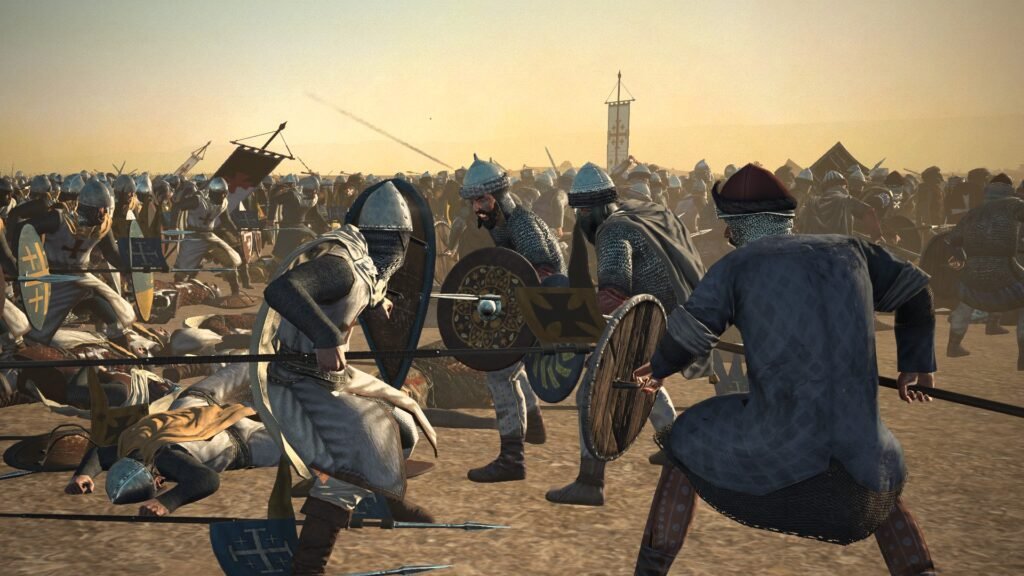
The Fall of the Outer Fortifications
Soon after establishing his camp, Kerbogha turned his attention to La Mahomerie, the siege fort that the Crusaders had constructed outside Antioch’s Bridge Gate during their own blockade of the city. The Crusaders appear to have abandoned their other outlying positions, including Malregard and Tancred’s Tower, but they remained determined to hold La Mahomerie because of its strategic importance. The fort controlled access to the road leading to St. Simeon, the Crusaders’ only remaining supply route.
Over the next three days, Kerbogha tested the defenders by launching repeated assaults with approximately 2,000 troops against the fort’s improvised defences. Responsibility for its defence fell to Robert of Flanders, despite the fact that Raymond of Toulouse had previously commanded the position during the siege of Antioch. With only about 500 men, Robert resisted successive Muslim attacks for three days. However, recognizing that the position could no longer be held, he withdrew his garrison into Antioch under the cover of darkness on the night of 8–9 June. Before leaving, the Crusaders set fire to La Mahomerie, destroying the fort to prevent it from being captured and used by Kerbogha’s forces.
At roughly the same time, though the exact date is unknown, another Crusader outpost outside the Gate of St. Paul came under attack. Commanded by Godfrey of Bouillon, the garrison fought a determined defence but was eventually forced to retreat into the city after suffering approximately 200 casualties.
Desperate Stand at Citadel
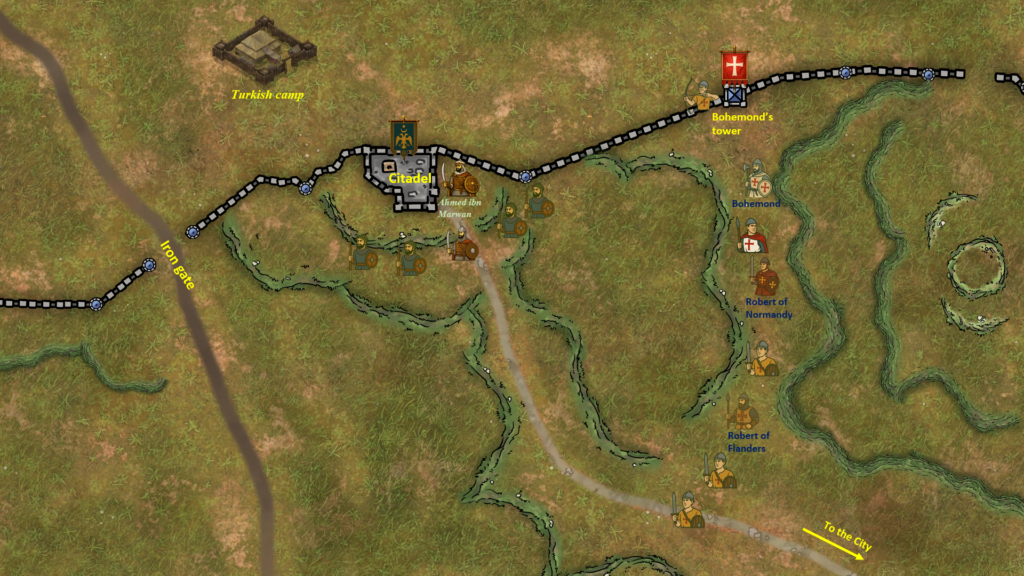
During this period, Kerbogha also established contact with Shams ad-Daulah, the son of Yaghi Siyan and the commander of Antioch’s citadel. Although there may have been some initial discussion regarding authority over the city, Shams ad-Daulah soon realized that he was in no position to negotiate. Kerbogha insisted that control of the citadel be transferred to his own forces. Shams ad-Daulah requested permission to remain in command until Antioch had been recaptured, but Kerbogha refused. He was compelled to surrender the fortress and its supplies to Kerbogha’s trusted lieutenant, Ahmed ibn Marwan, who assumed command of the citadel.
With La Mahomerie destroyed and control of Antioch’s citadel secured, Kerbogha launched the next phase of his offensive. He began repositioning his army to the south-eastern corner of the city, close to the fortress. From there, he could coordinate directly with the Muslim garrison inside the citadel and use it as a base for attacks against the Crusader-held city.
Recognizing the danger, the Crusaders attempted to disrupt this manoeuvre by launching an attack near the Gate of St. George. Fierce fighting continued throughout the day as both sides struggled for control of the area. The battle proved exceptionally brutal, leaving many participants physically exhausted and mentally drained. Some contemporary chroniclers even described Crusaders experiencing extreme fatigue, hallucinations, or sensations resembling out-of-body experiences amid the relentless combat.
By the end of the day, the Crusaders were unable to halt Kerbogha’s advance and withdrew behind Antioch’s walls. Their retreat allowed Kerbogha to establish a fortified camp beside the citadel, enabling close coordination with its Muslim garrison and strengthening attacks against the south-eastern sector of the city’s defences.
From this position, Turkish forces began concentrating in and around the citadel on the gentler eastern slopes of Mount Silpius. Additional troops were deployed to blockade the Gate of St. Paul in the northern part of the city, further tightening the encirclement of the Crusaders. From 8 June, as Kerbogha concentrated the bulk of his forces around the citadel, Bohemond was reinforced by Robert of Normandy and Robert of Flanders. Even so, the Crusaders could not afford to commit too many troops to this sector. Godfrey of Bouillon remained in the city to defend the Gate of St. Paul, while Raymond of Toulouse divided his forces between supporting the fighting near the citadel and protecting the Bridge Gate.
By 10 June 1098, Kerbogha was ready to launch a major assault on Antioch. Like the Crusaders before him, he faced the formidable challenge of overcoming the city’s massive fortifications. However, unlike the Crusaders during their earlier siege, Kerbogha possessed a decisive strategic advantage: control of the citadel. From this commanding position, he could threaten the entire stretch of walls along Mount Silpius and, more importantly, potentially gain access to the narrow path that descended from the fortress into the lower city, creating an opportunity to strike directly at the Crusaders’ defensive positions.
Although Kerbogha now controlled Antioch’s citadel, its position presented significant geographical challenges. The fortress stood in an isolated location on the summit of Mount Silpius, separated from the surrounding high ground by steep, rugged terrain. At the time of Antioch’s capture, Bohemond had raised his banner on a tower approximately 300–400 metres north of the citadel. Between the two positions lay a deep ravine containing an ancient cistern, while the only road leading to the citadel crossed a narrow strip of ground less than 30 metres wide along the edge of a steep precipice.
By holding this elevated position, the Crusaders controlled the only practical route connecting the citadel with the city below. The terrain to the west and north was so steep and broken that it was virtually impassable, making any alternative approach extremely difficult.
By the time Kerbogha assumed control of the citadel, Bohemond had also established a camp on the ridge of Mount Silpius opposite the fortress. The two forces faced one another across a narrow rocky valley that formed a natural barrier between their positions. From this vantage point, Bohemond controlled a substantial section of Antioch’s walls and several nearby towers, allowing him to monitor and, if necessary, contest movement along the narrow path linking the citadel to the lower city.
Realizing what Kerbogha was planning, the Crusader leaders decided to strike first. Hoping to disrupt the coming offensive, they emerged through a small postern gate on the southern ridge of Mount Silpius and launched a surprise attack against the Muslim camp. The assault initially caught Kerbogha’s forces off guard, forcing them to retreat.
Encouraged by this early success, some Crusaders broke formation and began looting the abandoned camp. Their discipline quickly collapsed, allowing Kerbogha to launch a powerful counterattack. Caught in the open, the Crusaders retreated in disorder toward the narrow postern gate. According to a Frankish eyewitness, the passage was so confined that many men were crushed to death in the panic as they struggled to escape back into the city.
The failed attack left the Crusaders shaken and demoralized, but an even greater danger soon followed. Seizing the initiative, Kerbogha launched a coordinated offensive. Troops from the citadel advanced against Bohemond’s position on the heights of Mount Silpius while simultaneously descending the narrow path toward the city. At the same time, additional Muslim forces outside Antioch attacked the city walls south of the citadel. Confronted with assaults from both inside and outside the fortifications, the Crusaders were forced to defend two fronts at once, stretching their already limited manpower to its limits. One Frankish eyewitness later recalled that the fighting raged from morning until evening with an intensity unlike anything they had previously experienced.
As the first day of fighting drew to a close, a Frankish knight known as Hugh the Insane became isolated atop one of Antioch’s towers, surrounded by several Turkish warriors. Realizing that escape was impossible, he continued fighting for as long as he could. According to the chronicler Albert of Aachen, after being struck by numerous arrows and seeing no hope of survival, Hugh deliberately leapt from the tower into the enemy below, turning his final act into one last attack against his opponents. His death was later remembered as an extraordinary display of determination and self-sacrifice.
Around the same time, and in the same sector of the battlefield, Bohemond was struck in the leg by an arrow. Contemporary accounts describe the wound as bleeding heavily, and some chroniclers suggested that the injury affected not only his physical condition but also his confidence. Although he remained in command, the incident appears to have reduced his effectiveness during the fighting that followed.
What alarmed the Crusaders most was Kerbogha’s ability to sustain a relentless assault. With a much larger army at his disposal, he continuously rotated fresh troops into the fighting, allowing attacks to continue from dawn until dusk for two consecutive days. The intensity of the battle left the defenders with little opportunity even to eat or drink.
The constant pressure severely weakened morale. Some Crusaders abandoned their positions by lowering themselves from the city walls with ropes, while rumours spread through Antioch that the defenders faced certain destruction. As fear grew, even experienced knights began to desert.
Among those who fled were William of Grandmesnil, his brother Aubrey, Guy Trousseau, and Lambert the Poor. Escaping under cover of darkness, they made their way on foot to the port of St. Simeon, where they falsely informed the sailors that the Crusader army had been destroyed. Panic quickly spread through the harbour as many sailors rushed to their ships in an attempt to escape. Seizing the opportunity, Turkish forces attacked the port, killing those they caught, burning ships that remained at the river mouth, and capturing their cargoes.
Given the relentless attacks and the increasingly desperate situation inside Antioch, it is not surprising that many Crusaders considered fleeing. On 11 June, rumours spread that even the Crusader princes were preparing to abandon the city and retreat to the coast. To restore confidence, the leaders publicly swore an oath that they would not desert Antioch. Even then, according to one Provençal chronicler, a mass exodus was prevented only after Bohemond and Bishop Adhemar of Le Puy ordered the city’s gates to be closed.
Bohemond had not expected the campaign to unfold this way. He appears to have assumed that Antioch’s citadel would soon surrender and that Kerbogha, even if he arrived, would face a prolonged siege similar to the one the Crusaders had just endured. Instead, the citadel remained in Muslim hands, giving Kerbogha a strategic foothold from which to threaten the city. This unexpected development undermined Bohemond’s plans.
A day or two later, Bohemond encountered a new crisis as many of his soldiers refused to leave the safety of the houses they had occupied and rejoin the fighting around the citadel. Frustrated by their reluctance, he ordered parts of the city to be set on fire in an attempt to force them back into battle.
The fire quickly spread out of control, destroying around 2,000 houses and damaging many of Antioch’s historic buildings. It came close to reaching the Basilica of St. Peter and the Church of St. Mary before it was contained. Despite the destruction, the blaze appears to have succeeded in driving some reluctant Crusaders back into the fighting.
The Falling Star
As the siege continued, religious belief and medieval superstition began to play an increasingly important role in the Crusaders’ response to the crisis. On 11 June, a priest named Stephen of Valence claimed to have received a vision of Christ and the Virgin Mary, in which the Crusaders were rebuked for their sins and instructed to purify themselves for five days.
According to the chaplain Raymond of Aguilers, Stephen publicly swore that his vision was genuine and even offered to undergo dangerous ordeals to prove its authenticity. Although his account did not immediately transform morale, it marked the beginning of a growing wave of religious fervour among the Crusaders.
A few days later, on the night of 13–14 June, as the defence of Antioch neared collapse, an unusual light was reportedly seen in the sky above the battlefield. Some Crusaders interpreted the phenomenon as a divine sign. One contemporary claimed that the fiery light appeared to descend toward the Turkish camp, causing fear among Kerbogha’s troops, who were said to have withdrawn in panic the following morning.
The Crusaders regarded the mysterious light as a divine sign, while modern historians often suggest it may have been a comet or another astronomical phenomenon. Whatever its nature, it strengthened Crusader morale and unsettled many of the Muslim troops. On 14 June, however, Kerbogha altered his strategy for practical military reasons rather than superstition. After four days of unsuccessful attempts to break through the Crusader positions near the citadel, he concluded that this approach was proving too costly. The narrow, rugged terrain and Antioch’s formidable defences prevented him from fully exploiting his numerical superiority, while maintaining troops on the slopes of Mount Silpius created serious logistical difficulties, particularly in supplying food, fodder, and water.
Kerbogha therefore redistributed his forces to tighten the siege around the entire city. A strong garrison remained in the citadel, while additional troops reinforced the blockade of the Gate of St. Paul, the Bridge Gate, and the Gate of St. George, completing a more comprehensive encirclement of Antioch. Although the focus of the fighting shifted, the clashes near the citadel did not end. Raymond of Toulouse remained with a substantial force to contain the citadel’s garrison while the rest of the Crusader army prepared for the decisive battle ahead.
For the Crusaders, Kerbogha’s change in strategy brought welcome relief. The intense fighting around the citadel had stretched their limited manpower to its breaking point, and the reduction in pressure on that sector allowed them a brief opportunity to reorganize their defences.
Starvation
Conditions inside Antioch continued to deteriorate as severe famine took hold. During the previous eight months of siege, the city’s food supplies had been almost completely exhausted, leaving little for the Crusaders after its capture. Before long, they faced starvation even worse than the hardships they had endured during the previous winter.
Contemporary accounts describe desperate attempts to find anything edible. Some searched the ground for roots and wild plants, while others boiled the hides of long-dead horses and oxen or chewed pieces of leather in the hope of extracting some nourishment. The suffering affected civilians as well as soldiers. Chroniclers recalled mothers unable to feed their infants because starvation had left them without milk, a tragic reminder of the human cost of the siege.
Small Skirmishes
With Antioch completely surrounded and its supply route to St. Simeon cut off, the Crusaders were effectively isolated from the outside world. During the next two weeks, the siege entered a less intense but still dangerous phase, marked by frequent skirmishes rather than large-scale assaults.
Several Crusader commanders launched limited attacks against the besieging forces. Godfrey of Bouillon lost around 200 men during an unsuccessful raid outside the Gate of St. Paul. On another occasion, Tancred, described by one contemporary as a knight with an unrelenting desire to fight the Turks, led a small night raid with just ten men and returned carrying the heads of six Muslim soldiers.
Individual acts of bravery also featured prominently in the contemporary accounts. During one attack near the Iron Gate, Henry of Esch noticed Muslim troops attempting to scale an undefended tower. Accompanied only by his relatives Franco and Sigemar of Mechelen, he rushed to defend the position and held the attackers long enough for reinforcements to arrive. Henry escaped unharmed, but Franco suffered a serious head wound, while Sigemar was severely wounded in the abdomen.
Meanwhile, taking advantage of the temporary reduction in large-scale fighting, the Crusader princes strengthened their defences on the slopes of Mount Silpius. They constructed a simple stone-and-mortar wall between their upper camp and the citadel, which was guarded continuously to prevent further attacks.
Byzantine retreat
By mid-June 1098, the First Crusade had reached its lowest point. Trapped inside Antioch, the Crusaders faced constant pressure from Kerbogha’s army while famine, disease, and mounting casualties steadily weakened their ability to resist. Morale collapsed, and many believed that defeat was only a matter of time.
In these desperate circumstances, many Crusaders placed their hopes in the arrival of the Byzantine Emperor Alexios I Komnenos, who had already begun marching east with a relief army. By the middle of June, he had reached Philomelium in central Anatolia and was preparing to continue toward Antioch.
Before he could advance further, however, he was met by Stephen of Blois and William of Grandmesnil, who had fled the siege. They reported that Antioch had fallen to the Turks and that the Crusader army had been destroyed. Around the same time, Peter of Aulps arrived with reports that a Turkish force was advancing against the Emperor’s own army.
Faced with these reports, Alexios concluded that the Crusade had already been lost. Continuing toward Antioch would have exposed his army and the Byzantine Empire to unnecessary risk. After consulting his advisers, he decided to abandon the expedition and withdraw. The Emperor’s decision would have lasting consequences. When news of his retreat eventually reached Antioch, many Crusaders viewed it as a betrayal, deepening their distrust of the Byzantines. This resentment would later strengthen Bohemond’s political ambitions and further damage relations between the Crusaders and the Byzantine Empire.
Yet, even as the Emperor turned back and conditions inside Antioch grew increasingly desperate, the Crusaders’ fortunes began to change. A series of events soon revived their confidence and gave many the conviction that divine intervention was once again on their side. It was under these circumstances that one of the most remarkable and influential episodes of the First Crusade unfolded.
Beneath the Earth
At the centre of these extraordinary events was Peter Bartholomew, a poor peasant from Provence who had joined the Crusade as the servant of a fellow pilgrim, William-Peter. Despite his humble background, Peter claimed that he had experienced a series of visions in which St. Andrew revealed the location of one of Christianity’s most sacred relics—the Holy Lance, believed to be the spear that pierced Christ’s side during the Crucifixion.
According to Peter, the visions had begun months earlier and continued throughout the Crusade. St. Andrew repeatedly instructed him to return to the army and reveal the Lance’s location, even after Peter had tried to abandon the expedition. Believing that no one would take the word of a poor servant seriously, he kept the visions to himself.
On 10 June, as the Crusaders’ situation became increasingly desperate, Peter finally revealed his story to Raymond of Toulouse and Bishop Adhemar of Le Puy. Adhemar remained sceptical, but Raymond believed the claim deserved further investigation and entrusted Peter to his chaplain, Raymond of Aguilers, who recorded his testimony.
Peter’s account gained additional importance because it followed other reports of divine intervention, including Stephen of Valence’s vision calling on the Crusaders to repent and promising that God would soon come to their aid. Interpreting these visions as connected, Raymond of Toulouse resolved on 14 June to search for the Holy Lance.
The following morning, Peter led a small group that included Raymond of Toulouse, the Bishop of Orange, and Raymond of Aguilers into the Cathedral of St. Peter. After hours of digging beneath the church floor without success, many present began to lose hope. Finally, Peter entered the excavation himself and produced an iron spearhead, declaring it to be the Holy Lance. News of the discovery spread rapidly through the Crusader camp, inspiring widespread excitement and renewed confidence.
Whether the relic was genuine remains impossible to determine. Some contemporaries accepted it as a miracle, while others—including Bishop Adhemar—suspected it was a fraud. Regardless of its authenticity, the discovery transformed morale within the Crusader army. Raymond of Toulouse interpreted it as a sign of divine favour and prepared his men for a final battle rather than surrender. Peter later claimed to receive another vision in which St. Andrew instructed the Crusaders to fast for five days before their promised victory, despite the severe famine that already gripped the city.
Words Before the Storm
Despite the renewed confidence inspired by the discovery of the Holy Lance, the Crusaders still needed a practical way to break the siege. With Raymond of Toulouse seriously ill, Bohemond assumed overall command of the army. Realizing that Antioch’s dwindling supplies could not sustain the Crusaders much longer, he concluded that waiting behind the city’s walls was no longer an option. Their best chance of survival was to launch a full-scale attack against Kerbogha’s army.
At the same time, the Crusader leaders recognized that victory might also depend on exploiting weaknesses within the enemy camp. Although Kerbogha commanded a large coalition, divisions were beginning to emerge among his allies. Rivalries between Muslim rulers, disagreements among the emirs, and growing resentment toward Kerbogha’s leadership weakened the unity of his army. As the siege continued, increasing numbers of troops reportedly deserted and returned home.
Aware of these internal tensions, the Crusaders made one final attempt to avoid a decisive battle. On 27 June, they sent Peter the Hermit and Herluin, a Frank who spoke both Arabic and Persian, to negotiate with Kerbogha. The exact terms they offered are unknown, although later chroniclers mention proposals ranging from peaceful withdrawal to settling the conflict through single combat. Kerbogha rejected all negotiations and demanded the Crusaders’ unconditional surrender.
The embassy returned without an agreement. Even so, Herluin may have gathered valuable information about the condition of Kerbogha’s army—intelligence that could prove useful as the Crusaders prepared for the decisive battle that now seemed unavoidable.
Breaking the Turkish Host
With negotiations having failed, the Crusaders had no choice but to fight. Early on the morning of 28 June 1098, Bohemond organized the army for what would become the decisive battle of Antioch. The Crusader force was divided into six battle formations, each led by one of the expedition’s principal commanders. Hugh of Vermandois and Robert of Flanders commanded the first division, Godfrey of Bouillon the second, Robert of Normandy the third, and Bishop Adhemar of Le Puy the fourth, as Raymond of Toulouse was too ill to lead his own troops. The remaining two divisions were commanded by Bohemond and Tancred. Meanwhile, around 200 soldiers remained inside Antioch under Raymond’s direction to contain the Muslim garrison in the citadel.
Before the army marched out, priests conducted prayers and religious services, while others accompanied the soldiers into battle. Raymond of Aguilers carried the Holy Lance, which many Crusaders regarded as a symbol of divine support. Although months of campaigning had left many knights without their warhorses, forcing them to fight on foot or ride inferior animals, morale was high.
The Crusaders entered the battle facing overwhelming disadvantages. Kerbogha commanded a larger army, composed mainly of cavalry, while the Crusader force had been transformed by months of campaigning and siege. Although they may still have numbered around 20,000 people, this figure included non-combatants, and the fighting force itself was now largely infantry.
By June 1098, almost all of the warhorses brought from Europe had been lost through disease, starvation, and exhaustion. Only about 200 trained warhorses remained, forcing many knights to fight on foot or ride pack animals. Even leading commanders struggled to obtain suitable mounts. Godfrey of Bouillon borrowed a horse from Raymond of Toulouse, while Robert of Flanders reportedly had to raise money to buy one. Before the battle, Bishop Adhemar of Le Puy ordered that every remaining horse be given what little grain was available to keep it strong enough for combat.
Despite these hardships, the Crusader army retained an important advantage. Months of continuous fighting had left it with a hardened core of experienced soldiers. Many knights were now forced to fight as heavily armed infantry rather than cavalry, creating a disciplined and resilient force adapted to close combat. Recognizing this transformation, Bohemond adjusted his battle plan to suit the army he had, rather than the one he had begun the Crusade with.
To deploy his army as quickly as possible, Bohemond devised a carefully planned formation for the Crusaders’ advance through the Bridge Gate. Once the leading force had secured the exit, the remaining divisions marched out one after another before spreading to the left, gradually forming a broad semi-circular battle line.
The manoeuvre was not executed with the precision of a professional standing army, but it proved highly effective under the circumstances. It enabled the Crusaders to leave the city rapidly while organizing themselves for battle. Even so, the plan carried considerable risk. Had Kerbogha responded more quickly or attacked while the Crusaders were still emerging from the gate, their army might have been overwhelmed before it had fully deployed.
As soon as the Bridge Gate was opened, the Muslim garrison in Antioch’s citadel signalled the Crusaders’ advance by raising a black flag, alerting Kerbogha, whose main army was camped several kilometres to the north. He was immediately faced with a crucial decision: attack while the Crusaders were still emerging from the city or wait until their entire force had deployed before engaging them.
Some of Kerbogha’s commanders urged an immediate assault, believing the Crusaders were at their most vulnerable. Kerbogha, however, chose to wait. He hoped that by allowing the entire Crusader army to leave the city, he could destroy it in a single decisive battle rather than defeat only its leading divisions.
By the time he reconsidered and attempted to open negotiations, it was too late. The Crusaders ignored his offer and continued their advance. Convinced that the coming battle would decide their fate, they marched forward in a deeply religious atmosphere. Priests and monks walked before the army, chanting prayers and calling upon divine assistance as the Crusaders prepared for what they believed would be a holy struggle.
Bohemond’s choice to lead the Crusaders out through the Bridge Gate was a deliberate tactical decision. His army’s greatest strength lay in close-quarters combat, where its heavily armed infantry could engage the enemy directly. A prolonged fight at a distance would have favoured Kerbogha’s predominantly mounted forces, whose mobility and archery gave them a clear advantage.
An advance through Antioch’s northern gates would have forced the Crusaders into the narrow Orontes Valley, where they risked becoming trapped between the river and Kerbogha’s main army, which was camped near the junction of the Orontes and the Kara Su rivers. By choosing the Bridge Gate instead, Bohemond gave his troops more room to deploy before confronting the enemy, reducing the danger of being overwhelmed as they left the city.
According to Albert of Aachen, around 2,000 mounted Turkish archers advanced toward the Bridge Gate as the Crusaders began to emerge from the city. Anticipating this, Hugh of Vermandois had positioned Crusader archers at the head of the column. Advancing with their shields raised against the incoming arrows, they returned fire and forced the Turkish cavalry to withdraw once they came within range.
The retreating horsemen were then pursued by Anselm of Ribemont, followed by Hugh of Vermandois and the northern French contingents, including the forces of Robert of Flanders, Robert of Normandy, Baldwin of Hainault, and Eustace of Boulogne. The fiercest fighting developed on the Crusaders’ right flank near the Orontes River, where they engaged a large part of Kerbogha’s army. As in earlier battles, the Turks employed their familiar tactic of the feigned retreat, drawing the Crusaders onto more difficult ground before turning to shower them with arrows from a distance.
While the main engagement continued near the Orontes River, additional Muslim forces struck the Crusaders from several directions. Troops stationed at the Bridge Gate were reinforced by soldiers from the Gate of St. Paul and the Gate of the Duke, while another force advanced from the Gate of St. George, threatening the Crusader rear.
To prevent encirclement, Reinhard of Toul was sent with a force of northern French and Lotharingian infantry to hold the rear. His men suffered heavy casualties but succeeded in delaying the attack, buying valuable time for the main Crusader force to continue the battle.
On the main battlefield, the fighting remained intense. Among the Crusader casualties was Bishop Adhemar’s standard-bearer, yet the Turkish archers failed to halt the Frankish advance, and Kerbogha’s battle line gradually began to give way. During the fighting, many Crusaders claimed to see a vision of mounted saints—St. George, St. Mercury, and St. Demetrius—riding across the hillside with white banners. They interpreted this as a sign of divine support, strengthening their determination.
At the same time, Kerbogha’s coalition started to disintegrate. Several Muslim emirs, reportedly led by Duqaq of Damascus, abandoned the battlefield, fearing that a victory would make Kerbogha too powerful. Their withdrawal spread confusion throughout the army. Kerbogha attempted to slow the Crusader advance by setting fire to the dry grass in front of his lines, but the tactic failed. Only Soqman the Artuqid and the Emir of Homs remained loyal until the final stages of the battle. When they too withdrew, Kerbogha accepted defeat and ordered a retreat.
The Muslim army soon collapsed into a rout. Following the advice that Peter Bartholomew claimed had come from St. Andrew, the Crusaders ignored the enemy camp and instead pursued the fleeing troops as far as the Iron Bridge, inflicting heavy losses. Others who sought refuge in Tancred’s fort were surrounded and killed, while many more were cut down by local Syrian and Armenian inhabitants during their flight. Kerbogha escaped to Mosul with only a small remnant of his army, and the defeat permanently destroyed his military prestige.
Although only a portion of Kerbogha’s army had been destroyed in the fighting, his defeat effectively ended the threat to the Crusaders. His camp was captured and thoroughly plundered, providing the victors with desperately needed food, animals, weapons, and other supplies after weeks of starvation.
Contemporary accounts record that many women were found in the camp. One Latin chronicler noted that the Crusaders did not sexually assault them but instead killed them. While this statement may seem shocking today, it reflects the attitudes of the time. For many medieval clerical writers, killing enemies in a religious war was considered more acceptable than committing what they regarded as the grave sin of sexual relations with non-Christians.
After witnessing Kerbogha’s defeat from the citadel, its commander, Ahmed ibn Merwan, recognized that further resistance was futile and offered to surrender. The message was first delivered to Raymond of Toulouse, who ordered one of his banners to be raised over the fortress.
Ahmed, however, refused to accept Raymond’s banner. According to contemporary accounts, he had already reached a private agreement with Bohemond that would take effect if the Crusaders won the battle. He therefore delayed the surrender until Bohemond arrived in person. The citadel was then peacefully handed over, and its Muslim garrison was allowed to leave unharmed. Some of its members, including Ahmed himself, reportedly converted to Christianity and entered Bohemond’s service.
Birth of an Iron Realm
The victory over Kerbogha secured Antioch for the Crusaders, but it immediately sparked a dispute over who should control the city. According to the oaths sworn before the Crusade, Antioch was to be returned to the Byzantine Emperor Alexios I Komnenos. Bohemond, however, argued that the Emperor had broken this agreement by failing to come to the Crusaders’ aid after turning back in Anatolia. Most of the Crusader leaders accepted this argument and supported Bohemond’s claim, recognizing his leading role in both the capture and defence of the city. Raymond of Toulouse remained the principal opponent, insisting that the original oath should be honoured.
To resolve the dispute, Hugh of Vermandois and Baldwin of Hainault were sent to inform Emperor Alexios, although Baldwin disappeared after being ambushed on the journey. Alexios made no attempt to recover Antioch, further strengthening Bohemond’s position. While Bohemond took control of most of the city and the citadel, Raymond occupied the former palace of Yaghi-Siyan, and rivalry between the two leaders continued.
The Crusaders’ success was soon overshadowed by new hardships. An epidemic, probably typhus, spread through Antioch, claiming many lives, including Bishop Adhemar of Le Puy on 1 August 1098. Food remained scarce, horses were in short supply, and tensions within the army increased. Although the Crusader leaders appealed to Pope Urban II to assume authority over Antioch, he declined.
As the months passed, ordinary soldiers grew increasingly impatient. Eager to continue their pilgrimage to Jerusalem, they pressured their leaders to end the dispute. In November 1098, Raymond finally withdrew his opposition for the sake of unity. Early the following year, the main Crusader army resumed its march toward Jerusalem, leaving Bohemond behind as the first Prince of Antioch.
Bibliography
1) THE DEEDS OF THE FRANKS AND OTHER JERUSALEM-BOUND PILGRIMS : THE EARLIEST CHRONICLE OF THE FIRST CRUSADES | Nirmal Dass (trans.)
2) LE « LIBER » DE RAYMOND D’AGUILERS | John Hugh Hill and Laurita L. Hill (eds.)
3) A HISTORY OF THE EXPEDITION TO JERUSALEM 1095-1127 | Fulcher of Chartres / Frances Rita Ryan (trans.)
4) A HISTORY OF THE CRUSADES VOLUME I: THE FIRST CRUSADE AND THE FOUNDATION OF THE KINGDOM OF JERUSALEM | Steven Runciman
5) VICTORY IN THE EAST: A MILITARY HISTORY OF THE FIRST CRUSADE | John France
6) THE CRUSADES AND THE EXPANSION OF CATHOLIC CHRISTENDOM, 1000-1714 | John France
7) THE FIRST CRUSADE: A NEW HISTORY | Thomas Asbridge
8) GOD’S WAR: A NEW HISTORY OF THE CRUSADES | Christopher Tyerman
9) ARMIES OF HEAVEN: THE FIRST CRUSADE AND THE QUEST FOR APOCALYPSE | Jay Rubenstein
10) THE FIRST CRUSADE 1096–99: CONQUEST OF THE HOLY LAND | David Nicolle
11) WESTERN WARFARE IN THE AGE OF THE CRUSADES, 1000–1300 | John France
© 2026 History and War
Author: Jishu Roy
Unauthorized reproduction of this content is prohibited.