The Frontier Under Philip II (359–336 BC)
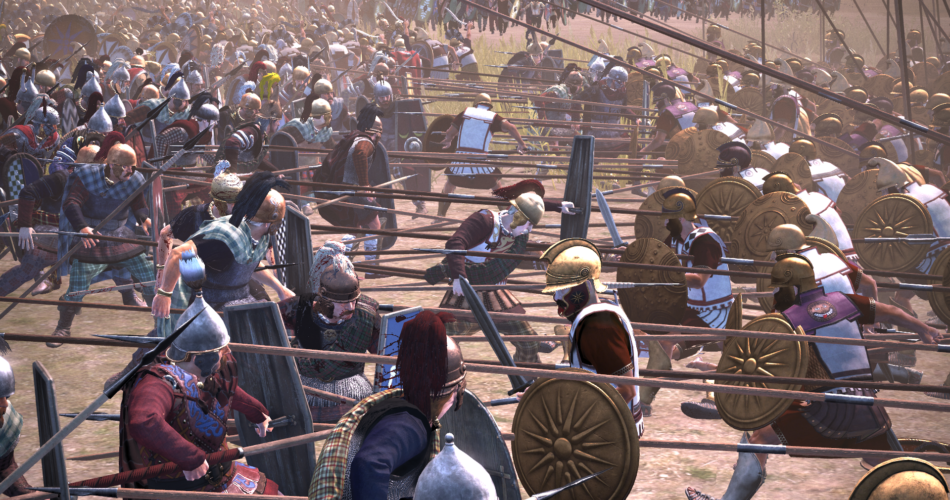
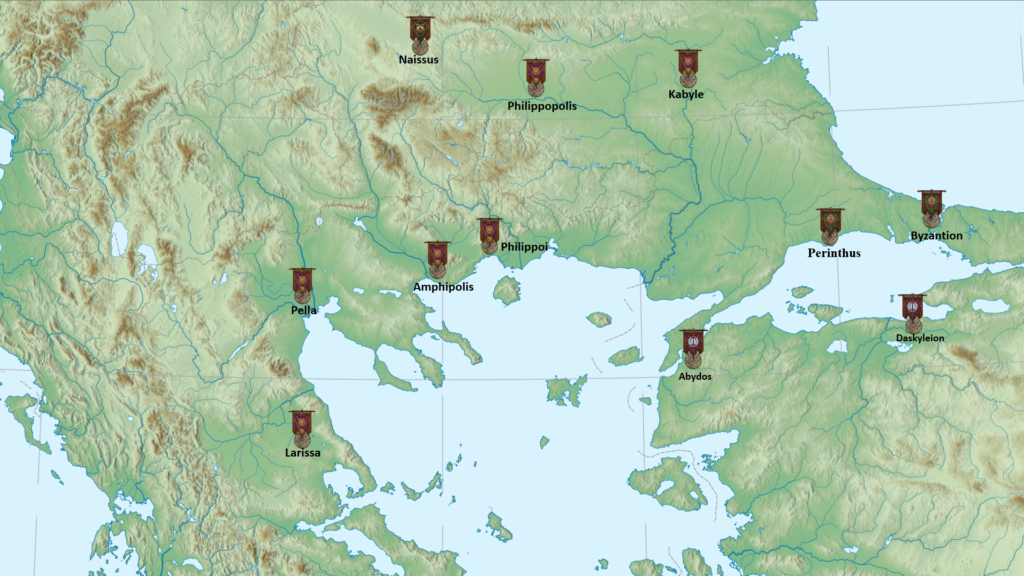
To understand the Celtic invasion of Greece in 280–279 BC, it is necessary to look further back and examine the political and military developments that shaped the region in the preceding decades. Under the Macedonian king Philip II, who ruled from 359 to 336 BC, Macedon expanded its influence considerably into the neighboring regions. Philip launched several campaigns into Thrace, the region lying to the north and east of his kingdom, and gradually brought large areas under Macedonian control. Although he failed to capture several important cities along the Sea of Marmara, most notably Perinthus and Byzantium, he succeeded in extending Macedonian authority deep into the Thracian interior, as far as the Haemus Mountains, or modern Balkan Mountains. To consolidate his control over these territories, Philip established several forts and a small number of Macedonian colonies in the region.
Despite Philip II’s territorial expansion, Macedonian authority over much of Thrace remained weak and was more nominal than firmly established. In practice, Macedonian control seems to have rested primarily on a limited network of major garrisons, particularly at Philippopolis and Kabyle, where Macedonian settlers were also established. These principal strongholds were supported by a series of smaller forts and military posts positioned along the roads connecting them. Such a relatively limited military presence, however, was unlikely to have been sufficient to secure lasting control over the wider Thracian countryside.
At the same time, a number of Thracian chiefs managed to retain their positions by acknowledging Macedonian authority and submitting formally to Philip. Among those who continued to hold influence were members of the Odrysian royal family, which had dominated much of the region for roughly two centuries. Although the Odrysian kingdom had been brought under Macedonian supremacy, members of its ruling dynasty remained active in the political affairs of Thrace.
Beyond the Haemus Mountains, Philip II extended his activities through diplomacy and military raids rather than permanent conquest. He established contacts with various tribes and local rulers and launched several expeditions into the territories to the north, particularly along the Black Sea coast and even across the Danube River. These campaigns, however, did not result in any lasting territorial acquisitions, leaving the Haemus range as the northern boundary of established Macedonian control.
Nevertheless, Philip’s actions beyond the mountains carried a clear political message. His raids demonstrated that the peoples living north of the Haemus were within the reach of the Macedonian army, while his diplomatic efforts frequently aimed at securing the submission of local rulers. The kings and chiefs who governed the lands between the Haemus Mountains and the Danube therefore had reason to expect that Macedonian expansion might eventually reach their territories. Philip, however, did not immediately turn his attention toward them. His next major objective lay much farther to the east: the Persian Empire.
Alexander the Great and the Triballi Campaign
Philip II was assassinated at Aegae in 336 BC, bringing his long reign to an abrupt end. He was succeeded by his twenty-year-old son, Alexander III, who would later become known as Alexander the Great. The sudden change of ruler created uncertainty across Macedon’s recently established sphere of influence. As was often the case after the death of a Macedonian king, the Illyrians soon resumed their raids, while unrest also began to spread in Greece. Alexander moved quickly to deal with these challenges and secured his position before turning his attention northward.
His next target was the Triballi, a powerful Thracian people whose territory lay beyond the Haemus Mountains. Alexander marched north and encountered resistance at a mountain pass, but succeeded in forcing his way through. The Triballi withdrew before him and moved their families to an island in the Danube, while their warriors remained behind to defend their territory. Alexander advanced against them with his army drawn up for battle and simultaneously sent ships down the Danube toward the island, placing further pressure on the Triballi. They were defeated again in the resulting battle.
The two battles are said to have cost the Macedonians only about fifty men, while approximately 5,000 Triballi were killed. Although these figures cannot be verified with certainty, they may be roughly accurate. Following this second defeat, the Triballian king Syrmus submitted to Alexander and agreed to peace. Arrian also records that several other Thracian tribes submitted at around the same time. Many of these groups had probably already acknowledged Philip II’s authority, and their renewed submission to Alexander helped restore Macedonian control over Thrace. In this way, Alexander secured the region before turning his attention to the much larger campaigns that lay ahead.
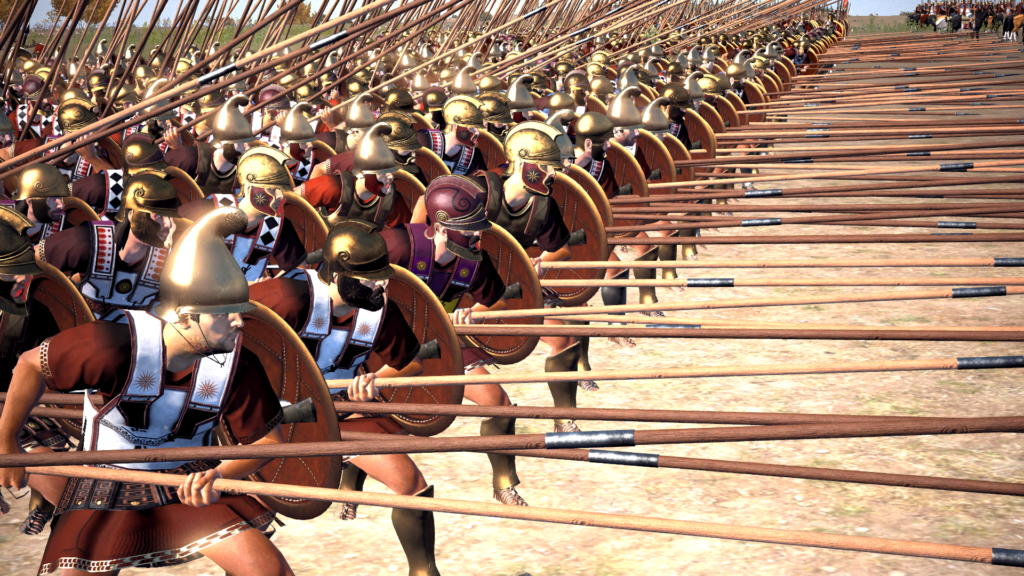
During his campaign against the Triballi, Alexander also secured an important crossing of the Danube at the site of modern Zimnicea, later occupied by the Roman settlement of Novae, or Ad Novas. The settlement was destroyed by fire during the fighting. After crossing the river, Alexander encountered Celtic groups for the first time. The Celts, who lived beyond the Danube, had been closely watching the expansion of Macedonian power during Philip II’s campaigns in Thrace. They now sought contact with Alexander and sent an embassy to participate in the negotiations for peace.
First Contact
This encounter marked the beginning of the first recorded contacts between the Macedonian monarchy and the Celtic peoples of the region. In 335 BC, Celtic envoys from the Adriatic region visited Alexander and negotiated a treaty based on friendship and hospitality. According to Strabo, Alexander received them warmly and, while drinking with the envoys, asked what they feared most. Expecting them to name him, he was instead told that they feared nothing except that the sky might fall upon them. They added, however, that they valued the friendship of a man such as Alexander above everything else.
A second recorded diplomatic contact took place in 323 BC, when a group of Celtic leaders visited Alexander at Babylon, shortly before his death. After these diplomatic encounters, the sources provide little information about the Celts for roughly the next two decades. During this period, however, the political situation of the region changed dramatically. Alexander’s death in 323 BC was followed by the fragmentation of his empire, while Macedon became increasingly consumed by struggles among the Successor states. As Macedonian power weakened and its attention was repeatedly diverted by conflicts in Greece and elsewhere, the south-eastern Balkans became increasingly vulnerable. For the more ambitious Celtic leaders based in Illyria and southern Pannonia, this weakening of Macedonian power created new opportunities for expansion toward the south.
The Balkan Power Vacuum: Celtic Consolidation and the Collapse of Lysimachus
The next recorded encounter between Macedon and the Celts occurred in 298 BC. The group involved was a Galatian force led by a chief named Kambaules, which had reached the Haemus Mountains and thereby come within the sphere of Macedonian concern. Cassander, who was then king of Macedon, responded by moving against them and forcing them to withdraw. It is also possible that his intervention prevented them from advancing farther into Macedonian territory. In any case, Kambaules did not penetrate far into Macedon, and the evidence does not establish that his expedition was intended as an attempt to conquer the kingdom.
The Greek writer and geographer Pausanias, writing in the 2nd century AD, later connected Kambaules’ expedition with the major Celtic invasions of Macedon that took place about two decades later. He suggested that Kambaules’ expedition had inspired those later movements, although this connection is difficult to establish with confidence. What the episode does show is that Celtic groups had already reached the Haemus region by the beginning of the 3rd century BC. Their presence in the area also suggests that substantial Celtic populations were now established farther to the north-west, in the direction of Singidunum.
The encounter should therefore not necessarily be viewed as an unsuccessful Celtic invasion of Macedon. Rather, it shows that Celtic groups were beginning to come into increasing contact with the Macedonian sphere of influence. Cassander’s intervention, meanwhile, indicates that the Macedonian king was determined to maintain his authority in Thrace and to prevent Celtic groups from advancing farther south. The Galatian communities around the Banat were thus made aware that Macedon was watching developments along its northern approaches and was prepared to intervene when necessary.
By the 280s BC, Celtic settlement in the Balkans had already existed for several generations. During this period, the Celtic population had grown through the arrival of new groups from elsewhere as well as through the incorporation of local peoples. Among the Celtic communities that emerged was the Scordisci, who developed into a significant political power and established influence over large parts of the central Balkans south of their main territory.
The emergence of the Scordisci represented an important change in the political landscape north of Macedon. For the first time, Macedon faced a relatively established and powerful Celtic polity in the northern Balkans. Although there had been no clear large-scale act of aggression against Macedon—apart from the earlier expedition associated with Kambaules—the Scordisci possessed the population and political organization necessary to support military expansion. Their reputation for warfare and their growing strength therefore made them a potential danger to the Macedonian kingdom.
Yet there is little evidence that the Macedonian rulers of the 280s BC fully recognized the significance of this developing threat. While the Celtic communities north of Macedon were becoming more organized and powerful, the Macedonian kingdom was entering a period of political instability that would soon leave it particularly vulnerable to events in the northern Balkans.
The opportunity for the Galatians to advance into Macedon emerged from the political upheavals that followed the events of 281 BC. In that year, Lysimachus was challenged by Seleucus I, whose empire stretched from Syria to the eastern territories of the former Persian Empire. Seleucus had carefully prepared for the conflict, while Lysimachus’ position had already been weakened by growing opposition within his territories. Political intrigue and violent disputes within his own family had further damaged his authority, and his position in Asia Minor was becoming increasingly insecure.
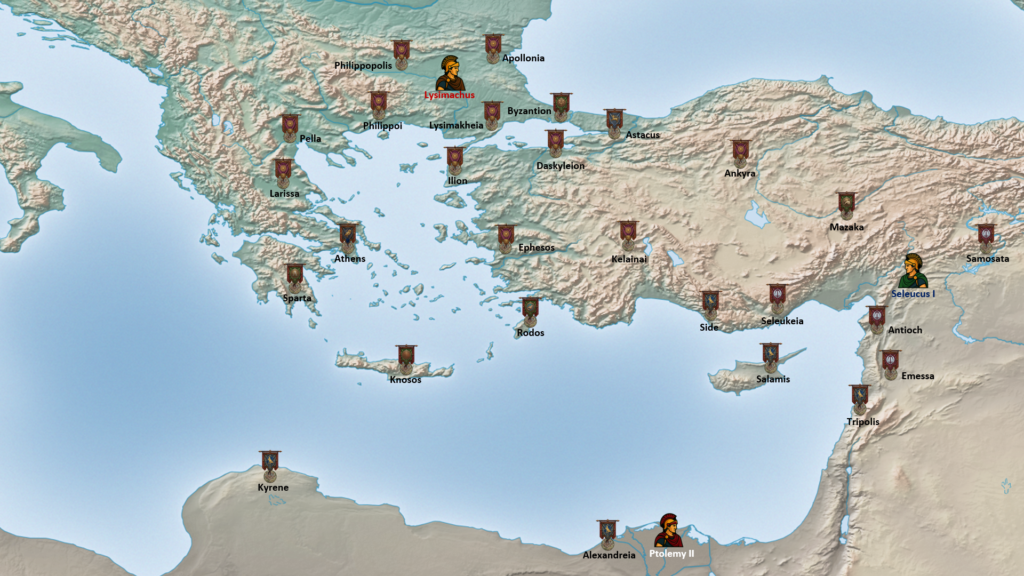
Having secured himself against any possible intervention by Ptolemy II of Egypt, Seleucus marched westward to confront Lysimachus. The two armies met at Corupedium in western Asia Minor in 281 BC, where Lysimachus was decisively defeated and killed in battle. His death brought an abrupt end to his rule and once again threw the territories of his kingdom into dispute, as rival powers and claimants competed for control.
The disintegration of Lysimachus’ kingdom created an opportunity for the Galatians to move southward into Thrace and Macedon. It is difficult to determine what motivated their earliest movements. They may have been exploratory expeditions intended to assess the region and prepare the way for the much larger migration that followed, or they may simply have been the result of increasing population pressure among the Celtic communities of southern Pannonia.
Another possibility is that developments farther west contributed to these movements. During this period, Rome was expanding into northern Italy and had fought the Senones on the Adriatic coast, defeating them in major battles in 295 and 283 BC. The disruption caused by these Roman campaigns may have encouraged some Celtic groups from the Po Valley to move eastward through the region of modern Slovenia in search of new territory. If so, these migrations could have added to the number of displaced warriors and contributed to the growing Celtic presence in the Balkans.
The Rise of Ptolemy Keraunos: Betrayal and the Struggle for the Macedonian Throne
The political turmoil following Lysimachus’ death was not confined to Asia Minor and Thrace; it soon spread into Macedon and the Greek world. Among those who saw an opportunity in the collapse of Lysimachus’ kingdom was Ptolemy Keraunos, the eldest son of Ptolemy I of Egypt. Ptolemy I had chosen his younger son, Ptolemy II, to succeed him, leaving Keraunos outside the line of succession. As a result, Keraunos left Egypt 287 BC and eventually found refuge at the court of Lysimachus, where he became involved in the political and military affairs of the kingdom.
Keraunos had fought alongside Lysimachus at Corupedium in 281 BC. After Lysimachus was killed, however, he quickly transferred his allegiance to Seleucus, who had emerged victorious from the conflict. Seleucus appears to have encouraged Keraunos with the possibility of receiving a kingdom of his own, but his intentions soon became clear. Rather than establishing Keraunos elsewhere, Seleucus decided to claim Macedon for himself and crossed the Hellespont into the Thracian Chersonese.
Seleucus had taken control of Lysimachus’ army after the battle, while most of his own troops were sent back to Syria, where they were based. Keraunos accompanied him, along with a number of officers, many of whom had previously served under Lysimachus. Before long, however, Keraunos turned against Seleucus. He persuaded the king to accompany him to inspect a supposedly remarkable altar and, once they were away from the main body of troops, murdered him.
Keraunos then returned to the soldiers and officers who had accompanied Seleucus. Having apparently secured their support beforehand, he was proclaimed king of Macedon. Thus, within only a few months of Lysimachus’ defeat and death, Macedon had passed from one ruler to another amid a rapidly changing struggle for power.
Antigonus Gonatas, the son of Demetrius I Poliorcetes, who had ruled Macedon from 294 to 288 BC, soon attempted to recover the Macedonian throne for himself. Keraunos confronted him at sea and defeated his forces in a naval battle, forcing Antigonus to withdraw to Demetrias in Thessaly. With this victory, Keraunos secured control over most of Macedon and Thessaly, although Demetrias remained outside his authority.
Keraunos, however, would not retain his newly acquired kingdom for long. His victory over Antigonus had removed one immediate rival, but a far more serious danger was already emerging to the north. In early 280 BC, a large Celtic invasion force moved southward into the Balkans, challenging the Macedonian kingdom on a scale that Keraunos had not previously faced. The northern frontier, which had been relatively secure under Lysimachus, was no longer able to prevent the Celtic groups from advancing into Macedonian territory.
The kingdom was also suffering from a serious military disadvantage. The army that Seleucus had intended to use in his attempt to secure Macedon—the former army of Lysimachus—had effectively ceased to exist as a unified force. Seleucus’ own army had largely returned to Syria.
The soldiers who had served under Lysimachus were likewise dispersed across Asia and Thrace, with others settled in Macedon. Only those still living in the European territories could realistically be called upon to defend the kingdom. Those who had been stationed in Asia had probably returned to their homes after Lysimachus’ fall and were now subjects of Seleucus’ successor, Antiochus I.
As a result, Ptolemy Keraunos was largely limited to the troops of the Macedonian army that remained available in Europe. These troops were far less numerous than the armies that earlier Macedonian rulers had commanded, having been heavily depleted by decades of almost continuous warfare. Keraunos therefore faced the additional problem of ruling with an army that was not only limited in size but may also have contained many soldiers who were hostile or resentful toward their new king.
The Three-Pronged Strategy: Organizing the Galatian Invasion Force
The Greek historian Pausanias provides one explanation for the origins of the invasion. He claims that some of the leaders who organized the new attack were survivors of the earlier expedition led by Kambaules. This is possible, although it cannot be established with certainty. Kambaules’ expedition had taken place around two decades earlier, and even if some of its participants later became leaders of the new invasion, they would by then have been considerably older. Kambaules himself was not involved in the later campaign.
Whether or not the invading leaders had personally taken part in Kambaules’ expedition, the earlier encounter may have given the Galatians valuable knowledge of the region. Over the intervening years, they had also gained greater familiarity with Thrace, Macedon, and the Greek world. Their subsequent invasion therefore appears to have been undertaken with a much clearer understanding of the territories they intended to enter and the opportunities presented by Macedon’s political weakness.
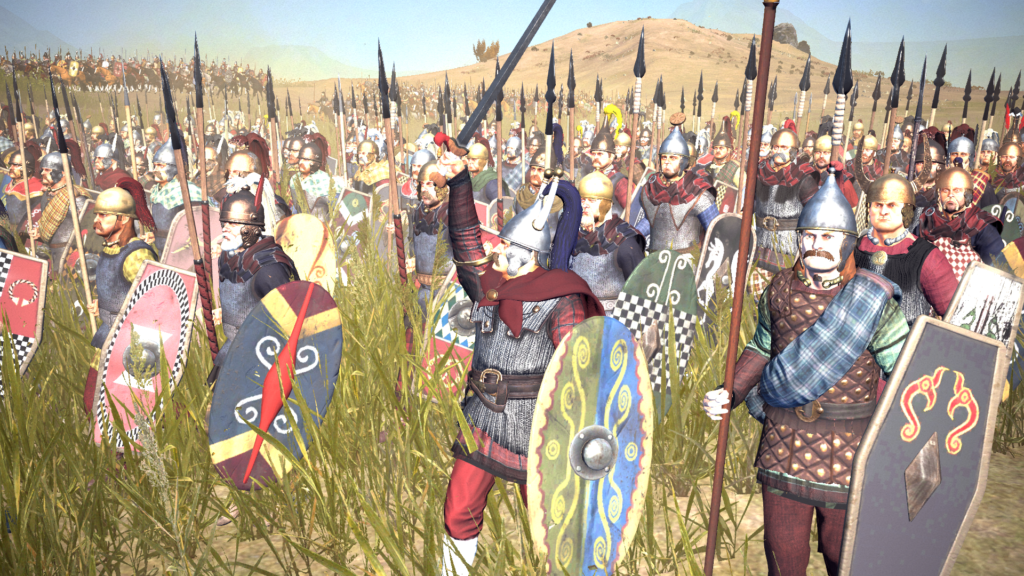
The invading force was divided into three main armies, each assigned a different area of operations. Cerethrius was given command of the force that would invade Thrace and attack the Triballi. Brennus and Acichorius were placed in charge of the army advancing into Paeonia, while Bolgius led the force assigned to invade Macedon and Illyria. This division suggests that the invasion was carefully organized rather than being a single undirected migration.
The original size of the combined Celtic army is impossible to determine with any confidence. Nevertheless, the fact that four prominent chieftains were entrusted with major commands indicates that the force was substantial. It probably included a considerable number of cavalry, as Celtic armies were capable of fielding effective mounted forces, but infantry appears to have formed the main body of the invasion army. The precise numbers remain uncertain, but the scale of the operation was clearly large enough to threaten several regions simultaneously.
.
The Fatal Defeat of Ptolemy Keraunos (280 BC)
The first major Celtic attack was directed against Macedon in 280 BC. According to Justinus, who preserves one of the principal literary accounts of the invasion, the Galatians under Bolgius initially sent envoys to Ptolemy Keraunos to determine whether the Macedonians were prepared to resist them. They offered peace, but Keraunos interpreted the offer as a sign of fear. Rather than treating the embassy as an opportunity for negotiation, he responded by demanding that the Galatian chiefs be handed over as hostages and that their weapons be surrendered. When the envoys returned with his answer, the Galatians reportedly laughed and declared that Keraunos would soon discover whether they had sought peace for their own protection or his.
Keraunos also rejected an offer of military assistance from the Dardanians, who reportedly offered him 20,000 armed men. He dismissed their offer and boasted that the Macedonians were descended from the soldiers of Alexander the Great and had conquered much of the known world without foreign assistance. The Dardanian ruler, on hearing this response, reportedly predicted that the Macedonian kingdom would soon suffer because of the recklessness of its inexperienced king.
Keraunos’ confidence was soon put to the test. When he learned that the army of Bolgius was approaching, he marched out against it before the full Macedonian levy had been assembled. This left him with only a portion of the forces that Macedon could potentially have mobilized. Justinus describes these troops as few and undisciplined, although their precise number cannot be established from the surviving sources. Had Keraunos waited, he might have been able to assemble a much larger force and potentially one comparable to, or even greater than, that of Bolgius. Instead, he chose to confront the Galatians immediately, apparently underestimating both their strength and the danger they posed.
No detailed description of the battle itself survives, so its course can only be reconstructed tentatively. Given the relatively small size of the Macedonian force, one possibility is that the Galatians managed to surround or outflank the Macedonian formation. If the phalanx was attacked from the sides and its formation disrupted, the Macedonians would have lost much of the advantage provided by the long sarissa that had been so effective in the armies of Alexander and his successors. Once the formation had been penetrated, the Galatian warriors could have engaged the Macedonian infantry at close quarters with their swords. The Macedonian cavalry may also have been driven from the field, particularly if the Galatians possessed a numerical advantage in mounted troops. These details remain speculative, however, as the surviving sources do not provide enough information to establish the tactics used in the battle.
The fighting nevertheless ended in a decisive Macedonian defeat. Keraunos was wounded several times before being captured and killed. His head was then cut off, placed on a spear, and carried around the Galatian army, apparently to strike terror into the Macedonians. The death of their king appears to have caused the army to collapse. The surviving soldiers were scattered, while many others were either captured or killed.
The defeat was a serious blow to Macedon. Although Keraunos had taken only a relatively small force into battle, Macedon’s military manpower had already been severely depleted by decades of warfare. The destruction of even this limited force therefore further reduced the kingdom’s ability to resist the Galatian invasion. Combined with the death of Keraunos himself, the defeat left Macedon in an extremely vulnerable position at a critical moment.
The Aftermath of 280 BC
The defeat of the Macedonian army and the death of Keraunos did not lead to the immediate collapse of Macedonian resistance. The population reacted quickly to the news of the disaster. As people mourned the dead and worried about those taken prisoner, defensive preparations were put into effect. Soldiers who had escaped from the battlefield, probably including a significant number of cavalrymen, carried news of the defeat to the surrounding communities. Prayers were offered, people living in the countryside sought safety inside the fortified towns, the city gates were closed, and the walls were manned in preparation for a possible Galatian attack.
Yet Bolgius did not immediately attempt to press his advantage. Instead, he withdrew northward after his victory. The reasons for this decision are uncertain. His immediate objective may have been to obtain booty and possibly demand payment from the Macedonians rather than to conquer the kingdom outright. Alternatively, his army may have suffered substantial casualties, although the surviving sources do not provide evidence for the scale of its losses. It is also possible that Bolgius was unable to count on assistance from the other Galatian armies, which were operating in different parts of the Balkans. The difficulty of capturing a succession of fortified Macedonian cities may have been another reason for abandoning the advance. His withdrawal may therefore have resulted from a combination of these factors.
The campaign of Bolgius was only one part of a much larger Galatian offensive. At roughly the same time, Cerethrius was operating in Thrace, where his army became heavily involved in fighting and was forced to turn back against the Triballi. Meanwhile, the army commanded by Brennus and Acichorius had attempted to advance through Paeonia but failed to penetrate the mountain barrier protecting Macedon. Their failure meant that the three Galatian armies had not achieved a decisive breakthrough into Macedon.
The Macedonians therefore gained a short period in which to recover and organize their defenses. From early 279 BC until the arrival of the larger Galatian invasion later that year, they also had to find a new king to replace Keraunos. The temporary withdrawal of the Galatian forces appears to have provided Macedon with a brief but important breathing space.
The failure of the first invasion to achieve its wider objective may explain why the Galatians returned with a much larger force. Their original plan may have been intended to weaken Macedonian defenses and prepare the way for a more extensive invasion in the following year. Bolgius had defeated Keraunos, but the other Galatian armies had failed to break through the defensive barriers protecting Macedon, while Bolgius himself had withdrawn after a hard-fought victory without securing the kingdom. From this perspective, Keraunos’ decision to fight was not necessarily as reckless as it first appeared; his principal error may have been that he confronted the Galatians before the Macedonian army had been fully assembled. His defeat, however, left Macedon weakened and ensured that the Galatians would have another opportunity to attack when they returned in 279 BC.
Chaos in Macedon: The Succession Crisis and the Rise of Sosthenes
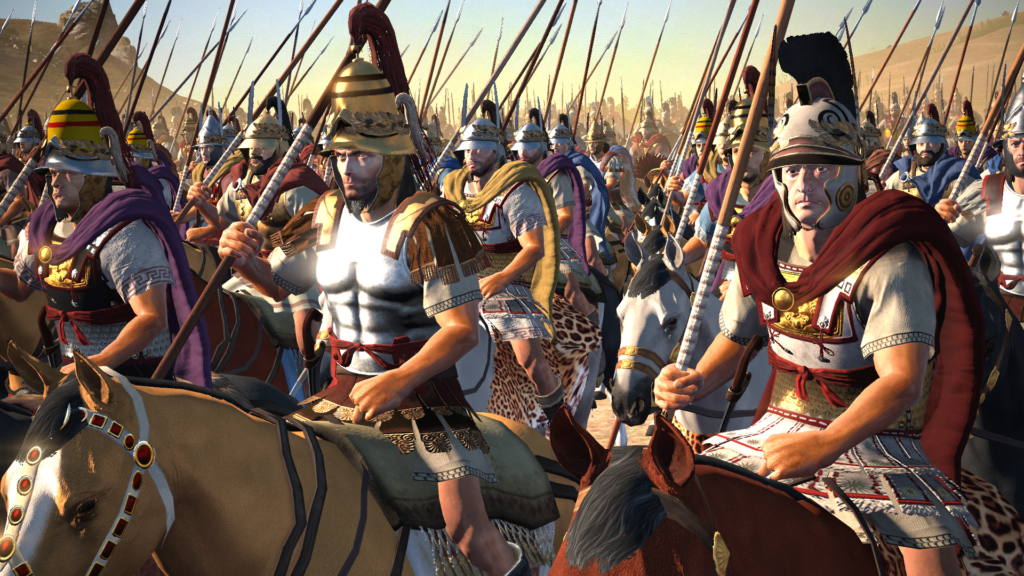
The death of Ptolemy Keraunos left Macedon without a stable ruler, and the kingdom entered a rapid succession of short-lived reigns. Keraunos was succeeded by his brother Meleager, but within only two months the Macedonian army judged him unsuitable to continue as king and removed him from the throne. He was replaced by Antipater, son of Philip, whose reign lasted only about forty-five days before he too was deposed.
The Macedonian army then turned to Sosthenes, who may previously have served in the army of Lysimachus during the final years of his reign. Sosthenes was chosen by the army to take control of Macedon, although it is uncertain whether he formally accepted the title of king. Some sources describe him instead as strategos, or military commander, perhaps because he lacked a connection to a ruling royal dynasty. In practice, however, he became the dominant military and political authority in Macedon during this period.
The rapid succession did not end with Antipater. Ptolemy and Arrhidaeus, both sons of Lysimachus, were subsequently proclaimed king in quick succession, although neither appears to have exercised effective authority over the whole of Macedon. The exact relationship between these short-lived kings and Sosthenes remains uncertain. At least three of them—Antipater, Ptolemy, and Arrhidaeus—may have continued to exercise some authority in parts of the country, possibly with Sosthenes’ agreement.
Significantly, none of these short-lived rulers was killed during the succession crisis. Instead, Macedon experienced a period in which several competing figures claimed or retained authority while Sosthenes emerged as the principal military leader. This political instability unfolded at precisely the moment when the kingdom was attempting to recover from Keraunos’ defeat and prepare for the much larger Galatian invasion expected in 279 BC.
While Macedon was struggling with its succession crisis, Brennus was assembling a much larger Galatian army for a renewed invasion. He gathered his own forces and also recruited warriors from the armies of Bolgius and Cerethrius who were willing to return for another campaign against Macedon. Unlike the earlier invasion, this time the Galatians appear to have prepared carefully for the passage through the mountains. The defensive barrier in Paeonia, which had previously prevented the Galatians from advancing farther south, was no longer likely to stop them for long.
The precise circumstances of the Paeonians’ withdrawal are unknown. They may have been persuaded through bribery, but it is equally possible that the prospect of confronting the combined strength of the Galatian forces was enough to make further resistance seem impractical. Having already suffered casualties in the earlier fighting, the Paeonians may have chosen to step aside rather than face an army considerably larger than the force they had previously encountered.
The Macedonians were unlikely to have been unaware of these preparations. Scouts could have reported the Galatians’ movements, while the Paeonians themselves may also have warned the Macedonians of the approaching invasion. By around June 279 BC, probably after the harvest, news of the Galatian advance would have made the need for effective military leadership increasingly urgent. This may have been one of the reasons Antipater was removed from the throne. With a much larger invasion approaching, the Macedonian army may have considered him incapable of providing the military leadership required to defend the kingdom.
The Great Invasion of 279 BC
Pausanias gives a remarkably large estimate for the army that Brennus brought into Greece. He claims that the Galatian force consisted of 152,000 infantry and 20,400 cavalry. These figures are probably exaggerated, although Pausanias provides an additional explanation for the number of cavalry. According to him, the 20,400 represented the horsemen actually serving in combat at any one time. Each cavalryman was accompanied by two servants who were also trained riders and had their own horses. When these attendants were included, Pausanias gives the total number of mounted men as 61,200.
At an early stage of the advance, the Galatian army itself was divided. According to Livy, around 20,000 warriors under Leonorios and Lutorios separated from the main force and eventually moved into Asia Minor. The remainder, commanded by Brennus and Acichorius, continued toward Macedon. The exact route they followed is uncertain, but they eventually encountered the Macedonian army under Sosthenes.
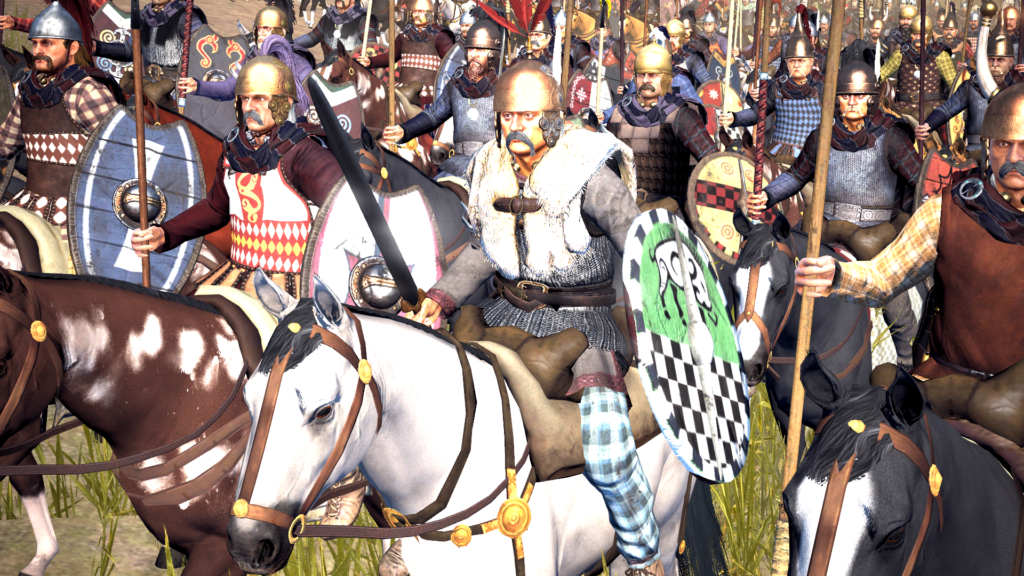
Sosthenes met the Galatians with his army, but his forces were smaller and were defeated. The surviving Macedonians withdrew into the fortified cities, apparently according to a deliberate defensive plan. Brennus was therefore able to ravage the countryside without facing another major field army. However, the campaign produced less booty than the Galatians may have expected. The harvest had already been gathered, while valuable possessions had probably been moved into the cities for protection. Capturing these fortified settlements would have required considerably more time and effort.
An Existential Crisis for the Greek World
Brennus therefore decided to abandon the immediate campaign in Macedon and advance farther south into Greece. He persuaded the Galatian leaders to change their objective, with the prospect of obtaining greater booty from the wealthy cities and religious centers of Greece. Macedon had been the principal target of the earlier phase of the invasion, but it now became the route through which the Galatians advanced toward Greece.
The arrival of the Galatians in Greece created a serious crisis for the Greek communities. Their advance had already demonstrated the consequences of the invasion in Macedon, Thrace, and Paeonia, while reports of atrocities committed against the Thessalians were reaching the Greeks as the Galatian army moved south. Pausanias describes the population as being overwhelmed by fear, but this fear also convinced them that submission might not guarantee their safety.
The situation differed from the earlier wars against the Persian Empire. During the Persian invasions, Greek communities could sometimes submit by offering the traditional tokens of allegiance, earth and water, and thereby hope to avoid destruction. The Galatian advance offered little reason for such confidence.
The Greek communities consequently prepared themselves for resistance. According to Pausanias, both individuals and states came to understand that there was little room for compromise: they would have to resist the Galatians or face the destruction of their communities. Brennus’ decision to turn south had therefore brought the invasion into a new phase, with the Greek cities now preparing to defend themselves against the advancing Galatian army.
Bibliography
1) PAUSANIAS DESCRIPTION OF GREECE | Pausanias
2) EPITOME OF THE PHILIPPIC HISTORY OF POMPEIUS TROGUS | Junianus Justinus
3) ANCIENT CELTS | Barry Cunliffe
4) ALEXANDER TO ACTIUM: THE HISTORICAL EVOLUTION OF THE HELLENISTIC AGE | Peter Green
5) THE CLASSICAL WORLD | David Rankin
6) THE GALATIANS: CELTIC INVADERS OF GREECE AND ASIA MINOR | John D. Grainger
© 2026 History and War
Author: Jishu Roy
Unauthorized reproduction of this content is prohibited.