The Celtic Invasion of 279 BC
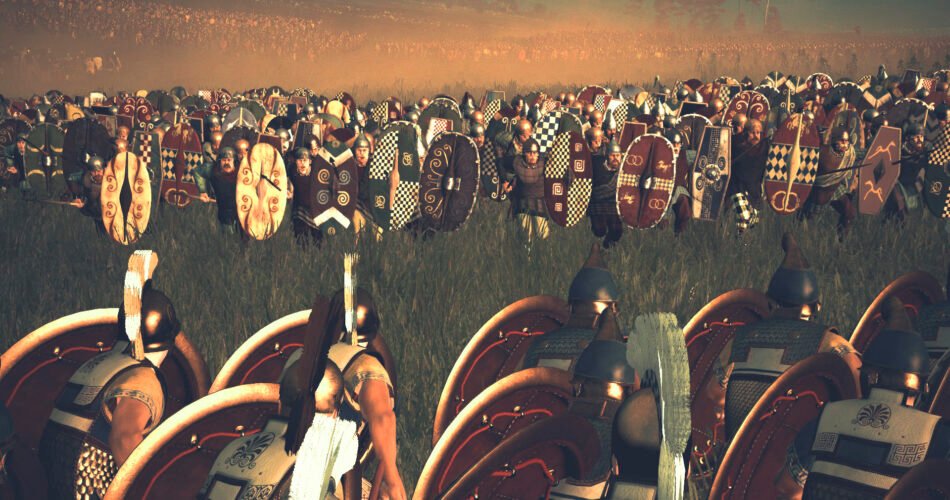
In 279 BC, the Greek mainland confronted a military crisis unprecedented in its recent history: a large-scale migration and invasion by Celtic tribes. Having aggressively bypassed the northern frontiers of Macedonia and Thessaly, this formidable coalition directed its advance toward the strategic pass of Thermopylae. This location carried profound historical resonance, serving as the narrow corridor where a pan-Hellenic alliance had famously resisted the Persian Empire two centuries prior.
However, the geopolitical realities of the third century BC presented a vastly different challenge. Unlike the imperial forces of Persia, the Celts operated as a highly aggressive, numerically superior mass movement driven by plunder and territorial expansion. To mount an effective defense, the perennially divided Greek city-states had to overcome deep-seated political rivalries and maintain a fragile coalition, even as individual territories faced imminent destruction. This study examines the operational mechanics of the Celtic advance into central Greece, the tactical maneuvering at the pass of Thermopylae, the invaders’ subsequent outflanking strategies, and the brutal theater of asymmetrical warfare that emerged in Aetolia.
The Fall of Thessaly and the Mechanics of the Trimarcisia
When the Celtic chieftain Brennus initiated his massive southward march later in 279 BC, his forces—comprising an estimated 152,000 infantry and over 20,000 cavalry—represented far more than a conventional military threat; they posed an existential crisis to the Hellenistic world. This offensive followed a protracted period of political instability in the north, triggered months earlier by the catastrophic initial invasion under Bolgios, which had resulted in the defeat and brutal death of King Ptolemy Keraunos.
Though the Macedonian nobleman Sosthenes had briefly stabilized the region after Keraunos’s demise, his subsequent death plunged the kingdom back into ruin. Capitalizing on this power vacuum, Brennus drove his massive columns through the fractured northern borders, making the neighboring region of Thessaly the next major theater of the invasion. Throughout the ancient Mediterranean, Thessaly was renowned for its expansive plains and its elite, highly formidable cavalry. Under standard operational conditions, these Thessalian horsemen would have served as a devastating counter-measure against an invading army. However, the overwhelming numerical superiority of the Celtic Trimarcisia—a sophisticated, triple-layered tactical cavalry network—rendered the traditional regional defenses entirely ineffective.
Pausanias gives a remarkably detailed description of this Celtic tactic in Book 10. According to him, every single Celtic horseman was assigned two servants. These servants were not mere camp followers; they were skilled riders themselves, fully armed, and mounted on their own horses.
While the elite Celtic horsemen clashed on the front lines, these servants waited just behind the ranks, acting as a living, breathing assembly line of reinforcements. If a warrior or his horse fell, a servant instantly brought him a fresh mount. If a rider was killed, a servant leapt into the saddle to take his master’s place. If a warrior was wounded, one servant carried him back to camp, while the second servant instantly plugged the gap in the battle line.
Pausanias believed that the Celts copied this concept from the famous Persian Immortals—the elite ten thousand. However, he notes one terrifying difference. The Persians waited until a battle was entirely over to replace their casualties. The Celts, conversely, reinforced their lines during the height of the action. This relentless, rolling wave of fresh cavalry completely exhausted the less numerous Thessalian horsemen, breaking the back of their resistance before the real war for Greece had even begun.
In Thessaly, the Celtic forces were reportedly responsible for various forms of violence and plunder. This may have included massacres and the seizure of food and valuables, as well as aggressive moves like hostile occupation and forced troop transit. Even when their movement through a territory did not result in immediate bloodshed, the unarmed populations were still subjected to severe military intimidation and coercion. Ultimately, the surviving accounts do not always make clear the exact nature or scale of these abuses.
Thessalian society was strongly hierarchical, with powerful landowning elites exercising authority over a largely dependent rural population. It is therefore possible that many of the local elites sought refuge within fortified cities and strongholds, while the countryside and its inhabitants were left more exposed to the advancing Celts.
The Celtic advance also revealed that the Greeks themselves did not all respond to the invasion in the same way. Some Thessalians reportedly joined the Celtic forces as they continued southward. Their participation may have resulted from agreements with the invaders or from coercion, but the pursuit of plunder may also have provided an incentive. In this respect, some Thessalians appear to have been willing to profit from the invasion at the expense of other Greek communities.
Subjugation or Survival
While the Celts were engaged in plundering Thessaly, reports of their earlier atrocities in Macedon, Thrace, and Paeonia continued to spread. At the same time, news of the violence inflicted upon the Thessalians gradually reached the Greek city-states of central Greece. These communities closely assessed the danger confronting them and came to regard the Celtic invasion as a threat comparable in seriousness to the Persian invasions of roughly two centuries earlier.
Yet there was an important difference between the two situations. During the Persian invasions, some Greek communities could submit to Persian authority by offering the traditional tokens of allegiance, earth and water, and thereby hope to preserve their cities and populations from destruction. The advance of the Celts offered far less reason for such confidence. The reports arriving from the regions already overrun suggested that submission did not necessarily provide protection from plunder or violence.
Pausanias describes the Greek population as being overwhelmed by fear as the Celtic army approached. Yet this fear did not simply lead to submission. Instead, it strengthened the conviction that surrender might offer no real protection. If the Celts were willing to devastate communities that came under their control, then resistance appeared to be the only reliable way to defend their cities, territories, and people.
The Greek communities therefore began preparing for resistance. According to Pausanias, both individuals and states understood that there was little room for compromise: they would have to confront the Celts or risk seeing their communities destroyed. The situation also revived memories of the Persian Wars, when Greek states had faced another powerful invading army and organised a collective defense. Athens once again took part in the effort to defend Greece, although the resistance of 279 BC was a broader coalition involving several Greek communities, with the Aetolians emerging as particularly important in the coming struggle.
Athenian orator and statesman Demochares may have played a role in spreading the warning and encouraging the Greeks to prepare for the approaching danger, although the extent of his involvement is uncertain. Communities stretching from Phokis to the Isthmus of Corinth sent troops to join the defense. Their objective was to occupy the pass of Thermopylae before the Celtic army could reach it. The delay caused by the Celts’ prolonged plundering in Macedon and Thessaly gave the Greeks valuable time. While the forces of Brennus were still in the regions of Phthiotis and Magnesia in southern Thessaly, the Greek contingents had already assembled at Thermopylae and prepared to block the route into central Greece.
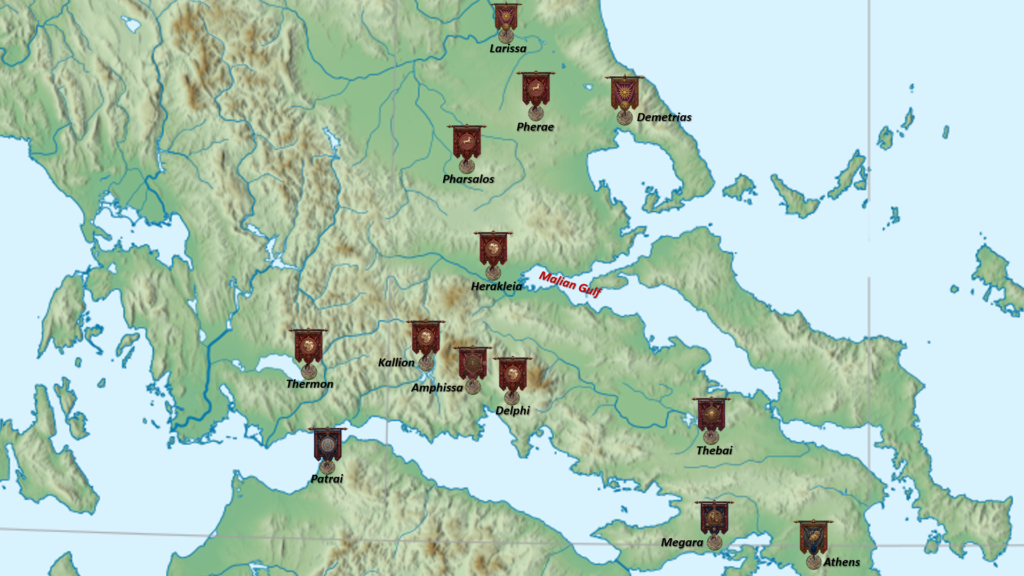
Between Phokis and Thessaly, and therefore between the Greek army assembled at Thermopylae and the advancing Celtic forces, lay several smaller communities around the Malian Gulf and along the valley of the Spercheios River. Among them were the Malians and the Ainianians. Because these communities lay on the northern side of the Greek defensive position, they were exposed directly to the advancing Celts and could not rely on the main Greek force for protection.
Their position left them with few alternatives. Like some of the Thessalians before them, they were compelled to submit to the Celts and, once under their control, were required to cooperate with the invading army. Submission was therefore not necessarily a voluntary act of alliance, but a means of survival under the circumstances.
The Aetolians faced a similar danger. Their territory extended across much of central Greece toward Herakleia Trachineia on the southern shore of the Malian Gulf. Although the main Greek army had established its defensive position at Thermopylae, large parts of Aetolia lay beyond that line and remained exposed to the Celtic advance. The security of these territories would therefore depend not only on the defense of Thermopylae, but also on the ability of the Greeks to prevent the Celts from penetrating farther into central Greece.
The Greek Order of Battle: Reconstructed Forces of the 279 BC
Pausanias provides unusually detailed figures for the forces that assembled from the Greek communities to confront the Celtic invasion. The largest contingent came from Boeotia, which supplied ten thousand hoplites and five hundred Cavalry. Its Boeotarchs were Cephisodotus, Thearidas, Diogenes, and Lysander.
Phokis contributed three thousand infantry and five hundred Cavalry under the command of Critobulus and Antiochus. The Locrians from the region opposite the island of Atalanta sent seven hundred men under Meidias, with no cavalry. Megara contributed four hundred hoplites, commanded by Hipponicus of Megara.
The Aetolians provided a particularly substantial force, drawing upon virtually every category of fighting man. Pausanias does not give the number of their cavalry, but records seven hundred light-armed troops and more than seven thousand hoplites. Their commanders were Polyarchus, Polyphron, and Lacrates.
Athens also made a significant contribution. The Athenian commander was Callippus, son of Moerocles. The Athenians brought five hundred cavalry and one thousand Infantry, while also deploying a large part of their naval strength. Their ships were important because the Greek position at Thermopylae was intended to be supported not only by land forces but also by naval operations in the nearby waters.
With this coalition assembled, another difficult question arose: who would exercise overall command?
Pausanias states that Callippus of Athens was chosen as commander because of Athens’ ancient prestige and reputation. However, the situation was probably more complicated than this explanation suggests. The Athenian contingent was far from being the largest force present; the Boeotians and especially the Aetolians contributed considerably larger bodies of troops. It is therefore difficult to assume that Athens automatically possessed unquestioned authority over the entire coalition simply because of its historical reputation.
The actual command structure may have been much less centralised. It is possible that an Aetolian commander exercised the greatest practical influence, particularly given the size of the Aetolian contingent and the fact that the Celtic advance posed an immediate threat to Aetolian territory. Alternatively, the commanders of the major contingents may have been reluctant to place themselves under the authority of another Greek state. In practice, whoever was regarded as the overall commander appears to have had limited ability to impose his decisions upon the individual contingents.
The appeal for assistance had also reached the Hellenistic rulers. Pausanias states that the king of Macedonia sent five hundred mercenaries, while the king of Asia, Antiochus, sent another five hundred. Aristodemus, a Macedonian, commanded the troops associated with Antigonos II Gonatas, while Telesarchus, a Syrian from the region of the Orontes, commanded the forces sent by Antiochus.
The political situation surrounding Antigonos II Gonatas requires some caution. Although he had a strong claim to the Macedonian throne, he was not yet in effective control of Macedonia when the Celtic invasion began. His own military resources were based elsewhere, particularly at Peiraieus, which he controlled, and possibly at Demetrias in Magnesia. His troops were therefore largely his own mercenary forces rather than an army drawn from Macedonia under his direct control.
The identity and position of the “king of Macedonia” mentioned by Pausanias should likewise be left without further qualification. Macedonia was undergoing severe political instability after the death of Ptolemy Keraunos, and Sosthenes was the leading military figure in the kingdom at this stage. Rather than imposing a specific identification that Pausanias himself does not provide in this passage, it is safer to retain his wording and refer simply to the king of Macedonia.
The contributions from the Hellenistic rulers were modest compared with the size of the Celtic invasion. Yet their limited assistance should be understood in the wider political context. The rulers of the Hellenistic world had other pressing concerns, and the continuing struggle for control of Macedonia was particularly important. The crisis created by the Celtic invasion was therefore not only a military emergency but also part of a larger struggle for political power in the Hellenistic world.
Tactical Paradigms: Contesting the Celtic Assault Doctrine
The formation of this Greek army did not mean that the traditional rivalries and self-interest of the individual Greek states had suddenly disappeared. Their cooperation was largely practical, driven by the immediate danger posed by the Celtic invasion.
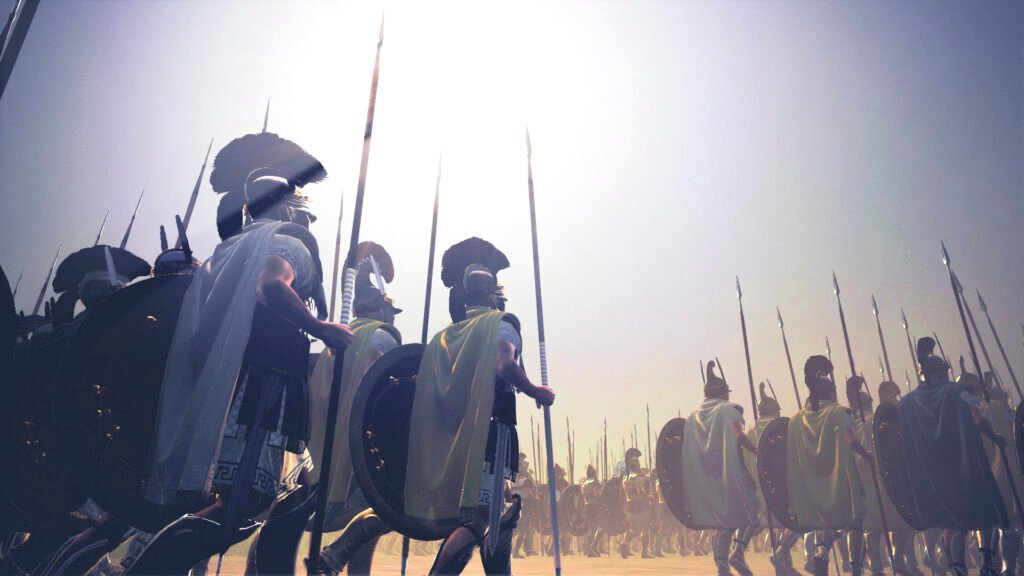
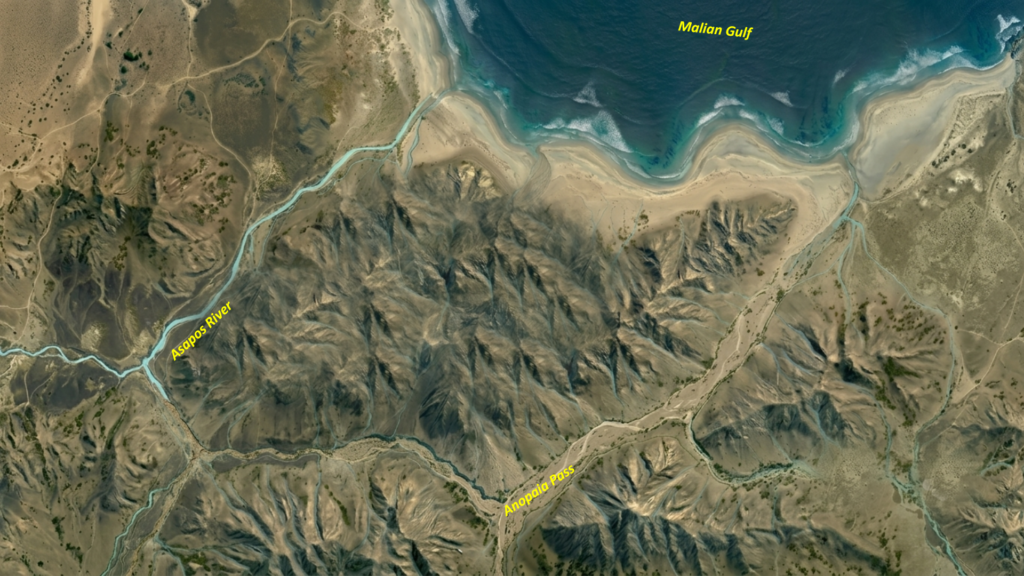
Thermopylae was an especially suitable place to make a stand. The pass carried enormous historical significance because of its association with the Persian Wars, although its practical military advantages were even more important. The narrow corridor between the mountains and the sea restricted the space in which the invading army could deploy. This allowed the Greek hoplites to fight in a confined area where their discipline, heavy armour, and close-order formations could be used to their greatest advantage.
By this stage, refugees and scouts would also have provided the Greeks with information about Celtic methods of warfare. Their attacks relied heavily on aggressive massed assaults, in which large numbers of warriors could use their speed, numbers, and close-combat weapons to overwhelm an opponent. Such tactics could be particularly effective in open terrain or against an enemy whose formation was poorly organised or significantly outnumbered.
At Thermopylae, however, the Greeks hoped to deny the Celts these advantages. A disciplined hoplite army defending a narrow position could prevent the Celts from fully exploiting their numerical strength or surrounding the Greek formation. Yet Thermopylae had one serious weakness. A position that appeared almost impossible to break from the front could still be turned if the enemy found a route around it. The history of Thermopylae had already demonstrated this danger during the Persian Wars, and the same geographical vulnerability would once again become crucial in the struggle against the Celts.
The Spercheios Line
When the Greek forces at Thermopylae learned that the Celtic army had reached Magnesia and Phthiotis, they sent their cavalry and 1000 light-armed troops to the Spercheios River. Their task was to make the Celtic crossing difficult and costly. The Greeks destroyed the bridges and established a temporary position along the riverbank.
Brennus, however, avoided a direct attempt to restore the destroyed bridges. During the night, he selected about ten thousand Celtic warriors, particularly strong swimmers and taller men, and sent them farther downstream. In this area, the Spercheios spread across the plain into a broad marsh and lake, making it possible to cross by swimming and wading. According to Pausanias, some of the Celts used their shields as makeshift floats, while the tallest warriors could cross on foot through the shallower water.
When the Greek detachment learned that the Celts had crossed the river, it withdrew to the main position at Thermopylae. The action had therefore served primarily as a forward delaying measure rather than an attempt to stop the entire Celtic army at the Spercheios. Brennus then ordered the inhabitants around the Malian Gulf to construct bridges across the river. Frightened by the destruction already caused by the invasion, the local population complied, hoping that the Celts would move on rather than remain in their territory and inflict further damage.
After crossing the Spercheios, the Celtic army entered Aetolian territory and reached the region of Oeta and the city of Herakleia Trachineia. The area had only recently come under Aetolian control, perhaps partly in response to the growing threat posed by the Celtic advance.
The surrounding countryside was ravaged, but Herakleia itself offered determined resistance. Pausanias appears to have regarded the city’s defense as noteworthy, perhaps because of its recent connection with the Aetolian League. The defenders nevertheless had strong reasons to resist, since the survival of Herakleia was closely tied to the security of the surrounding region.
The Celts soon learned of the Greek army assembled at Thermopylae, possibly through deserters or prisoners taken during the earlier fighting at the Spercheios, or through information supplied by local communities. Brennus therefore decided that the destruction of the Greek field army was more important than the capture of Herakleia. This followed a pattern already seen during the invasion of Macedon, where defeating opposing armies had allowed the Celts to advance freely in countryside. A substantial part of the Celtic army consequently continued toward Thermopylae, while the attack on Herakleia remained limited.
Blood in the Mudflats
Having decided to confront the Greek army at Thermopylae, Brennus marched his forces toward the Greek position. Confident in his superiority, he began the attack at sunrise. Pausanias notes that Brennus had neither a Greek soothsayer to advise him nor, apparently, did he perform the sacrificial rites of his own people, if the Celts possessed an established tradition of divination. The Greeks, meanwhile, advanced against the Celts in silence and in good order. When the two sides came into close combat, the Greek infantry maintained its formation rather than rushing forward and disrupting the line. The light-armed troops likewise remained in position, supporting the main force by throwing javelins, shooting arrows, and hurling projectiles with their slings.
The cavalry on both sides proved largely ineffective in the fighting. The terrain around Thermopylae was too confined for cavalry to operate effectively, while the rocky ground was naturally smooth and made slippery by the streams that ran across the pass. These conditions severely restricted mounted movement and prevented either side from gaining much advantage from its cavalry.
The Celts were also at a disadvantage in protective equipment compared with the Greek hoplites. According to Pausanias, their principal form of defense was their characteristic shield, while they lacked much of the body armour carried by the heavily equipped Greek infantry. He also considered them less experienced in the kind of close-order warfare required at Thermopylae.
The Celts continued to advance with extraordinary ferocity, maintaining their attacks even after suffering serious wounds. Those struck by swords or axes continued fighting for as long as they remained alive. Even when pierced by arrows or javelins, they did not immediately withdraw or lose their determination to fight. Some warriors pulled the weapons from their own wounds and hurled them back at the Greeks, while others used the recovered weapons in close combat.
Meanwhile, the Athenian triremes took considerable risks to support the Greek position. Despite the difficult conditions, they navigated along the coast through the extensive mudflats that reached far into the sea, bringing their ships as close to the Celtic forces as possible. From there, they attacked the Celts with arrows and other missiles.
At this point, however, we must treat Pausanias’s account with some caution, particularly his description of the Athenian role in the battle. His tendency to emphasize Athenian courage may have led him to exaggerate their contribution. He claims that on this occasion the Athenians surpassed the other Greek contingents in bravery. Among them, he singled out a young man named Cydias, who had never fought in battle before.
Cydias was killed during the fighting. His relatives later dedicated his shield to Zeus Eleutherios, Zeus the God of Freedom, and preserved an inscription commemorating his death. The inscription presented the shield as a memorial to Cydias, describing how he had first taken it up in battle and fought against the Celts at Thermopylae. Pausanias adds that the dedication remained in Athens for many years, until the Roman general Sulla and his army carried away the shields and other treasures kept in the porch of Zeus Eleutherios.
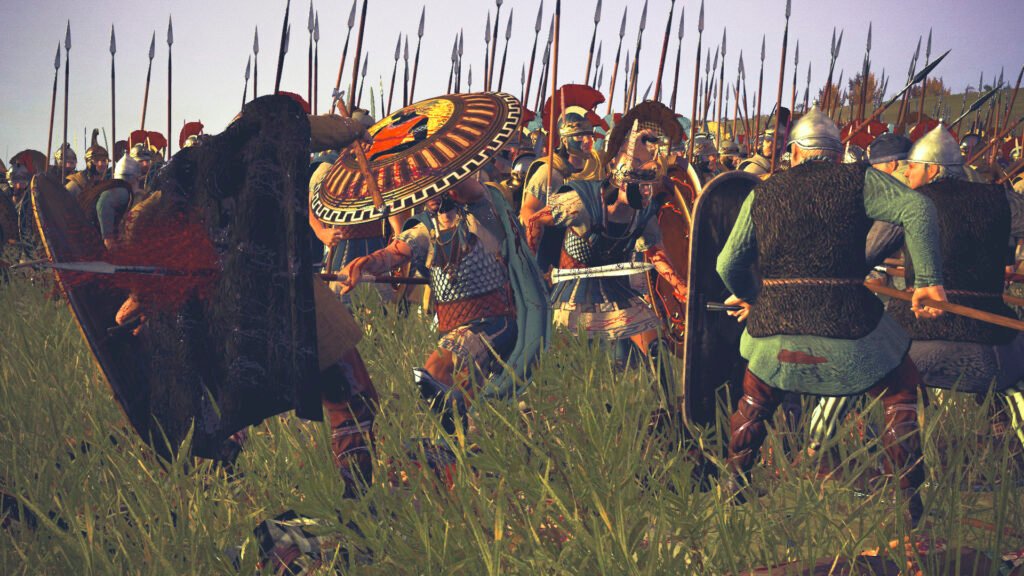
The confined battlefield worked against the Celts. They were able to inflict relatively few casualties on the Greeks, while suffering losses several times greater in return. Facing mounting casualties, their commanders ordered a withdrawal to the camp. The retreat quickly turned into a disorderly rout. Some Celts were trampled by their own comrades in the confusion, while others fell into the marsh and were swallowed by the mud. According to Pausanias, the losses suffered during the retreat were no fewer than those sustained during the fighting itself.
After the battle, the Greeks recovered and buried their own dead and stripped the bodies of the fallen Celts. The Celts, however, made no attempt to send a herald to request permission to recover their dead. Pausanias presents this as evidence of their indifference to the fate of their fallen, saying that they cared little whether the bodies were buried or left exposed to wild animals and carrion birds.
Pausanias gives two possible reasons for the Celts’ apparent indifference toward their dead. First, he believed that leaving their fallen unburied was intended to inspire fear in their enemies. Second, he attributed it to a cultural custom that made them less concerned about the fate of those who had died in battle.
According to Pausanias, only forty Greeks were killed in the fighting. The exact number of Celtic casualties could not be determined, partly because so many warriors had disappeared beneath the mud during the retreat. Whatever the precise figures, the contrast is striking: the Greeks had inflicted severe losses on the Celtic army while suffering comparatively few themselves.
The battle therefore demonstrated just how effective the Greek defensive position had become. The Celtic army, despite its numerical superiority and aggressive fighting style, struggled to break the disciplined Greek infantry in the confined terrain of Thermopylae. In this respect, Thermopylae presented an extraordinary reversal of the famous battle fought there against the Persians centuries earlier. The earlier Greek defenders had been overwhelmed relatively quickly, whereas in 279 BC the Greek army managed to withstand the Celtic assaults for several days and even forced the attackers to retreat with heavy losses.
Fracturing the Alliance
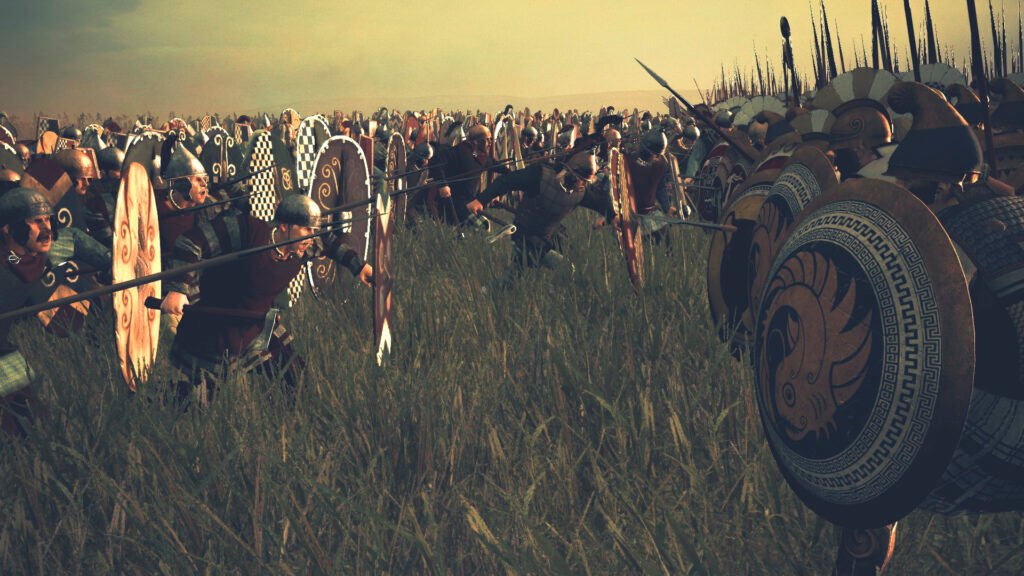
After the failed assault, Brennus gave his army about a week to rest while he examined the surrounding terrain and considered how to overcome the Greek position. The battle had shown that a direct attack against the Greek line would be costly, so he began looking for a way to bypass the defenses rather than trying to break through them again.
Brennus also appears to have recognized a weakness within the Greek coalition: its contingents remained closely tied to their own communities. The willingness of the Thessalians and Ainianians to cooperate with the Celts, together with the assistance provided by the Malians in helping them move through the region, demonstrated that not every local population was equally committed to the Greek defense. If one of the communities supporting the coalition came under direct threat, its forces at Thermopylae might be compelled to return home.
This made Aetolia a particularly attractive target. Much of Aetolia lay to the west, while many of the other Greek contingents at Thermopylae came from communities farther south, beyond the immediate reach of the Celtic army. The Aetolians had also contributed one of the largest contingents to the allied force. If Brennus could force them to withdraw, the Greek army at Thermopylae would be significantly weakened.
His first attempt was to send a force across Mount Oeta. From there, the Celts could potentially move toward Doris and then continue toward Amphissa and Delphi, threatening the Greek position from the rear. The route, however, was blocked by a force defending the sanctuary of Athena above Herakleia Trachineia. This force was commanded by Telesarchus, the leader of the Seleukid contingent sent by King Antiochus. Telesarchus and his men successfully defended the sanctuary and prevented the Celts from using this route to advance farther south. The attempt therefore failed, although Telesarchus himself was killed in the fighting.
The Sack of Kallion
After the failed attempt to force a route through the region of Herakleia Trachineia, Brennus once again benefited from divisions among the Greek communities. His army had spread through the Spercheios valley and into the territory of the Ainianians. Their leaders, together with the Thessalians, encouraged Brennus to try another route into Aetolia farther to the west. Neither the Ainianians nor the Thessalians had much sympathy for the Aetolians, and their hostility toward them made cooperation with the Celts easier.
This time, the invading force was considerably larger than the detachment that had attempted to advance through Herakleia Trachineia. Commanded by two Celtic chiefs, Combutis and Orestorius, it is reported to have numbered 40,000 infantry and 800 Cavalry. These figures come from Greek sources and should be treated with considerable caution rather than accepted as an exact count. The force moved out of the Spercheios valley and around the northern and western side of Mount Oeta. It then followed the valleys of the Vistritsa and Megas rivers, allowing the Celts to approach eastern Aetolia from an unexpected direction.
From there, they launched a sudden attack on the region and captured Kallion, one of its principal urban centers, which was insufficiently defended. The fall of Kallion appears to have taken the Aetolians and the wider Aetolian League by surprise. This was a serious failure in their defensive planning. The Celts had already demonstrated at Oeta that they were willing to use outflanking movements, while Thermopylae itself was famous for the possibility of bypassing the main defensive position through the surrounding mountain routes. After the earlier Celtic attempt at Oeta, the Aetolians should have realized that their mountain routes were vulnerable. Yet the approaches into eastern Aetolia were left insufficiently guarded.
According to the Aetolian account preserved by Pausanias, the Celts committed extreme acts of violence against its inhabitants before setting the city on fire. Kallion lay in the territory of the Apodotoi, an Aetolian people, although the inhabitants are referred to as Kallians. This may reflect the relatively recent development of an urban center in an area that had previously been organized around local communities.
Pausanias gives a particularly horrifying description of what followed. He claims that the Celts killed the city’s male population, showing no distinction between the elderly and young children. He further describes the killing of infants and makes the extreme claim that some Celtic warriors drank their blood and consumed their flesh. His account also states that many women and unmarried young women chose suicide rather than face captivity. Those who survived, according to Pausanias, were subjected to sexual violence and other abuses, with some dying from hunger and exhaustion.
Whether every detail of Pausanias’s account can be accepted literally is difficult to determine. His description is clearly intended to portray the Celts as exceptionally savage, and such accounts of atrocities in ancient warfare often contain elements of exaggeration. Nevertheless, the destruction of Kallion and the killing or enslavement of its inhabitants created a powerful shock among the Aetolians.
News of the disaster quickly reached the Aetolian forces at Thermopylae. The Aetolians immediately withdrew from the Greek position and hurried back toward their homeland. Their anger was driven not only by the suffering of the people of Kallion but also by the need to protect the other Aetolian communities that remained in the path of the Celtic advance.
The response was on an exceptional scale. Men of military age were mobilized throughout Aetolia, while even older men who would normally have been considered unfit for military service joined the ranks. According to Pausanias, Aetolian women also took part in the defense, driven by an even stronger determination to resist the Celts. The fall of Kallion had therefore achieved exactly what Brennus had hoped for: it forced one of the largest contingents in the Greek army to abandon Thermopylae and return home to defend its own territory.
As the Celts advanced, they encountered a detachment of Achaean hoplites from Patrai. The Patraeans had become separated from the main Greek force, or may still have been making their way toward Thermopylae. Trained for conventional hoplite warfare, they confronted the Celts in a direct attack. However, they were heavily outnumbered and faced an enemy fighting with considerable ferocity, suffering severe losses in the engagement.
Although the Patraeans were defeated, their resistance delayed the Celtic advance long enough for the Aetolians to organize a response. The Aetolians took up positions in the surrounding hills, using the same type of defensive strategy they had employed during earlier invasions, including those of the Macedonians.
From these elevated positions, they attacked the retreating Celts with stones, large rocks, javelins, and arrows. The terrain allowed the Aetolians to harass the invaders while avoiding a direct engagement on ground favorable to the Celtic warriors. Their attacks became so persistent that, according to Pausanias, the Celts lost approximately half their force during the retreat. This figure is almost certainly impossible to verify and should be treated cautiously, but the account emphasizes the severity of the Celtic losses. The infantry probably suffered the greatest proportion of casualties, as they would have been more exposed to the attacks during the difficult withdrawal through the hills.
The Great Escape
Even after the withdrawal of the Aetolians, the remaining Greek forces at Thermopylae continued to block the main route through the pass. The Greeks, however, faced the same problem that had confronted their predecessors at Thermopylae in 480 BC: there were alternative routes across Mount Oeta that could be used to bypass the main defensive position. There were two routes across Mount Oeta that could be used to bypass their position. The route above Herakleia Trachineia was extremely steep and, in places, almost impassable. The other route, passing through the territory of the Ainianians, was considerably easier for an army to cross. This was the same route that the Persian general Hydarnes had used during the invasion of 480 BC to get behind the Greek position commanded by Leonidas.
Brennus now turned once again to the strategy that had already served him well during the campaign: avoiding direct confrontation when necessary, exploiting local divisions, and searching for routes around the main Greek defenses. Encouraged by promises of assistance from the Ainianians and the people of Herakleia, he prepared another attempt to outflank the Greek army. Brennus left Acichorius in command of the main Celtic army, instructing him to attack the Greeks only after the flanking movement had been completed. Brennus then took a separate force of 40,000 men and began moving along the mountain route.
The operation was aided by the weather. On that day, a thick mist descended over Mount Oeta and obscured the sunlight. The Phocians who were guarding the mountain path therefore failed to detect the approaching Celts until they were already upon them. The Celts immediately attacked. The Phocians resisted fiercely, but eventually they were forced to abandon the path. They nevertheless accomplished something crucial: they managed to escape and reach the main Greek force before the Celtic encirclement had been completed.
The warning gave the Greeks just enough time to withdraw. With the assistance of the Athenian fleet, the Greek contingents were evacuated from Thermopylae before Brennus could complete his maneuver. The various contingents then separated and returned to their respective communities.
Target Delphi
Brennus, meanwhile, did not wait for Acichorius and the main Celtic army to join him. He immediately turned south and began his march toward Delphi. With the Greek position at Thermopylae finally abandoned, the second stage of the Celtic invasion had come to an end. The campaign now entered its final and most dramatic phase: Brennus’s advance toward Delphi.
Bibliography
1) DESCRIPTION OF GREECE | Pausanias
2) THE ANCIENT CELTS | Barry Cunliffe
3) CELTS AND THE CLASSICAL WORLD | David Rankin
4)THE GALATIANS: CELTIC INVADERS OF GREECE AND ASIA MINOR | John D. Grainger
5) THE POLITICS OF PLUNDER: AITOLIANS AND THEIR KOINON IN THE EARLY HELLENISTIC ERA, 279-217 B.C. | Joseph Scholten
6) THE CELTIC WORLD | Miranda J. Green (ed.)
© 2026 History and War
Author: Jishu Roy
Unauthorized reproduction of this content is prohibited.