The Road to Gela
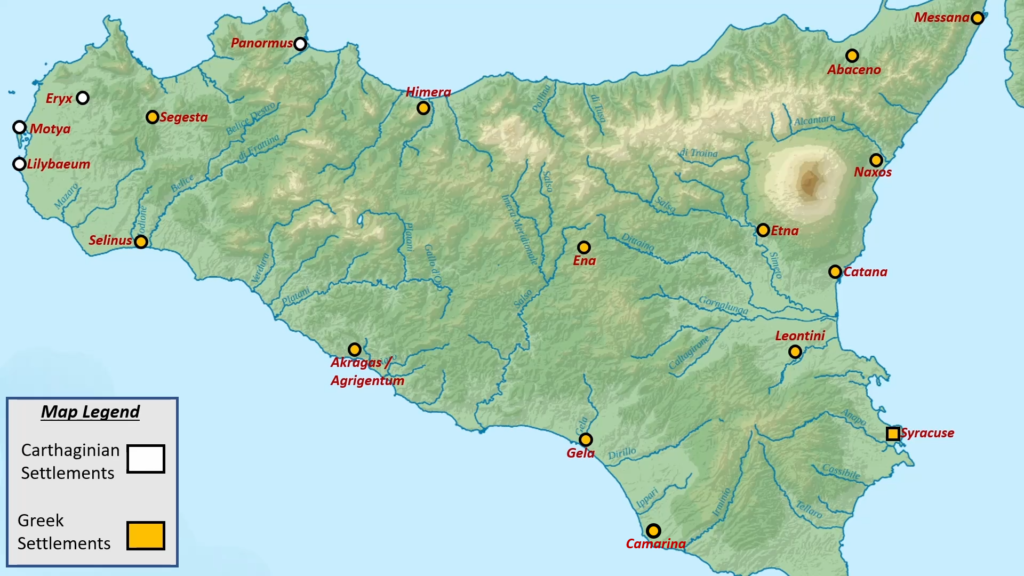
After the capture of Akragas, the Carthaginians turned their attention to Gela. At the centre of this struggle stood a single man—Dionysius of Syracuse—whose rise to power would transform him from a political outsider into one of antiquity’s most controversial rulers. As the Geloans and Carthaginians became locked in a deadly siege, Dionysius of Syracuse prepared a bold three-pronged surprise attack on the Carthaginian camp. And in the climactic battle of Gela, the destiny of Dionysius—and of Sicily itself—would be forever altered.
The Fall of Akragas and the Rise of Dionysius
The news of the destruction of Akragas spread rapidly across Sicily, causing widespread panic. Many inhabitants fled to Syracuse, while others evacuated with their families and possessions to southern Italy. The refugees from Akragas arrived in Syracuse and accused the city’s generals of betrayal. Their claims gained significant support, particularly from Dionysius, who had previously survived the failed campaign of Hermocrates and had since established a strong reputation through his effective service during the defense of Akragas.
During his address to the Syracusan assembly, Dionysius exceeded the accepted rules of debate, leading the magistrates to impose a fine upon him. A wealthy supporter, Philistus, intervened by paying the penalty and urging him to continue. Each time the magistrates attempted to restrain him with additional fines, Philistus covered the cost, effectively allowing Dionysius to speak without interruption. Persuaded by his arguments, the assembly voted to depose the existing generals and appoint new commanders in their place, among whom Dionysius was included.
During the same winter, the Greek cities of Sicily were gripped by deep mistrust, internal conflict, and political intrigue. In 406 BC, Dionysius took his first decisive step toward establishing himself as a tyrant. When urgent appeals for assistance arrived from Gela, requesting immediate aid against the advancing Carthaginians, Dionysius seized the opportunity to advance his ambitions. He promptly marched to Gela with a force of two thousand infantry and four hundred cavalry, where the Spartan commander Dexippus was already stationed with a substantial garrison.
Upon his arrival, Dionysius found the city in a state of civil unrest, with factions in open conflict. He intervened directly in these political disputes, aligning himself with the popular faction against the oligarchic leadership. Through this intervention, he succeeded in securing the condemnation and execution of the Geloan generals.
From the confiscated property of those he had condemned, Dionysius granted the soldiers double pay, thereby securing their loyalty and expanding his base of support. Through this policy, he won the allegiance not only of the troops who had accompanied him to Gela but also of those already stationed there. The people of Gela, meanwhile, praised him enthusiastically as a liberator who had freed them from oppression. Motivated in part by resentment toward the city’s elite, they went so far as to grant Dionysius supreme authority. They subsequently dispatched envoys to Syracuse to proclaim his achievements and to present the official decrees by which he had been honored with exceptional distinctions.
After these events, Dionysius returned to Syracuse and addressed the council with a serious accusation. He claimed that the Carthaginian commander Himilco had attempted to bribe all the Syracusan generals, and that he alone had refused the offer. Dionysius further asserted that Himilco had sent a herald under the pretext of negotiating the ransom of prisoners—likely including captured Syracusan nobles—but that the true purpose of the mission was far more covert. According to Dionysius, the envoy had secretly urged him not to use his authority to investigate ongoing matters too closely, or at least not to interfere if he was unwilling to participate in the scheme. Presenting this as evidence of widespread corruption, Dionysius declared that he could no longer serve as general under such conditions and announced his willingness to resign his command.
Amid a climate of growing fear and instability, Dionysius publicly accused the existing generals of treachery. As a result, he was appointed strategos autokrator—a general vested with supreme authority. Despite this elevation, he remained intent on securing a personal bodyguard to consolidate his position. Unwilling to make such a request openly in Syracuse, he instead marched to Leontini with troops composed largely of men under the age of forty. There, he convened an irregular military assembly and claimed that conspirators had attempted to assassinate him. Persuaded by this account, the soldiers voted to grant him a personal guard of six hundred men, a number he soon increased to one thousand. With this force at his disposal, Dionysius proceeded to reorganize the command structure according to his own preferences, dismissing and appointing officers at will. Among those removed was the Spartan commander Dexippus, whom he deliberately sent away.
This position was, in itself, a legitimate and recognized office. It did not place its holder above the law; rather, it granted a military commander the authority to act independently, without the need to consult colleagues or await instructions from the home government. However, such discretionary power carried a significant potential for misuse. In the case of Dionysius, it became a crucial step toward the consolidation of personal rule, marking a further advance on his path to tyranny.
With the removal of Dexippus, Dionysius faced little resistance in eliminating other potential rivals, including the still-dangerous Daphnaeus, who was subsequently executed. Such measures were characteristic of those employed by aspiring Greek tyrants, and it is likely that many Syracusans recognized the direction in which events were unfolding.
However, the city’s democratic institutions were effectively paralyzed by a combination of fear of the Carthaginian threat and deep mistrust among rival political factions. As influential figures in Syracuse were either brought into Dionysius’ camp, driven into exile, or put to death, he emerged as the dominant power within the city.
According to the historian Diodorus Siculus, upon returning to Syracuse, Dionysius stationed his forces in the arsenal and openly proclaimed himself ruler. Although the Syracusans regarded this development with deep resentment, they were compelled to remain silent. The city was filled with armed foreign troops loyal to Dionysius, and the continued presence of a large Carthaginian army nearby further discouraged any attempt at resistance.
Himilco Marches on Gela
While Dionysius was preoccupied with consolidating his power in Syracuse, the Carthaginian army resumed its campaign in Sicily. After wintering at Akragas, which they had thoroughly destroyed, the Carthaginians advanced once more under the command of Himilco. Taking advantage of the ongoing political divisions among the Greek cities, Himilco was able to prepare his forces without opposition and march from Akragas to Gela in the early summer. With Dionysius still occupied in Syracuse, Gela was temporarily left to rely on its own defenses. Unlike Agrigentum, the city was neither as favorably situated nor as strongly fortified, leaving it more vulnerable to the impending Carthaginian assault.
Himilco spent some time ravaging the surrounding countryside in order to secure provisions for his large army before advancing on Gela, which he reached in July. Upon arrival, he established his camp along the coast to the west of the city. Anticipating an attempt by Syracuse to relieve Gela, the Carthaginians fortified their position with a trench and a palisade, leaving only the seaward side unprotected. Meanwhile, the inhabitants of Gela made preparations to evacuate their women and children to Syracuse. However, many of the women refused to leave, choosing instead to remain in the city, where they would go on to play a significant role in the events that followed.
The Geloans chose to adopt an active defensive strategy rather than remain confined within their walls. The troops stationed in the city divided themselves into several detachments and conducted frequent sorties into the surrounding countryside. Familiar with the local terrain and routes, they targeted Carthaginian foraging parties dispersed across the area. These operations proved effective: they not only captured prisoners on a regular basis but also inflicted significant casualties on the enemy.
The Siege of Gela
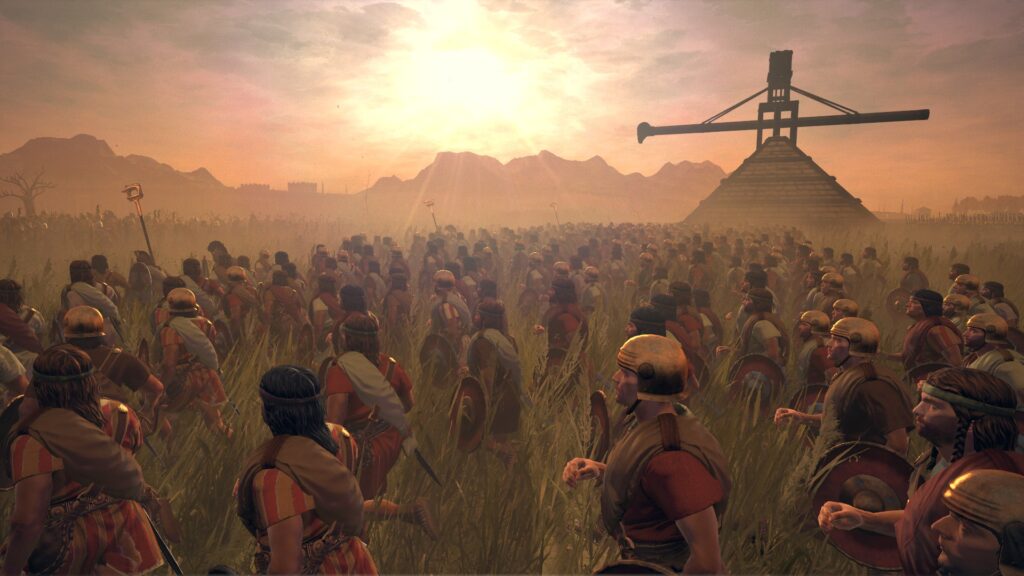
Although the Geloans significantly disrupted Carthaginian operations by harassing their foraging parties, Himilco chose not to construct a full line of circumvallation around Gela. Assessing the city’s comparatively weak fortifications, he instead opted for a rapid assault. The Carthaginians launched repeated attacks against the western walls using battering rams. These assaults succeeded in creating several breaches, as Gela’s defenses were not particularly strong. However, the attackers were unable to capitalize on these openings due to the determined resistance of the defenders. The Geloans not only held their positions but also repaired the damaged sections of the wall during the night. Such efforts were made possible in large part by the contribution of the women and children who had remained in the city, as the men were fully engaged in the fighting.
Dionysius Mobilizes Syracuse
Meanwhile, Dionysius the First of Syracuse mobilized all available resources to relieve Gela. He summoned Greek reinforcements from southern Italy and called upon his allies for additional support. Within Syracuse itself, he enlisted nearly every man capable of bearing arms and combined these forces with his corps of mercenaries. Ancient sources differ in their estimates of the army’s size. Some accounts suggest a total of around fifty thousand troops, while Timaeus gives a more conservative figure of approximately thirty thousand infantry and one thousand cavalry, supported by a fleet of fifty ships. With this force assembled, Dionysius advanced rapidly to assist Gela.
War of Attrition Before Gela
Dionysius of Syracuse established his camp at the mouth of the Gela River, on the side of the city opposite the Carthaginian position. This location allowed him to coordinate operations on both land and sea. Over the following three weeks, he employed light-armed troops to disrupt Carthaginian foraging efforts, while his fleet attempted to sever their supply lines from Africa. This approach echoed the strategy that had nearly brought success against the Carthaginians at Akragas. However, according to Diodorus Siculus, these efforts were only partially effective, as the Carthaginians were still able to obtain supplies despite the continued harassment.
It is possible that Dionysius was deliberately delaying, using the time to prepare and coordinate a complex plan of attack. However, it is more likely that pressure from his own troops compelled him to act. His army was composed largely of citizen-soldiers drawn from the Greek cities of Sicily, who were generally unaccustomed to prolonged campaigns. Such forces typically preferred a swift and decisive engagement rather than a drawn-out war of attrition, and they may have grown increasingly impatient with Dionysius’ cautious strategy. Whatever the precise cause, Dionysius ultimately resolved to abandon this approach and advance against the Carthaginian camp.
Dionysius devised an ambitious and carefully structured plan of attack. The Carthaginians, who held a fortified camp and enjoyed numerical superiority, presented a formidable challenge. To counter these disadvantages, Dionysius organized a coordinated three-pronged assault that integrated heavy and light infantry, cavalry, mercenary forces, naval support, and even an amphibious landing. This strategy reflects a sophisticated understanding of the limitations of the traditional massed phalanx when confronting a fortified position, and demonstrates an effort to overcome such constraints through combined and coordinated operations.
Greek Battle Plan
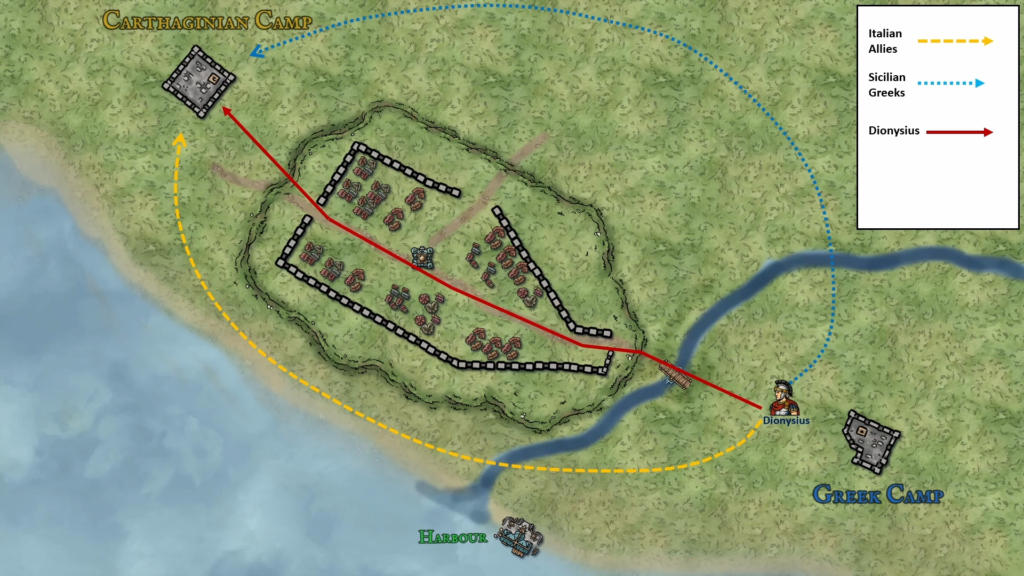
Dionysius divided his land forces into three coordinated divisions. The left wing, composed primarily of Italian hoplites, was instructed to advance along the coastline and attack the western sector of the Carthaginian camp. The right wing, made up largely of Sicilian hoplites supported by cavalry, was assigned to strike the eastern sector.
Dionysius himself assumed command of the central force, consisting chiefly of mercenaries. His plan was to move this contingent through the city and launch an assault against the area where the Carthaginian siege engines were positioned. At the same time, he ordered the cavalry to wait for a signal from the infantry; once given, they were to cross the river and spread out across the surrounding plain. Their role was flexible: if the Greek forces gained the upper hand, they were to join in the attack, but if the situation deteriorated, they were to provide support and stabilize the line.
Command of the naval forces was entrusted to Leptines, the brother of Dionysius. He was instructed to coordinate closely with the land forces: once the Italian contingents advanced into position, the fleet was to approach the Carthaginian camp, land its troops, and attack the western section of the fortifications. The success of this operation depended on precise coordination among the three Greek divisions. Without careful timing, there was a significant risk that each contingent would engage the enemy separately, exposing the entire force to defeat in detail.
The Battle of Gela
The engagement commenced with a naval landing by the Syracusan forces. The Carthaginians responded swiftly, concentrating their efforts on defending the sector of their camp facing the shore, which remained unfortified. At the same time, the Italian contingents advancing along the coastline launched an attack on the Carthaginian camp. In doing so, they intercepted and scattered many of the enemy troops who had moved out to oppose the landing. Exploiting the element of surprise, the left wing of the Syracusan army pressed its advantage and broke into the Punic camp. However, from this point onward, the coordination among the attacking forces began to deteriorate.
The right wing of the Syracusan army was delayed in its advance and failed to launch its attack at the appointed time. This delay allowed the Carthaginians to regroup and establish a coherent defense of their camp. Once their lines were reorganized, the Carthaginians mounted an effective counterattack against the Greek and Italian forces that had initially gained ground. Iberian and Campanian troops, supported by Carthaginian auxiliaries, struck the Italian contingents with considerable force, inflicting heavy casualties and reportedly killing more than a thousand men. At this stage, recognizing that the coordinated plan had broken down, Leptines concluded that the operation had failed and ordered a withdrawal.
The Carthaginians pursued the retreating Greek forces, pressing them closely as they withdrew. However, the pursuers were driven back by missiles and other projectiles launched from the ships, allowing the majority of the Greeks to reach the safety of the city. The Geloans did attempt a brief sortie to assist the Italian contingents, but, fearing that the city’s defenses would be left exposed, they soon halted their advance and withdrew back within the walls.
While the Carthaginians were engaged in pursuing the Greek forces on the left wing, the right wing finally launched its attack against the eastern sector of the Punic camp. The Sicilian Greek troops initially met with success, killing many of the African infantry and driving the remainder back toward their camp. However, this advantage proved short-lived. Iberian, Campanian, and Carthaginian forces soon moved in to support the Africans, halting the Greek advance. Having suffered significant losses—reportedly around six hundred men—the Sicilian troops were forced to withdraw back into the city. The cavalry, observing that the situation had turned decisively against them and facing increasing pressure from the enemy on all sides, likewise retreated toward the city.
Dionysius attempted to lead a force of mercenaries through the city, intending for them to sortie from the western gate at a decisive moment in the battle. However, the city was overcrowded with civilians who had taken refuge from the countryside, and the narrow streets became heavily congested. As a result, the mercenaries were delayed and never reached their intended position in time to take part in the coordinated attack. This failure further disrupted the overall plan, allowing the Carthaginians to confront and defeat the other Greek forces in sequence.
Retreat, Revolt, and the Survival of Dionysius
This defeat placed Dionysius in a highly precarious position, both militarily and politically. The failure to lift the siege left Gela facing the uncertain prospect of enduring a prolonged siege through the winter. At the same time, the setback threatened Dionysius’ standing in Syracuse. If he chose to remain at Gela with his army, his absence from the city would provide his political rivals with a valuable opportunity to undermine his authority. Faced with these constraints, Dionysius resolved to evacuate Gela without delay. The withdrawal was carried out that very night and executed with such haste that the fallen were left unburied on the battlefield.
To deceive the Carthaginians, Dionysius left behind a force of two thousand light-armed troops, instructing them to maintain fires throughout the night and to raise continuous noise so as to create the impression that the entire army remained within the city. At first light, these men withdrew rapidly and rejoined the main force. Once the Carthaginians realized the deception, they advanced into the city and plundered whatever remained in the abandoned houses.
Dionysius retreated to Camarina; however, despite the fact that his army remained capable of further resistance, the same considerations that had compelled him to abandon Gela led him to decide on the immediate evacuation of this city as well. These decisions reflect a degree of sound military and political judgment, as he prioritized strategic security over a potentially costly defense. Nevertheless, the rapid abandonment of two Greek cities in succession represented an unfavorable beginning for a leader seeking to establish a strong military reputation.
By this stage, the countryside was crowded with refugees, the majority of whom were women, children, and the elderly. The Carthaginians’ reputation for harsh treatment intensified their fear, as reports circulated of crucifixions and other severe punishments inflicted upon captives. The suffering of these displaced populations was so severe that discontent against Dionysius grew significantly, eventually developing into a conspiracy aimed at removing him from power.
The cavalry, drawn largely from the wealthy elite of Syracuse, took the lead in opposing Dionysius. Riding with urgency, they reached the city before he could return. Entering through the gates without raising suspicion—since the garrison remained unaware of the events at Gela—they quickly seized the opportunity to act. Upon gaining access, they plundered Dionysius’ residence, carrying off his gold, silver, and other valuable possessions. They also subjected his wife to harsh mistreatment, intending both to inflict personal humiliation and to send a clear message of defiance, demonstrating the existence of a coordinated conspiracy against his rule.
Suspecting what had occurred during his absence, Dionysius hastened back toward Syracuse with all the cavalry and infantry he could trust, advancing with the utmost speed. He recognized that his best chance of countering the rebels lay in preventing the spread of accurate information and in reaching the city before his opponents could consolidate their position.
This calculation proved effective. The cavalry who had preceded him assumed that Dionysius would neither abandon his army nor move far from it, and therefore did not expect his rapid return. Confident that their plan had succeeded, they began to spread the claim that Dionysius had withdrawn from Gela out of fear of the Carthaginians, and that his flight was, in reality, an attempt to escape the hostility of the Syracusans themselves.
Dionysius, having marched without pause for nearly four hundred furlongs, reached the gates of Acradina—one of the principal fortified districts of Syracuse—around midnight with a force of approximately one hundred cavalry and five hundred infantry. Finding the gates closed against him, he ordered that reeds, gathered from the nearby marshes and commonly used by the Syracusans for burning lime, be piled against them and set alight. While the gates were burning, additional troops who had been advancing more slowly began to arrive and reinforce his position. Once the gates had been destroyed, Dionysius immediately entered Acradina with all the forces at his disposal.
A small group of cavalry, drawn from the wealthiest and most prominent citizens, assembled in the marketplace to resist Dionysius’ advance, acting without waiting for broader support from the population. They were quickly surrounded by his mercenary troops and killed with missiles and spears. Dionysius then moved through the streets, ordering the killing of those he encountered attempting to rally resistance. He also entered the houses of suspected opponents, executing some and driving others into exile.
The remaining cavalry managed to escape beyond the city’s walls. By the following morning, the rest of the mercenaries and the main Sicilian forces had arrived at Syracuse. However, the contingents from Gela and Camarina, angered by Dionysius’ actions, refused to join him and instead diverted to Leontini.
Himilco was unable to take advantage of Dionysius’ weakened position, as his own army was once again struck by a severe outbreak of plague, effectively halting the campaign. He had likely advanced as far as the now-abandoned Camarina, and possibly even approached Syracuse itself, but his forces were rendered incapable of further movement due to widespread illness and exhaustion. As a result, both Carthage and Dionysius had a mutual interest in bringing the conflict to an end. In this context, Himilco initiated negotiations and offered to open peace talks.
The Peace of 405 BC
A peace treaty was concluded between the belligerents in 405 BC. Its terms were as follows: Carthage was to retain control of its existing settlements, including those belonging to the Sicanian tribes. The cities of Selinus, Agrigentum, Himera, Gela, and Camarina were permitted to be reoccupied by any surviving former inhabitants; however, these cities were to remain unwalled and were required to pay tribute to Carthage. Leontini, Messana, and the Sicel tribes were granted independence, while Syracuse was placed under the rule of Dionysius. In addition, all prisoners and captured ships were to be returned to their respective owners.
The Rise of the Tyrant of Syracuse
Following the agreement, the Carthaginian army and fleet withdrew from Sicily. The plague, however, was carried back to Africa, where it caused significant devastation in Carthage. The treaty remained in effect until 404 BC, when Dionysius initiated renewed hostilities against the Sicel communities. As Carthage took no immediate action, Dionysius was able to consolidate and expand his power across Sicily. Eventually, in 398 BC, he launched a full-scale war against Carthage by attacking Motya, prompting Himilco once again to lead the Carthaginian response. This marked the beginning of the Third Sicilian War.
© 2026 History and War
Author: Jishu Roy
Unauthorized reproduction of this content is prohibited.