Crisis on the Han Frontier
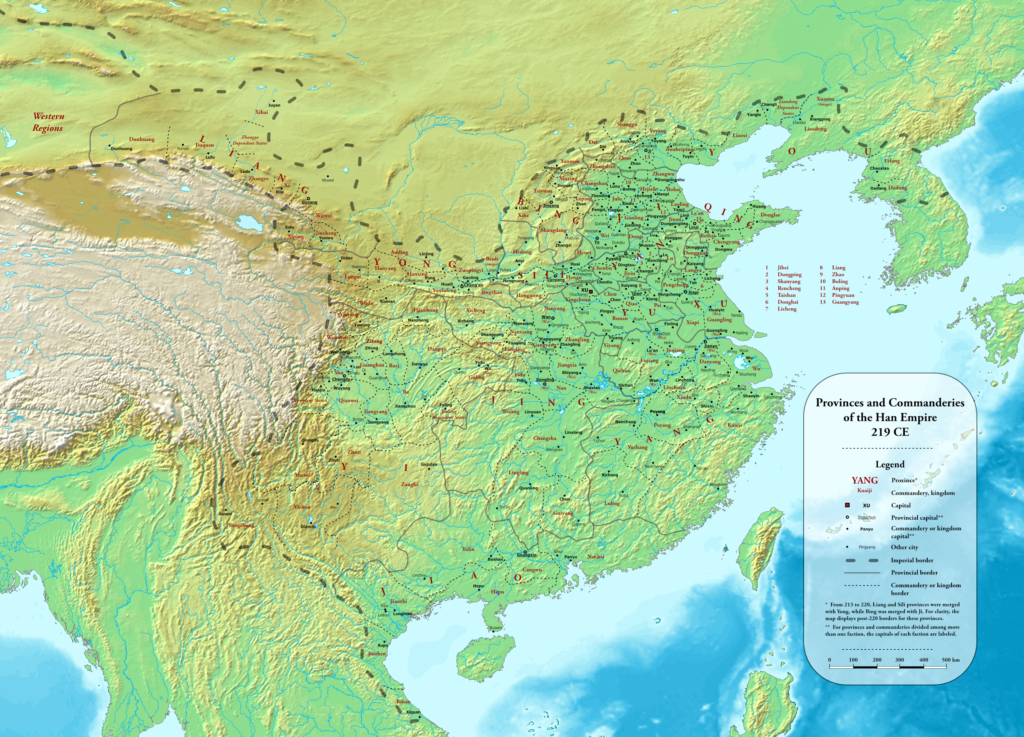
Image Source- Wkipedia

Today, we journey into a nearly forgotten chapter of Chinese history—one buried beneath the shadows of frontier mountains and imperial neglect. This is the story of the Great Qiang Rebellion, a fierce and protracted uprising that erupted during the troubled reign of Emperor An, in the year AD 107.
At this time, the mighty Han dynasty—once the unchallenged master of East Asia—was beginning to crumble from within. Corruption festered in the court, eunuchs pulled the strings behind the throne, and the central government grew ever more distant from the outer reaches of the empire. On the windswept western frontier, the Qiang tribes, long pushed to the margins, burdened by heavy taxes and military abuse, finally had enough. They rose—not just in protest, but in open rebellion.
But the empire would not let them go unchallenged. Riding out from the troubled province of Liang, the Han dispatched Liang Qin, a hard-bitten general known as much for his strict discipline as for his iron resolve. He marched into the wild, unforgiving terrain of the northwest—into the heartland of a people who had nothing left to lose. There, he would meet tens of thousands of Qiang warriors in a brutal campaign that would leave the frontier forever changed. This is not just a tale of rebellion—but of resistance, reprisal, and survival on the edge of empire.
The Qiang People and the Western Frontier
Before the armies of Han reached the far edges of the known world, the mountains and plateaus of the west were home to a proud and ancient people—the Qiang. The Qiang were not a single tribe, but a wide network of semi-nomadic pastoralists, spread across the rugged highlands of the Longxi, Wudu, Jincheng, and Xihai commanderies—roaming even into the frontier zones of Anding and Beidi. These were the lands where they herded sheep, cattle, and horses, following seasonal pastures along the river valleys and mountain passes. They moved with the seasons, following water and pasture, raising sheep, horses, and cattle in the harsh, beautiful terrain of China’s western frontier. According to the Han dynasty dictionary Shuowen Jiezi, compiled in the second century AD, the word “Qiang” (羌) literally meant “shepherds of sheep.” This simple yet revealing description captured their core identity—herders, warriors, and free people of the highlands.
To the Han, the Qiang were both a thorn and a tool. Some clans were recruited into Han armies as auxiliaries, others settled under imperial oversight. But these arrangements rarely lasted. Land disputes, cultural misunderstandings, and heavy-handed officials bred deep resentment. By the Eastern Han period, tensions flared into violence again and again. The Qiang rebelled, not just for land—but for survival, dignity, and autonomy. These were not simple raiders, but proud tribes fighting to defend their way of life.
By the first half of the Second century AD, the Han dynasty still claimed to rule all under Heaven—but in truth, its grasp was weakening. At court, eunuchs and corrupt officials drained the power of the throne, while ordinary people across the empire suffered under heavy taxes, land seizures, and a growing sense of injustice. But nowhere was this pressure felt more fiercely than on the empire’s western frontier. There, in the wild lands of Anding and Beidi commanderies, the Han had long struggled to dominate the Qiang tribes—the proud and diverse people who refused to bow to imperial rule. What was once an uneasy alliance had turned into simmering hostility.
The Outbreak of the Great Qiang Rebellion (AD 107)
The Chinese position in the far west was fragile. In the autumn of AD 106, shortly after the new regency government was established following the death of Emperor He. Meanwhile, General Ren Shang found himself besieged by rebels in Shule (modern-day Kashgar), the outermost point of Han control. In response, he sent an urgent request for assistance. The Senior Colonel Liang Qin was authorised to assemble a relief force composed mainly of Qiang and other non-Chinese groups from Liang province. Although the siege was lifted before Liang Qin’s arrival, Ren Shang was nevertheless dismissed from his post. His replacement, Duan Xi, proved no more effective, and unrest soon spread to Qiuzi (modern Kuqa). Faced with ongoing instability and reluctant to commit additional resources to such a remote and difficult region, the regent Dowager ultimately decided to order a full withdrawal from the area.
Even the process of retreat required a significant short-term effort. Liang Qin had already gathered five thousand Qiang and other tribal fighters from the commanderies along the Gansu corridor—namely Dunhuang, Jiuquan, Zhangye, and Wuwei. To assist with the withdrawal, Cavalry Commandant Wang Hong was tasked with recruiting an additional force from the commanderies of Jincheng, Longxi, and Hanyang. This second group numbered only a few hundred to around a thousand men, and they were not expected to serve for more than a few months. However, the recruitment was carried out hastily and poorly. The conscripts believed they were being sent into indefinite exile. When they reached Jiuquan, they mutinied and scattered in an attempt to return home. As officials tried to capture the deserters, their efforts escalated into a widespread crackdown on non-Chinese communities, which in turn fueled rumors and fear further east. Worried about possible reprisals, some tribes, including the Shaodang Qiang, fled back beyond the frontier to their former lands. Meanwhile, other groups turned hostile, attacking nearby Chinese settlements.
According to the Qianfu lun and the Hou Han shu, the early phase of the rebellion in the latter half of 107 AD was marked by considerable disorder and confusion. After the Shaodang tribe fled beyond the frontier, those Qiang who remained were largely long-settled communities with limited experience in warfare and poor equipment. Initially, the rebels fought using simple weapons such as wooden or bamboo sticks and staves, along with shields made from similar materials. Some are even reported to have carried bronze mirrors, hoping that sunlight reflecting off them would create the illusion of metal weaponry. Their Chinese neighbors were similarly poorly armed, suggesting that the conflict was a desperate and chaotic struggle between ill-equipped forces.
Early in the unrest, the Xianlian chieftain Dianlian, leader of a small group in western Longxi, allied with the Zhong tribe to launch an attack on the Long Road. The weapons and supplies they seized from various garrison posts significantly enhanced their military capabilities. As a result, Dianlian emerged as the leader of a broader tribal alliance. By the time Deng Zhi and his forces arrived in Hanyang during the winter, nearly all of Liang province had fallen into rebellion.
The imperial force was planned to consist of approximately fifty thousand men, centered around the five professional regiments of the Northern Army. This core was supplemented by militia drawn from several regions: Taiyuan and Shangdang in Bing province; Runan and Yingchuan in Yu province; Nanyang in Jing province; as well as areas surrounding the two capitals, Luoyang and Chang’an. However, many of these troops came from internal commanderies of the empire and generally lacked military training and experience in organized, formation-based combat. As a result, during this early campaign, the regular imperial forces were largely unsuccessful.
The strategy was for Deng Zhi to take control of Hanyang commandery, located west of the Long Pass, and to use it as a base to advance against the rebels. However, even before Deng Zhi had fully assembled his forces, Dianlian and the Zhong tribe launched an attack early in AD 108 on the imperial outposts west of Ji City, the capital of Hanyang. They successfully pushed back the imperial army. This was followed by several months of relative calm until winter, when Ren Shang was ordered to launch an offensive. He suffered a severe defeat in the northern part of the commandery, losing eight thousand men and being forced onto the defensive. Subsequently, Deng Zhi was promoted to General-in-Chief and recalled to the capital, likely to prevent further embarrassment. Ren Shang was left to maintain the defensive line as best as he could.
Buoyed by their victories, Dianlian declared himself with an imperial title and established his capital at Lingzhou in Beidi, located on the Yellow River south of present-day Yinchuan in Ningxia. The Xianlian and their Zhong allies controlled the commanderies of Anding and Beidi. They were also allied with the Shenlang tribe in Wudu to the south and received support from other Qiang groups in the commanderies of Shang and Xihe to the east.
Meanwhile, Liang Qin had returned with his forces from the Western Regions and re-established control over the commanderies along the Gansu corridor, stretching from Zhangye to Wuwei, including Jiuquan, where the original unrest had begun. Unlike the troops recruited by Wang Hong, the auxiliary forces raised by Liang Qin remained loyal, and local chieftains came forward to reaffirm their allegiance. As a result, this region remained stable and did not cause further problems.
The government instructed Liang Qin to establish a garrison camp in Jincheng, near present-day Lanzhou. However, upon learning that the Qiang threatened Chang’an, he moved south and east instead. Following the Long Road through Hanyang, Liang Qin engaged the Qiang forces in Youfufeng and, in a series of battles near Meiyang—approximately one hundred kilometers from the former capital—he successfully defeated and scattered the enemy. This was a significant accomplishment, and despite being wounded during the fighting, Liang Qin was promoted to general command against the rebels. Nonetheless, the impact of his victory was short-lived. Communications with the northwest remained vulnerable to interruption, the Xining valley in western Jincheng was isolated and faced shortages of grain, and further south, the Shenlang tribe from Wudu crossed the mountains to raid Hanzhong, where they defeated and killed the local Administrator.
The situation worsened significantly in AD 109. In the west, the Zhong tribe destroyed Lintao, the capital of Longxi, while the Qiang in the Xining valley rebelled, capturing Poqiang and gaining control over the region. At the same time, the rebels renewed their advance toward Chang’an. Ren Ren, the Commandant of Cavalry, led local levies to defend the city. Although he suffered several defeats, the city’s defenses ultimately held. Meanwhile, Qiang raiding parties crossed the Taihang Mountains, reaching as far as the Zhao and Wei regions on the North China Plain. In the winter at the end of the year, the Shanyu Tan of the Xiongnu also rebelled in Xihe. Although unrelated to the Qiang, he formed an alliance with the Wuhuan to the northeast. Liang Qin was able to suppress this rebellion within a few months, but his campaign required twenty thousand troops. In comparison, the government’s response to the Qiang rebellion remained much weaker.
Up to this point, the imperial forces had achieved little success against the rebels. The initial response relied on direct attacks aimed at crushing the insurgents, but many troops were poorly trained and ill-prepared. As a result, these offensives quickly stalled, reducing the government’s efforts to merely holding defensive positions. Recognizing that victory would be difficult, the strategy shifted in AD 110. Most conscripts from the inner commanderies—who had performed poorly under Deng Zhi and his successors—were dismissed. Ren Shang was assigned command of Chang’an along with his most experienced soldiers. Simultaneously, to strengthen the defense and serve as a training center for militia forces, a Tiger Tooth Commandant position was established in Jingzhao commandery, based at Chang’an. The existing garrison at Yong in Youfufeng was placed on the frontline, reflecting the changing nature of the conflict.
A clear sign of the failure of the previous policy occurred in the autumn, when the levies under the command of Ren Ren—who had suffered repeated defeats against the Qiang—refused to follow further orders to launch attacks. Although discipline was quickly restored, Ren Ren was recalled to Luoyang and later died in prison. Early in the following year, AD 111, his superior officer Ren Shang was also dismissed due to his lack of success, although he faced no additional punishment. In reality, it is likely that the main issue was not with the commanders themselves but with the poor training and inexperience of the troops they were required to lead.
At this time, serious debate arose within the imperial court over whether the northwest region should be entirely abandoned. Following the rebellion of AD 109, the Xining valley in western Jincheng had largely fallen out of government control. In AD 110, the capital of the commandery was relocated from Yuanya to Xiangwu in the eastern part of Longxi, while the headquarters of the Protector of the Qiang was moved north to Zhangye. The Internuncio Pang Can, who had briefly held command near Chang’an, went further by arguing that the government should withdraw from the entirety of Liang province. He pointed out that the territory was highly unstable, suffering from repeated raids and rebellions by the Qiang. Additionally, the financial and resource costs required to maintain an imperial presence in the region placed excessive strain on more secure and settled commanderies elsewhere.
The Dowager’s brother, Deng Zhi, who had direct experience with the situation, supported Pang Can’s recommendations for withdrawal. However, Yu Xu, a gentleman cadet who had served as a clerical officer under the Grand Commandant Li Xiu, argued against this view. He convinced Li Xiu that it was a sacred duty to defend the lands held by previous generations and to protect the dynasty’s ancestral tombs, emphasizing that the barbarians must be kept under control. Li Xiu then secured the backing of the other senior officials, leading to the abandonment of the plan for a full retreat. Instead, efforts were made to involve the leading local families more closely in regional administration, aiming to strengthen control and stability in the area.
Despite these efforts, in the spring of AD 111, further withdrawals took place. The headquarters of the Anding, Beidi, and Shang commanderies were relocated to Youfufeng and Zuopingyi, while the administration of Longxi moved eastward to join that of Jincheng in Xiangwu. In many regions, local populations were forced to abandon their homes and farms. Although Pang Can had advocated for an orderly relocation process, including assistance and concessions for those moving to more secure areas, historical accounts from Qianfu lun and Hou Han shu describe a far harsher reality. Soldiers were reportedly sent to destroy the homes of those unwilling to leave, refugees were driven away through violence, subjected to robbery and looting, and left abandoned without support or protection.
Although some areas may have remained under imperial control and no official decision was made to abandon the territory, Dianlian and his rebel Qiang forces effectively controlled a large region. This area stretched from the Xining valley eastward to the southern course of the Yellow River between present-day Shanxi and Shaanxi provinces, and from the harsh Ordos Desert southward to the Wei River valley and the approaches to Chang’an. Hanyang remained contested territory, imperial control over Longxi was weak, and the Shenlang tribe of Wudu continued to conduct raids through the mountains into Hanzhong, where they killed a second Administrator in battle.
In AD 111, raiding parties expanded eastward across the Yellow River toward the Taihang mountains and south into the regions of Henei and Hedong, located just across the river from the capital commandery of Henan. In response, the territories of the plains facing the Taihang ranges—from Zhongshan kingdom in the north to Wei commandery in the south—were ordered to strengthen their defenses. Approximately six hundred forts were established to secure all possible approaches from the surrounding highlands. Meanwhile, the main force of the Northern Army was recalled from the western frontier to defend the Meng Crossing of the Yellow River, located north of Luoyang. Ren Shang was placed in command and led an attack against a Qiang group at Sheep’s Head Mountain in Shangdang. Although the victory was modest, with the enemy suffering only about two hundred casualties, it effectively removed the immediate threat to Luoyang. Following this, the army stationed at Meng Crossing was withdrawn, and imperial forces gradually reasserted control over Henei, Hedong, and the adjacent commanderies of Bing province.
Turning Point: Death of Dianlian
The year AD 112 marked a turning point in the conflict. In the autumn of AD 111, the local Chinese leader Du Qi allied with the Qiang and seized control of Shanggui city, located in the southern part of Hanyang commandery. However, just a few months later, Du Qi was assassinated by a traitor after the commandery government placed a bounty on his head. The assassin was rewarded with one million cash and granted the title of marquis. Subsequently, an imperial army led by the censorate official Tang Xi defeated and eliminated Du Qi’s remaining supporters, effectively dismantling his faction.
Shortly thereafter, Dianlian died at his headquarters in Lingzhou. His son, Lianchang, who was too young to assume full leadership, was guided by the regent Langmo. At the same time, the renegade Du Jigong—brother of Du Qi—who had fled north following the defeat in Hanyang and established a base at Dingxi near Lingzhou, held a third position in the rebel leadership triumvirate. However, none of these figures matched Dianlian’s ability or the authority he had commanded, leading to a gradual weakening of the rebel alliance.
The Imperial Counter-Offensive
In AD 113, Protector Hou Ba and Commandant of Cavalry Ma Xian, operating from Wuwei, launched a campaign to retake Jincheng. By AD 114, they had regained partial control over the entire commandery. This success, combined with the earlier victories in Hanyang, effectively split the rebels’ territory into two separate areas. Additionally, Ma Xian conducted raids against rebel positions on the eastern bank of the Yellow River in Anding, capturing around twenty thousand horses, camels, cattle, and sheep. This loss was significant for the herding Qiang population, and the captured livestock was distributed as rewards to non-Chinese allies who had joined the imperial forces. Although the Qiang continued their attacks, they now faced well-matched resistance from Han troops and their allies and were pushed back in the regions of Henei, Hanyang, and Hanzhong. However, the Inspector of Liang province suffered a major defeat while attempting to recapture Lintao in Longxi. Thus, while the Chinese position had improved, the conflict remained evenly balanced, with neither side achieving a decisive advantage.
Hou Ba died in AD 114, and his position as Protector was succeeded by Pang Can. Although Pang Can had previously advocated for abandoning the territory, he now committed himself to restoring Han authority in the region. His approach differed from that of his predecessors, as he aimed to reconcile with the Qiang and demonstrate the government’s good intentions. Early in his tenure, he achieved a notable success by persuading the chieftain Haoduo to surrender along with seven thousand followers. Haoduo was rewarded with the title of marquis, and the headquarters of the Protectorate was moved back to Lianju in Jincheng.
The Han court now launched a major offensive aimed at the rebel capital, but the campaign ended in failure. Pang Can led a combined force of seven thousand Qiang auxiliaries and local militia, while a second column of eight thousand levies drawn from Zuopingyi, Youfufeng, Anding, and Beidi advanced from the east. Before the two forces could unite, Pang Can was intercepted and defeated by Du Jigong. Although the eastern column succeeded in capturing the fortress at Dingxi, disagreements among the commanders led to indecision. As a result, the force was caught in an ambush and suffered severe losses, with nearly half of their men killed.
Pang Can was dismissed following the failed campaign and replaced as Protector by Ma Xian, while Ren Shang was once again assigned to Chang’an to take overall command of military operations. In a shift of strategy, Ren Shang disbanded the commandery militia and other conscripted levies, many of whom served as foot soldiers and lacked mobility. Instead, he required each former soldier to make a financial contribution in lieu of service. The funds collected were used to recruit a mobile force of light cavalry, better suited to countering the speed and tactics of the Qiang. In late AD 115, this new cavalry force conducted a successful raid against Du Jigong at Dingxi, killing four hundred enemy fighters and seizing several thousand head of livestock. This innovative policy was reportedly implemented on the advice of Yu Xu—the same official who, five years earlier, had argued against abandoning the northwest and now served as a magistrate in Henei.
Ren Shang also fortified his position by establishing a network of strongholds in the northern part of Zuopingyi commandery, securing the Wei River valley. Throughout AD 116, he launched additional raids against Dingxi, gradually weakening the rebels. Meanwhile, territories east of the Yellow River in what is now Shanxi were brought back under imperial control, and the region’s irrigation systems were restored, improving stability and agriculture. The Southern Xiongnu in Xihe also renewed their loyalty to the Han court. In the summer, General Deng Zun—cousin of the Empress Dowager and commander on the Liao frontier—led a cavalry force of ten thousand, including Xiongnu allies, to strike at the Qiang leader Lianchang in Lingzhou. Then, in the winter, a separate detachment dispatched by Ren Shang captured the rebel capital, killed Lianchang’s wife and children, and brought back his official seals and insignia, along with another twenty thousand livestock. These blows dealt a significant setback to the Qiang and demonstrated the growing effectiveness of the Han military response.
At the same time, Han officials continued their efforts to weaken the rebel alliance by encouraging defections, surrenders, and targeted assassinations of key leaders—just as they had done with Du Qi in AD 112. In AD 117, Ren Shang arranged for the deaths of both Du Jigong and Lianchang, who were killed by members of their own factions. In return, these traitors were rewarded with prestigious titles—one was named “Marquis Who Smashes the Qiang,” and another was declared “King of the Qiang”—demonstrating how the government used status and privilege to divide its enemies. Later that year, in the winter, Ren Shang led a final campaign against Langmo, the last major Qiang leader. He was joined by the Protector Ma Xian, who brought a combined force of Han soldiers and surrendered Qiang from the western territories. Together, they confronted Langmo at Fuping, the former capital of Beidi, located near modern Qingyang in Gansu. The battle ended in a decisive Han victory: about five hundred Qiang fighters were killed, over one hundred thousand livestock—cattle, horses, asses, and camels—were captured, and around a thousand people, likely Chinese captives taken in earlier raids, were freed. This marked the collapse of the Qiang rebellion’s leadership and the effective end of large-scale resistance.
The Final Collapse of the Rebellion
The victory at Fuping effectively marked the end of organized resistance from the Qiang rebels. By the following year, AD 118, most of the remaining opposition had collapsed. Langmo, the last major rebel leader, was assassinated, and—as with previous cases—his killer was rewarded with an official title, reinforcing the Han policy of encouraging betrayal among enemy ranks. In recognition of their roles in these final campaigns, some Han commanders were honored. Deng Zun, for instance, was granted the noble rank of marquis, with income drawn from three thousand households. However, not all received such favorable treatment. Ren Shang—who had participated in the conflict from its early stages and had led the decisive campaign—was accused of corruption, including bribery, embezzlement, and inflating his military accomplishments. He was brought in chains to the capital Luoyang in a cage cart, where he was publicly executed. His properties were seized by the state, illustrating the harsh consequences faced by officials who lost favor, regardless of past service.
Aftermath: A Broken Frontier
The full impact of the Great Qiang Rebellion is difficult to measure precisely, but its scale and consequences were unquestionably severe. Although the Han forces ultimately regained control, the central government had effectively lost much of Liang province and large parts of Bing province for nearly a decade. Even territories closer to the heart of the empire—including the capital regions of Chang’an and Luoyang, as well as the western part of the North China Plain—faced frequent raids or the threat of attack. The human cost was enormous. Thousands were killed, and many more were forced to abandon their homes, either out of fear or as a result of government-ordered relocations. As a result, large areas of farmland were left desolate, and the countryside in many regions fell into ruin. Financially, the war was a massive burden. The government spent over 24 billion in cash, but the long-term economic damage went even further. Many displaced people never returned to their land, which was often taken over by non-Chinese herders, altering the demographic and economic character of the frontier. Perhaps one of the most revealing outcomes was the exposure of military weakness. The early failures under Deng Zhi highlighted the serious limitations of the Later Han militia system. These conscripted troops, drawn from the inner provinces, had little training in warfare or coordinated movement. While they were suitable for dealing with small rebellions or local unrest, they proved ineffective against a prolonged and large-scale frontier conflict.
Although the Great Qiang Rebellion eventually came to an end, the spirit of the Qiang people was far from broken. Scattered across the highlands and valleys of the western frontier, they endured—resilient, proud, and defiant. Han armies may have silenced their uprising for a time, but the embers of resistance still smoldered beneath the surface. The Qiang would rise again in the years to come, clashing time and again with the crumbling authority of the imperial throne.
© 2026 History and War
Author: Jishu Roy
Unauthorized reproduction of this content is prohibited.