The Road to the Battle of Pelusium (525 BC)
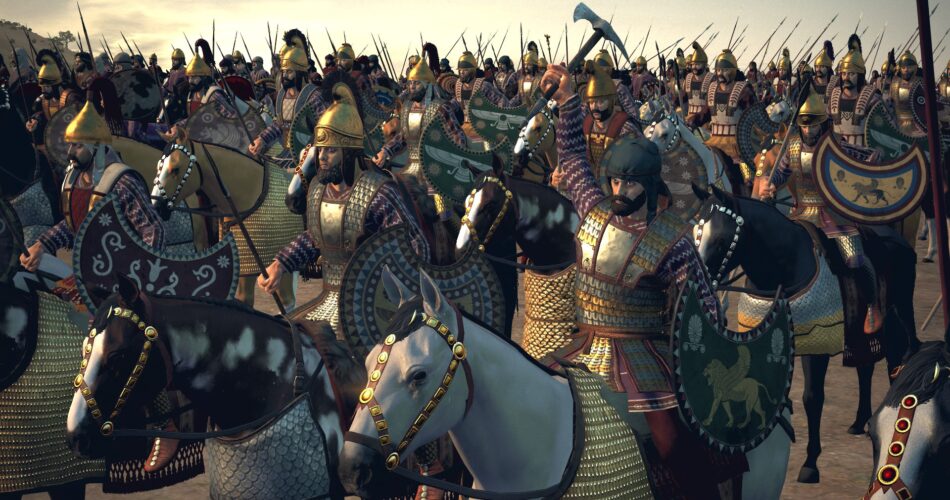
The year is 525 BC. At the edge of the Nile Delta, where the green lifeline of Egypt meets the burning sands of the east, a storm is gathering. For centuries, Egypt stood as one of the greatest civilizations on earth—rich, ancient, and seemingly eternal. But now, it faces an enemy unlike any before. From the vast lands of the east marches the army of Cambyses II, king of kings, ruler of the rising Achaemenid Empire. His objective is clear: the complete conquest of Egypt. Defending the frontier is the young Pharaoh Psamtik III. His army stands at Pelusium—the gateway to Egypt. Behind them lies the Nile… and the survival of their kingdom. This is not just a battle. It is the final stand of an ancient power against an unstoppable empire. What follows will decide the fate of Egypt. This is the Battle of Pelusium.
The Decline of Egypt After the New Kingdom
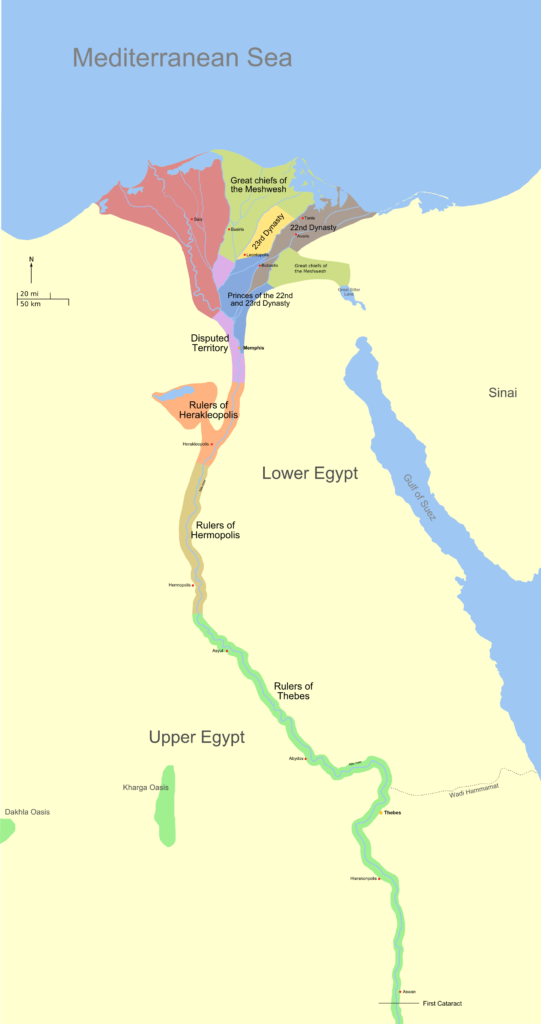
Image Source- Wikipedia

At the end of around 1069 BC, the New Kingdom of Egypt came to an end. With it, the Egyptian Empire—once dominant across the Near East—began to fragment. The centralized power that had held the kingdom together gave way to a divided political landscape. In the centuries that followed, Egypt entered what modern scholars call the Third Intermediate Period—a time defined not by total collapse, but by fragmentation and competing centers of power. Internal rivalries and periodic civil wars weakened the state, even as life continued and local authorities maintained control.
Even so, Egypt was no longer the military power it had been during the New Kingdom. By the later years of the 22 dynasty, these divisions had intensified. Civil war deepened the fractures, and by the 23 dynasty, Egypt was no longer a unified state. Instead, it was divided among rival rulers—self-proclaimed kings who held power in cities such as Herakleopolis, Tanis, Hermopolis, Thebes, Memphis, and Sais. This disunity made any coordinated defense nearly impossible. And from the south, a new threat emerged. The Nubians, rising from Kush, took advantage of Egypt’s weakness and pushed northward—reshaping the balance of power along the Nile.
During the twenty-fifth dynasty, Egypt was reunified under Nubian rule, a development that brought a degree of stability and effective governance. However, this revival proved limited in the face of external pressures. In the early seventh century BC, the Assyrian Empire launched a series of invasions—first under Esarhaddon in 671–670 BC, and later under Ashurbanipal in 663 BC. These campaigns exposed the underlying fragility of the Egyptian state. Although the Assyrians were eventually expelled, the prolonged conflict left Egypt weakened. Its resources were diminished, and its capacity to resist future large-scale invasions was significantly reduced.
While Egypt struggled with division, a new power was rising in the east. From the highlands of Persia, Cyrus the Great forged an empire with remarkable speed. In a series of decisive campaigns, he overthrew the Medes, conquered Lydia, and brought Babylon under his control—uniting vast territories under a single rule. What emerged was the Achaemenid Empire—a state unlike any before it. Vast, organized, and expanding, it stretched across much of the known world. After Cyrus, his son Cambyses II inherited both the empire and its ambition. To the west lay Egypt—the last great kingdom of the Near East still beyond Persian control.
Causes of the War
The Greek historian Herodotus provides one of the earliest accounts of how tensions developed between Egypt and the Achaemenid Empire. He describes the conflict as a gradual process shaped by a series of personal interactions, many involving Egyptians themselves. According to his account, Cambyses II requested a skilled Egyptian physician from the Pharaoh Amasis II, with whom he maintained friendly relations. Amasis agreed and sent the physician to the Persian court. However, the physician, resentful of the conditions under which he had been compelled to serve, allegedly sought revenge. He advised Cambyses to request the hand of Amasis’s daughter in marriage—knowing that such a demand would be deeply unwelcome. Cambyses followed this advice, formally asking for the Pharaoh’s daughter.
According to the Greek historian Herodotus, the Pharaoh Amasis II faced a difficult dilemma when Cambyses II requested his daughter in marriage. Unwilling to give up his own child, yet also unwilling to risk provoking a conflict with Persia, Amasis chose a different course. Instead of sending his daughter, he sent another young woman named Nitetis. She was presented as his daughter, but in reality, she was the child of the former Pharaoh Apries—the ruler whom Amasis had overthrown and killed. Upon arriving at the Persian court and being received as the daughter of Amasis, Nitetis revealed the truth to Cambyses. She explained that she was not the Pharaoh’s daughter, but had been sent in her place as part of a deliberate deception. According to Herodotus, this revelation deeply angered Cambyses. He regarded the act as a personal insult and, in response, resolved to take revenge—further escalating tensions between Persia and Egypt.
Herodotus also recounts another story, which he considered equally remarkable. An unnamed Persian woman was admitted into the presence of the royal women. There, she saw the children of Cassandane and was struck by their beauty and fine appearance. She admired Cassandane, the wife of Cyrus the Great, for her good fortune. Cassandane, however, responded with bitterness. She explained that although she was the king’s wife and the mother of his children, she was neglected by him, as he showed greater favor toward an Egyptian woman, referring to Nitetis. At this point, her eldest son, Cambyses II, still a boy of no more than ten years, declared that when he became a man, he would overturn all of Egypt on her behalf. Herodotus notes that this bold statement astonished the women present, and that Cambyses later fulfilled this vow when he became king and waged war against Egypt.
According to Herodotus, another key factor that reinforced Cambyses II’s decision to invade Egypt was the involvement of Phanes of Halicarnassus. Phanes had originally served as a councillor and advisor to Amasis II. However, due to circumstances that are not clearly explained, a serious conflict arose between them, leading to deep resentment. As a result, Amasis dispatched an Egyptian eunuch to capture Phanes, who pursued him as far as Lydia. Although Phanes was eventually caught in Lycia, he managed to escape by getting his guards drunk and slipping away. He then made his way to Persia, where he entered the service of Cambyses. Once in Persia, Phanes provided valuable strategic advice and played a significant role in encouraging and shaping Cambyses’s campaign against Egypt.
Whether these accounts are historically accurate or not, it is likely that the Persians would have eventually invaded Egypt regardless. The country had already been conquered by the Neo Assyrian Empire in the late seventh century BC, demonstrating that the Egyptian military was no longer able to withstand the more advanced weapons and tactics of Mesopotamian armies. By the time of Cambyses II, the Achaemenid Empire was rapidly expanding. The Persians were likely aware of this earlier Assyrian success, as well as Egypt’s declining military strength compared to its earlier power during the New Kingdom of Egypt. Given these conditions, Egypt would have appeared vulnerable, and the Persians would have had little reason to hesitate in launching an invasion.
Preparations for War
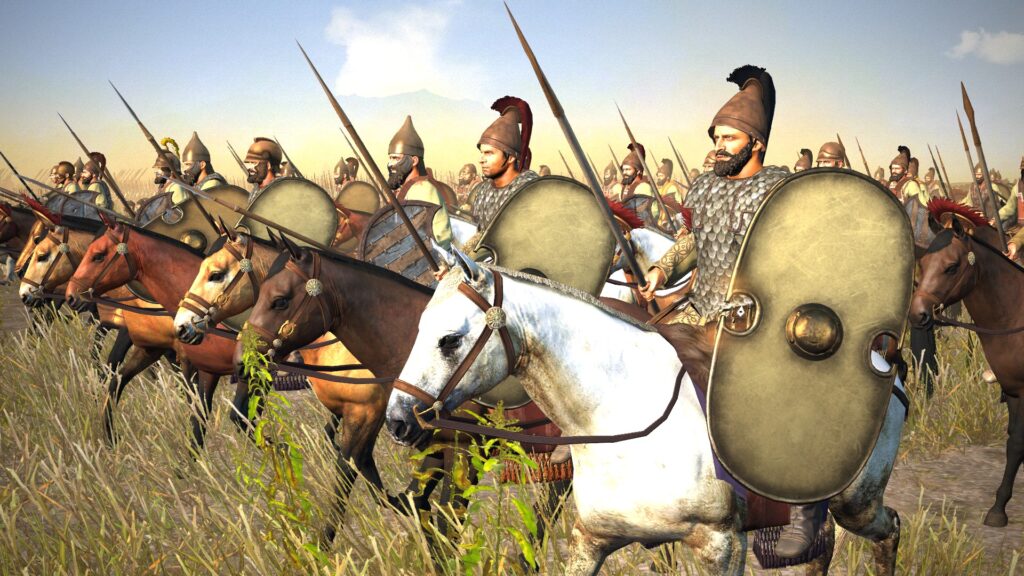
Despite exercising control over the Neo-Babylonian Empire and its surrounding regions, including northern Arabia, Cambyses II sought to secure his line of advance into Egypt. He therefore sent a message to the King of Arabia, requesting safe passage across the desert route from Gaza to Pelusium. The Arabian king, who was hostile toward Amasis II and willing to support his downfall, granted this request. He not only allowed the Persian army to pass but also provided logistical assistance and troops. According to Polybius, only the city of Gaza opposed the Persian advance, and it eventually fell after a prolonged siege.
If the account of Herodotus is accepted, then between the initial insult and the outbreak of war, Amasis II died, leaving the kingdom to his son, Psamtik III (also known as Psammetichus III). Psamtik was a young and relatively inexperienced ruler who had lived in the shadow of his father’s achievements and was not well prepared to face a major external threat. Nevertheless, upon learning of Cambyses II’s mobilization, he attempted to organize a defense and prepare for the coming conflict. He relied in part on the expected support of Greek allies, particularly the cities of Cyprus and Polycrates, the tyrant of Samos, who commanded a powerful fleet. However, these allies ultimately chose to support the Persians instead. At the same time, the defection of Phanes of Halicarnassus—one of Egypt’s most capable military advisers—further weakened the Egyptian position. As a result, Psamtik was left largely dependent on his own limited military experience in confronting the Persian invasion.
Psamtik III established his defensive position at Pelusium, near the mouth of the Nile, where he awaited the Persian advance. At the same time, he prepared his capital, Memphis, to withstand a potential siege. Both Pelusium and Memphis were strongly fortified and well provisioned, making them formidable defensive positions. Given these preparations, the young pharaoh—who had ruled for only six months—likely believed that he could repel the impending Persian attack.
Before the confrontation with the Persian army, Psamtik III carried out a brutal act of vengeance against Phanes of Halicarnassus, who had defected to the Persian side. Seeking both retribution and a display of resolve, Psamtik ordered the arrest of Phanes’ sons and had them brought before the army, within sight of their father. A large bowl was placed between the opposing forces, and the sons were brought forward one by one and executed, their blood collected in the vessel. Afterward, wine and water were mixed into the bowl, and the auxiliary troops drank from it before advancing into battle.
The Battle of Pelusium: Clash at Egypt’s Eastern Frontier
Herodotus’ Account of the Battle
The battle is described by two ancient historians—Herodotusand Polyaenus—and in this article, we will examine both of their accounts to better understand what truly happened. According to Herodotus, the battle near Pelusium was relatively straightforward in its outcome. He reports that the fighting was intense and that many soldiers fell on both sides.
Herodotus also records an unusual observation, which he claims to have learned from local inhabitants. After the battle, the bones of the dead were found scattered in separate groups, as the Persian and Egyptian armies had originally been positioned in different areas of the battlefield. He notes a striking difference between the two: the skulls of the Persians were relatively fragile, while those of the Egyptians were much stronger.
He explains this difference through local custom and environment. According to his account, Egyptians shaved their heads from childhood, and prolonged exposure to the sun caused the skull to become thicker. He also adds that this is why Egyptians rarely go bald, as baldness was uncommon among them. In contrast, the Persians wore head coverings, such as felt caps or tiaras, which protected their heads and resulted in softer skulls. Herodotus concludes this explanation as part of what he considers a factual account of the battle. At the end, the Egyptians were defeated and retreated toward Memphis.
Polyaenus’ Account: Strategy and the “Sacred Animals” Story
The second-century AD writer Polyaenus, a former Macedonian military officer more interested in unusual anecdotes than strict historical accuracy, presents a very different account of the battle. In his Strategems, he describes the conflict not as a field battle but as a siege at Pelusium, which guarded the entrance into Egypt. According to his version, the Egyptians defended the city with determination, using siege engines and hurling missiles, stones, and fire against the Persian forces. In response, Cambyses II allegedly placed animals considered sacred by the Egyptians—such as dogs, sheep, cats, ibises, and others—in front of his troops. The Egyptians, unwilling to risk harming these sacred animals, reportedly ceased their defensive operations, allowing the Persians to capture the city and secure entry into Egypt. While Polyaenus’ account is vivid and dramatic, it is generally viewed with caution by modern historians due to its anecdotal nature. Nevertheless, regardless of the exact style of fighting—whether a pitched battle or a siege—it is clear that the Egyptians were decisively defeated and subsequently retreated toward Memphis for their final stand.
Aftermath: The Fall of Memphis and the End of Egyptian Independence

According to Herodotus, Cambyses II made a final attempt to end the resistance by sending a Persian herald by ship to Memphis, urging the Egyptians to surrender and avoid further bloodshed. However, upon seeing the Persian vessel arrive at the port, the Egyptians rushed out, attacked the ship, and killed everyone on board. Herodotus adds that they even mutilated the bodies and carried the remains back into the city.
Following this incident, the Egyptians were placed under siege and, after some time, were forced to surrender. The pharaoh, Psamtik III, was captured after the fall of Memphis. He was initially allowed to live under Persian supervision, but later attempted to lead a revolt against Persian rule and was consequently forced to commit suicide. With this, Egyptian independence came to an end, and the country was annexed into the Achaemenid Empire.
© 2026 History and War
Author: Jishu Roy
Unauthorized reproduction of this content is prohibited.