Map Copyright © Cyowari
Geopolitical Tensions Leading to the Battle of Mu’tah (AD 629)
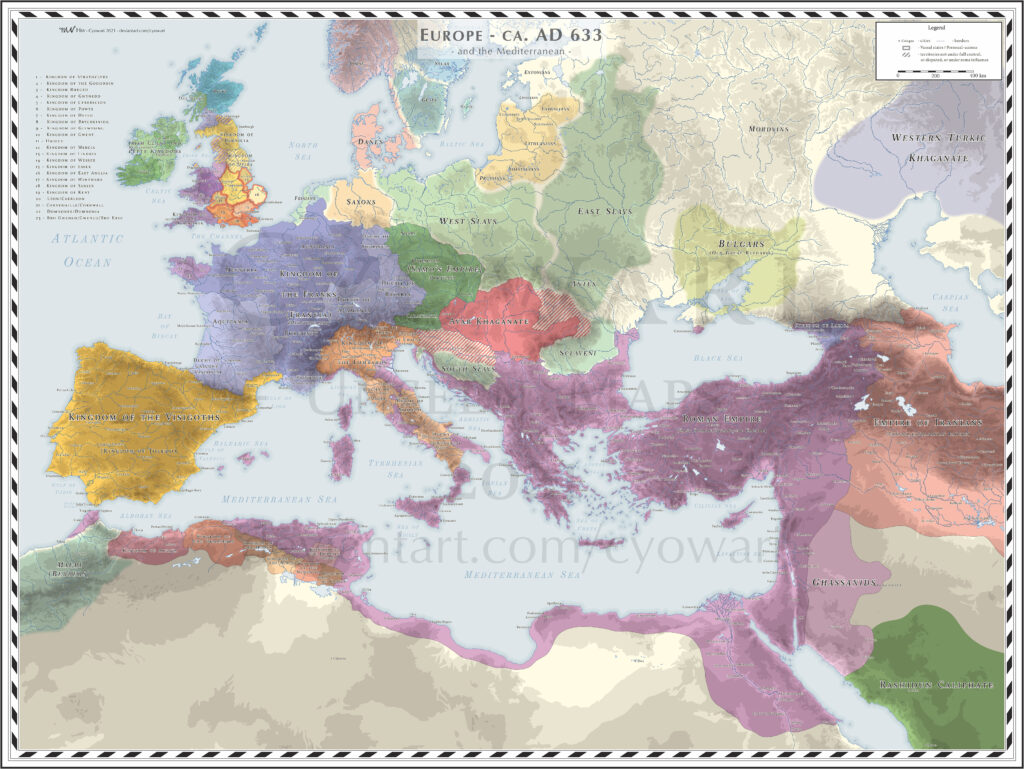
The Battle of Mu’tah, fought in the year AD 629, stands as one of the most pivotal and intense confrontations during the lifetime of Prophet Muhammad. At this time, the geopolitical landscape was shifting dramatically, as the Byzantine emperor Heraclius had recently won a decisive victory over the Sassanid Empire. This triumph enabled him to reclaim not only all the territories lost to the Persians but also to release captured soldiers, impose a war indemnity, and most significantly, recover the True Cross and other sacred relics that had been taken from Jerusalem in AD 614. In this context of rising tensions and territorial disputes, Prophet Muhammad aimed to extend his influence and the message of Islam beyond the Arabian Peninsula. To this end, he dispatched an emissary named al-Harith ibn Umair al-Azdi, with the task of delivering a letter inviting the ruler of the Byzantine-allied Ghassanid tribe to accept Islam. The Ghassanids were a significant power in the region, and gaining their allegiance could strengthen the nascent Islamic state against external threats. However, upon reaching the town of Mu’tah, al-Harith’s mission met with tragedy. He was captured and executed by Shurahbil ibn ‘Amr al-Ghassani, a prominent leader of the Ghassanid tribe. The execution of al-Harith escalated tensions and set the stage for the confrontation at Mu’tah, where a Muslim force of approximately 3,000 faced a significantly larger Byzantine and Ghassanid coalition.
Diplomatic Crisis
Historically, the killing of an envoy was regarded as a grave offense, as envoys were considered sacred and afforded protection under both tribal and international customs. In this context, the Muslim community, under the leadership of Prophet Muhammad, viewed the execution of al-Harith ibn ‘Umair al-Azdi as an act that demanded a decisive response. This was not only to seek justice for the slain envoy but also to uphold the sanctity of diplomatic relations and assert their emerging position on the regional stage. From the Byzantine and Ghassanid perspective, the growing influence of Islam likely represented a challenge to their political and cultural dominance in the region. The Ghassanid tribe, as Byzantine allies, may have seen the expanding reach of the Muslim community as a destabilizing force threatening their alliance network. These overlapping tensions created a volatile situation, making the Muslim response at Mu’tah both a defensive measure and a broader assertion of their diplomatic sovereignty.
Strategic Response – Formation of the Muslim Expeditionary Force
In response to the execution of his envoy, Prophet Muhammad organized a military expedition of approximately 3,000 troops from Medina to confront the Byzantine-Ghassanid forces near Mu’tah, located close to the modern-day Jordanian border. This campaign represented a significant moment in early Islamic military history, marking the Muslim community’s first engagement beyond the Arabian Peninsula.
To ensure effective leadership and continuity during the battle, Prophet Muhammad meticulously established a chain of command, appointing a sequence of commanders to take over in the event of leadership casualties. According to Sunni historical sources, such as Ibn Hisham’s Sirah and Ibn Sa’d’s Tabaqaat, Prophet Muhammad appointed Zayd ibn Harithah, a trusted companion and his adopted son, as the primary commander. If Zayd were to fall, Ja’far ibn Abi Talib, the Prophet’s cousin, would assume command, followed by ‘Abdullah ibn Rawahah, a prominent figure from Medina. This planned succession highlighted the Prophet’s strategic foresight and his confidence in these leaders’ abilities. Shia historical sources offer a slightly different account of the chain of command. In this tradition, Ja’far ibn Abi Talib is identified as the first commander, followed by Zayd ibn Harithah and then ‘Abdullah ibn Rawahah. Despite these variations, both Sunni and Shia narratives agree on the significance of these three individuals and their close relationship with the Prophet.
Byzantine-Ghassanid Mobilization
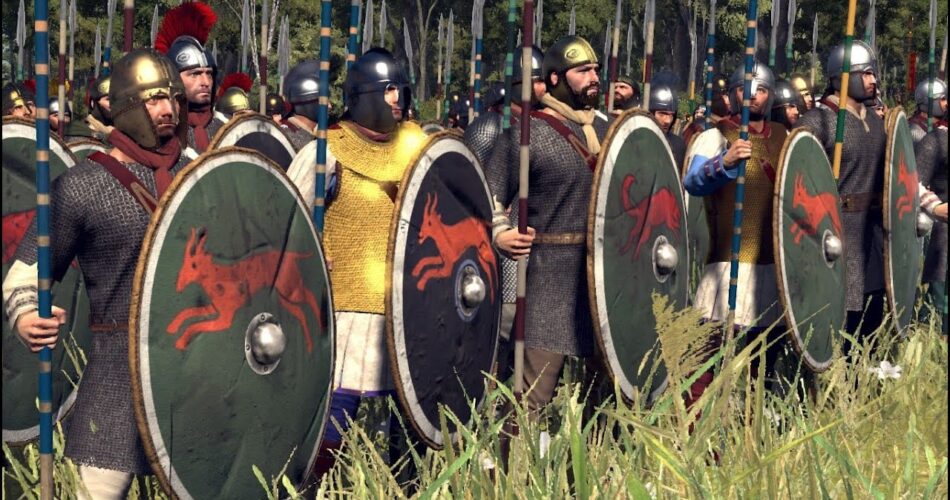
When the Ghassanid leader learned of the approaching Muslim army from Medina, he mobilized his forces and sought reinforcements from the Byzantine Emperor Heraclius. In response, Heraclius dispatched an army under the command of Theodore. This force consisted of Roman troops along with allied Arab tribes, including the Lakhm, Judham, Balqain, Bahra’, and Bali tribes, all of whom maintained alliances with the Byzantine Empire. Early Muslim historical sources claim that the Byzantine-Ghassanid army numbered between 100,000 and 200,000 soldiers. However, modern historians consider these figures to be exaggerated, as they far exceed the logistical capacities of the region at the time. Contemporary estimates suggest that the Byzantine force likely numbered around 10,000 men. Despite this revised figure, the Byzantine army still held a significant numerical advantage, outnumbering the Muslim forces by approximately three to one.
Skirmish at Musharif
The Muslim army advanced northward to Ma`an, a town near the border of Greater Syria. There, they received intelligence that a large Byzantine force, supported by allied Arab tribes, had gathered at Ma’aab in the Al-Balqa’ region. The size of this force was far greater than what the Muslims had anticipated, leaving the army uncertain about how to proceed. They spent two nights deliberating their options under these unfavorable conditions. Some members of the Muslim force proposed sending a message back to Prophet Muhammad to inform him of the enemy’s overwhelming numbers. They hoped he would either dispatch reinforcements or order a tactical withdrawal. Others suggested retreating immediately, arguing that their presence in the region had already achieved a significant psychological impact by spreading fear among the local population. However, `Abdullah ibn Rawahah, one of the appointed commanders, opposed the idea of retreat or hesitation. Addressing the troops, he said:
“By Allah, the very goal you are trying to avoid is the one for which we have set out—martyrdom. In our fight, we do not rely on the size of our army or the strength of our equipment but rather on the faith that Allah has honored us with. Advance and seek one of two rewards: victory or martyrdom.”
Inspired by his words, the Muslim army resolved to confront the enemy. They marched toward Masharif, a town in the Al-Balqa’ region, and prepared to engage in battle.
The initial engagement at Masharif was brief but intense, revealing the disparity in strength between the two forces. The Muslim commanders quickly recognized that a direct confrontation with the much larger Roman army would likely lead to their defeat. In response, they made a strategic decision to withdraw and reposition their forces. The Muslim army chose Mu’tah as the primary battleground due to its favorable terrain. The elevated landscape provided a tactical advantage, enabling the Muslim forces to defend themselves more effectively against the numerically superior Byzantine army. By retreating to Mu’tah, the Muslim commanders aimed to mitigate the enemy’s numerical advantage and maximize their own defensive capabilities.
Battle of Mu’tah
Opening Engagement
As the Muslim army regrouped at Mu’tah, they organized their forces in preparation for the impending battle. The right flank was placed under the command of Qutbah ibn Qatadah Al-‘Udhari, while the left flank was led by ‘Ubadah ibn Malik Al-Ansari. The central formation was commanded by Zayd ibn Harithah, the overall leader of the Muslim forces. The Muslim army, composed of approximately 3,000 soldiers, faced an enemy force estimated at 10,000. Despite being significantly outnumbered, the Muslim troops demonstrated remarkable discipline and determination, engaging the Byzantine-allied forces in a struggle that would test their resolve and tactical skill.
Martyrdom of Zayd ibn Harithah
As the battle commenced, Zayd ibn Harithah, the commander of the Muslim army, took up the banner and led the charge with great fervor. Shaking the banner firmly to inspire his troops, he advanced directly into the heart of the enemy lines, igniting enthusiasm and determination among the Muslim forces. Intense fighting soon erupted. However, Zayd’s bravery came at a heavy cost. In the course of the battle, Zayd was struck by multiple spears, resulting in fatal injuries. He fell to the ground, his body marked by the blood of his wounds. Zayd ibn Harithah became the first Muslim to die for the faith on foreign soil, a significant and poignant moment in the early history of the Islamic community.
Heroism of Ja’far ibn Abi Talib
Before the banner fell from Zayd ibn Harithah’s hand, Ja’far ibn Abu Talib quickly seized it and continued the charge with great determination. He fought valiantly, his voice rising above the clamor of battle as he proclaimed the good news of either victory or martyrdom, a hope shared by every believer. Ja’far, demonstrating his unwavering commitment, was the first in Islamic history to dismount his horse during battle to fight on foot. He fought courageously for an extended period, defeating many of the enemy forces, whose fallen bodies surrounded him like stacked wood. His resilience was akin to that of a mountain, withstanding enemy blows. His firmness in the face of adversity astonished the enemy, prompting them to intensify their attacks. A sword struck his right hand, severing it and sending it flying. Undeterred, Ja’far took the banner with his left hand and continued to fight. Another sword strike severed his left hand as well, but Ja’far pressed the banner to his chest with his upper arm to ensure the continuation of the fight. In those final moments, Ja’far was struck again and fell to the ground, becoming a martyr.
Leadership of Abdullah ibn Rawahah
Abdullah ibn Rawaha, the third commander, swiftly moved toward the banner to raise it once again above the battlefield. As the new leader, he fought valiantly to repel the relentless attacks of the Roman forces, who advanced like waves. However, Abdullah eventually fell to the ground and became a martyr. In the wake of his death, Thabit ibn Al-Arqam, from the Banu `Ajlan tribe, took up the banner and called upon the Muslims to select a new leader. The leadership was unanimously given to Khalid ibn Al-Walid, known for his skill, bravery, and exceptional strategic mind. According to Al-Bukhari, Khalid fought fiercely that day, reportedly breaking nine swords in his relentless combat with the enemy. Recognizing the dire situation facing the Muslims, Khalid devised a new course of action that demonstrated the brilliance of his strategic thinking, solidifying his reputation as a master tactician.
Khalid’s Tactical Maneuvers
Khalid ibn Al-Walid reorganized the Muslim army by shifting the right and left flanks and moving the rear division to the front. This maneuver was intended to create the impression that fresh reinforcements had arrived, thereby instilling fear in the Byzantine forces. The Muslims engaged the enemy in sporadic skirmishes, retreating strategically and in an orderly manner. The Byzantines, perceiving this shift in tactics, believed they were being lured into the heart of the desert, and as a result, they halted their pursuit. When night fell, the Muslim army made a peaceful withdrawal, disappearing into the desert.
Byzantine Response and Withdrawal
The next morning, the Romans were surprised to learn that the Muslims had retreated. They hesitated to follow, partly because their cavalry was ill-suited for desert terrain. To the Romans, the desert was as daunting as the sea—an environment where they had no means to effectively navigate or operate. Unlike the Arabs, who were adept at maneuvering in the desert, the Romans and Persians were land-based powers, at a distinct disadvantage in such an environment. The desert, as a natural barrier, effectively protected the Arabs from external threats. It was their “fortress,” ensuring their safety and independence, and posing significant logistical challenges for any invading force.
Historical Significance of the Battle of Mu’tah – Legacy and Future Conflicts
After the campaign of Mu’tah, the Muslim army, under the leadership of Khalid ibn al-Walid, returned to Medina not as victors or defeated, but simply relieved to have returned safely. For the Romans, the battle was regarded as a minor border skirmish. They had pushed the Arabs back into the desert, and for them, the matter was resolved. Muslim accounts of the battle, however, vary in their interpretation of the outcome. According to David S. Powers, early Muslim sources, such as those by al-Waqidi, describe the battle as a humiliating defeat. Powers suggests that later Muslim historians reinterpreted these early sources to align with the Islamic narrative of God’s plan. Consequently, subsequent sources framed the battle as a victory for the Muslims, primarily because most of the Muslim soldiers returned safely. The battle of Mu’tah was also a pivotal moment in the interactions between the Islamic State and the Byzantine Empire, laying the groundwork for future conflicts in the region.
© 2026 History and War
Author: Jishu Roy
Unauthorized reproduction of this content is prohibited.