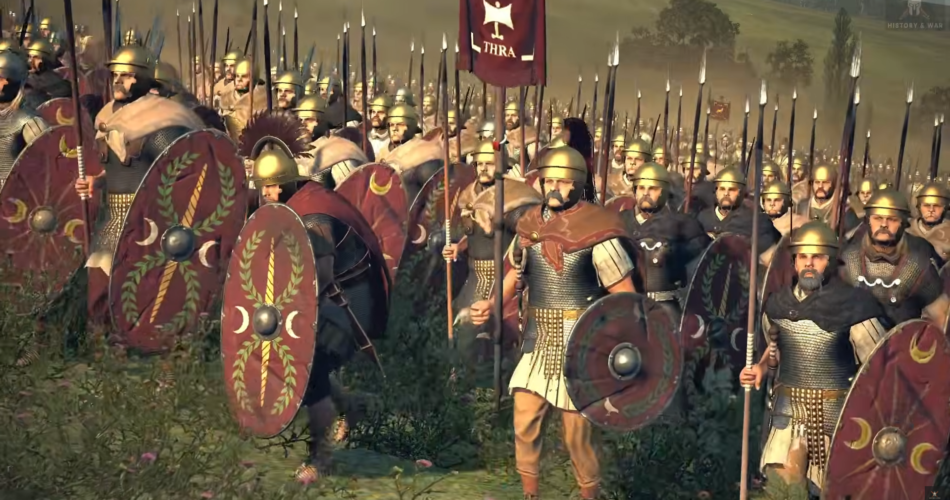
Rome at the End of the World
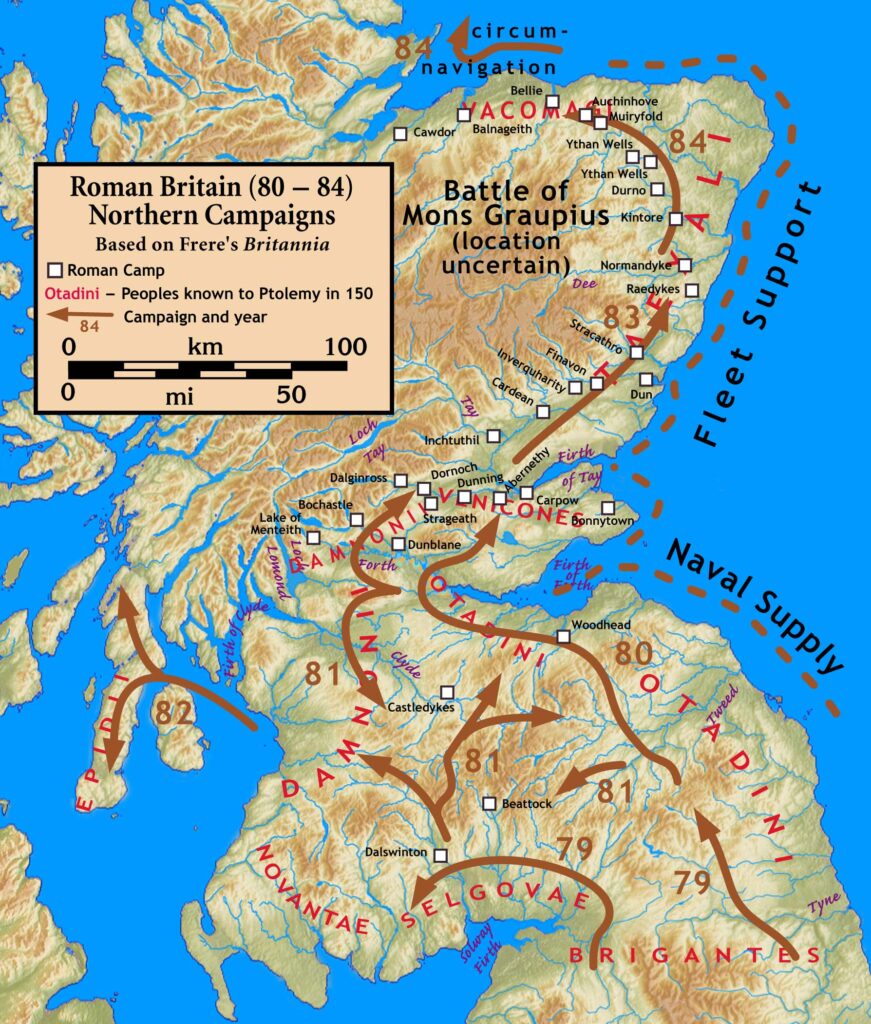
Image Source- Wikipedia

At the very edge of the known world, beyond the limits of Roman maps and Roman fear, two civilizations prepared for a decisive reckoning. In the far north of Britannia, where mist clung to the hills and the land itself seemed hostile to invaders, Rome had finally reached the end of its long advance. For years, legions had marched, forts had risen, and tribes had fallen. Now, under the command of Gnaeus Julius Agricola, the empire stood poised to deliver a final blow. Opposing them were the warriors of Caledonia—men who had watched their lands burn, their strongholds fall, and their freedom shrink with every Roman road driven into their soil. United under the war leader Calgacus, they gathered for one last stand, determined to fight not for conquest, but for survival. What followed was not merely a battle of swords and shields, but a clash of worlds: discipline against defiance, empire against independence, history against oblivion. This is the Battle of Mons Graupius—the last great confrontation between Rome and the free peoples of northern Britain, and a battle known to us only through the words of a Roman historian… and the silence of the defeated.
Rome’s Long Conquest of Britain
Rome’s story in Britain did not begin with conquest, but with reconnaissance and curiosity. In 55 and 54 BC, Julius Caesar crossed the Channel and clashed with the Celtic tribes of the island. Though his expeditions achieved no lasting occupation, they had a lasting consequence: Rome was, for the first time, truly aware of Britain—its peoples, its wealth, and its strategic importance. What lay across the sea was no longer a mystery, but a future target.
Nearly a century later, that awareness matured into ambition. In AD 43, under Emperor Claudius, Roman legions returned to Britain—not to raid, but to occupy and govern. What was expected to be a swift demonstration of imperial authority instead became a prolonged and costly enterprise. Resistance was widespread and determined, and Rome soon discovered that conquest in Britain would be measured in decades rather than in single campaigns.
Progress was notably slow. After almost forty years of fighting, Roman control extended only as far as Chester and York. Even then, there was no clearly defined frontier. Much of the army’s effort was devoted not to further expansion, but to maintaining order within the territories already subdued. Britain remained unstable, difficult to govern, and far from fully integrated into the Roman world. This situation began to change with the arrival of a new governor—Gnaeus Julius Agricola. His appointment would mark a decisive shift in Roman policy and momentum in Britain.
Although Tacitus, Agricola’s son-in-law, is our principal source for Roman campaigns, he is not the only ancient author to record them. Agricola’s activities are also briefly mentioned in the Roman History of Cassius Dio, a vast multi-volume work researched during the reign of Septimius Severus and composed in the following decade.
Agricola’s Arrival and the Destruction of the Ordovices
When Agricola arrived in Britain, the Roman position was precarious. The Ordovices tribe had almost completely annihilated a Roman ala operating in their territory. Such defiance could not be ignored. Despite poor weather conditions, Agricola acted immediately. When the Ordovices withdrew into the hills, he pursued them relentlessly, himself at the head of the column, sharing in the danger alongside his men. Tacitus reports that “almost the entire tribe was destroyed,” a claim he may have believed first hand.
Agricola did not, however, return at once to winter quarters. Determined to eliminate any remaining centres of resistance, he turned his attention to Anglesey, the sacred island of the Druids and a long-standing focus of Roman concern. The assault was led by a select force of auxiliaries, chosen specifically for their familiarity with the tidal shallows and their traditional skill in swimming while armed and controlling their horses. These troops were almost certainly Batavians.
The surrender of Anglesey brought the campaigning season to an end, and the army was dispersed into winter quarters. This brief but decisive episode reveals Agricola’s energy and decisiveness in command. Yet its aftermath also highlights another aspect of his character. Rather than exploiting his success for personal glory, he presented the campaign as a necessary act of security, describing the victory simply as the suppression of a people already conquered.
The Pacification of Northern Britain
When the campaigning season resumed in AD 78, Agricola’s immediate priority was the pacification of the Brigantes of northern England, a necessary precondition for any further advance. Tacitus describes Agricola’s methods in detail. As summer began, he assembled the army and was constantly present on the march, enforcing discipline and preventing straggling. He selected camp sites himself, personally reconnoitred estuaries and forests, and denied the enemy any respite by launching sudden and unexpected raids.
Once the population had been sufficiently intimidated, Agricola deliberately changed his approach. He then displayed the advantages of peace by exercising restraint rather than force. As a result, many communities, which had previously dealt with Rome on near-equal terms, abandoned armed resistance and submitted, providing hostages as guarantees of their compliance.
Beyond the Frontier: Rome Marches to the Tay
The account of Agricola’s third campaigning season introduces a number of unfamiliar names. Tacitus describes him as “ravaging the peoples as far as the Taus,” a reference that is almost certainly to the River Tay. During this campaign, the Romans encountered tribes previously unknown to them. Among these were most likely the Dumnonii, whose territory appears to have extended across the Forth–Clyde isthmus into what is now Stirlingshire and Perthshire.
Despite campaigning in extremely harsh weather conditions, the Roman army succeeded in intimidating these northern communities. As with their southern neighbours, the Dumnonii were probably compelled to submit and may have provided hostages as a sign of their compliance.
Imperial Transition and Changing Priorities
During this campaigning season, Agricola would have received news of the death of his patron, Emperor Vespasian. The elderly emperor succumbed to illness on 23 June AD 79, in his seventieth year. According to tradition, he struggled to rise from his bed and remarked that “an emperor ought to die standing up.” By midsummer, word would have reached the provincial governors that Vespasian’s elder son, the thirty-nine-year-old Titus, had succeeded him as emperor.
With the accession of a new ruler, fresh mandata may have been issued. We know enough about Titus to conclude that he did not simply adhere uncritically to his father’s policies. At the same time, it is striking that governors already in place in key consular provinces—such as Britain, Pannonia, and Syria—were retained throughout his brief reign. Nevertheless, Titus may have held different priorities for Britain. Agricola’s previously rapid forward momentum now appears to have slowed, suggesting that imperial policy, or at least its emphasis, may have shifted.
Consolidating the Roman Hold on Scotland
According to Tacitus, “the fourth summer was spent securing what had been overrun.” Whether or not Emperor Titus had formally ordered a pause in expansion, it was clearly prudent to consolidate Roman control over lowland Scotland. The lessons of the Boudiccan revolt were unlikely to have been forgotten by Agricola, and caution was warranted after such rapid advances.
At the same time, if Titus ultimately intended the conquest of Caledonia to continue, it would have been strategically sound to reposition individual army units further north, placing them within effective striking distance of hostile territory. In this way, consolidation and preparation for future operations could proceed simultaneously.
Toward Final Confrontation
In the following years, Agricola continued to press deeper into Scotland. By AD 82, he probably made use of the Roman fleet to support the campaign, integrating naval operations into the broader strategy of conquest. Tacitus notes that infantry, cavalry, and marines were often gathered within the same camps. There, they shared meals and exchanged stories of their exploits, comparing achievements with the customary boastfulness of soldiers.
By AD 83, the peoples of Caledonia appear to have concluded that there was no longer any secure refuge from Roman advance. With no safe haven left to rely upon, they resolved upon open war. “The peoples who inhabit Caledonia,” Tacitus writes, “resorted to warbands and weapons, with great preparations—magnified by rumour, as is usual when the facts are unknown.” Their initial move was a coordinated attack on the northernmost Roman forts. During this phase of the conflict, the Ninth Legion was caught in a sudden night assault. Agricola responded swiftly and decisively, intervening in time to relieve the besieged legion and prevent its destruction.
Calgacus and the Last Alliance of Caledonia
The Caledonians must eventually have recognized that open battle was unavoidable. They therefore began to assemble a unified host drawn from their previously divided communities. As Tacitus observes, “they had at last learned that a common danger must be repelled by a common effort”. Embassies were dispatched far and wide, alliances were invoked or renewed, and the tribes of Caledonia gathered their forces.
Some of these peoples—including the Venicones of Angus, the Taexali of Aberdeenshire, and even the Vacomagi of Moray—had already encountered Roman troops at close quarters and understood the nature of the threat they faced. Command of this confederated force was entrusted to King Calgacus, leader of the Caledonian alliance.
Tacitus claims that more than thirty thousand warriors, both young and old, answered the call to arms, although the accuracy of this figure has often been questioned. He describes the fighters as “distinguished in battle and each wearing his decorations.” If this does not refer to the painted designs or tattoos commonly associated with Celtic peoples, it may instead indicate the large bronze armlets, collars, and torcs that archaeologists periodically recover from Iron Age sites in Scotland. More than two centuries earlier, the Greek historian Polybius had made a similar observation when describing Celtic warriors “richly adorned with golden torcs and armlets,” referring to the Gallic tribes at the Battle of Telamon in 225 BC. The Caledonian host at Mons Graupius may well have presented a comparable and visually striking spectacle.
Tacitus’ account makes it clear that the Caledonians themselves chose the battlefield. Their selection was likely guided by several practical considerations. First, in assembling a force drawn from across Caledonia, a relatively central location was required—one that even the most distant communities could realistically reach in time. Second, the site needed to be topographically distinctive, allowing unfamiliar groups to identify and locate it without difficulty. Third, since a significant element of the Caledonian fighting force employed chariots, the terrain had to include a broad and relatively level plain suitable for their use. The site known to Tacitus as Mons Graupius appears to have fulfilled all of these requirements.
Agricola’s Army of Conquest
Upon receiving news of the approaching enemy army, Agricola advanced with his own forces to meet it. When he arrived at Mons Graupius, he deployed approximately eight thousand auxiliary infantry and around five thousand cavalry. The exact size of his legionary contingent is not recorded, but it is reasonable to infer that it was broadly comparable in strength to the auxiliary infantry.
The Search for the Battlefield
The Battle of Mons Graupius has long occupied a central place in the study of Roman activity in Scotland. During the nineteenth century, scholars identified the battlefield with numerous Roman sites across Perth and Kinross, ranging from Dalginross to Blairgowrie. In the twentieth century, however, the use of aerial photography and the study of crop marks shifted scholarly attention north eastward, where a chain of Roman marching camps appears to lead toward the Moray coast.
This evidence has encouraged many historians to place the battle in Aberdeenshire, particularly near Bennachie, a prominent and easily identifiable hill located just south of the large Roman marching camp at Logie Durno. Sites in Aberdeenshire align well with Tacitus’ description and have produced archaeological evidence of Roman military presence. They also lie close to the Elsick Mounth, an ancient route used by both Roman and native forces. Bennachie is particularly attractive as a candidate: its long east–west ridge, divided into several distinct peaks, forms a striking silhouette visible from many miles away. If Mons Graupius is best understood as a “ridged hill” rather than a single rounded summit, Bennachie fits the description well and would have served as an ideal mustering point for the Caledonian army.
Debate continues, but most proposed locations now fall between Perthshire and the area north of the River Dee. Several scholars have argued that the battle took place in the Grampian Mounth, possibly on high ground near Roman camps such as Raedykes, including Kempstone Hill or Megray Hill.Despite these arguments, the precise location of the battle remains uncertain. This lack of definitive evidence led Historic Environment Scotland to exclude Mons Graupius from the Inventory of Historic Battlefields in Scotland.
Battle Formations at Mons Graupius
Tacitus records that the conclusion of Agricola’s speech was followed by a tremendous outburst of enthusiasm, and that the troops immediately rushed to take up their arms. It is reasonable to envisage columns of soldiers leaving the western and southern gates of the camp at Durno and advancing in good order across the River Urie to occupy their prearranged positions on the battlefield. Despite their eagerness for combat, Agricola deployed his forces with deliberation. The auxiliary infantry, numbering approximately eight thousand, formed the solid centre of the battle line, while around three thousand cavalry were positioned on the flanks. The legions remained near the rampart as a reserve. As Tacitus observes, it would have been a notable distinction to win the battle without committing Roman legionaries, though they stood ready to intervene should the auxiliaries be driven back.
The remark regarding the conservation of Roman blood is almost certainly Tacitus’ own interpretation of Agricola’s strategy. There is nothing in the military history of the period to suggest that any Roman general would have actually conceived of warfare in such terms. Both the auxiliaries and the legionaries were integral components of a professional army: each possessed distinct strengths and specific vulnerabilities, and both were valued equally for their contributions to Roman military operations.
The Caledonians, likewise, prepared for battle in a formation that maximized the advantages offered by the terrain, likely accompanied by the resounding blast of war horns. Tacitus describes their deployment: “The Caledonians’ line was posted on high ground, both for display and to inspire terror, with the front ranks standing on the plain while the remainder rose along the slope in a curved formation. The charioteers occupied the centre of the plain, creating a tumult as they maneuvered.”
The Caledonians advanced across the hillside “as if in a curving formation,” overlooking the plain below, where scythed chariots rumbled and rattled in an effort to intimidate the Roman lines. Dozens of chariots were clearly deployed to cover the plain, each manoeuvring independently under the control of its chieftain-driver, who sought to demonstrate his skill. Their principal tactic appears to have been to charge along the front ranks, where the scythed wheels could inflict maximum damage.
Agricola’s decision to extend his battle line may not have been solely a response to the large Caledonian army, but rather aimed at countering the Covinni formation. This consideration, in turn, may have influenced his selection of auxiliaries for the front of the line. The legions were traditionally arrayed in close order, forming a solid wall of shields through which soldiers could deliver thrusts with their short swords. By contrast, the auxiliaries were trained to fight in open order, allowing them to respond with greater flexibility to the particular threat posed by scythed chariots.
The Battle of Mons Graupius
While Agricola took his stand—likely accompanied by his infantry guard the pedites singulares at the front of the legionary line—his auxiliaries advanced into battle. By positioning himself to the rear, he was following the strategic principles outlined by Onasander. The engagement began at long range. As the extended line of auxiliaries, now cleared of the threat posed by the scythed chariots, closed within missile range—perhaps as far as sixty meters or as near as thirty meters from the enemy—a resounding relay of shrill Roman battle horns likely signalled the next phase of action.
At that moment, Calgacus and his allies would have faced the formidable sight of some three thousand javelins shouldered in the front rank of Agricola’s army, with perhaps as many as eight thousand poised across all three ranks. It is possible that British javelins were already in flight when the order came for the Romans to launch their own projectiles. Tacitus makes no mention of British archery at Mons Graupius. The Caledonians, wielding their large swords and short shields, either parried the Roman missiles or deflected them while simultaneously launching a heavy counter-barrage of spears.
Soon, only six of Agricola’s infantry cohorts advanced “to bring matters to a decision through hand-to-hand swordplay.” Four of these cohorts, totaling slightly fewer than two thousand men, were Batavians—described by Tacitus as “the most conspicuously courageous of all the German peoples of Gaul” and highly esteemed for their esprit de corps. The remaining two cohorts, probably numbering just under one thousand, were Tungri, another Germanic people from the west bank of the Rhine.
Agricola had clearly placed his greatest confidence in the Batavian and Tungrian cohorts. Whether or not they had already thrown their spears, each soldier now drew his short sword, the classic gladius, and charged into the densely packed ranks of the Caledonians. Even their shields, constructed of layered wood with brass edging and an iron boss, became offensive weapons, striking opponents with force. This decisive action encouraged the other cohorts in the line, which gradually advanced, climbing over the fallen—dead or injured.
As Tacitus presents it, the British swordsmen, despite their skill with small shields and their cumbersome, unwieldy blades, proved no match for the quick and versatile Roman gladius. It is unlikely that Agricola’s auxiliaries were armed with these swords; indeed, it seems probable that there was no significant disparity in weaponry between the opposing forces at Mons Graupius. The advantages enjoyed by the men from the Low Countries fighting for Rome lay primarily in their rigorous drilling and training, as well as in their mail cuirasses, which offered effective protection against the cutting action of the slender native swords, if not against the force of a heavy blow. While the heavy Roman shield could make it difficult to parry a rapid succession of strikes, this proved less problematic at Mons Graupius, where blows were likely delivered at relatively generous intervals.
The opening minutes of the engagement—with the accompanying clamour of battle cries, clashing weapons, shield blows, and agonized cries—would likely have had a profound psychological impact on Calgacus’s coalition army. In the usual context of native warfare, the sight of the most skilled and courageous warriors standing firm would serve to inspire the less experienced men positioned behind them, bolstering morale and compensating for their lack of discipline. On this occasion, however, the effect was likely the opposite. Waves of shock and disbelief would have spread through the British ranks as these conspicuous and celebrated fighters—the very flower of the host—fell or were driven back in their individual engagements with the Batavian and Tungrian infantry.
The exact deployment of the Caledonian cavalry remains uncertain, but they were presumably positioned on the level ground at the base of the hill, perhaps even intermingled with their infantry. They were soon routed. Their lack of cohesion may have contributed to their disorderly retreat, but the principal cause is evident: Agricola had stationed some three thousand cavalry on his flanks. It was likely these Roman horsemen who outmatched their Caledonian counterparts and precipitated the rout—a task entirely consistent with the traditional role of cavalry in battle.
Meanwhile, the Caledonian chariots had performed poorly. Such vehicles required relatively level terrain to prevent their scythed wheels from fouling in the ground, yet the battlefield was likely far from uniform. Moreover, to be effective, the scythed wheels needed to remain in continuous motion. By this stage of the battle, however, the chariots were largely immobilized, having become entangled in the infantry melee. As the Roman line advanced steadily, it was forced to contend with stray chariot horses and the debris of the wrecked vehicles, which further hindered the Caledonian effort.
Throughout the engagement, the Romans had effectively confined the fighting to the lower slopes of the hill, drawing successive waves of Caledonian attackers downward while avoiding the boulder-strewn upper reaches. It was now the moment for the troops positioned on these higher slopes—who had enjoyed a commanding view of the battle—to descend and join the fray.
It was precisely for such an eventuality that Agricola had retained a cavalry reserve. These four squadrons were now committed to the task of preventing any attempted outflanking by the enemy. By this stage, the elite of the Caledonian forces had likely been destroyed, leaving only the less experienced or poorly armed warriors. Their nobles and chariots had been eliminated, the cavalry had long since fled, and the Roman auxiliary infantry continued their relentless assault, though by now they must have been thoroughly fatigued.
The newly arriving Caledonian warriors proved no match for the charging Roman cavalry, well armed and heavily armoured. As Tacitus depicts it, the Romans appear to have treated them with grim efficiency: as soon as a group was hunted down and captured, they were executed, only for the same process to be repeated as additional enemies came into view.
Once the Caledonians began to flee—a clear indication that the battle was effectively over—Agricola mounted his horse to take an active role in the mopping-up operations. The fate of his Caledonian counterpart, Calgacus, remains unknown. It is possible that, as one of the charioteer nobles, he fell early in the engagement, allowing the course of the battle to unfold without his leadership.
Only the onset of darkness brought the operations to an end. Untold hundreds of Caledonians had fled without engaging in combat. Tacitus claims that some 10,000 Caledonians were killed, compared with only 360 Romans. The disparity appears remarkable, though it was common practice in ancient sources to exaggerate enemy casualties in order to emphasize the significance of a victory.
The Aftermath of Mons Graupius
Following this final battle, it was proclaimed that Agricola had subdued all the tribes of Britain. Soon afterwards, he was recalled to Rome, and his command passed to Sallustius Lucullus. It is likely that Rome had intended to continue the campaign, but pressing military demands elsewhere in the empire necessitated a withdrawal of troops, and the opportunity for further conquest was lost.
Although Agricola’s campaign temporarily brought much of what is now Scotland under Roman control, the occupation proved short-lived. The Romans displayed little interest in permanently colonizing the northern territories, which were considered poor in resources and strategically less valuable than southern Britain. Within a few years, Roman forces had retreated to the line of the Forth–Clyde isthmus, abandoning most of Caledonia.
© 2026 History and War
Author: Jishu Roy
Unauthorized reproduction of this content is prohibited.