Copyright © Cyowari
A Republic Under Siege
By the closing months of 240 BC, the Mercenary War had entered a new and increasingly dangerous phase. Although Hamilcar Barca’s victories in the African interior had restored some measure of Carthaginian confidence, they failed to bring the rebellion to an end. The insurgents under Mathos, Spendius, and Autaritus remained formidable, while Carthage continued to struggle with severe financial pressures, manpower shortages, and the immense challenge of defending a far-flung empire in the aftermath of the First Punic War.
The conflict soon expanded beyond the North African mainland. In Sardinia, the mercenary garrison stationed on the island abandoned its allegiance, murdering its commanders and plunging one of Carthage’s most important overseas possessions into revolt. At the same time, military operations in Africa settled into a prolonged struggle of maneuver, raids, and sieges, as neither side proved capable of delivering a decisive blow. Internal disagreements within the Carthaginian high command further complicated the republic’s efforts, while the rebels steadily regained the initiative.
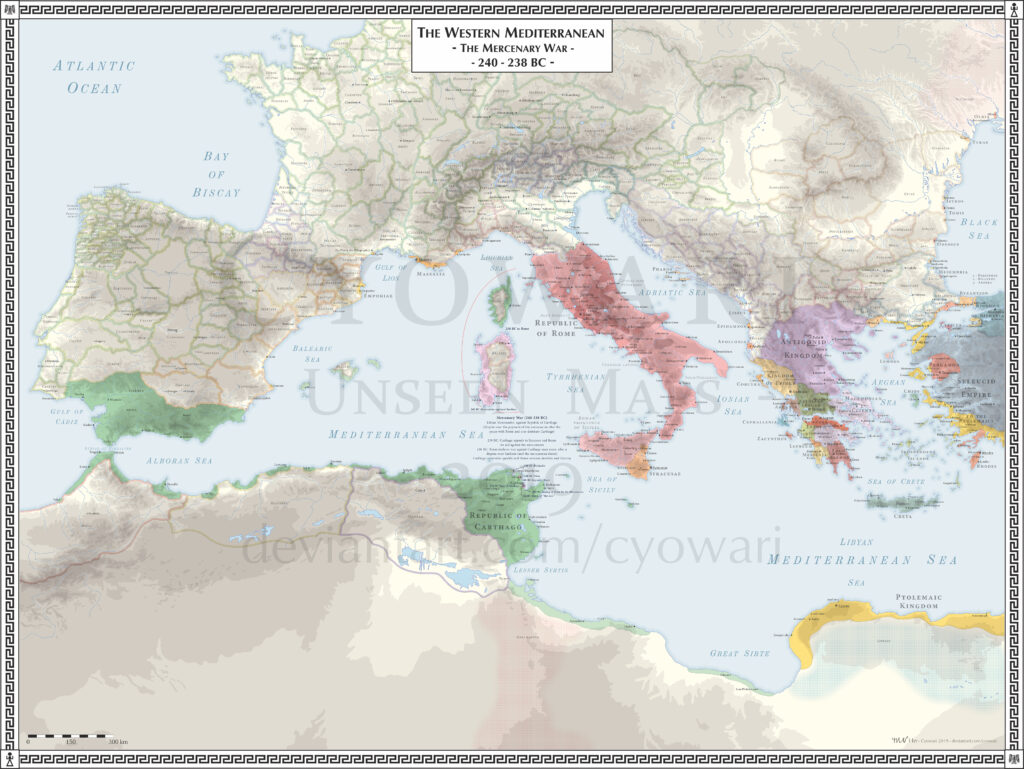
These developments culminated in one of the gravest crises in Carthaginian history. The defection of key allied cities and the rebels’ subsequent decision to besiege Carthage itself transformed what had begun as a military mutiny into an existential threat to the republic. This article examines the events from late 240 to 239 BC, focusing on the Sardinian Revolt, the deteriorating strategic situation in Africa, and the first siege of Carthage during the Mercenary War.
The Mercenary War Enters a New Phase
By autumn or winter of 240 BC, Hamilcar’s inland campaign had progressed significantly. The subsequent phases of the campaign—operations against rebel-held towns, the pursuit by Spendius and Autaritus, and the ensuing developments—likely spanned at least two to three additional months. During this period, many significant events unfolded. However, reconstructing the precise sequence, as well as some specific details, requires careful interpretation of the sparse references provided by Polybius. Despite these limitations, the core elements of the narrative remain well-established.
Military preparations in Carthage continued unabated even after Hamilcar’s departure with his army. As previously noted, it is unlikely that he left the city undefended. Following his initial victory, he appears to have incorporated reinforcements for his inland campaign. This suggests that recruitment efforts remained active, likely becoming significantly easier with the return of the summer sailing season. The spread of news about the major conflict in Africa across the Mediterranean would have attracted numerous eager mercenaries. Most of these, however, were drawn to Carthage and its coastal allies, as the republic’s navy actively patrolled to block aid to the rebels. Even with reinforcements, the combined forces of Hamilcar and Hanno the Great would have numbered only around 30,000 men. This figure was smaller than several Punic field armies deployed during the recent war against Rome and still insufficient compared to the vast numbers of rebel forces. For both sides, therefore, it was crucial to continuously build and sustain effective armies and garrisons. A particularly alarming episode, likely occurring in the latter half of 240 BC, illustrates the extent of Carthage’s ongoing military efforts during this critical period.
The Sardinian Revolt
During this period, the Carthaginians faced a significant setback in Sardinia when the mercenaries stationed there mutinied. Initially, these troops had not joined the mainland uprising, but Polybius later describes them as being “eager to rival Mathos and Spendius.” It is highly likely that these rebel leaders had been sending messages to Sardinia, urging the mercenaries to join the rebellion. Any development that increased Carthage’s difficulties would have been actively encouraged by the mainland rebels. As previously noted, the Carthaginians had hoped that the Sardinian garrison would remain loyal. However, something triggered these troops to abandon their allegiance in a manner as violent as the mutinies in Tunis. The most straightforward explanation lies in financial strain. The mercenaries’ pay and rations may have become irregular or even ceased altogether, likely due to the severe financial pressures Carthage faced. The costs of defending the Carthaginian heartlands during this protracted conflict likely took precedence, necessitating even dangerous reductions in expenditure.
While financial hardship likely contributed to the Sardinian mutiny, it does not appear to be the sole cause. Nor is it entirely convincing that the mercenaries were suddenly swayed by the latest appeals from Africa. These mercenaries had resisted such persuasion earlier, and Mathos and Spendius, preoccupied with their own struggles and the financial burdens of war, were unlikely to have provided substantial support in the form of money or reinforcements. The actions of the Sardinian mutineers following their revolt offer valuable insights into their motivations. Their systematic and violent persecution of captured Carthaginians suggests a deep-seated animosity between the two groups. For this level of hostility to manifest, it likely stemmed from longstanding grievances, extending back several years.
Polybius’ account of the Sardinian mutiny is relatively brief. He mentions that the mercenaries, under the command of Bostar, imprisoned him and his fellow citizens in a citadel and subsequently killed them. The term “boetharchos” used to describe Bostar is a Greek word not commonly found in Punic contexts until much later, when it referred to a military officer in charge of a region. This suggests that Bostar was likely the military governor of Sardinia and the commander of the mercenaries stationed there. The identity of the “citadel” mentioned by Polybius remains uncertain. Several possibilities exist. One candidate is Tharros, a strongly fortified city on the west coast and one of Sardinia’s leading Punic settlements, possibly its most significant. Another is Sulci, situated on a small island off the southwest coast. Carales, modern-day Cagliari on the southern coast, is also a plausible option. However, the most compelling possibility is the ancient Punic fortress at Monte Sirai, located about 15 kilometers north of Sulci. Although Monte Sirai was not a town, it served as a fortified outpost and an advanced bastion for Sulci. Its location, on a 200-meter-high ridge overlooking a fertile region, made it a strategic stronghold.
A plausible reconstruction of the events suggests that when the mercenaries under the governor Bostar—likely the largest group of mercenaries in Sardinia—mutinied, Bostar, possibly accompanied by a few loyal officers and soldiers, along with several Carthaginian citizens, retreated into the nearby citadel for refuge. While Polybius may have been referring only to Carthaginian officers, he specifically mentions “citizens,” which implies that able-bodied civilians may have also participated in the defense. Such involvement is not without precedent. For example, in 112 BC, when Jugurtha, a descendant of Masinissa, attacked his cousin and fellow Numidian king at Cirta (modern-day Constantine in Algeria), Italian traders in the city joined the resistance and were killed when the city surrendered. he fate of Bostar and those who took refuge with him was similarly grim. Once the citadel was captured, the defenders, including Bostar, perished. The means by which the mutineers overcame the citadel remain unclear. Despite its fortifications, starvation, fear, or false promises could have compelled its surrender. Alternatively, the mutineers may have stormed the fortress, though Polybius’ account does not indicate that significant fighting occurred during its fall. This suggests that the citadel’s defenses may have been breached through less direct means.
The coup in Sardinia did not immediately place the entire island under the control of the mutineers. Polybius indicates that the towns fell to them only at a later stage. However, the elimination of Bostar effectively gave the mutineers control over the surrounding territory. Mercenary units stationed elsewhere on the island soon rallied to their cause. Yet, based on Polybius’ account, these forces were initially unable to capture any towns. Carthaginian and Liby-Phoenician residents, possibly joined by some Punicized native Sardinians, managed to maintain control of the towns and sent urgent appeals for assistance to Carthage. Polybius dates these events to “around the same time” as the victory of Hamilcar and Naravas, placing them during the summer of 240 BC. This timeline aligns with Carthage’s response: the dispatch of an expedition under a general named Hanno, to recover Sardinia. It is unlikely that Hanno’s troops were drawn from Hanno the Great’s army, as weakening that force would have been too risky. Instead, the soldiers were likely sourced from the new forces Carthage continued to assemble. The expedition’s composition reveals that the troops sent were mercenaries, reflecting Carthage’s reliance on such forces during this period. Similarly, Hamilcar’s inland army also included newly recruited professional soldiers. This pattern underscores Carthage’s efforts to rebuild and reinforce its military capacity amid the ongoing crises.
Given Carthage’s strained resources, the expedition to Sardinia was unlikely to have been a large force. However, it was reasonable to assume that the troops dispatched were at least comparable in size to the mutineer forces. Sending significantly fewer would have been ineffective, while deploying a substantially larger contingent would have been impractical given the volatile situation in Libya. Hanno’s appointment and the organization of the expedition appear to have been executed with great urgency. By the time he landed in Sardinia, the mutineers had not yet secured control of the towns, which suggests that swift Carthaginian action disrupted their efforts. From Carthage’s perspective, such speed was strategically crucial. A rapid counterstrike could protect the towns and their inhabitants while also preventing the mutineers from consolidating their power. Failure to act quickly would not only risk the loss of Sardinia’s resources but also embolden the rebel leaders Mathos and Spendius, further complicating Carthage’s already precarious position.
Hanno’s expedition to Sardinia ended disastrously. He failed to inspire his troops, and fortune was not on his side. Upon his arrival, his soldiers abandoned him, evidently seeing better prospects in joining the mutineers. This defection strongly indicates that his forces were composed of mercenaries, as it is implausible that Carthaginian citizen-soldiers, even if available, would have deserted. Similarly, Libyan conscripts were unlikely to be part of his force, given their scarcity and the lack of trust the republic could place in them. Polybius records that Hanno was seized “by capture,” implying that he attempted to flee when his men mutinied, though his efforts were ultimately in vain. Once captured, he suffered a brutal execution by crucifixion, a form of punishment associated with Punic practices and often employed for its symbolic impact. The mutineers likely intended this public display to send a clear message across Sardinia: it was a stark declaration of their contempt for Punic authority and a warning of the fate awaiting any other Carthaginian leaders who might fall into their hands.
The violence in Sardinia did not end with Hanno’s execution. Reinforced by the defection of his troops, the mutineers were finally able to seize control of the towns, capturing and killing every Carthaginian they could find. The native Sardinian communities did not intervene to aid the Carthaginians. Had they done so, it is likely that the Carthaginians could have maintained their hold on at least some locations. Historical evidence shows that the Sardinians were well-armed and warlike, as demonstrated later when they eventually expelled the mutineers themselves. It is possible that the mercenaries convinced the Sardinians to remain neutral or even to provide support, likely through promises that were later broken. Once the Carthaginians on the island fell into their hands, the mutineers subjected them to “unusual punishments,” torturing and killing them all. This distinguishes the fate of these civilians from that of Hanno, who was crucified—a severe but not uncommon form of execution in Punic territories. Polybius’ language implies the use of other, more horrific methods, though he refrains from detailing them. The brutality of these actions parallels the atrocities later committed against Gisco and his colleagues at Tunis. This calculated ferocity suggests that the hostility between the Carthaginian residents and the mercenaries tasked with defending them was deeply rooted, reflecting longstanding antagonism that erupted in this violent rebellion.
The Military Situation in Africa
The other major theater of the conflict was the coastal region surrounding Carthage. Militarily, little significant activity appears to have taken place in this area during this period. The rebels, who maintained control of Tunis and its surroundings, continued their blockade of Carthage, though it achieved little tangible effect. Similarly, the siege of Hippo Diarrhytus persisted in a state of apparent stalemate. Despite enduring a year-long blockade and significant pressure, the defenders of the city continued to resist effectively. Mathos, last reported near Hippo Diarrhytus, was now rejoined by Spendius and Autaritus. Both leaders, hardened and embittered by their earlier defeat, returned to the conflict with even greater resolve to wage war. These developments highlight the ongoing intensity of the conflict, even in areas where direct military progress was limited.
The Carthaginian defenses along the coastal regions displayed a degree of strategic acumen—or perhaps fortuitous positioning—that counterbalanced the rebel forces concentrated around Tunis and Hippo Diarrhytus. Carthage itself remained well-defended, supported by Hanno’s nearby army, creating a stalemate that the rebels were unable or unwilling to break. Despite their numerical strength, the rebels did not combine their forces to launch a decisive attack on Hanno, Carthage, or Hippo Diarrhytus. It seems unlikely that Mathos and Spendius never considered such a strategy. More plausibly, they were constrained by the risks involved. Weakening the forces around Tunis to strike at Hanno, for example, could invite a counterattack from Carthage against the remaining forces. Similarly, concentrating their entire strength against Carthage’s formidable defenses was unappealing, particularly with the possibility of Hanno harassing their rear or, worse, Hamilcar rapidly returning to the coastal front. The option of dispatching another large force against Hamilcar was equally unappealing, as it risked overextending their position. While some units were eventually sent to confront him, this occurred at a later stage, as subsequent events will demonstrate.
The Defection of Utica and Hippo Diarrhytus
At this stage, the year 240 was giving way to 239. Polybius’ account suggests that the conflict during this period consisted of a series of smaller engagements and skirmishes rather than a decisive battle. It is reasonable to assume that if Hamilcar had fought a significant third battle, Polybius would have recorded it. The rebels, having learned from their previous defeats, likely adopted a more cautious strategy aimed at undermining Hamilcar’s efforts indirectly. The newly mobilized rebel forces focused on harassing Hamilcar’s movements and disrupting his supply lines, while attempting to reclaim towns that had surrendered to him and persuading others to remain loyal to “the Libyans.” These tactics, resembling those of the larger expedition planned a year later, emphasized maneuvering, minor skirmishes, and occasional ambush attempts. Such a form of warfare was drawn out, often lasting weeks or even months, reflecting the rebels’ adaptation to a more protracted and evasive strategy.
Hamilcar faced no immediate threat of defeat, but the ongoing operations placed significant strain on his army. Casualties from storming resistant towns would already have thinned his forces, and the possibility of desertions could not be dismissed, especially given the rebels’ ruthless decree from Tunis. This proclamation, which declared that no prisoners would be taken and that any captured soldier faced execution or mutilation, added a psychological burden to the conflict. Such factors likely influenced Hamilcar’s decision to summon Hanno to join him. Hanno had made little progress against the coastal rebels and was not under significant pressure from them. The sieges of Hippo Diarrhytus and Utica were being effectively resisted, and Carthage remained well-defended, with steady access to supplies and munitions by sea. In fact, a major convoy of provisions was expected from the Emporia region, bolstering the city’s resilience. Hamilcar likely reasoned that combining their forces would provide a decisive advantage, allowing them to end the stalemate caused by fighting on two separate fronts. A united field army could confront the rebels directly, potentially defeating them decisively and then leveraging that success to advance on the coastal territories. Such a development, combined with the rebels’ already fragile morale and fear of the Carthaginian policy of no quarter, could demoralize them completely.
Before departing, Hanno needed to ensure the security of the loyal coastal regions, particularly since Utica was likely to come under renewed threat as soon as he left. To address this, he stationed 500 Carthaginian citizen soldiers at Hippo Diarrhytus and the same number at Utica—or possibly 250 at each, though this interpretation is less convincing. These small contingents were only practical if Hanno trusted the towns’ local defenders to handle most of the burden. The presence of Carthaginian soldiers was intended to guarantee the loyalty of these key settlements. With these precautions in place, Hanno set out to join Hamilcar. The rendezvous between the two commanders, as noted by Polybius, raised optimism among the citizens of Carthage. The combined forces likely exceeded 20,000 troops, all of whom were now seasoned in the challenges of North African warfare. This formidable number at least equaled, and possibly surpassed, the rebels’ field strength. The united armies launched new operations, and according to Polybius, multiple opportunities arose for decisive victories against the rebels. However, these promising prospects were consistently undermined by a fresh setback, preventing a conclusive resolution to the conflict.
Hamilcar clearly expected the two armies to continue his strategy. They could either move together or operate separately but in coordination, with the goal of distracting, frustrating, and trapping the enemy. This meant Hanno would have to work under Hamilcar’s leadership. The Carthaginian senate and magistrates likely understood this and approved the union of the armies, agreeing to Hamilcar’s request. However, it’s unlikely that Hanno was on board with this plan, especially after seeing the situation firsthand. In fact, he likely disagreed strongly with Hamilcar. Polybius doesn’t explain the reasons for their quarrel, but it doesn’t seem to be due to personal animosity, as the two had worked together before. Even later, despite personal conflicts, they were still able to coordinate military actions under pressure from their fellow citizens. However, this time, their disagreement disrupted the campaign. Hanno’s opposition wasn’t just a reaction to being treated as a subordinate. Hamilcar’s months of campaigning in Libya hadn’t succeeded in breaking the rebel effort or securing the territory he had taken. His harsh retaliation had only fueled more hostility from the Libyans. Hanno had every right to point out these failures and push for a change in strategy. Their quarrel severely hindered their efforts, as they not only missed opportunities to strike at the enemy but also left themselves vulnerable to attacks.
By this time, it was likely well into summer, and the war’s momentum had shifted against Carthage. Hanno’s withdrawal from the coastal front had left Utica and Hippo Diarrhytus vulnerable. While Carthage itself remained protected by its formidable walls and defenders, Mathos and his rebel forces now enjoyed near-complete freedom of movement beyond the city. The small garrisons and citizens in Utica and Hippo Diarrhytus were significantly outnumbered by the rebels surrounding them. However, the first major blow to Carthage came not from the rebels but from nature. A sudden storm sank the supply ships transporting provisions from the Emporia region, the granary of Carthage located approximately 200 miles south near Syrtis Minor. This loss of critical supplies was a severe setback. Worse still, the most devastating event was yet to come. The cities of Utica and Hippo Diarrhytus, long loyal to Carthage—even during earlier crises such as Agathocles’ invasion and Marcus Atilius Regulus’ campaign—unexpectedly defected to the rebels. The inhabitants of both cities turned on the Carthaginian garrisons, executing over 500 Punic soldiers and throwing their bodies over the city walls. Requests from Carthage to retrieve and bury the dead were bluntly denied. With these defections, control over the northeastern Libyan coast slipped from Carthage’s grasp almost overnight. Moreover, the rebel forces previously stationed outside the cities were now free to regroup and prepare for their next campaign. Emboldened by their recent successes, Mathos and Spendius decided on a bold and audacious move: a siege of Carthage itself.
The Siege of Carthage Begins
Carthage had been under blockade since the revolt began, which raises the question of how a siege differs from this ongoing blockade. The blockading forces, based in Tunis, had already cut the city off from its surrounding regions. Hamilcar’s initial march to the Bagradas River had been possible only during the night and with the help of a strong wind at the river’s mouth. Although the rebels likely took extra precautions to prevent any further breakouts, the effectiveness of the blockade probably varied over the course of the following year. After Hamilcar’s victories and his operations through parts of Libya, the supply and support for the rebels around Carthage, Utica, and Hippo Diarrhytus weakened, as previously mentioned. However, the situation changed once the rebellion regained momentum. Mathos and Spendius’ decision to lay an actual siege to Carthage was both a bold military strategy and a significant propaganda victory, amplifying the psychological impact of the Carthaginians’ recent defeats. This development likely encouraged continued Libyan support, both in terms of supplying munitions and financial resources, while also attracting additional recruits. The rebellion may have even drawn mercenaries from abroad, despite Carthaginian naval patrols attempting to stop such movements. Notably, envoys from Utica were able to sail to Rome with a request for assistance—an effort the Carthaginians would have wanted to prevent, but ultimately failed to do so.
Besieging the city, as opposed to blockading it, required bringing forces closer to its walls. This necessitated the construction of trenches and the use of protective equipment, such as mantlets. The rebels would occasionally attempt attacks on vulnerable sections of the city’s fortifications. They had some siege engines, notably those captured from Hanno outside Utica earlier in the conflict. It’s possible they crafted more, as some of the veterans from Sicily may have had the technical expertise, and craftsmen among the camp-followers might have attempted to replicate Hanno’s engines. However, if direct assaults were made, they were unsuccessful against the city’s formidable fortifications and determined defenders. Another strategy often employed when brute force failed was internal treachery. This tactic was famously used by Hannibal and the Romans decades later. Despite possibly having the resources, Mathos and Spendius were unable to find any willing insiders. Solidarity within Carthage was notably strong, and even the slaves, who were likely numerous, did not cause any disturbances. This left the final, slowest, and least dependable option: attempting to starve the city into surrender.
Before the siege of Carthage began, the deadlock between the Carthaginian generals was resolved. The army, or at least its citizen contingent, decided that Hanno should step down from command. According to Polybius, as the siege commenced, a replacement had already been chosen: a general named Hannibal. Hamilcar, Hannibal, and the Numidian lord continued operations across Libya, with the goal of disrupting the siege by cutting off supplies to Mathos and Spendius. It seems Hannibal was given his own division, likely taking over Hanno’s troops. Hamilcar intended for the two armies to operate separately but work together against the enemy. While Hannibal had his own command, Polybius indicates that he still followed Hamilcar’s orders.
Before the new military leadership could make significant progress, the siege of Carthage finally began. As previously mentioned, Polybius reports that Hamilcar’s goal, alongside Hannibal and Naravas, was to “cut off supplies to Mathos and Spendius” from the interior. This suggests that much of Libya continued or resumed its resistance. However, the next few months of the war remain unclear, as Polybius provides only a brief summary. With help from their allies overseas, the Carthaginians managed to withstand the siege. In contrast, the forces of Mathos and Spendius were themselves besieged, as Hamilcar effectively restricted their supplies, forcing them to lift the siege. It can be inferred that this process took several months. The siege likely began in the second half of 239, with August or September being a reasonable estimate. Polybius emphasizes the critical importance of supplies from Sicily and Italy for Carthage. Building up sufficient stockpiles, especially with the upcoming winter, was as crucial for Carthage as denying supplies to the besiegers was for Hamilcar, Hannibal, and Naravas. Significant supplies could only arrive before late autumn, as the non-sailing season in winter would limit further shipments. While some daring ships might continue amid storms, the flow of supplies would slow considerably by mid-October.
The rebels chose not to launch a direct assault on Carthage, so their only realistic strategy was to attempt to starve the city into submission. However, as long as summer and early autumn persisted, they had no real chance of succeeding in this approach due to their lack of naval power. As noted earlier, the Syracusans, under King Hiero, had been providing vital supplies from the outset, a decision driven by self-interest, which Polybius praises. Now, Hiero intensified his efforts. The Romans also increased their support, though their motivations differed—unlike Hiero, they sought to prevent a breakdown of political and social order in North Africa. Carthage’s harbor was located on the side opposite the city’s land walls, so while Mathos and Spendius at Tunis could observe the arrival and departure of naval and merchant ships, including transport vessels, they were powerless to stop them.
For Hamilcar, the immediate priority was to focus on relieving Carthage, which required him to largely disregard much of Libya, a region that likely remained rebellious or had reverted to rebellion. In order to disrupt the besieging forces and cut off their supply lines, he, along with Hannibal and Naravas, would need to position themselves closer to Tunis. A strategic location for this could have been Thuburbo Minus, situated on the north bank of the Bagradas River, around 35 kilometers west of the rebel stronghold. To effectively block the besiegers’ supply lines, Hamilcar had to divide his forces without spreading them too thinly. The best approach was likely to establish a few key bases in the region, supplemented by smaller strongpoints nearby. The goal was not to form a continuous line around Tunis, but to control the main supply routes, as most of the rebel supplies were transported by pack animals or wagons using these routes. While some supplies might have slipped through back roads or across fields, this would not be enough to sustain the large rebel forces. Naravas’ cavalry, well-known for striking fear into the rebels, could patrol the countryside, intimidating travelers and alerting nearby bases when necessary, where infantry and elephants could intervene. This strategy also explains why Hamilcar sought a reliable Carthaginian commander—results would not be immediate, but a methodical approach involving regular patrols, local intelligence, and ongoing actions to instill fear could slowly weaken the besieging forces.
Over time, Hamilcar’s methods proved effective. The besieging forces began to experience shortages, which were exacerbated by the winter months, particularly if the siege had begun in the latter half of the year. With fewer munitions and financial resources available, the rebel supply lines became increasingly vulnerable. The reduction in supply trains made it easier for Hamilcar’s forces to intercept them. Additionally, the dangers of winter sailing effectively cut off merchant ships from other regions, limiting supplies to Tunis, Utica, and Hippo Diarrhytus. While Hamilcar’s own forces also faced difficult conditions, with reduced rations and limited supplies, particularly for cavalry and elephants, they gradually gained the advantage. As Polybius notes, this situation effectively created two sieges: one within Carthage and one around it, with the latter proving increasingly difficult for the rebels to sustain.
The rebels made no serious attempt—or at best, only failed attempts—to drive Hamilcar’s forces away, though Polybius does not provide a clear explanation for this. It may be that the rebels were demoralized, with their leaders fearing further defeat, which could lead to their own downfall. Rather than facing two disjointed and conflicting Carthaginian commanders, the rebels now faced a unified command under Hamilcar, who was well-supported by his lieutenants, Hannibal and Naravas. It was only when the situation became truly desperate that the rebels finally broke out, likely in early 238 BC. Meanwhile, Mathos, Spendius, and Autaritus had no viable strategy other than to continue the siege of Carthage. Their successes in winning over Utica and Hippo Diarrhytus, while important in reviving the revolt, ultimately proved counterproductive. These cities provided few additional resources for the rebel effort, though they did free up the forces that had previously been tied up in their defense. While besieging Carthage had seemed like the logical next step, it eventually trapped the rebels in an untenable situation. They could neither capture the city nor evade Hamilcar’s blockade, and with time, they were forced to face starvation.
Ultimately, the rebels’ endurance broke, and they lifted the siege of Carthage. Polybius leaves it somewhat unclear what this entailed, but it can be inferred that the rebel forces did not retreat to another part of Libya. Rather, they maintained control of Tunis and its surrounding area. In practice, Mathos and Spendius simply abandoned their positions outside Carthage’s walls, relieving the city from the immediate threat of direct assault. However, the rebel forces still held key positions along the routes from Tunis and the Bagradas River to Utica and Hippo Diarrhytus. The land routes into Carthage remained blocked. Essentially, the rebels shifted from a direct siege to a form of blockade, continuing to isolate the city from a distance rather than mounting an ongoing siege. With the siege of Carthage ended, the war entered its final stage, and both sides were once again in the open field in 238 BC.
© 2026 History and War
Author: Jishu Roy
Unauthorized reproduction of this content is prohibited.