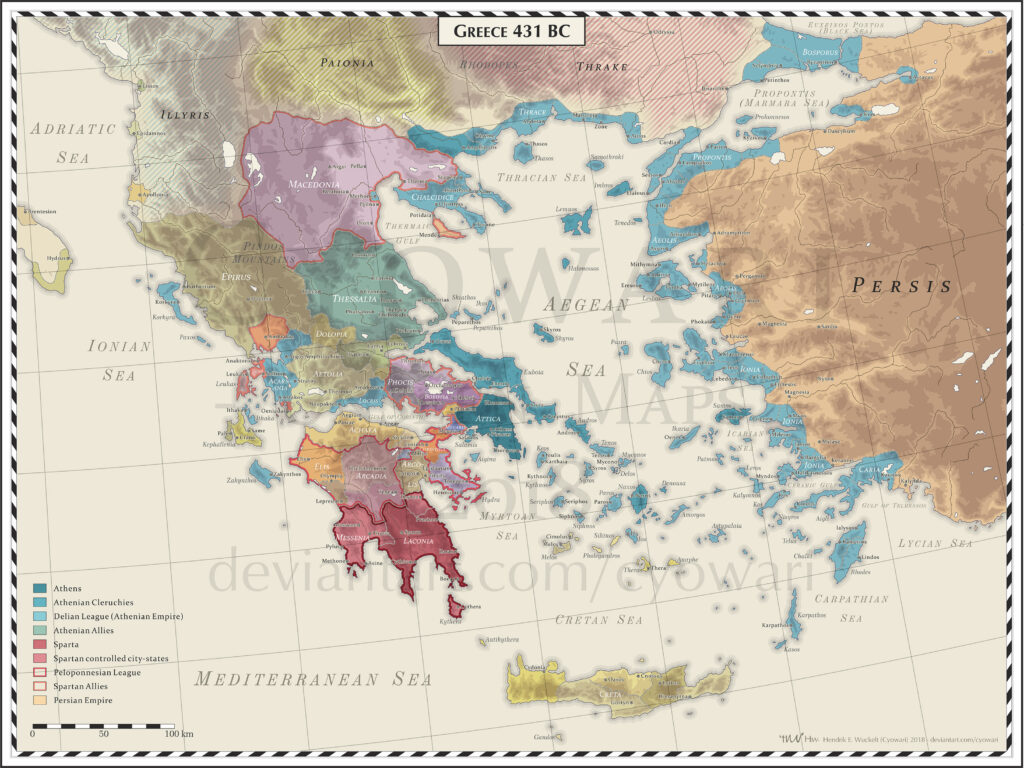
Map credit – © Crowari
The Affair of Epidamnus: A Fragile Peace Before the Storm
In 435 BC, the Greek world was still officially at peace. Treaties remained intact, alliances were unchanged, and no herald had announced a general war. Yet beneath that surface, the system was already fracture. The city of Epidamnus, a distant colony on the Adriatic coast, should have mattered to no one beyond its immediate neighbors. Instead, its internal collapse—marked by civil strife, exile, and desperation—exposed the fault lines running through the entire Greek world. When its leaders appealed for help, they did not merely seek allies. They compelled rival powers to choose sides. Corcyra intervened. Corinth answered. Old resentments flared, bonds of kinship turned hostile, and diplomacy failed where force appeared faster and more decisive. What began as a local crisis rapidly evolved into a test of honor, influence, and fear—one that Athens could not afford to ignore. No battle formally announced the end of peace at Epidamnus. No declaration was issued. Yet something irreversible had occurred. For the first time in a generation, Greek states chose escalation over restraint, and power over compromise. The Affair of Epidamnus was not the Peloponnesian War. But it was its first catalyst. From this moment onward, the road to war lay open.
Epidamnus: Origins, Geography, and the Roots of Internal Conflict
The city of Epidamnus was situated on the right-hand side of the entrance to the Ionian Gulf, in a region inhabited by the Taulantians, an Illyrian people. The settlement was originally founded as a colony of Corcyra, under the leadership of Phalius, son of Eratocleides, a member of the Heraclid family. In keeping with ancient custom, Phalius was invited from Corinth, the metropolis of Corcyra, to lead the foundation. Alongside the Corcyraeans, the colony also included settlers from Corinth and others of Dorian origin, reflecting the mixed character of its population from the very beginning.
Over time, Epidamnus grew into a large and prosperous city. However, internal divisions gradually weakened it. These tensions were exacerbated by conflicts with neighboring Illyrian tribes, which drained the city’s strength and reduced its power. The immediate crisis before the wider war was political. The ruling oligarchic faction was overthrown and expelled by a democratic movement, plunging the city into instability and leaving it vulnerable to outside intervention.
A Colony Abandoned: Epidamnus Seeks Help from Corcyra
The expelled oligarchic faction allied itself with the neighboring Illyrian tribes and began to raid the city by both land and sea. Under increasing pressure, the citizens of Epidamnus appealed to Corcyra, their mother city, asking it not to abandon them to destruction. They requested mediation with the exiles and assistance in ending the war with the Illyrians. In accordance with Greek religious custom, the ambassadors presented themselves as suppliants in the temple of Hera, seeking protection and mercy. The Corcyraeans, however, rejected their appeal. The envoys were dismissed, and no assistance was given.
The Oracle of Delphi and the Shift Toward Corinthian Intervention
When the people of Epidamnus realized that no assistance would come from Corcyra, they found themselves with no clear course of action. In this uncertainty, they sent envoys to Delphi to consult the oracle, asking whether they should place their city in the hands of the Corinthians and seek help from their original founders. The oracle’s response was unambiguous: they were instructed to hand over the city and place themselves under Corinthian protection.
Accordingly, the people of Epidamnus went to Corinth and formally handed over the colony, acting in obedience to the oracle’s command. They emphasized that their original founder had come from Corinth and presented the oracle’s response as justification for their appeal. They then urged the Corinthians not to abandon them to destruction, but to provide protection and assistance. The Corinthians agreed to these requests and resolved to support Epidamnus.
The Corinthians believed that Epidamnus belonged to them no less than to the Corcyraeans and therefore regarded its protection as a matter of obligation. Their decision was reinforced by longstanding resentment toward Corcyra, which they felt had shown open contempt for its mother city. Unlike other colonies, Corcyra did not grant Corinth the customary honors at public ceremonies, such as precedence at sacrifices.
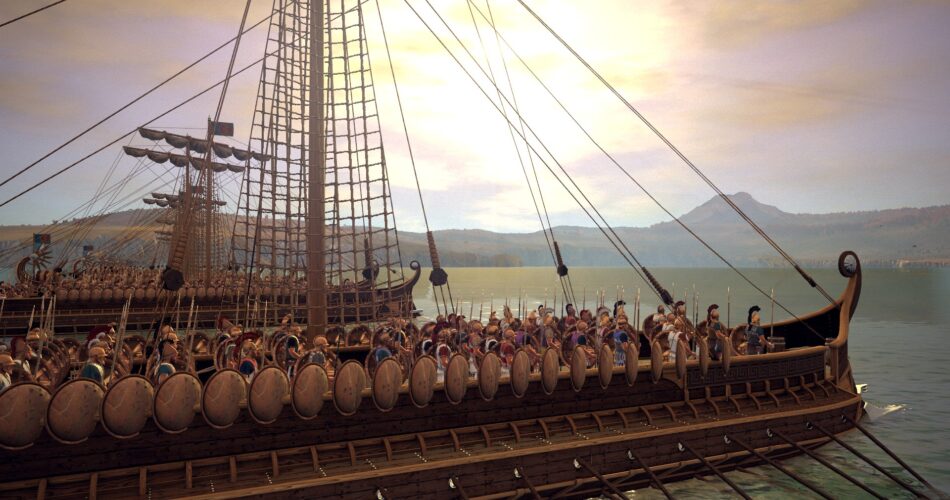
This sense of insult was sharpened by Corcyra’s power. The island was among the wealthiest communities in Hellas, possessed substantial military strength, and took particular pride in its naval reputation—one it traced back to the legendary Phaeacians, famed sailors of the past. Corinth found this arrogance intolerable. These tensions partly explain the attention Corinth devoted to strengthening its fleet. By the outbreak of war, Corinth had assembled a highly effective naval force, numbering 120 triremes.
These accumulated grievances made Corinth determined to provide the assistance it had promised to Epidamnus. A call was issued for volunteer settlers, and a force composed of Ambraciots, Leucadians, and Corinthians was assembled. To avoid interference from the Corcyraean navy, this expedition advanced by land, passing through Apollonia, a Corinthian colony, rather than risking a sea route.
Corcyra’s Response and Escalation
When the Corcyraeans learned that settlers and troops had arrived in Epidamnus, and that the city had formally placed itself under Corinthian control, they reacted with anger. They immediately put to sea with 25 ships, soon reinforced by additional vessels. Upon arrival, they issued a forceful demand: that the Epidamnians restore the exiled oligarchic leaders and expel the Corinthian garrison and settlers.
The Epidamnians refused to comply with these demands. In response, the Corcyraeans escalated the conflict and launched an operation against the city with a fleet of 40 ships. They brought with them the exiled leaders, intending to restore them to power, and also secured the support of Illyrian allies. After taking position before Epidamnus, the Corcyraeans issued a proclamation offering safe departure to any citizens or foreigners who wished to leave. Those who remained, they warned, would be treated as enemies. When the offer was rejected, the Corcyraeans began a formal siege of the city, which was situated on a narrow isthmus.
When the Corinthians learned that Epidamnus was under siege, they immediately began assembling a military force and proclaimed the establishment of a new colony there. Full political equality was promised to all who chose to settle in Epidamnus. Those unable or unwilling to depart at once were allowed to secure a share in the colony by paying 50 Corinthian drachmae, without leaving Corinth. Large numbers responded to this call: some prepared to set out immediately, while others paid the required sum to participate indirectly.
Anticipating that the Corcyraeans might attempt to block their passage, the Corinthians sought naval escorts from allied cities. Megara agreed to contribute 8 ships, Pale in Cephallenia 4, Epidaurus 5, Hermione 1, Troezen 2, Leucas 10, and Ambracia 8. Additional support was requested elsewhere: Thebes and Phlius were asked to provide financial assistance, while Elis was asked to supply ship hulls. Corinth itself committed 30 ships and 3000 hoplites, demonstrating the seriousness of its intervention.
Failed Negotiations Between Corinth and Corcyra
When the Corcyraeans learned of Corinth’s military preparations, they sent envoys to Corinth, accompanied by representatives from Lacedaemon and Sicyon, whom they had persuaded to support their mission. The envoys demanded that Corinth withdraw its garrison and settlers, arguing that Corinth had no legitimate claim to Epidamnus.
At the same time, they proposed a peaceful resolution. If Corinth believed it had valid claims, the Corcyraeans offered to submit the dispute to arbitration by mutually agreed cities of the Peloponnese, with Epidamnus remaining under the authority assigned by the arbitrators. They further expressed their willingness to refer the matter to the oracle at Delphi.
The Corcyraeans warned that, if Corinth chose war despite their protests, they would be forced by necessity to seek allies where they had no wish to do so, even if this meant abandoning long-standing relationships. Corinth replied that negotiations might be possible only if the Corcyraean fleet and their Illyrian allies withdrew from Epidamnus. While the city remained under siege, Corinth argued, arbitration was impossible. The Corcyraeans responded by proposing an alternative: if Corinth withdrew its troops, they would withdraw theirs as well. Failing that, they suggested that both sides remain in their current positions, under an armistice, until a formal judgment could be reached.
Naval Clash at Leucimme
Rejecting all proposed compromises, the Corinthians, once their ships were fully manned and their allies assembled, sent a herald ahead to formally declare war. They then set sail for Epidamnus with a force of 75 ships and two thousand hoplites, intending to confront the Corcyraeans in battle. The fleet was commanded by Aristeus, son of Pellichas, Callicrates, son of Callias, and Timanor, son of Timanthes. The land forces were placed under the command of Archetimus, son of Eurytimus, and Isarchias.
When the Corinthian force reached Actium, in the territory of Anactorium, at the entrance to the Ambracian Gulf, where the temple of Apollo was located, the Corcyraeans sent a herald ahead in a light vessel. The messenger warned the Corinthians not to advance against them.
Meanwhile, the Corcyraeans continued to prepare their fleet for combat. All available ships were fully equipped, and the older vessels were reinforced to ensure their seaworthiness. When the herald returned without any conciliatory response from the Corinthians, and the crews were ready, the Corcyraeans put to sea to confront the enemy. They sailed out with a fleet of eighty ships, although forty of these remained behind to maintain the siege of Epidamnus.
The Corcyraean fleet formed its battle line and engaged the enemy, winning a decisive victory and destroying fifteen Corinthian ships. On the same day, Epidamnus, under pressure from the besieging forces, was compelled to surrender. The terms of capitulation stipulated that the foreign inhabitants were to be sold into slavery, while the Corinthians were to be held as prisoners of war, their ultimate fate to be determined at a later time.
From Epidamnus to Empire War: The Road to the Peloponnesian War
After the battle, the Corcyraeans erected a victory trophy at Leukimme, a headland on Corcyra. They put to death all their captives except the Corinthians, who were retained as prisoners of war. Defeated at sea, the Corinthians and their allies withdrew and returned home, leaving the Corcyraeans in control of the surrounding waters.
Exploiting their naval dominance, the Corcyraeans sailed against Leucas, a Corinthian colony, and devastated its territory. They also attacked and burned Cyllene, the harbor of Elis, in retaliation for the ships and financial support the Eleans had provided to Corinth. Despite this decisive defeat, the conflict was far from concluded. In four hundred thirty-three BC, the two sides would clash again at sea, and this time a far greater power—Athens—would enter the struggle. With that intervention, a local dispute became a matter of pan-Hellenic importance, setting the stage for the Peloponnesian War. But that is a story for another day.
© 2026 History and War
Author: Jishu Roy
Unauthorized reproduction of this content is prohibited.