Imperial Vulnerability and Steppe Hegemony
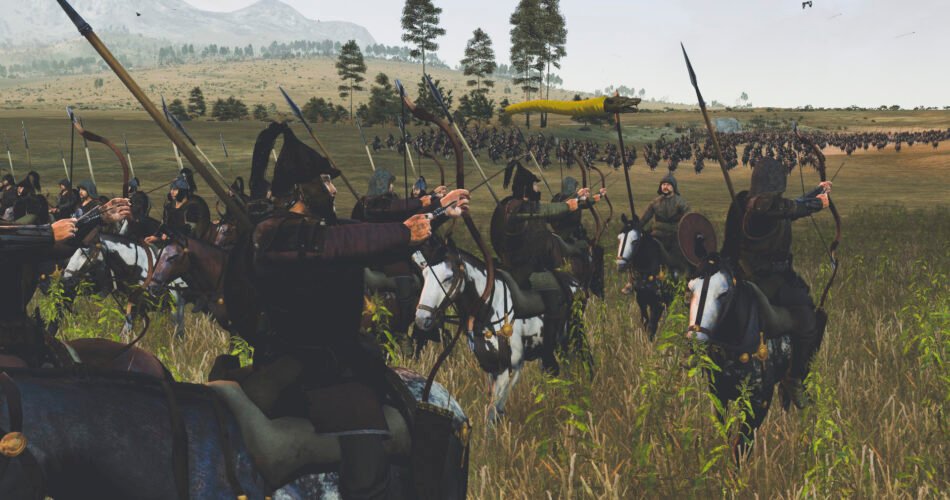
The Hunnic invasion of AD 441–443 marks a pivotal and destructive escalation in the geopolitical relations between the nomadic confederation and the Eastern Roman Empire. Under the joint leadership of the brothers Attila and Bleda, the Huns launched a massive offensive across the Danube, rapidly dismantling the frontier defenses (limes) and systematically sacking major civic centers including Constantia, Margum, Sirmium, and Naissus. Far from a simple cavalry raid, this campaign demonstrated a profound evolution in steppe warfare, characterized by the Huns’ acquisition and mastery of advanced engineering and siege techniques capable of reducing heavily fortified Roman strongholds.
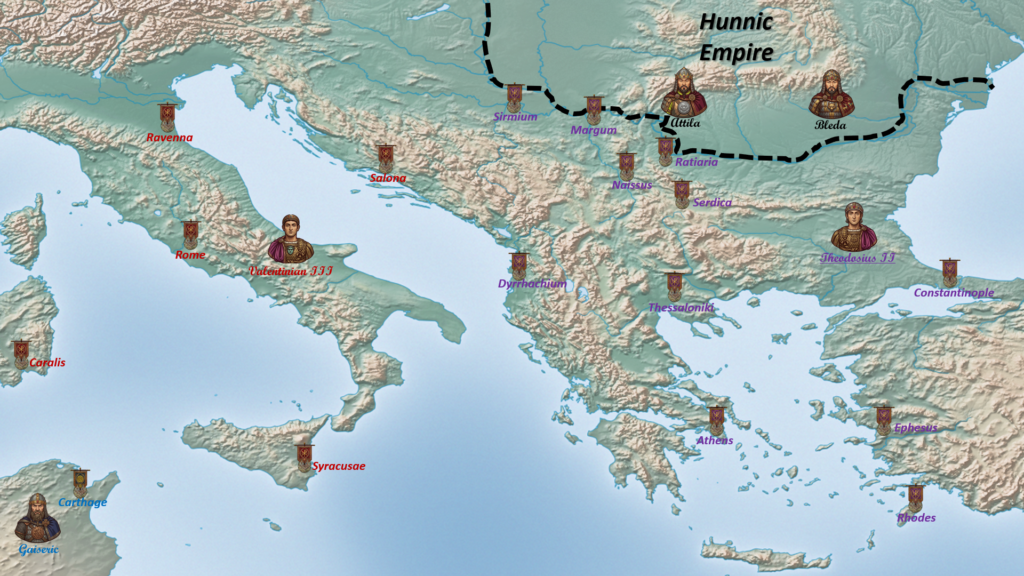
The strategic timing of the invasion exploited severe imperial vulnerabilities. With the military resources of Constantinople heavily committed to a western expedition against the Vandals in North Africa, the Eastern Roman government struggled to mount an effective tactical response as the Hunnic vanguard penetrated deep into the Balkan interior toward Serdica.
This article provides a rigorous historical overview of the AD 441–443 offensive, evaluating the structural collapse of the Danubian defenses, the tactical mechanics of early Hunnic siege warfare, and the strategic paralysis of the court of Theodosius II. Finally, it examines how this sweeping devastation systematically dismantled Roman leverage, ultimately forcing the imperial capital to capitulate to an exceptionally punitive and humiliating peace settlement that catalyzed Attila’s ascent as a legendary conqueror.
Shadows on the Danube: The Prelude to the Hunnic Offensive of AD 441
By the AD 430s, the Eastern Roman Empire faced a growing threat along its northern frontier. Beyond the Danube, the Huns had developed into a powerful confederation whose rulers could compel large numbers of Germanic and steppe peoples to follow them. For Constantinople, maintaining peace with the Huns was therefore a matter of both diplomacy and survival.
Around AD 434, Attila and his brother Bleda succeeded their uncle Rua as joint rulers of the Huns. In the early years of their reign, the Eastern Roman Empire sought to preserve peace through diplomacy rather than risk a direct confrontation. The Treaty of Margum, concluded in AD 435, required the Romans to make significant concessions to the Huns. They agreed to increase the annual payments of gold to the Huns and to surrender fugitives who had sought refuge within Roman territory.
For Attila, and possibly for Bleda as well, such an arrangement offered considerable advantages. A secure frontier along the Danube would give the Huns the opportunity to consolidate their expanding empire without the immediate burden of a major war against the Eastern Roman Empire. The period of peace also provided time to rebuild their military strength and reinforce the authority of the new rulers.
During this interval, the brothers could instead direct their attention toward carefully chosen campaigns in northern and eastern Europe. Victories against weaker or more accessible opponents would strengthen Hun power and prestige while minimizing the risks associated with a major expedition across the Danube into Roman territory.
However, from around AD 436, the Eastern Roman government fell into arrears with the annual payments promised to Attila under the Treaty of Margum. This understandably increased tensions between the Huns and the Empire. Nevertheless, Hun policy appears to have been to attack the Eastern Roman Empire only when circumstances were favorable, particularly when its defenses were weakened or its armies were occupied elsewhere.
As a result, Attila did not immediately launch a major campaign despite the interruption of the payments. The Eastern Roman military remained deployed along the frontier, its forts were fully garrisoned, and the Danube was closely patrolled by the imperial river fleet. Moreover, the fortifications established along the lower Danube several decades earlier were still strong enough to make a direct Hun assault a costly undertaking.
In AD 439, alarming news reached Constantinople. On 19 October, Carthage, the capital of Roman North Africa, had fallen to the Vandals under King Gaiseric. The crisis also threatened Italy, where the civilian population was being armed for the defence of the peninsula, although slaves were excluded from military service. Sigisvult, the magister militum, was tasked with organizing the defence of the Italian coastline against the Vandal threat.
The situation prompted Valentinian III’s government to reassure the population of Rome. On 24 June AD 440, an official proclamation announced that military assistance from the Eastern Roman Empire was already being prepared and would soon be sent to support the Western Empire.
Around this time, in AD 440, Attila sent envoys to Constantinople to accuse the Eastern Roman Empire of violating its treaty obligations. According to the Hunnic claim, Romans had plundered the graves of Huns located across the Danube from the city of Margum. The alleged desecration was said to have been carried out under the direction of the bishop of Margum.
The accusation may well have had some basis in fact. A law issued in AD 437 had addressed the practice of Christian bishops ordering the plundering of graves, suggesting that the desecration of burial sites was a genuine problem at the time. If Christian graves could be treated as legitimate targets by some individuals, the pagan burial sites of the Huns may have been even more vulnerable.
The Hunnic envoys received no satisfactory response from the Romans. Nevertheless, Attila did not immediately take military action. Although the Vandals had captured Roman Africa, the Eastern Roman Empire itself had suffered little direct military damage and therefore remained a formidable power that Attila could not afford to confront without favorable circumstances.
Soon, however, the situation changed dramatically. In the spring of AD 440, preparations began for a major Eastern Roman expedition intended to recover Carthage from the Vandals. The fleet was reportedly composed of as many as 1,100 ships and was placed under the command of five generals, all of whom bore Germanic names. The scale of the operation reflected the importance of the campaign and the extensive preparations ordered by Emperor Theodosius II.
The main army did not depart from Constantinople until the spring of AD 441, suggesting that the Eastern Roman government had taken considerable time to organize the expedition. At almost the same time, another crisis emerged in the east. The Persian king Yazdegerd II launched an invasion of Roman Armenia, although the precise reasons for the campaign remain uncertain. The Persian army was soon forced to withdraw after the Hephthalites, or “White Huns,” threatened its rear. Nevertheless, the Eastern Romans had been compelled to deploy a substantial force against the Persian threat. With troops committed to both the western and eastern fronts, the defences of the Danubian frontier were significantly weakened. Attila now had the opportunity he had been waiting for—and he was prepared to exploit it.
The AD 441 Offensive: Reconstructing the Early Siege Operations of Attila and Bleda
As soon as Attila and Bleda received reliable intelligence that the Eastern Roman fleet had sailed west toward Sicily, they launched their offensive along the Danube. The Romans had fallen behind on the tribute stipulated by the treaty, while fugitives who had crossed the Danube into Roman territory had not been returned to the Huns. These unresolved disputes gave Attila and Bleda sufficient grounds for going to war.
The Huns’ first target was Constantia, located across the Danube from Margum, where the Romans and Huns had negotiated their peace only a few years earlier. Under the terms of that agreement, both sides had committed themselves to promoting peaceful trade across the frontier. Constantia, one of the few Roman strongholds still maintained on the northern bank of the Danube, had consequently been designated as a protected trading post. The Huns chose a crowded market day to strike. Their forces attacked the town without warning and, through a coordinated assault, quickly overwhelmed its Roman garrison and captured the settlement.
Despite this sudden attack, Emperor Theodosius II initially refused to believe that Attila intended to wage an all-out war against the Eastern Roman Empire. He instead sought to resolve the crisis through negotiation by addressing the Huns’ grievances and reaching a new settlement. The emperor appointed Flavius Aspar as his envoy.
Aspar was instructed to negotiate a truce and determine why the Huns had apparently violated the peace agreement. When he reached the Danubian frontier, however, he discovered that Attila considered the treaty already null and void. From the Hunnic perspective, the Romans had been the first to violate its terms.
Attila’s accusations were serious. The bishop of Margum was alleged to have crossed the Danube secretly and plundered Hun burial sites, stealing valuables from the tombs. More seriously, the bishop was accused of desecrating the graves of members of Attila and Bleda’s own family. Attila therefore demanded that the bishop responsible for the tomb robbery be handed over, together with other fugitives whom the Romans were accused of protecting in violation of the treaty.
Aspar probably sought to find a compromise. He may have questioned the validity and significance of some of the Huns’ accusations while remaining willing to discuss matters of mutual concern. If Theodosius II was correct in believing that Attila did not yet seek a full-scale war, such an approach could have created an opportunity for further negotiations and perhaps a new settlement.
Attila, however, was unwilling to wait. Aspar’s failure to surrender the bishop of Margum and the fugitives whom the Huns demanded was enough, in Attila’s view, to confirm that the existing treaty had already been violated and could no longer be regarded as binding. He therefore abandoned the possibility of negotiation and proceeded with the offensive.
After Attila rejected further negotiations, Aspar withdrew from the city of Margum. His departure could be criticized as an abandonment of his responsibilities, but as an imperial envoy he had little choice. He had neither an army with which to defend the city nor any reason to remain and become a valuable hostage. His responsibility was to return to Constantinople and report the situation to the emperor.
With Aspar gone, some of the inhabitants considered whether an agreement with Attila might still be possible. One proposal was to surrender the bishop of Margum as a gesture of goodwill, potentially satisfying one of the Huns’ principal demands. Whether this possibility was seriously debated cannot be established with certainty, but the bishop himself apparently recognized the danger he faced.
Rather than wait for the decision of the townspeople, the bishop secretly left Margum and crossed the Danube. He approached Attila and offered to reveal how the city could be taken in exchange for assurances that he would be spared. Attila accepted the offer.
That night, the bishop returned to Margum and persuaded the defenders to admit him into the city. According to the surviving account, he claimed that he had been conducting reconnaissance and had returned with information about the Huns’ movements. His position as the city’s bishop may have helped convince the defenders that he could still be trusted.
Once inside, he apparently encouraged the defenders to launch a surprise attack against the Huns, possibly suggesting that Attila’s forces were preparing to cross the Danube and would therefore be vulnerable during the operation. The defenders took the bait. However, the Huns had concealed troops along the riverbank, and the attack turned into a trap. The Roman defenders were overwhelmed, and Margum was subsequently captured and destroyed. After the city fell, the Huns advanced deeper into the Eastern Roman Empire, plundering settlements and seeking further booty.
Our knowledge of the campaign comes largely from the names preserved by Roman sources, which provide little detailed description of the fighting or of the collapse of imperial authority along the frontier. Among the cities attacked were Sirmium, modern Sremska Mitrovica; Singidunum, modern Belgrade; Margum, near modern Orašje; Viminacium, near modern Kostolac; Naissus, modern Niš; and Serdica, modern Sofia.
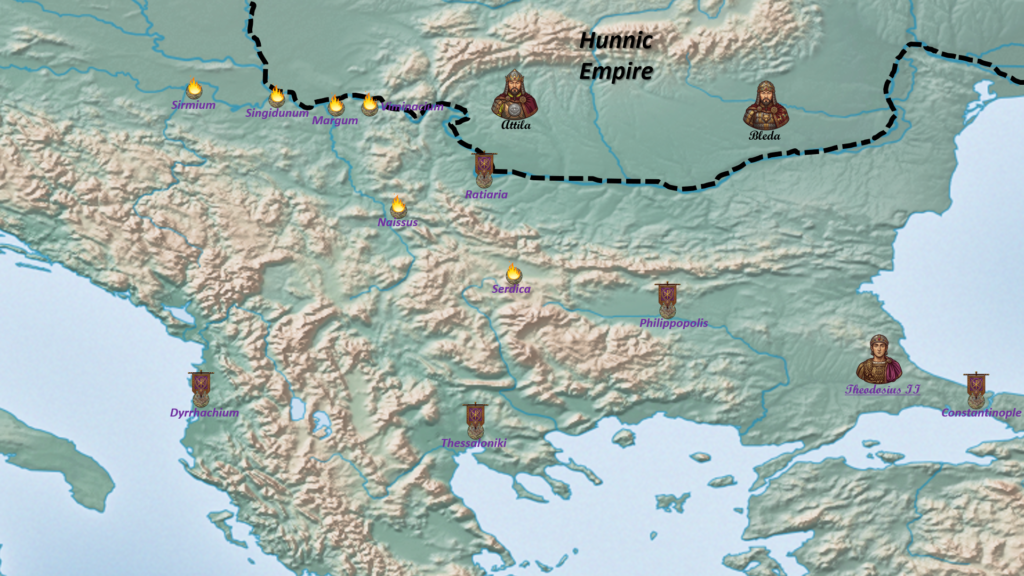
These were only the principal fortified centres. Numerous smaller settlements and undefended communities must also have been attacked, looted, and burned, yet the surviving sources rarely record their names or the fate of their inhabitants. Behind the fall of each city was a much larger human cost: civilians were killed, captured, displaced, or forced to abandon their homes, while those who attempted to defend their families and communities faced the dangers of warfare with little expectation that their actions would ever be recorded.
The campaign therefore represented more than a series of military victories and the destruction of individual cities. It brought widespread devastation across the frontier regions and exposed the inability of the Eastern Roman authorities to protect many of their subjects.
Not every city fell through treachery. A significant part of Attila’s success during the Danube campaign was the Huns’ ability to conduct effective siege warfare. Seventy years earlier, the Goths’ inability to capture Roman strongholds, and therefore to seize the grain and wealth stored within them, had hindered their offensive following the Battle of Adrianople.
Attila ensured that the Huns acquired the siege technology and expertise necessary to attack and capture fortified cities. They were even capable of employing established Roman siege techniques. Much of this knowledge was probably acquired from Roman prisoners of war, some of whom, like the bishop of Margum, may have been willing to cooperate with the Huns in exchange for guarantees of their survival.
This new expertise made Attila’s Huns a far more formidable enemy than any force that had previously penetrated the Danubian frontier. The Romans could no longer depend on their well-defended cities as secure centres of refuge within a hostile countryside. These fortified settlements had traditionally protected their inhabitants, supplies, and accumulated wealth; now, even their walls could no longer guarantee their safety.
The capture of Sirmium brought the first phase of the Hun offensive to an end in AD 441. The numerous Roman cities and fortified positions along the Danube restricted the movement of the Hunnic cavalry and prevented Attila from making a deep advance into Roman territory. Even so, the achievements of the campaign were considerable.
The Huns had breached a major section of the Danubian frontier and destroyed or captured several important fortified centres. With the defensive system severely weakened, much of the Balkans was left vulnerable to further Hunnic operations in the years that followed.
Breaching the Birthplace of Constantine: Priscus’s Account of the Fall of Naissus
By AD 442–443, the Huns had shifted their attention to Naissus, a major and heavily fortified city in the central Balkans. To capture it, they employed sophisticated siege techniques, drawing upon their own military expertise and possibly the skills of engineers taken captive during earlier operations.
In his historical work, the fifth-century historian Priscus of Panium recorded in detail the methods used by the Huns to overcome the city’s fortifications. He gave the following account:
“Since the barbarians were destined to capture this populous and well-fortified city, they advanced steadily with each attempt. The inhabitants were unwilling to risk an open battle outside the walls. The Huns therefore constructed a bridge across the river from the southern side, allowing their forces to cross easily and bring their siege machinery close to the city walls.
Their first machines consisted of large wooden beams mounted on wheels. Soldiers stood upon the beams and fired missiles at the defenders on the ramparts, while men positioned behind them pushed the machines forward and moved them wherever they were required. Screens made of woven willow covered with rawhide and leather protected the soldiers operating the machines from arrows, stones, and other missiles, as well as from incendiary weapons thrown by the defenders.
Once a large number of these machines had been brought close to the walls, the defenders were overwhelmed by the volume of missiles and abandoned their positions on the battlements. The Huns then brought forward their rams. These were large siege engines in which a heavy wooden beam was suspended by chains from a supporting framework. The beam was fitted with a sharp metal point and protected by screens similar to those used on the earlier machines. Using ropes attached to the rear, the soldiers pulled the beam backward and then released it, allowing it to swing forward with great force against the wall.
The defenders responded by dropping enormous stones, which they had prepared in advance for precisely such an attack. Some of these crushed both the siege machinery and the men operating it. Nevertheless, the defenders were unable to withstand the large number of siege engines brought against them.
Eventually, the Huns broke through the walls with their battering rams. They also used scaling ladders to climb sections of the fortifications that had not yet collapsed. Through the breach and over the walls, the attackers entered the city, and Naissus was captured.”
Priscus’s account demonstrates that the Huns were capable of conducting a methodical siege against a major Roman fortress. Their use of mobile siege engines, protective screens, battering rams, and scaling ladders shows that their military capabilities extended far beyond the mounted warfare for which they were traditionally known. The fall of Naissus was followed by extensive destruction. Much of its population was killed, displaced, or taken captive and sold into slavery, and the city would not be substantially rebuilt for roughly another century.
Several years after the Hun attack, Priscus himself passed through Naissus and found the city largely deserted, with only a small number of monks remaining among the ruins. The devastation was still clearly visible. His companions reportedly struggled to find a suitable place to establish their camp, while near the river, where the Huns had broken through the walls with their battering rams, the ground was still scattered with the remains of those who had been killed during the siege.
The destruction was all the more striking because Naissus had once been an important Roman city. Around a century and a half earlier, it had been the birthplace of Emperor Constantine the Great, who had developed and embellished his native city. By the time Priscus visited, however, much of that earlier prosperity had disappeared, leaving behind the ruins of a city devastated by Attila’s campaign.
The few monks who remained had established themselves among these ruins, giving the former imperial city an entirely different character. What had once been a prosperous Roman centre was now a largely abandoned settlement surrounded by the physical remains of the violence that had brought about its destruction.
Geopolitical Realignments
By this stage, the situation in Constantinople had become increasingly serious. Reports arriving from the Danubian frontier described the Huns’ continued advance and the fall of one Roman stronghold after another. Theodosius II lacked a sufficiently large field army to confront Attila directly, leaving the Romans with few options for halting the offensive. The Huns’ decision to besiege each major city in succession offered only a temporary advantage, as the time required to capture each fortress slowed their advance but did not stop it.
The Eastern Roman government therefore faced an urgent strategic dilemma. The most practical course was to negotiate a settlement with Geiseric and bring the Roman expeditionary force operating against the Vandals back from the west. Roman troops had already been stationed in Sicily for much of the previous year, yet they had still made no serious attempt to retake Carthage.
The commanders of the expedition were aware of the deteriorating situation along the Danube and had good reason to hesitate before committing their forces to a prolonged campaign against the Vandals. With Attila’s army advancing deep into the Balkans, the Eastern Roman government could no longer afford to keep such a large military force tied down in the west.
Geiseric understood that his position, although strong, was not permanently secure. If the Eastern Roman government succeeded in stabilizing the Danubian frontier, it could eventually return its attention to Africa and launch another attempt to recover the lost territories. For this reason, Geiseric had little interest in prolonging the conflict. A negotiated settlement would give the Vandals valuable time to consolidate their control over the territories they had already conquered.
The earlier division of Roman Africa, established by the treaty of AD 435, was therefore renegotiated. Under the new settlement, the Vandals were formally recognized as masters of the richest part of North Africa, centred on Carthage and covering roughly the territory of modern Tunisia. Other territories along the African coast, broadly corresponding to parts of modern Algeria and Morocco, remained under the authority of the Western Roman Empire, although the exact territorial arrangements were more complicated than a simple division along modern borders.
Geiseric also agreed to make an annual payment to the government of Emperor Valentinian III. Although this could not compensate Rome for the enormous loss of African tax revenues, it provided the Western Empire with some immediate financial relief while giving the Vandals the political recognition they needed to consolidate their new kingdom.
In the spring of AD 442, the Eastern Roman expedition against the Vandals was recalled, and its forces were redirected toward the increasingly dangerous situation in the Balkans. After the fall of Naissus, Attila advanced as far as Serdica, but the arrival of a newly reinforced Roman army changed the strategic situation. Rather than risk a direct confrontation with a stronger Roman force, he chose to withdraw.
The Hunnic army retreated in an organized manner across the devastated provinces and eventually returned to the Great Hungarian Plain. Despite this withdrawal, the campaign had been a major success. The destruction and capture of the principal cities along the central Danube had severely weakened the Roman frontier system. The fall of Naissus and the Hunnic advance beyond Serdica had also opened a route toward the heart of the Eastern Roman Empire, bringing Attila’s forces considerably closer to Constantinople.
Attila also benefited from the enormous amount of wealth and the many captives taken during the campaign. Such spoils were important not merely as material rewards but also as instruments of political power. By distributing wealth, slaves, and other valuables among influential Hunnic leaders and allied groups, Attila could reward their support and strengthen their loyalty to his rule.
The famous golden bowl from the Pietroasa Treasure may possibly have been among the objects acquired during this period. Its elaborate representations of gods and goddesses suggest that it originated in a wealthy Roman or Gothic context. It may have been looted from a prosperous household in a city such as Sirmium, Singidunum, or Naissus, although its precise origin remains uncertain. The object could have reached the Huns through a Gothic warrior serving alongside them, or it may have been redistributed by Attila himself as part of the wider distribution of war booty.
Whatever its precise history, the redistribution of such wealth served an important political purpose. The spoils of war allowed Attila to reward his followers, strengthen alliances, and reinforce his personal authority over the increasingly powerful Hun confederation.
Securing the Spoils: The Settlement of AD 443 and the Hunnic Withdrawal
With the Eastern Roman army unable to offer effective resistance, Theodosius II was ultimately forced to negotiate. He sent Anatolius, the magister militum per Orientem, to meet Attila and negotiate the terms of peace.
The settlement was considerably harsher than the earlier agreements. The Eastern Roman government was required to pay 6,000 Roman pounds of gold as a penalty for violating the previous treaty. The annual tribute was also tripled, rising to 2,100 Roman pounds of gold, while the ransom for each Roman prisoner was increased to twelve solidi.
Attila had achieved what he had sought. The Huns had devastated large parts of the Balkans, broken through the Roman frontier, captured major fortified cities, and forced Constantinople to accept far more demanding terms. For the moment, the payments and concessions were enough to satisfy the Hun rulers, and Attila and Bleda withdrew with their forces into the heart of their empire.
Bibliography
1) THE CHRONICLE OF MARCELLINUS COMES | Marcellinus Comes
2) ATTILA THE HUN: ARCH-ENEMY OF ROME | Ian Hughes
3) THE END OF EMPIRE: ATTILA THE HUN AND THE FALL OF ROME | Christopher Kelly
4) ATTILA THE HUN: A BARBARIAN KING AND THE FALL OF ROME | John Man
5) ATTILA’S WARS, AD 440–53: HUNNIC WARRIOR VS LATE ROMAN CAVALRYMAN | Murray Dahm
6) THE HUNS | Hyun Jin Kim
© 2026 History and War
Author: Jishu Roy
Unauthorized reproduction of this content is prohibited.