When Peace in Greece Began to Collapse
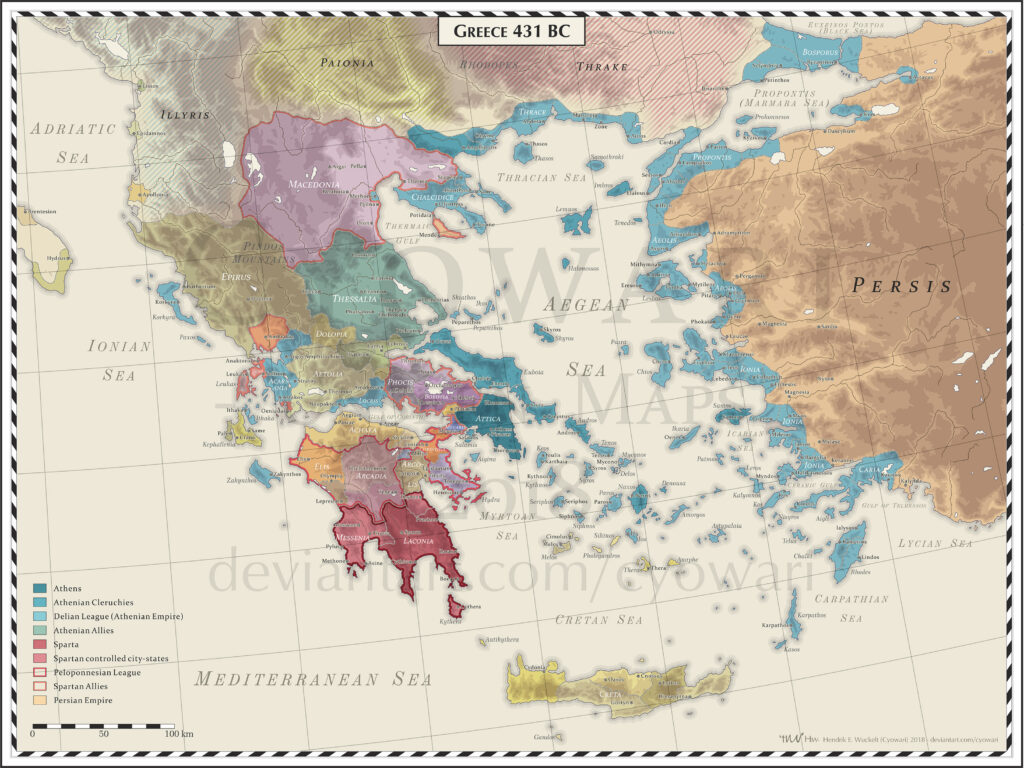
Map credit – © Crowari
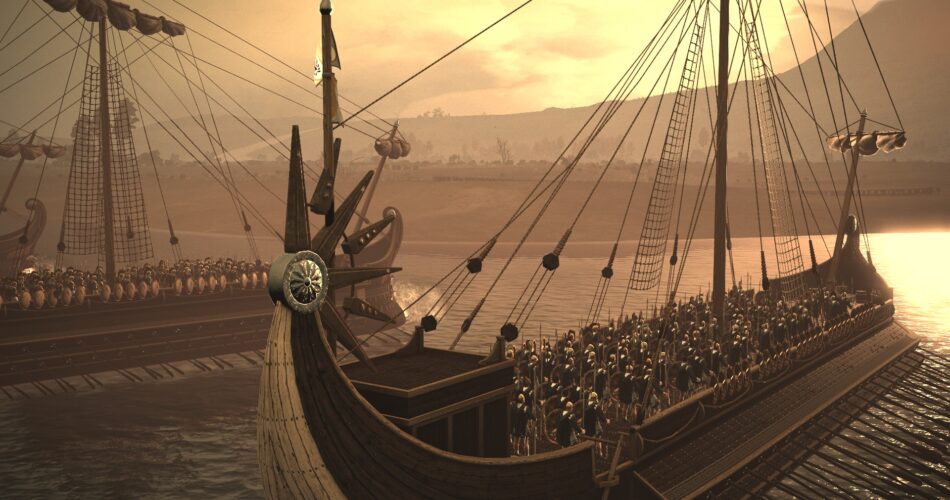
In 433 BC, Greece was not yet at war—but peace was already hollow. The treaties still stood, the oaths were still spoken, yet every city knew that the balance had begun to fail. Across the Ionian Sea, a dispute that should have remained local began to pull the great powers of the Greek world toward confrontation. At Sybota, Corinthian triremes advanced against Corcyra, a colony that had grown rich, proud, and defiant. This was not merely a naval clash; it was a reckoning between past and present, authority and independence. When Athens appeared on the horizon, it came under the guise of restraint, bound by words of neutrality that convinced no one. The fighting was brutal and confused. Ships rammed and recoiled, decks became killing grounds, and men vanished beneath the water without names or graves. By nightfall, neither side could claim certainty—only loss. Yet the true consequence of Sybota was not measured in ships destroyed or lives taken. That day, fear replaced diplomacy. Trust collapsed. And the Greek world crossed a line it could no longer step back from. Sybota did not announce the Peloponnesian War—but it made it inevitable.
Escalation Between Corinth and Corcyra
At the Battle of Leucimme in 435 BC, the Corcyraeans defeated their mother-city, Corinth, but the conflict was far from concluded. Rather than bringing a decisive end to hostilities, the defeat only intensified Corinthian resolve. Angered and humiliated by the outcome, Corinth devoted the next two years to rebuilding its naval strength. New warships were constructed, and strenuous efforts were made to create an effective fleet. To crew these vessels, Corinth recruited experienced rowers from the Peloponnese and across the wider Greek world, offering generous financial incentives to attract manpower. This response transformed a single defeat into a broader escalation, setting the stage for renewed confrontation at sea.
Alarmed by reports of Corinth’s renewed naval preparations, the Corcyraeans recognized the vulnerability of their position. They stood entirely without allies in Hellas, having deliberately remained outside both the Athenian and the Lacedaemonian alliance systems. Faced with the prospect of confronting Corinth alone, they resolved to send envoys to Athens to seek an alliance and to secure Athenian support. Corinth, upon learning of this initiative, acted swiftly. An embassy was dispatched to Athens with the aim of blocking any agreement between Athens and Corcyra. The Corinthians sought to prevent the powerful Athenian fleet from combining with that of Corcyra, which would have fundamentally altered the balance of naval power and undermined Corinth’s ability to conduct the war on its own terms.
An assembly was convened at Athens, where representatives of both sides presented their arguments. The Corinthian speakers reminded the Athenians that seven years earlier Corinth had not interfered when Athens suppressed the revolt of Samos. On that occasion, they claimed, Corinth had shown restraint and respect for Athenian interests, and they now expected a similar neutrality while Corinth sought to discipline its own colony. At first glance, this comparison appeared persuasive, but it did not withstand closer examination. Samos had been a recognized subject of Athens, and any Corinthian intervention in 440 BC would have violated existing treaties. Corcyra, by contrast, was an independent and neutral state. Athens was therefore under no treaty obligation to remain aloof and was legally free to enter into an alliance with Corcyra if it chose to do so.
Even so, the Athenians were unwilling to treat the Corinthians with open contempt, since doing so risked damaging relations with the Peloponnesian League as a whole. At the same time, to ignore the Corcyraean appeal carried serious strategic consequences. If left unsupported, Corcyra might eventually be defeated, allowing Corinth to absorb its powerful fleet and thereby pose a direct challenge to Athenian naval dominance. To resolve this dilemma, the Athenian Assembly adopted an innovative diplomatic compromise. Athens offered Corcyra an alliance that was strictly defensive in nature, obliging Athens to assist only if Corcyra were attacked, not to support offensive operations. This agreement is the earliest fully defensive alliance attested in Greek history. Modern historians generally attribute this novel approach to Pericles, the repeatedly elected and highly influential political leader of Athens.
Ten Athenian triremes were dispatched to Corcyra with clear and restrictive instructions: they were not to engage the Corinthians in battle unless the latter attempted to land on the island itself. Through this carefully limited deployment, Athens sought to safeguard its new ally while simultaneously reassuring both Sparta and Corinth that it did not intend to alter the existing balance of power. Whether this diplomatic signal achieved its intended effect remains uncertain. Thucydides offers no indication of how the Corinthians interpreted this unprecedented arrangement, leaving open the question of whether Athens’ restraint was understood—or trusted—by its rivals.
Forces Assembled: The Fleets of Corinth and Corcyra
The Corinthian-led coalition assembled a powerful fleet of one hundred fifty triremes for the campaign against Corcyra. Of this total, Elis contributed ten ships, Megara twelve, Leucas ten, Ambracia twenty-seven, Anactorium one, and Corinth itself the largest contingent, with ninety triremes. Each allied squadron operated under its own admiral, while overall command was entrusted to Xenokleides, who was supported by four colleagues acting as subordinate commanders. Departing from Leucas, the fleet crossed to the mainland opposite Corcyra and made its first landfall there. The ships then anchored in the harbour of Chimerium, located in the territory of Thesprotis, where the coalition prepared for the next stage of operations.
When the Corcyraeans saw the enemy fleet approaching, they promptly prepared for battle. They manned one hundred ten triremes, placing them under the joint command of Meikiades, Aisimides, and Eurybatus, and took up position near one of the Sybota islands. The ten Athenian triremes were present alongside them, in accordance with the defensive alliance. On Point Leukimme, the Corcyraeans deployed their land forces, including one thousand heavy-armed infantry who had arrived from Zacynthus to provide assistance. The Corinthians, meanwhile, were not without support on the mainland. Large numbers of non-Greek allies—described by Greek sources as “barbarians”—gathered to aid them, as the peoples of this region had long-standing ties and alliances with Corinth.
Once their preparations were complete, the Corinthians embarked with provisions sufficient for three days and sailed from Chimerium under cover of night, fully prepared for combat. At daybreak, while at sea, they sighted the Corcyraean fleet approaching them. As soon as each side became aware of the other’s presence, both fleets moved deliberately to arrange themselves into battle formation, ready for the impending engagement.
Lines of Battle: Deployment at Sybota
On the Corcyraean right wing were stationed the Athenian triremes. The Corcyraeans themselves held the center and the left wing, drawn up in three separate divisions, each commanded by one of their generals. This arrangement placed the main strength of the Corcyraean fleet opposite the bulk of the Corinthian line.
The Corinthians organized their formation accordingly. On their right wing they positioned the ships from Megara and Ambracia, while the center was composed of the contingents provided by their other allies. Corinth’s own squadron, consisting of its fastest and most maneuverable vessels, formed the left wing. This wing directly faced the Athenian ships and the Corcyraean right division, where the most critical confrontation was expected.
The Battle of Sybota: Chaos, Collision, and Turning Points
As soon as the signal was given on both sides, the fleets advanced and the battle began. Each side carried large numbers of heavy-armed infantry aboard their ships, along with many archers and javelin-throwers, reflecting an older and still relatively unspecialized form of naval warfare. The fighting at sea was fierce and prolonged, but it showed little in the way of advanced naval tactics or maneuver. In character, the engagement more closely resembled a land battle fought on floating platforms than a highly technical contest of seamanship.
Whenever the opposing ships collided, the sheer number and density of the vessels made it extremely difficult for them to disengage. Victory depended largely on the hoplite stationed on the decks, who fought in close order while the ships themselves remained largely stationary. Complex naval maneuvers, such as breaking through the enemy line, were not attempted. Instead, the outcome was determined less by technical skill or tactical innovation than by physical strength, discipline, and sheer determination in hand-to-hand fighting.
Confusion dominated the fighting on all sides, and the battle unfolded amid constant disorder and noise. In this chaos, the Athenian ships played a limited but significant role. Whenever the Corcyraeans were hard pressed, the Athenians sailed in close support, their presence alone serving to unsettle the enemy. Yet their commanders refrained from full engagement, constrained by the strict instructions under which they operated. The heaviest losses were suffered by the Corinthian right wing, which was composed of the Megarian and Ambraciot contingents. Under sustained pressure, this section of the line proved the most vulnerable during the engagement.
The Corcyraeans quickly routed the Corinthian right wing and pursued the fleeing ships in disorder toward the mainland with a squadron of twenty triremes. Continuing their advance, they sailed to the enemy camp, which they found deserted, set fire to the tents, and looted the equipment left behind. In this sector of the engagement, the Corinthians and their allies were decisively defeated, while the Corcyraeans secured a clear victory.
In contrast, where the Corinthians themselves were positioned on the left wing, they achieved a clear success. The Corcyraean forces in this sector were relatively weak to begin with and were further reduced by the absence of the twenty ships that had been detached in pursuit of the enemy. Observing that the Corcyraeans were now under severe pressure, the Athenians finally began to intervene more openly, moving beyond mere support and offering direct assistance to prevent their ally’s defeat.
At first, the Athenians did indeed refrain from attacking any ships directly. However, as the scale of the Corcyraean collapse became unmistakable and the Corinthian advance intensified, restraint could no longer be maintained. The moment arrived when all parties fully committed to the fighting, previous distinctions were abandoned, and the confrontation reached the point at which Corinthians and Athenians openly engaged one another in combat.
After routing the Corcyraean right wing, the Corinthians did not focus on securing the disabled ships by fastening them or towing them away. Rather, they directed their attention toward the crews, killing many as they passed and showing little concern for taking prisoners. In the resulting confusion, even some of their own allies were mistakenly slain.
The large number of ships on both sides, combined with the vast area of the sea over which the battle was fought, made it difficult to distinguish between victors and defeated once the engagement had begun. In terms of scale, this encounter surpassed any previous naval engagement among the Greeks, particularly with regard to the number of vessels involved.
After the Corinthians had pursued the Corcyraeans to the shore, they turned their attention to the wrecked ships and the bodies of the fallen. They were largely able to recover both, transporting them to Sybota, which served as the assembly point for the land forces provided by their non-Greek allies.
Having completed this task, the Corinthians regrouped and set sail once more against the Corcyraeans. In response, the Corcyraeans advanced to meet them with all their serviceable ships, accompanied by the Athenian vessels, in order to prevent any attempt at landing on their territory. By this time, the day was drawing late, and the customary paean had been sung in preparation for the attack, when the Corinthians unexpectedly began to withdraw.
The Corinthians noticed twenty additional Athenian ships approaching, sent to reinforce the ten vessels already present. The Athenians, as it turned out with good reason, feared that the Corcyraeans might be defeated and that their small fleet would be insufficient to protect them. Observing these reinforcements first, the Corinthians suspected that they were Athenian and that even more ships might be following. Acting on this assumption, they began to withdraw.
Meanwhile, the Corcyraeans had not yet noticed the approaching Athenian reinforcements, as they were advancing from a position that limited their view. Puzzled by the sudden withdrawal of the Corinthians, some of their sailors eventually spotted the incoming ships and raised an alarm. In response, the Corcyraeans also began to withdraw. By this time, darkness was falling, and the Corinthians’ retreat had effectively brought the fighting to a halt. As a result, the two fleets parted, and the battle ended with the onset of night.
The Corcyraeans were in their camp at Leukimme when the twenty Athenian ships, commanded by Glaucon and Andocides, navigated through the debris and wreckage from the earlier engagement and sailed directly to the camp. By the time they arrived, night had fallen, and the Corcyraeans initially feared that these approaching vessels might be hostile. Their apprehension was soon dispelled, however, as they recognized the ships as allies, and the Athenian vessels safely came to anchor.
The following day, the thirty Athenian ships set out to sea, accompanied by all Corcyraean vessels that were still seaworthy, and sailed toward the harbour at Sybota, where the Corinthians were stationed, in an effort to provoke an engagement. In response, the Corinthians left the shore and formed a line in the open sea, but made no further advance, as they had no intention of taking the offensive.
They observed that fresh Athenian reinforcements had arrived and faced a number of serious challenges, including the need to guard the prisoners they had taken and the lack of any facilities to repair or refit their ships in the remote location. Their primary concern, however, was how they would manage the voyage home. They feared that the Athenians might interpret the recent clash as a breach of the treaty and prevent their departure.
Diplomacy Amid Conflict: The Corinthian–Athenian Standoff
The Corinthians therefore decided to send a small boat to the Athenians without a herald’s staff, as a test of their intentions. They accused the Athenians of unjustly initiating hostilities and violating the treaty by intervening while Corinth was punishing its own enemies. If Athens intended to block their movements, they declared, it should openly treat them as enemies. Hearing this exchange, the nearby Corcyraeans immediately called for the Corinthians to be seized and killed. The Athenians replied that they were neither starting a war nor breaking the treaty. They stated that Corcyra was now their ally and that they had come solely to provide defensive support. The Corinthians were free to sail wherever they wished, but if they attempted to attack Corcyra or its possessions, Athens would oppose them.
Aftermath of Sybota: Prisoners, Power, and Rising Tensions
After receiving this response from the Athenians, the Corinthians began preparations to sail home and erected a trophy on the mainland at Sybota. Meanwhile, the Corcyraeans collected the wreckage and the bodies of the fallen, which had been carried toward them by the current and dispersed by a night wind. They set up their own trophy on the island of Sybota, claiming victory in the engagement.
The reasons each side claimed victory were as follows. The Corinthians had dominated the sea battle until nightfall, allowing them to recover most of the wreckage and the bodies of the dead. They captured no fewer than one thousand prisoners and had sunk around seventy enemy ships. The Corcyraeans, meanwhile, had destroyed approximately thirty Corinthian vessels and, with the arrival of the Athenians, were able to recover the wreckage and dead on their side. They also witnessed the Corinthians retreating at the approach of the Athenian fleet and refusing to sail out from Sybota after the reinforcements arrived. On this basis, both sides claimed to have won the engagement.
On their return journey, the Corinthians captured Anactorium at the mouth of the Ambracian Gulf through treachery, as it was claimed by both Corinth and Corcyra. They settled Corinthian colonists there and then returned home. Of the Corcyraeans taken, eight hundred were sold into slavery, while two hundred and fifty, many of high status, were kept in hopes they might influence Corcyra in favor of Corinth. Despite these losses, Corcyra maintained its political existence, and the Athenian ships departed. Although both sides held back temporarily, they would soon clash again at Potidaea, ultimately leading to a formal declaration of war—but that is another story.
© 2026 History and War
Author: Jishu Roy
Unauthorized reproduction of this content is prohibited.