The Hunnic Surge and the Road to the River Utus
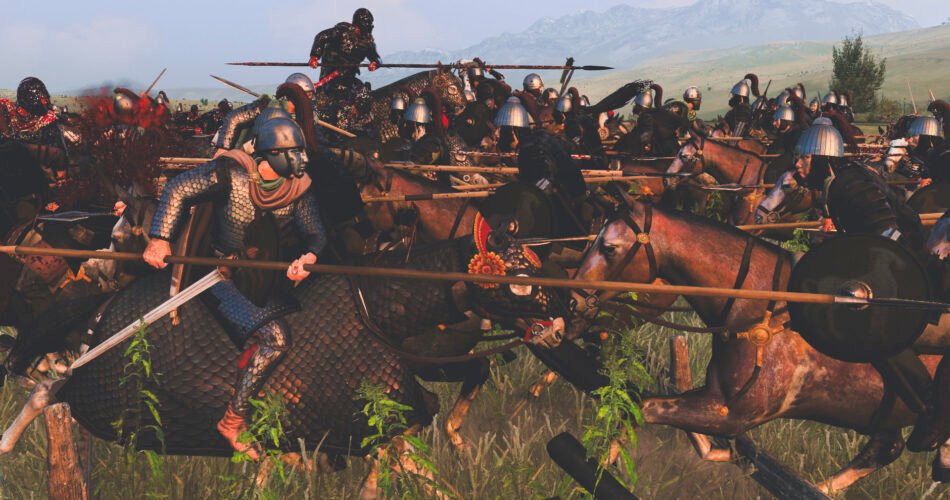
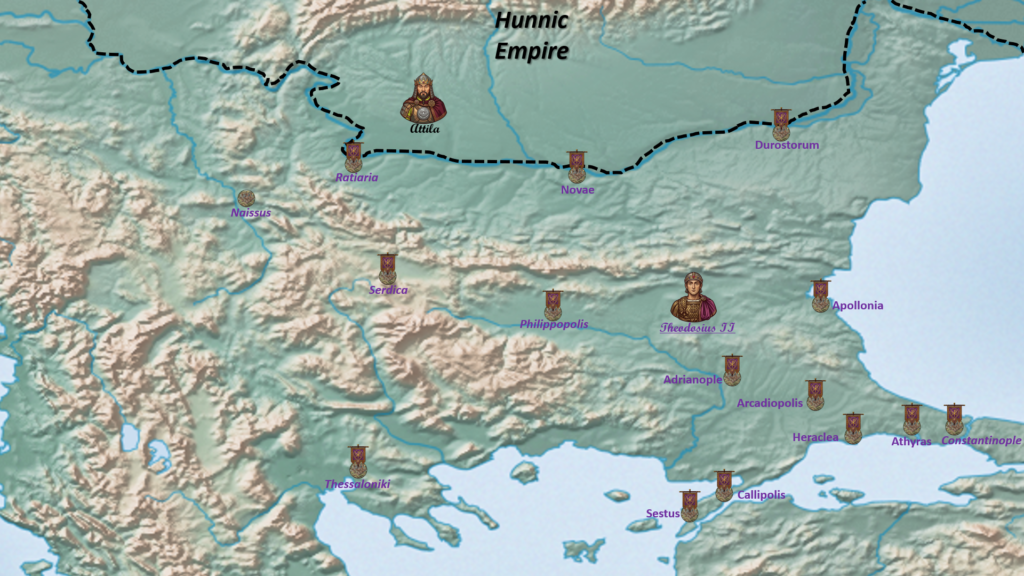
The Hunnic invasion of AD 447 represents one of the most severe existential crises ever endured by the Eastern Roman Empire. Striking with unprecedented velocity, Attila’s forces breached the Danubian frontier defenses and penetrated deep into the Balkan interior, systematically reducing fortresses and cities along their path. The strategic threat escalated rapidly as the Huns advanced toward Constantinople—a capital already vulnerable and structurally compromised by a recent, catastrophic earthquake that had shattered large sections of its defensive walls.
Despite the swift collapse of the frontier, the Roman military response was not entirely passive. Regional garrisons offered localized resistance, culminating in a high-stakes counter-offensive led by the magister militum Arnegisclus, who chose to pursue and intercept the Hunnic host during their tactical withdrawal. The resulting engagement on the banks of the River Utus stands as one of the most violent, yet historically obscure, clashes of Attila’s early military career.
This article provides a rigorous historical analysis of the AD 447 campaign. It evaluates the strategic mechanisms of the Roman defensive strategy, offers a tactical reconstruction of the Battle of the Utus, and examines the ultimate fate of Arnegisclus. Finally, the study assesses how the widespread geopolitical and economic devastation of this offensive systematically dismantled Roman leverage, forcing the imperial court to accept an exceptionally punitive and humiliating peace treaty.
The Fratricide and Consolidation: Attila’s Rise to Absolute Power
Following the peace agreement with the Eastern Roman Empire in AD 443, the Danube frontier remained relatively quiet for the next few years. Roman sources provide little information about the Huns during this period, suggesting that major conflict between the two powers temporarily subsided.
Having secured favorable terms and strengthened their reputation as formidable and seemingly invincible rulers, Bleda and Attila likely used these years to consolidate their power and expand their influence across Barbaricum. Although Attila appears to have taken a leading role in military campaigns against Eastern Rome, Bleda continued to be the senior figure in the Hunnic leadership.
Under the joint rule of Bleda and Attila, the Hunnic Empire reached the height of its power. The two brothers brought the various Hunnic tribes under a more centralized authority based in the Hungarian Plain. Significantly, contemporary sources no longer mention other Hunnic kings alongside Bleda and Attila, indicating the extent to which political authority had become concentrated in their hands.
Despite their outward success, tensions between the two brothers were clearly growing. The exact cause of their deteriorating relationship, however, remains uncertain. Bleda may have opposed further attacks against the Eastern Roman Empire, or Attila may have resented Bleda’s military successes. It is also possible that Attila simply sought sole control of the Hunnic Empire, or that their conflict reflected deeper rivalries between different Hunnic tribes or clans. Whatever the underlying cause, by either AD 444 or 445, the tension had reached a breaking point. Attila took decisive action against his brother and had Bleda assassinated, bringing their period of joint rule to an end and emerged as the sole ruler of the Huns.
Whatever the reasons or justification behind Bleda’s death, the evidence that Attila ordered his assassination appears to be beyond serious doubt. However, Bleda’s removal was not accepted by all of the peoples who were subject to Hunnic rule. The Akatziri, for instance, rebelled against the Huns after receiving news of the assassination.
At the same time, Attila faced another political challenge: some members of the Hunnic ruling family had sought refuge within the Roman Empire. Recovering these relatives and bringing them back under Hunnic control became an important part of Attila’s political agenda in the years that followed.
One of Attila’s first major actions after Bleda’s death was therefore to send embassies to both the Eastern and Western Roman Empires. Through these diplomatic missions, Attila formally announced that he was now the sole ruler of the Huns and established his position as the empire’s undisputed leader.
The Fragile Peace: Roman Defensive Restructuring on the Danube Frontier
Neither the Eastern Roman government nor the Huns genuinely trusted the peace agreement of AD 443. Constantinople, in particular, appears to have been preparing for the possibility of renewed conflict, although the evidence for this is limited. Two laws introduced in the summer and autumn of AD 444 suggest that the Eastern Roman government was taking steps to strengthen its military and financial resources.
For some time, landowners had been required either to provide military recruits from among their tenants or to make a payment in place of the required soldiers. Senior government officials, many of whom were also landowners, had traditionally been exempt from this obligation as a privilege of their office. One of the new laws removed this exemption, requiring these officials to provide troops or pay a fine.
A second law imposed a four-percent tax on all commercial sales. Together, these measures indicate that the government needed both additional soldiers and the financial resources necessary to support them. According to an edict issued under Emperor Theodosius II, the Danube fleet was also being reinforced, while military bases along the river were being rebuilt.
The emperor was therefore right to anticipate renewed trouble, although his own policies would soon provide the Huns with a reason for confrontation. Theodosius II had no intention of continuing the costly payments made to the Huns under the previous agreement. As the historian Otto Maenchen-Helfen famously summarized the situation, Theodosius had initially paid the Huns to secure their withdrawal, but once they had returned to their own territory, he abandoned the terms of the peace and stopped the payments altogether. This decision effectively destroyed the fragile peace between the Eastern Roman Empire and the Huns and created a major source of tension that would soon lead to renewed conflict.
Toward the end of AD 446, Attila sent diplomatic letters to the Eastern Roman court, once again demanding the return of individuals who had crossed the Danube and sought asylum within the Eastern Roman Empire. He also demanded payment of the seven hundred pounds of gold per year that had been agreed upon at Margum in AD 439. It is possible that only one or two annual payments had been made before the outbreak of war in AD 441.
Emperor Theodosius II refused to surrender either the refugees or the outstanding payments. Instead, he proposed sending ambassadors to negotiate a settlement and resolve the dispute through diplomacy. Theodosius was well aware of the dangers involved. Five years earlier, Flavius Aspar had attempted to open discussions with the Huns over the activities of the Bishop of Margum. The Huns had rejected the proposal and responded with immediate hostility. The emperor therefore had good reason to be cautious: another failed diplomatic initiative could easily provoke a renewed war with Attila.
By this time, Theodosius II was more confident that the Eastern Roman Empire could withstand a renewed Hun attack. The legions stationed in the Danube provinces had been restored to full strength, while the frontier defenses had recently undergone a thorough review.
In September AD 443, senior military officers were ordered to ensure that their troops were properly trained and received their full pay. The emperor also sought to encourage soldiers to settle permanently along the frontier. To achieve this, he confirmed that ordinary soldiers were permitted to own farms along the Danube without having to pay rents or taxes on them.
The government also introduced a system of regular inspections to monitor the condition of the frontier forces. Every January, officials at the imperial court were to receive annual reports detailing the strength and readiness of the troops, as well as the condition of the river patrol vessels and military camps.
Theodosius was confident that these reforms would significantly strengthen the frontier. In his own words, he believed that if military affairs were organized according to his instructions, then wherever an enemy might attempt to invade, victory would be assured—even before the battle had begun.
The Breach of the Danube
Undeterred by Theodosius II’s confidence, Attila rejected the emperor’s proposal for negotiations. The Huns then launched their offensive by capturing a number of Roman forts along the Danube frontier, including Ratiaria, which served as the headquarters of the Roman Danube fleet.
The Hunnic attack proved to be faster and more destructive than the Romans had anticipated. With Attila’s forces advancing to within roughly sixty miles of Naissus—or at least of the ruins that remained after its destruction—Theodosius was faced with a difficult choice. He may still have been willing to risk a full-scale war, or the rapid Hunnic advance may have convinced him that making further concessions was preferable if they could secure peace.
As tensions once again intensified along the Danubian frontier, a major event on 26 January AD 447 dramatically changed the situation between Attila and Theodosius II. In the early morning, a powerful earthquake struck Constantinople and severely damaged the city’s defensive walls. Large sections collapsed into rubble, while fifty-seven towers were destroyed.
Theodosius interpreted the disaster as a sign of divine anger. In response, he abandoned the use of his carriage and removed his jewels and imperial diadem as an act of penitence. He then walked approximately seven miles from the Great Palace to the Hebdomon, the military parade ground located outside the city walls.
The earthquake came at a particularly dangerous moment for the Eastern Roman Empire. Attila had already demonstrated, through his capture of Ratiaria, that the frontier defenses rebuilt and reorganized by Theodosius after the wars of AD 441–443 were less effective than the Romans had hoped. When news of the earthquake reached Attila, he appears to have interpreted the destruction of Constantinople’s walls as a favorable sign from the gods. Taking advantage of the Roman Empire’s weakened defenses, he ordered a major offensive into the Balkans.
Attila’s primary objective was Constantinople, and he would have understood that speed was crucial. If he could reach the city before the earthquake-damaged walls were repaired, the capital would be highly vulnerable to attack. The earthquake had left significant sections of the city’s defenses in ruins, creating an urgent need for repairs.
In response, Flavius Constantinus, the Praetorian Prefect, organized an extraordinary effort to restore the walls as quickly as possible. He mobilized Constantinople’s two major racing factions, the Blues and the Greens, and assigned different sections of the damaged fortifications to each group. He then turned the reconstruction into a competition, with the two factions racing to determine which could complete its assigned section first. This emergency mobilization allowed the Romans to repair the damaged defenses with remarkable speed, giving Constantinople a much better chance of withstanding Attila’s advance.
Despite the damage inflicted on Constantinople’s defenses by the earthquake of January AD 447, Attila was unlikely to risk the success of his campaign by advancing immediately on the capital. Two major obstacles stood between the Danubian frontier and Constantinople.
First, Attila would have been reluctant to leave any strongly defended Roman cities behind his army. These fortified positions could threaten his lines of communication and, more importantly, endanger his army’s return to the Danube if he was forced into a rapid retreat.
The second obstacle was even more significant. Although the Huns had successfully broken through the frontier defenses, Attila would have known that a substantial Roman field army still remained available to oppose him. Unlike the forces guarding the frontier, this army had not been weakened by the need to fight simultaneously against the Persians or the Vandals.
For these reasons, a direct and immediate advance on Constantinople would have been unnecessarily risky. A more cautious strategy was to move steadily through the Balkans, dealing with or bypassing serious Roman resistance as circumstances required. This approach would allow Attila to preserve the strength of his army while keeping open the option of advancing toward the capital once the situation was more favorable.
After capturing Ratiaria, the Huns continued their advance by attacking the major cities and fortified positions that stood between them and Constantinople. As during the campaigns of AD 441–443, Roman historians appear to have been so overwhelmed by the scale of the Hunnic successes that they provide only brief accounts of the devastation. They report that the Huns plundered no fewer than seventy cities, but identify only a handful by name.
Among the places recorded as being captured or destroyed were Philippopolis (modern Plovdiv), Arcadiopolis (modern Lüleburgaz in Turkey), Callipolis (modern Gelibolu, in the northern part of the Gallipoli Peninsula), Sestus (modern Eceabat, near the Dardanelles), and Athyras (modern Büyükçekmece, on the northern shore of the Sea of Marmara). The destruction of these settlements demonstrates the scale of Attila’s advance through the Balkans and shows that the Huns were systematically eliminating or overwhelming Roman strongpoints as they moved toward Constantinople.
The Hunnic invasion of the Balkans was not simply a lightning raid carried out by rapidly moving cavalry. Philippopolis, for example, was protected by substantial fortifications and, like Naissus during the campaign of AD 441–443, could only have been captured after a siege. Moreover, the closer Attila’s army came to Constantinople, the stronger the Roman resistance became.
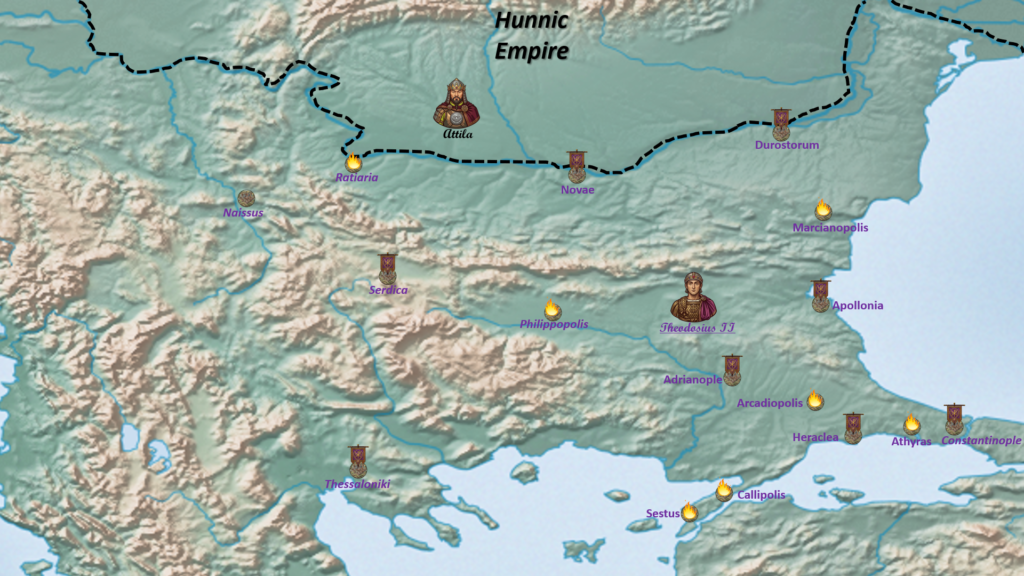
Two cities successfully resisted the Hunnic attacks: the heavily fortified Adrianople (modern Edirne), near the site of the famous battle between the Romans and Goths, and Heraclea (modern Marmara Ereğlisi), approximately sixty miles along the coast from Constantinople.
These limited Roman successes may have been connected with the renewed activity of the imperial army, which was now under the command of three experienced generals. Flavius Aspar, who had previously been involved in negotiations with the Huns, now had the opportunity to abandon diplomacy in favor of military action. Flavius Ariobindus, one of the commanders of the Roman expedition against the Vandals in AD 441, also took part in the campaign. The third commander was Arnegisclus, who commanded imperial forces in Thrace. Although these successes did little to halt the wider Hunnic offensive, they demonstrate that Attila’s army did encounter organized Roman resistance as it advanced deeper into the Balkans.
The Roman army was divided among the three generals, allowing them to cover the principal land routes leading toward Constantinople. Although this defensive strategy could not stop the Hunnic advance, it did slow it down. The Roman forces were unable to defeat the Huns in a major field battle, but they may have harassed Attila’s marching columns and forced his army to advance more cautiously.
The price of this strategy, however, was extremely high. Roman soldiers and cities were repeatedly sacrificed in order to protect Constantinople. Aspar and the other generals were also unwilling to risk everything in a single decisive battle. Instead, they chose to absorb heavy and demoralizing losses while buying the two months necessary to repair the earthquake-damaged defenses of the capital. Their objective was therefore not to defeat Attila in the field, but to delay him until Constantinople’s walls had been fully restored. Once the repairs were complete, the capital would once again possess the defenses necessary to withstand a direct Hunnic assault.
Although the Eastern Roman praesental armies chose not to engage the Huns in a single decisive battle, this was consistent with a broader imperial strategy. Paying subsidies to hostile powers was generally considered less costly than replacing the soldiers, weapons, and equipment that could be lost in a major battle, regardless of whether the Romans ultimately won or lost.
Delayed by the Roman forces operating across the Balkans, Attila’s army was unable to reach Constantinople before the city’s damaged fortifications had been repaired. By the time Hunnic scouts reached the capital, they found the walls restored and Constantinople no longer vulnerable to a direct assault. Attila’s reaction is not recorded, but frustration must have been among the emotions he experienced.
A direct attack on Constantinople was now too risky. Attila had little prospect of supplying a large army that remained stationary in a region already devastated by invasion, earthquake and threatened by disease. Moreover, the Huns lacked a fleet, making it impossible to complete a full siege of the capital from both land and sea.
One conclusion, however, was becoming increasingly clear to Attila: the Romans were unwilling to confront the Huns in a major field battle and instead preferred to rely on the protection of their fortified cities. Under these circumstances, Attila may have decided to detach at least one substantial force from his main army and send it southward to ravage regions that had previously escaped the worst of the invasion.
The activities of such a large raiding force could explain the attacks recorded at Lysimachia, Callipolis, and Sestus, as well as the possible Hunnic attack on Thermopylae, although the latter remains uncertain. The Huns eventually reached the Propontis, the body of water now known as the Sea of Marmara. By this stage, Attila had demonstrated that even without capturing Constantinople, his forces could devastate a vast area of the Eastern Roman Empire.
Roman Troop Estimates at the River Utus
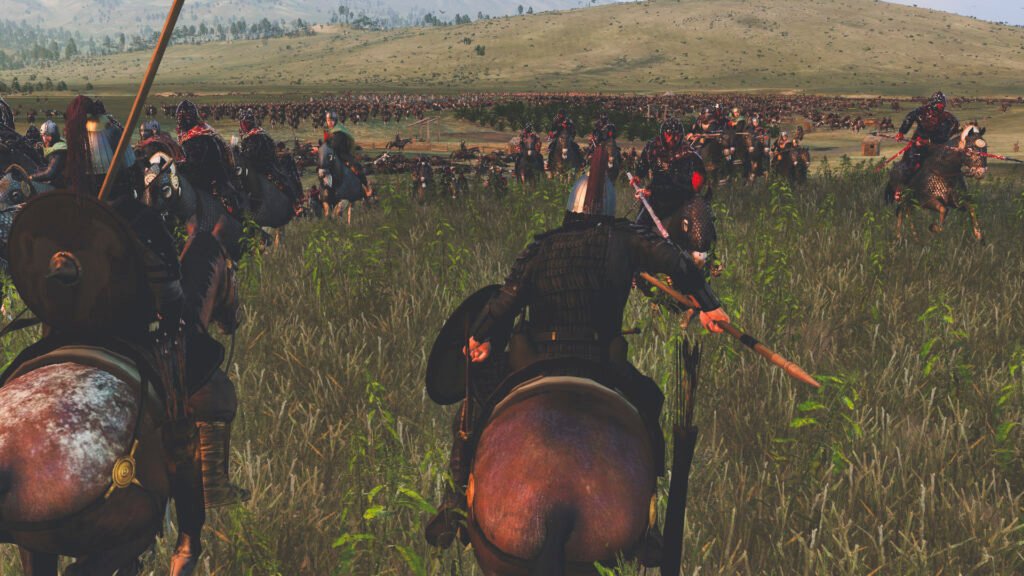
After sacking numerous major cities across the Balkans and Greece, Attila continued his advance southward until his movement was checked at the pass of Thermopylae. Unable to proceed farther along this route, he turned north and began withdrawing toward the Danube. His forces then followed the Danube westward, where they encountered a Roman army commanded by the magister militum Arnegisclus. The two forces met at the River Utus in Dacia Ripensis, west of Marcianopolis. Marcellinus Comes records the battle in his Chronicle under the year AD 447, providing the location of the engagement.
The Roman army had not been ordered to seek a decisive battle with the Huns. Arnegisclus nevertheless appears to have disregarded these orders, perhaps after learning of the enormous quantities of booty and large numbers of captives taken by Attila’s army. Seeing an opportunity to intercept the Huns while they were returning from their campaign, he marched toward the Utus to block their route home.
The sixth-century historian Jordanes, in his work Romana, section 331, tells us that Arnegisclus marched from Marcianopolis, in modern-day Devnya, Bulgaria, with the army of Thrace to confront the Hunnic threat. Significantly, his former co-commanders from AD 443, Aspar and Areobindus, are not mentioned in the accounts of the campaign of AD 447.
Both Jordanes and Marcellinus Comes describe Arnegisclus simply as magister militum, without specifying which military command he held, and as dux of Moesia. The latter designation, however, appears to be problematic. The battle at the Utus was fought outside the normal jurisdiction of the magister militum per Thracias, making it unlikely that Arnegisclus held only a regional command in Thrace.
A more plausible reconstruction is that Arnegisclus held the senior command of magister utriusque militiae, giving him authority over both eastern and western field forces in the region. Such a position would have allowed him to lead an army as far as the River Utus without operating outside his normal jurisdiction.
The circumstances of the battle suggest that Arnegisclus was pursuing the Huns, a situation in which cavalry would have been particularly important. In theory, the comitatus of the magister militum per Thracias could draw upon more than 27,000 troops, based on the units recorded in the Notitia Dignitatum and modern estimates of their average strength.
These forces were concentrated around Marcianopolis, while the provincial armies of the surrounding regions could provide additional troops. The dux of Moesia Prima theoretically commanded around 6,250 men, while the dux of Moesia Secunda could call upon approximately 7,000 limitanei. Scythia contributed a further 8,000 troops, and Dacia Ripensis another 8,000.
If Arnegisclus had taken every available cavalry unit with him in pursuit of Attila in AD 447, his cavalry force could theoretically have numbered around 11,000 men. In practice, however, the actual number was almost certainly lower, since it is unlikely that he would have stripped every frontier command of its cavalry. A more realistic estimate might be around 8,000 cavalrymen.
Even this figure may be too high. The army of the magister militum per Thracias contained only seven recorded cavalry units compared with twenty-one infantry units. On this basis, Arnegisclus may have had no more than approximately 4,000 cavalrymen available for the pursuit—perhaps only 15 percent of the total forces theoretically at his disposal. The precise size of Arnegisclus’s army therefore remains uncertain, but the evidence suggests that his force was relatively cavalry-heavy for a pursuit while still representing only a fraction of the troops theoretically available to the Roman command in the region.
Based on the arguments outlined above, it is possible that Arnegisclus had access to additional units that could have increased the size of his army. Nevertheless, he was almost certainly heavily outnumbered by the Huns. His force may have been reinforced by troops from the comitatus of Illyricum, which theoretically numbered around 17,000 men and was based at Sirmium (modern Sremska Mitrovica, Serbia).
The possibility of Illyrican reinforcements is supported by the suggestion that Arnegisclus held a supreme regional command rather than serving merely as magister militum per Thracias. However, there are significant logistical difficulties with this interpretation. Sirmium was approximately 540 kilometres from Somovit on the Utus, more than twice the distance between Somovit and Marcianopolis. It was also around 160 kilometres west of Viminacium, the point where the Huns had crossed the Danube during their invasion of AD 441.
Most importantly, none of our surviving sources mention troops from the magister militum per Illyricum taking part in the battle. In the absence of such evidence, it would be unsafe to assume that the Illyrican field army had joined Arnegisclus at the Utus. Taking all these factors into consideration, a more cautious estimate is that Arnegisclus had approximately 8,000 cavalry at his disposal for the pursuit of Attila. This figure is still an estimate, but it is more defensible than assuming the arrival of the much larger Illyrican field army without supporting evidence.
If we accept the estimated figure of approximately 8,000 cavalrymen, Arnegisclus could have drawn upon a wide range of cavalry units from both the field army and the frontier forces. If Arnegisclus had approximately 8,000 cavalrymen at his disposal, the core of this force may have come from the comitatus of Thrace. The Notitia Dignitatum records seven cavalry formations attached to this field army: the Comites Arcadiaci, Comites Honoriaci, Equites Theodosiaci iuniores, Equites catafractarii Albigenses, Equites sagittarii seniores, Equites sagittarii iuniores, and Equites primi Theodosiani. It is possible that most, or even all, of these units accompanied Arnegisclus during his pursuit of Attila.
Additional cavalry may have been drawn from the frontier armies of Moesia Prima, Moesia Secunda, Scythia, and Dacia Ripensis. Their proximity to the Danubian frontier made them potential sources of reinforcement, although there is no surviving evidence identifying which of these individual cunei actually joined Arnegisclus at the Utus.
Attila’s Cavalry Strength and the Numerical Disparity
The strength of Attila’s cavalry is difficult to determine with any certainty. Modern estimates have placed the Hunnic cavalry as low as 30,000 men, but this figure may be too low to fully account for the scale of the devastation inflicted during the campaign and the fear generated among the Romans. Since this was the first campaign in which Attila could employ his newly expanded forces on such a large scale, an estimate of around 50,000 cavalrymen is plausible.
If Attila’s army contained around 50,000 cavalrymen, Arnegisclus faced overwhelming numerical superiority. His estimated 8,000 cavalry would have been outnumbered by more than six to one. His attack can therefore be understood as a desperate attempt to strike the rear of the Hunnic column, particularly while the Huns were burdened with large quantities of plunder and potentially more vulnerable during their withdrawal.
It is possible that the Hunnic army had already begun to divide into smaller groups, with some contingents returning home with their plunder. Arnegisclus may therefore have encountered only the portion of the army commanded by Attila himself. Even so, the Roman force would probably have remained heavily outnumbered. Even if Arnegisclus had been reinforced by the combined comitatenses armies of Illyricum and Thrace, his army would still have faced a substantial numerical disadvantage.
The Fatal Pursuit: Evaluating the Historical Accounts of the Battle
It therefore seems more likely that Arnegisclus pursued Attila’s forces as they withdrew toward the Danube. He may have learned that the Huns were returning by different routes and perhaps discovered the location of Attila’s own contingent. This may have encouraged him to strike the rear of the Hunnic column, possibly at a moment when much of Attila’s army had already crossed the Utus. If successful, such an attack could have isolated the rear of the Hunnic army and prevented troops that had already crossed the river from immediately turning back to support it. If Attila himself was present with this contingent, the attack may even have offered Arnegisclus an opportunity to strike at the Hunnic king directly.
The surviving sources provide only limited information about the battle. It appears to have been a closely contested engagement, after which the Huns continued their withdrawal from Roman territory. Whether their withdrawal was accelerated by the losses they suffered or simply followed Attila’s original plan is impossible to determine. Arnegisclus fought courageously during the battle. According to the sixth-century historian Jordanes, in his work Romana, section 331, Arnegisclus’s horse collapsed beneath him, forcing him to continue fighting on foot until he was surrounded and killed. The chronicler Marcellinus Comes, in his Chronicle under the year AD 447, gives a slightly different detail, stating that Attila himself killed Arnegisclus, and that this happened only after a large part of the Hunnic force had been destroyed.
The latter claim should nevertheless be treated with caution. The continued strength of Hunnic power in the following years makes the wholesale destruction of Attila’s army unlikely. If only a portion of the Hunnic host was present at the Utus, however, heavy losses among that contingent remain possible. The report that Attila personally killed Arnegisclus may also suggest that the Hunnic king was directly involved in the fighting, although this cannot be established with certainty.
One of the immediate consequences of the battle was the fall of Marcianople, Arnegisclus’s base and the capital of Moesia Secunda. The city was subsequently devastated and remained largely abandoned for nearly a century, until it was restored under the emperor Justinian in the sixth century.
The Price of Peace: Financial Ruin and the Danubian Border Collapse
Although the battle itself was costly, the campaign as a whole was a major political victory for Attila. The Huns had penetrated deep into Roman territory, overwhelmed much of the Danubian frontier, and demonstrated the limitations of the Roman military response. Arnegisclus’s resistance could not reverse the wider outcome.
The sixth-century historian Marcellinus Comes described the devastation, stating that the Huns had “attacked and pillaged forts and cities, lacerating almost all the territory surrounding the capital.” Attila had once again exploited weaknesses in the Roman military system. In 441, Roman troops had been transferred to North Africa to confront the Vandals, weakening the Danubian frontier. In 447, the situation was different: a devastating earthquake had disrupted the defenses of Constantinople just as the Hunnic invasion began.
The Roman leadership may have been justified in avoiding a major set-piece battle. The memory of disasters such as Adrianople demonstrated the danger of committing the entire field army against a powerful enemy. Had the Roman army been destroyed in a single afternoon of fighting in early 447, Constantinople might have been left virtually undefended, potentially bringing the Eastern Roman Empire to the brink of catastrophe.
Yet the battle on the banks of the Utus also demonstrated that Attila could not take a Roman victory for granted. Arnegisclus’s attack, although ultimately unsuccessful, showed that the Hunnic army remained vulnerable when caught in a difficult position. Attila had won the campaign, but the battle revealed an important limitation: the Roman army still possessed the capacity to inflict serious losses, and there was always a real possibility that a Hunnic offensive could end in defeat.
After the defeat of Arnegisclus, Theodosius sent the senior general Flavius Anatolius to negotiate peace with Attila. For much of the previous fifteen years, Anatolius had been responsible for the security of the eastern frontier and was therefore an experienced figure in dealing with Rome’s enemies. He may have been accompanied by Nomus, the magister officiorum and one of the most powerful officials at the imperial court. The presence of such high-ranking envoys appears to have impressed Attila, who agreed to negotiate and indicated that he was prepared to withdraw from Roman territory.
As in previous negotiations, Attila’s principal demands were the return of refugees and the payment of gold. Given the success of his campaign, the Roman negotiators were in no position to resist. They agreed to surrender Huns seeking refuge within the empire and to pay 2,100 pounds of gold annually, together with a further 6,000 pounds to cover arrears. This additional payment may also have included sums for the ransom of Roman prisoners captured during the campaign.
The settlement represented a dramatic increase over the payments agreed in earlier treaties. Rome had been paying 350 pounds of gold annually since 422, a sum that was increased to 700 pounds under the treaty of Margum in 439. The new agreement therefore placed a far greater financial burden on the Eastern Roman Empire.
The territorial concessions were even more serious. Anatolius and Nomus agreed that the Danube would no longer serve as the effective frontier of Roman authority. Attila demanded the evacuation of a broad strip of territory extending from Singidunum, modern Belgrade, eastward along the Danube to Novae, near modern Svishtov. The zone was to extend as much as five days’ journey inland in places, creating a depopulated buffer between the Hunnic and Roman territories. In some areas, the Roman frontier was pushed back by as much as 120 miles, leaving the ruins of Naissus almost directly on the new frontier.
This arrangement gave the Huns a substantial defensive advantage. By removing the Roman population and military presence from the Danubian frontier, it reduced the possibility of a surprise Roman attack while depriving the empire of the Danube itself as a natural defensive barrier.
For some Roman contemporaries, the settlement was an outright humiliation. Priscus of Panium, one of the most important surviving historians of Rome’s conflicts with Attila, was highly critical of the terms accepted by Theodosius and portrayed the emperor’s concessions to Attila in a deeply unfavorable light. After two devastating campaigns, Attila had brought the Eastern Roman Empire to its knees. The scale of destruction inflicted across the Balkans and the submission forced upon Constantinople transformed Attila from a formidable enemy into a figure of almost legendary terror. It was from this reputation that the later image of Attila as the “Scourge of God” would emerge.
Bibliography
1) THE ROMANA AND GETICA | Jordanes
2) THE CHRONICLE OF MARCELLINUS COMES | Marcellinus Comes
3) ATTILA THE HUN: ARCH-ENEMY OF ROME | Ian Hughes
4) THE END OF EMPIRE: ATTILA THE HUN AND THE FALL OF ROME | Christopher Kelly
5) ATTILA THE HUN: A BARBARIAN KING AND THE FALL OF ROME | John Man
6) ATTILA’S WARS, AD 440–53: HUNNIC WARRIOR VS LATE ROMAN CAVALRYMAN | Murray Dahm
7) THE HUNS | Hyun Jin Kim
© 2026 History and War
Author: Jishu Roy
Unauthorized reproduction of this content is prohibited.