Constantinople on the Brink
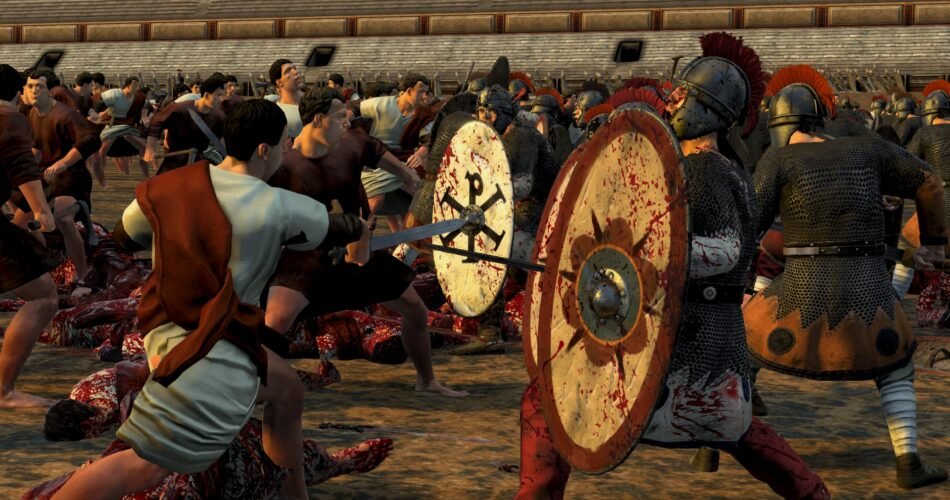
In January of AD 532, Constantinople was pushed to the brink of collapse by the Nika Revolt, the most devastating outbreak of urban violence in the history of the Byzantine Empire. While the crisis initially ignited as a unified protest by the city’s rival chariot factions—the Blues and the Greens—over botched judicial executions, it rapidly evolved into a coordinated political rebellion that threatened to depose Emperor Justinian I. Fuelled by widespread public discontent with the aggressive fiscal reforms of John of Cappadocia and long-standing religious divisions, the uprising was soon co-opted by elements of the senatorial aristocracy seeking systemic political change. Over the course of five chaotic days, much of the imperial capital was reduced to ashes, a rival emperor was crowned, and Justinian’s regime nearly faltered. Imperial survival was ultimately secured only through the tactical defiance of Empress Theodora and a brutal military counteroffensive led by Generals Belisarius and Mundus inside the Hippodrome.
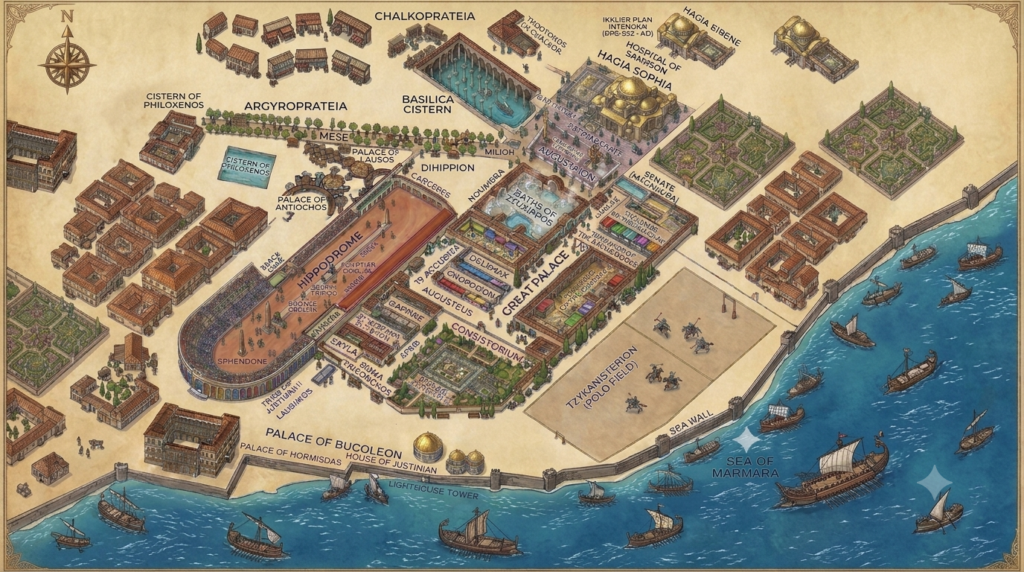
This article provides a comprehensive analysis of the Nika Revolt, moving beyond a simple narrative of sports-driven mob violence to examine the deep-seated structural vulnerabilities of the early Justinianic state. Readers can expect a detailed, phase-by-phase breakdown of the insurrection, exploring how administrative centralisation, economic strain on rural migrants, and elite political conspiracies converged to fuel the crisis. Finally, the text evaluates the violent aftermath of the rebellion, illustrating how its bloody suppression ultimately allowed Justinian to purge his aristocratic opposition and permanently consolidate absolute imperial authority.
The Roots of Discontent
As the new year of AD 532 began, Emperor Justinian had already spent five years on the Byzantine throne. During this period, he had managed the empire’s external challenges with considerable success. Yet, despite these achievements abroad, the situation within the capital was becoming increasingly unstable. Much of this growing crisis stemmed from the policies of John of Cappadocia, whose administration was bringing serious trouble to the empire at home.
John the Cappadocian lacked a traditional classical education, but he possessed considerable expertise in financial administration. Justinian relied on him to increase state revenues and reduce expenditure, thereby securing the resources needed to pursue his ambitious vision of imperial renewal and restoration. John proved highly effective in fulfilling this task. He strictly enforced fiscal laws and kept a close watch on landowners, merchants and shopkeepers. Under his administration, tax revenues were collected directly by his inspectors and channelled to the central government, bypassing the provincial elites and their traditional councils, known as the curiae.
John thus played a crucial role in advancing the centralisation of imperial administration, an essential part of Justinian’s wider ambitions. However, his determination to reduce expenditure extended even to vital public services. In an effort to cut costs, he reduced and, in some areas, abolished parts of the imperial postal system, which was essential for communication and administration across the empire. This service had long been one of the great achievements of the Roman world, helping to connect its numerous cities and distinguish the organised Roman territories from the less integrated lands beyond its frontiers.
The consequences of dismantling parts of the imperial postal system soon became apparent. Reports of events from different regions arrived with great difficulty and often too late to allow the authorities to take effective action. By the time information reached the capital, circumstances had frequently changed, making any response ineffective. The postal system, however, was important for more than just the rapid transmission of information. It also facilitated the transportation of essential goods, raw materials and agricultural produce throughout the empire.
Its decline had severe consequences for the rural economy, particularly for agricultural production, which provided both food supplies and tax revenues to the state. Large estate owners, who had traditionally sold their surplus crops, now found themselves unable to transport their produce to the markets, leaving much of it to rot. Small landowners suffered even more severely, as they were among the principal suppliers to urban markets.
Without affordable public transportation, small farmers could no longer move their harvests to the cities. Many were forced to carry their crops on their backs along the imperial roads, sometimes travelling considerable distances on foot. Exhausted by these journeys, some reportedly collapsed and died along the way, while others abandoned their produce and migrated to the cities, hoping to find assistance through religious charity or imperial relief.
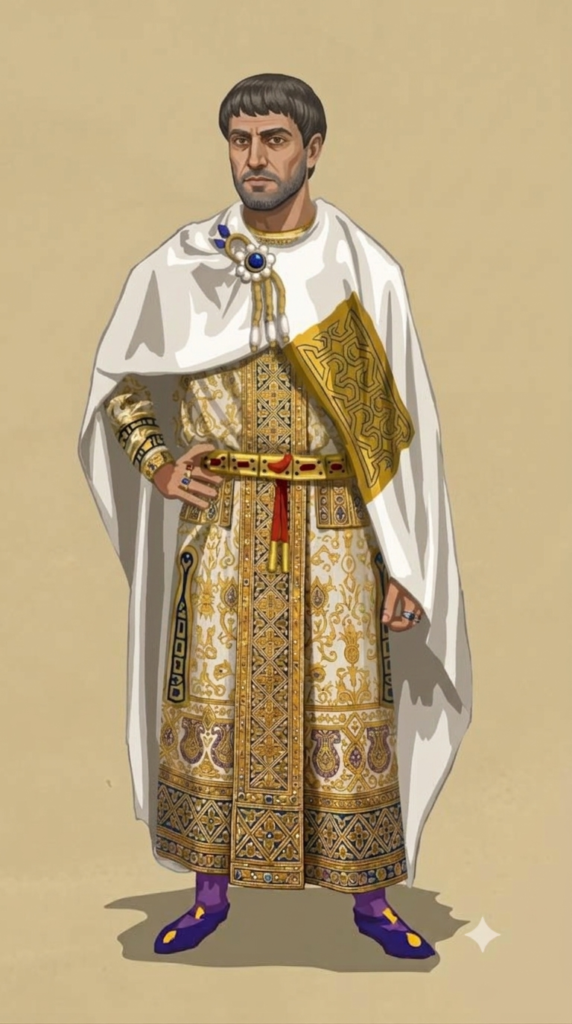
John the Cappadocian
John’s policies were therefore pushing small farmers towards economic ruin. Increasing numbers migrated to Constantinople, placing additional pressure on the city’s public relief system and contributing to rising crime. His financial measures also created considerable hostility among the senatorial aristocracy, whose wealth was directly affected by his new taxation policies, which placed a particularly heavy burden on the richest sections of society.
An even more serious challenge came from religious divisions within the empire. Although paganism had largely disappeared from Roman public life, Christianity itself was deeply divided. In Constantinople, the two principal Christian factions, the Chalcedonian Orthodox (often referred to as Catholics) and the Monophysites, showed little tolerance towards one another. Their disagreements frequently erupted into violent confrontations, creating an atmosphere of persistent religious unrest in the capital. Indeed, three men awaiting execution by hanging had been convicted of murders committed during one such religious disturbance.
With food supplies becoming increasingly unreliable, conditions in a capital already struggling to feed its enormous population grew even worse. Hunger and hardship also fuelled public discontent, providing fertile ground for rumours and accusations. Constantinople, in particular, had long been a centre of political intrigue and malicious gossip. Before long, John of Cappadocia was being condemned not merely for his administrative and political policies but also on moral and religious grounds.
Rumours began to circulate that John was a cruel and corrupt official who secretly imprisoned Roman citizens in hidden chambers and forced them to pay taxes that he claimed were overdue. Those who refused were allegedly subjected to degrading forms of torture, similar to punishments inflicted upon slaves and highway robbers. According to these accusations, the money was collected to fill Justinian’s imperial treasury. But was that really his only motive? Others went further, alleging that John was embezzling much of the revenue, keeping for himself the money that ordinary citizens believed they were contributing to the welfare of the empire.
Constantinople had two rival street gangs, known as the Blues and the Greens, which had become powerful forces in the city’s public life. They took their names from the colours of the chariots they supported in the races at the Hippodrome. The government officially recognised these factions and organised them into civilian militia groups responsible for helping defend the city’s walls.
Over time, however, their influence extended far beyond chariot racing and military duties. They became increasingly involved in political and religious affairs. Following the establishment of Christianity as the empire’s dominant religion, the factions also developed associations with opposing Christian doctrines. The Blues generally supported the Chalcedonian Orthodox position, while the Greens were associated with Monophysitism. Consequently, their religious affiliations also shaped their political loyalties, with each faction tending to favour emperors who supported its religious position.
Both factions also maintained violent street gangs, known as partisans. These gangs adopted a distinctive style of dress inspired by the Huns. They shaved the front of their heads while allowing the hair at the back to grow long. They wore Hunnish-style trousers, boots and loose-sleeved shirts, concealing daggers inside their sleeves.
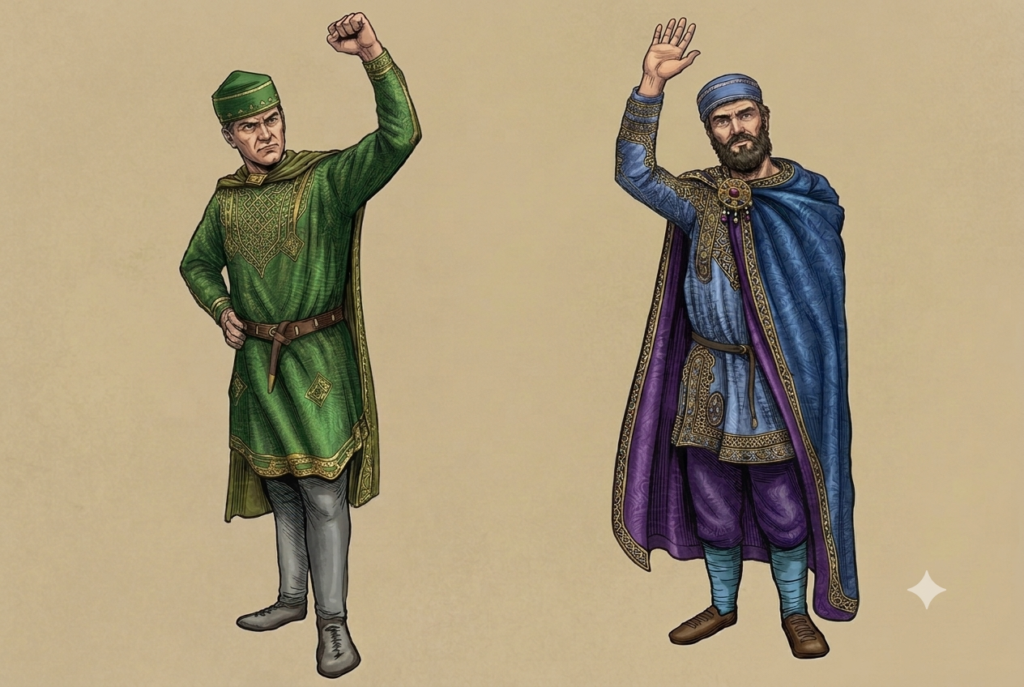
Green & Blue Gang
The Spark
At the beginning of AD 532, tensions between the Blues and the Greens flared up once again. With Justinian preoccupied by military affairs in the western provinces, he ordered the authorities in Constantinople to restore order in the capital. Eudaemon, the city prefect, responded by instructing the militia to arrest anyone involved in acts of violence, regardless of their factional allegiance.
The Greens regarded these measures as yet another instance of unjust persecution against their supporters. The Blues, meanwhile, felt betrayed by an emperor whom they had traditionally supported, particularly when they learned that the investigations had resulted in death sentences for members of both factions. Eudaemon had arrested several partisans and found seven of them guilty of murder. He ordered their execution using different methods of execution.
On January 10, AD 532, a large crowd gathered to witness the executions. The condemned men were led to the scaffold, where nooses were placed around their necks. When the trapdoor opened beneath them, three bodies fell. However, the ropes holding two of the prisoners snapped, allowing them to survive the fall. After a brief moment of confusion, the executioners and their assistants hurried the two survivors, one a Blue and the other a Green, back onto the scaffold and attempted to hang them again. Yet, once more, the ropes broke.
The executioners were left bewildered, while murmurs spread through the crowd. Many began to wonder whether this extraordinary occurrence was a divine sign that the men should be spared. At that moment, monks from the nearby monastery of Saint Conon rushed forward and rescued the two prisoners. They carried them to a boat, crossed the Golden Horn and took refuge in the Church of Saint Laurence. However, Eudaemon, the city prefect who had ordered their execution, was determined to see the sentence carried out. He therefore stationed guards outside the church, with orders to seize the two men as soon as they emerged.
According to tradition, the following Tuesday, January 13, marked the beginning of a new series of chariot races at the Hippodrome, which Emperor Justinian was expected to attend in person. These races were known as the Ides, and the emperor was present for the occasion.
During the races, supporters of both the Blues and the Greens repeatedly appealed to Justinian, loudly pleading for mercy for the two prisoners who had miraculously escaped execution. However, the emperor remained silent and offered no response. Perhaps Justinian intended to demonstrate his authority and determination, but his refusal to acknowledge their appeals appeared more like arrogance and stubbornness than firm leadership.
According to the chronicler John Malalas, the supporters continued their chants until the twenty-second race of the day, out of a total of twenty-four. By then, something extraordinary began to happen. As Malalas recounts, the devil inspired the Blues and Greens to unite in their demands, and they began chanting to one another:
“Long live the merciful Blues and Greens!”
This extraordinary display of unity marked the beginning of a much greater confrontation.
The increasingly loud chants soon reached Justinian, who, according to his critics, had “donkey ears.” The emperor could no longer tolerate the growing uproar. Leaving his imperial seat in the Hippodrome, known as the Kathisma, he withdrew to the Great Palace, seeking refuge within its walls.
But the crowd’s anger did not subside. Instead, a new and much shorter cry began to echo throughout the Hippodrome:
“Nika! Nika! Nika!”
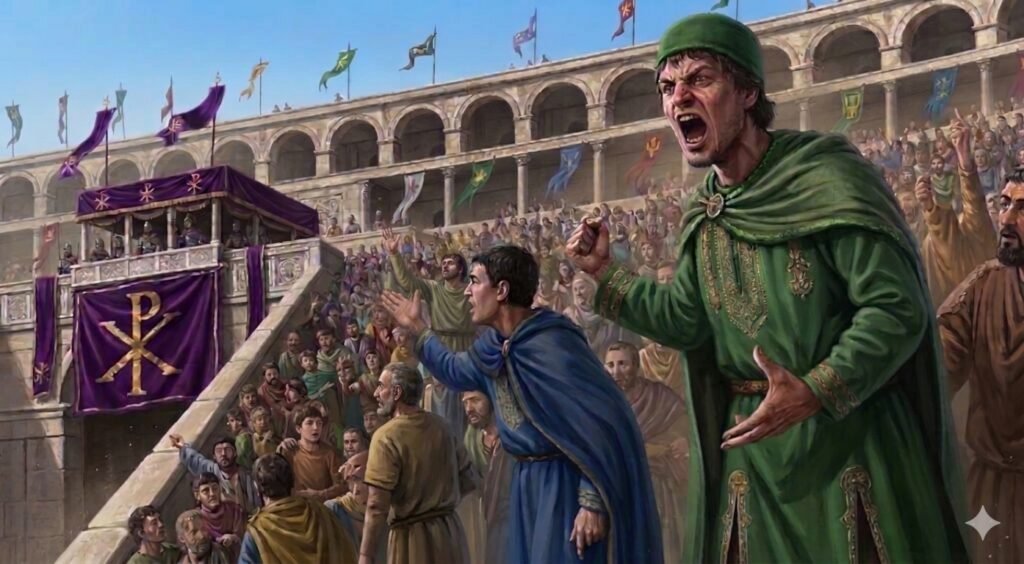
The Greek word Nika means “Win!” or “May you be victorious!” It was derived from the traditional Latin acclamation Tu vincas, which crowds used to hail the emperor in his capacity as supreme military commander. However, its meaning had now taken on a different significance. Rather than urging the emperor to triumph over his enemies, the Blues and Greens were now encouraging one another to prevail.
This marked a fundamental change in the situation. The crowd was no longer merely appealing to the emperor for mercy; it was now asserting its own collective power, overcoming the divisions between the rival factions. The united voices of ordinary citizens had become a force in their own right. Their ability to express their demands was rapidly turning into a determination to act.
Justinian refused to engage in a verbal confrontation with the crowd, perhaps because doing so would have meant acknowledging the authority of those challenging him. Meanwhile, Eudaemon, the city prefect responsible for maintaining public order, also remained silent when crowds gathered outside his palace, demanding to know the fate of the two men who had survived the hanging. His refusal to respond proved to be the final provocation that pushed the already tense situation towards open revolt.
Storming the Praetorium (Phase 1)
The unrest soon escalated into open violence. The rioters stormed the praetorium, killed several officials, broke open the prison and freed all the inmates. Emboldened by their initial success, they moved east towards the Augusteum, where they set fire to several buildings. The violence then spread to the imperial palace itself. When the crowd attacked its entrances, the palace guards, whose role was largely ceremonial rather than military, offered little resistance.
The rebels then set fire to the Chalkê, the grand entrance vestibule of the imperial palace, the Senate building and the Basilica of Hagia Sophia. In a single night, flames engulfed three of Constantinople’s most significant monuments, each representing a different pillar of the empire. The imperial palace embodied the authority of the emperor, the Senate building represented the political institutions of the New Rome, and Hagia Sophia stood as the spiritual heart of the Christian capital, symbolising its religious identity and divine protection.
The Dismissal of Ministers (Phase 2)
On Wednesday morning, January 14, Justinian ordered the chariot races to resume, hoping to demonstrate that the authorities remained in control of the capital. However, the Blues and Greens had no intention of returning to their usual sporting activities. As the customary signal was raised to mark the beginning of the races, members of both factions set fire to the upper tiers of the Hippodrome and destroyed much of the neighbouring colonnade. The flames spread as far as the nearby Baths of Zeuxippus, which housed a celebrated collection of statues depicting historical and mythological figures. The baths, too, were consumed by the fire.
By now, the uprising had taken on an entirely different character. During the previous night, representatives of the Blues and Greens had met secretly and begun formulating demands that went far beyond securing the freedom of the two condemned prisoners. What had started as a protest against their treatment had evolved into a concerted political movement directed against Justinian’s administration. The factions were now calling for the dismissal of powerful government officials and sweeping changes in the way the empire was governed. The crisis had thus moved beyond factional unrest and developed into a direct challenge to the emperor’s authority.
The rioters now presented their demands directly to Emperor Justinian. They called for the removal of three prominent officials: Eudaemon, the city prefect, whose harsh methods of maintaining public order had provoked widespread resentment; Tribonian, the quaestor sacri palatii, whose legal reforms and policies had become deeply unpopular; and John of Cappadocia, whose oppressive taxation measures had fuelled public anger. At this stage, however, the protesters were directing their hostility towards the emperor’s ministers and their policies rather than seeking to overthrow Justinian himself.
Justinian eventually yielded to the protesters’ demands and removed his three prominent officials from office. He made little effort to defend his former ministers, apparently believing that their dismissals would be only temporary and that he could restore them to their positions once order had been re-established.
In the meantime, he entrusted the administration to a new group of officials whom he considered capable of handling the crisis. Tryphon was appointed City Prefect, Basilides became Quaestor, and Phocas, a man regarded for his exceptional integrity, was appointed Praetorian Prefect. The dismissed ministers, however, were not cast aside entirely. Justinian kept them within the imperial palace, both to protect them from possible attacks and to reassure them that they still enjoyed his confidence and favour.
These concessions might have been enough to satisfy the Blues and Greens and bring the disturbances to an end, as similar measures had done during earlier reigns. However, the situation had now taken a very different turn. The uprising was no longer simply driven by the demands of the circus factions. The call for the dismissal of three senior officials suggested that influential political interests were exploiting the unrest to bring about a wider change in government.
The Military Failure (Phase 3)
When Justinian realised that his concessions to the circus factions, including the dismissal of his senior ministers, had failed to quell the revolt, he turned to the army, as rulers traditionally did when faced with a direct threat to their authority. However, the palace guards, consisting of the Scholarians and the Excubitors, showed little willingness to defend the emperor. Lacking any strong personal loyalty to Justinian, they chose to remain inactive and wait to see how events unfolded. Fortunately for the emperor, other military forces of a less regular nature were present in Constantinople, led by two experienced and dependable commanders, Belisarius and Mundus, who happened to be in the capital with loyal troops under their immediate command.
Belisarius, who had served as Master of Soldiers in the East and led the campaign against the Persian Empire, had recently been recalled to Constantinople. He was accompanied by a substantial force of armed retainers, consisting mainly of Gothic warriors. Mundus, another capable commander who had distinguished himself in defending the Danube frontier, was also present in the capital with a contingent of Herulian troops.
Although these forces provided Justinian with some military support, their numbers were relatively small. The combined strength of the troops available to him probably amounted to no more than 1,500 to 2,000 men. Nevertheless, Belisarius and Mundus decided to lead their soldiers against the much larger rebel crowds, confident that their military training and discipline would give them the advantage.
However, their attempt to disperse the rioters encountered an unexpected obstacle. Clergymen from the Basilica of Hagia Sophia appeared in the streets carrying religious relics they had managed to rescue from the recent fire. Hoping to prevent further bloodshed, they attempted to place themselves between the soldiers and the crowd. But Belisarius’s troops regarded their intervention as an obstruction to military operations and reportedly trampled them underfoot.
The incident further damaged Justinian’s standing among the people of Constantinople. He now appeared not merely as an oppressive ruler but as an inhumane and irreligious emperor, willing to turn his soldiers against defenceless priests and a crowd that, despite its violence, continued to portray itself as seeking justice and mercy. The sight of the clergymen being trampled caused widespread outrage. The incident made such a profound impression that even the women of Constantinople left their homes and poured into the streets, urging the men to continue their resistance. Belisarius’s and Mundus’s troops, meanwhile, failed to disperse the crowds. Unable to make further progress, they were eventually forced to withdraw.
The emperor, who claimed authority over the entire Christian world, now found himself confined within his own palace, virtually a prisoner within its walls. Meanwhile, men who had recently been behind bars roamed freely through the streets, and women, whose presence in public disturbances was unusual, had joined the unrest in large numbers. Constantinople had descended into chaos and lawlessness, even as Justinian was attempting to establish a legal code that would endure for centuries.
Fires continued to illuminate the night sky as hospitals, churches and other buildings lay in ruins. Countless people, injured in body and traumatised by the violence, had been left homeless. In a bitter reversal of its former glory, the city that had long presented itself as the centre of civilisation had become a scene of destruction, suffering and disorder.
The rebellion had now taken a more dangerous turn. The rioters marched towards the nearby palace of Probus, a nephew of the former emperor Anastasius, where they gathered weapons and shouted slogans such as “Another emperor for the city!” and “Probus! Emperor of Romania!” However, finding that Probus was not at home, they set his residence on fire.
This episode made the rebels’ intentions increasingly clear. Having already secured the removal of Justinian’s chief ministers, those directing the uprising were no longer satisfied with these concessions. Their objective had now shifted towards removing Justinian himself from the throne and replacing him with another emperor.
The Proclamation of a Rival Emperor (Phase 4)
By Friday, January 16, AD 532, the violence had spread further across Constantinople. The insurgents continued setting fire to public buildings, this time directing their attacks against the imperial archives, which contained vital tax registers and government records. Their destruction was accompanied by the burning of numerous hospitals, hospices and charitable establishments. One of the most tragic losses was the Hospice of Samson, where contemporary accounts report that every patient inside died in the fire.
The uprising had now entered an especially brutal phase. According to a later account by a well-informed Constantinopolitan writer, the violence was no longer confined to arson and attacks on public property. Members of the factions began murdering people without distinction, seizing their victims and throwing their bodies into the sea. Women, too, fell victim to these killings.
It remains unclear whether these atrocities resulted from the rebels losing control of their own supporters or whether they were deliberately encouraged by those directing the revolt. If the latter was the case, the violence may have served a calculated political purpose: to spread terror throughout the capital, deepen the crisis and make Justinian’s position inside the palace increasingly untenable, possibly forcing him to flee Constantinople.
On Saturday, January 17, another violent confrontation broke out between the imperial troops and the insurgents along the street running north from the Mese towards the Basilica and the district of Chalkoprateia. Some of the rioters appear to have taken refuge in the Octagon, a building near the Basilica. The soldiers set the building on fire in an attempt to drive them out.
Unfortunately, a strong north wind carried the flames southwards, spreading the destruction to the nearby Church of Saint Theodore Sphoracius and the Palace of Lausus, which was consumed along with its priceless collection of treasures. The fire then advanced along the Mese towards the Forum of Constantine, destroying its colonnades and the Church of Saint Aquilina.
The growing devastation must have caused considerable alarm within the imperial palace, which was now virtually under siege. Justinian found himself in an increasingly desperate position. He could no longer place complete trust in his own palace guards, while his suspicions that several senators surrounding him were secretly conspiring against him seemed far from unfounded.
Growing increasingly distrustful of those around him, Justinian ordered almost everyone to leave the imperial palace. Only a small circle of his closest advisers and military commanders were permitted to remain, including John of Cappadocia, Narses, Belisarius, Mundus and Tribonian.
The two nephews of the former emperor Anastasius, Pompeius and Hypatius, also requested permission to remain inside the palace. Perhaps they feared for their safety after learning that Probus’s residence had been burned by the rioters. However, their request only deepened Justinian’s suspicions. He refused to let them stay and ordered them to leave as well.
Ironically, by driving the two men out of the palace, Justinian may have provided the rebels with precisely what they needed: potential candidates around whom they could rally against him. It was now the evening of Saturday, January 17, AD 532, and the emperor’s position had become increasingly precarious.
The Final Stand (Phase 5)
On Sunday morning of 18 January, Justinian made one final attempt to bring the uprising to an end. Carrying a Bible, he emerged through a heavily guarded entrance of the imperial palace that led directly to the emperor’s box, known as the Kathisma, in the Hippodrome. News of his appearance quickly spread, and a huge crowd gathered inside the arena to hear him.
According to a detailed Constantinopolitan account, Justinian swore an oath before the assembled crowd, declaring:
“By this Power, I forgive you this error, and I order that none of you be arrested. But remain peaceful, for the blame lies not with you but with me. It was my own sins that prevented me from granting your earlier requests in the Hippodrome.”
Initially, some among the crowd responded by chanting, “Augustus Justinian, may you be victorious!” But the emperor’s conciliatory approach soon backfired. Others recognised what they perceived as a sign of weakness and began shouting accusations against him. They even revived old grievances, including his alleged betrayal of Vitalian years earlier. Some went further, mocking his name through a play on the Greek words Ioustinianos (Justinian) and onos (donkey), accusing him of stubbornness and stupidity.
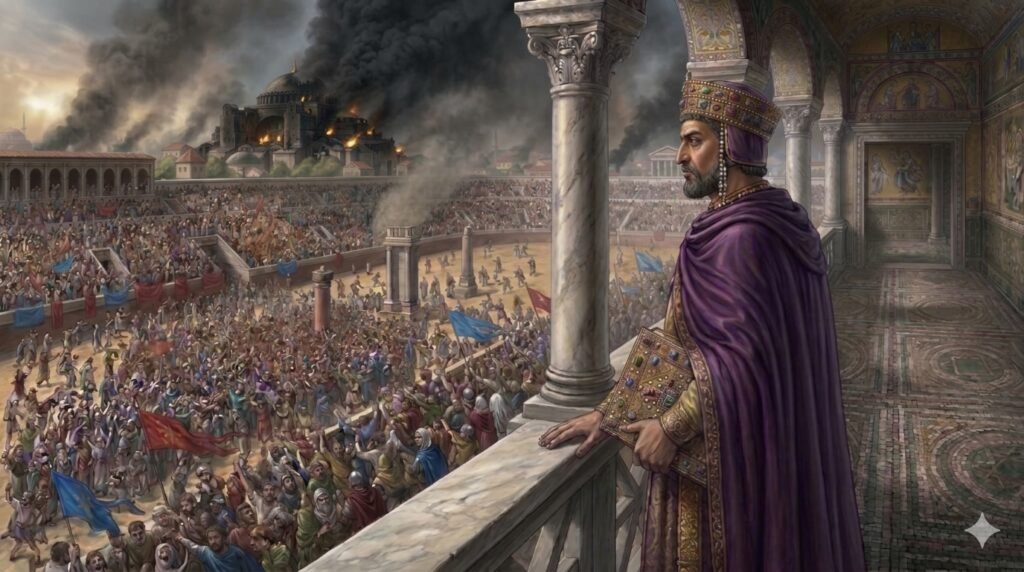
The jeering grew louder, and Justinian eventually withdrew down the steps of the Kathisma. The doors closed behind him, once again shutting him inside the protective walls of the palace. His attempt to present himself as a mediator between the government and the rebellious factions had failed. Instead, he had become the principal target of their hostility.
Meanwhile, news spread that the nephews of the former emperor Anastasius had been expelled from the palace. The crowds quickly gathered outside Hypatius’s residence. Despite his reluctance to accept their demands, and the desperate pleas of his wife Maria, who feared that he was being led to his death, the rioters seized him and carried him to the Forum of Constantine. There, they placed a golden chain, fashioned like a royal diadem, upon his head and proclaimed him emperor.
Among those cheering his elevation were several prominent aristocrats whom Hypatius personally knew. Their support and the enthusiastic cries of “Long live Hypatius!” gradually strengthened his confidence. Encouraged by the growing support, he allowed himself to be carried to the Hippodrome.
There, the rebels raised him to the imperial box, the Kathisma, from which Justinian had addressed the crowd earlier that morning. But unlike Justinian, who had entered through the palace, Hypatius arrived directly from the arena. Only a single door, guarded by palace soldiers, separated him from the imperial palace and the centre of power. Although this physical barrier was relatively small, its symbolic significance was enormous. For those inside the palace, the sight of a rival claimant occupying the imperial box so close to the seat of power was almost unthinkable.
Belisarius was determined to eliminate the usurper. He attempted to persuade the guards controlling access to the Kathisma to carry out his orders, but they refused. Uncertain about which side would ultimately prevail, the guards preferred to remain neutral and wait for events to unfold. They wanted to see whether Hypatius was merely a temporary claimant whose rise would quickly fade, or a genuine emperor whose authority deserved their allegiance. In an age when people often looked for divine signs to determine the legitimacy of rulers, even a single unexpected event might have settled their doubts.
The Hippodrome Massacre (Phase 6)
Meanwhile, another emergency council was convened inside the imperial palace to decide how to deal with the rapidly deteriorating situation. The position of Justinian appeared increasingly hopeless, and even the emperor himself began to consider abandoning Constantinople by sea. John of Cappadocia proposed escaping to Heraclea, a city on the northern coast of the Sea of Marmara, and Belisarius supported the plan. The emperor and his advisers seemed ready to accept this course of action. However, their decision was overturned by the intervention of Empress Theodora, whose extraordinary courage and determination restored the resolve of her wavering husband and his advisers.
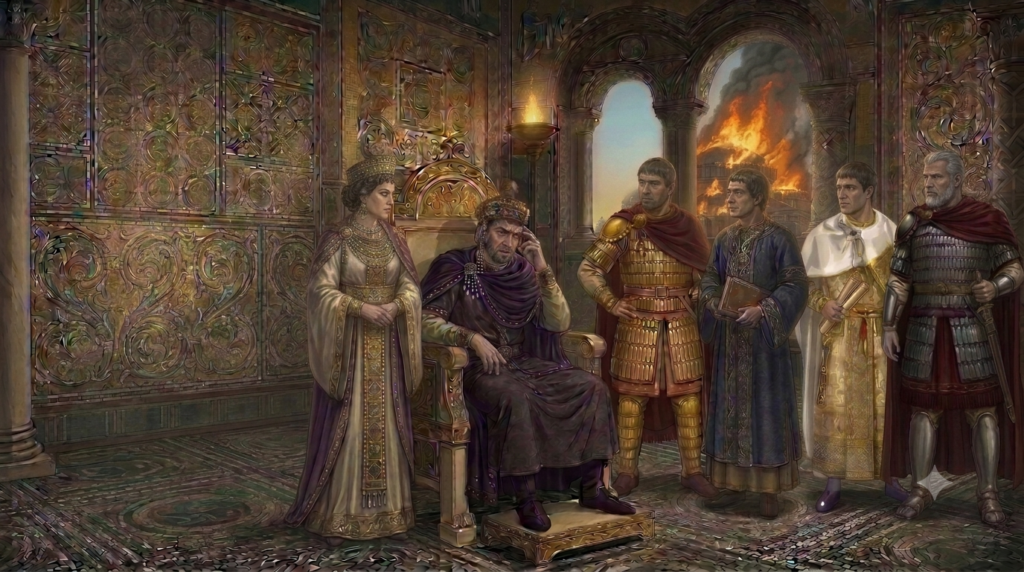
The historian Procopius recorded Theodora’s famous response to the proposal of flight. Addressing her husband and the assembled advisers, she declared: “The impropriety of a woman speaking boldly among the men or stirring up those who are cringing in fear is hardly, I believe, a matter that the present moment affords us the luxury of examining one way or another. For when you reach the point of supreme danger nothing else seems best other than to settle the matter at hand in the best possible way.
I believe that flight, now more than ever, is not in our interest even if it brought us to safety. For it is not possible for a man who is born not also to die, but for one who has reigned it is intolerable to become a fugitive.
May I never be parted from the purple! May I never live to see the day when I will not be addressed as Mistress by all in my presence! Emperor, if you wish to save yourself, that is easily arranged. We have much money; there is the sea; and here are our ships. But consider whether, after you have saved yourself, you would then gladly exchange safety for death. For my part, I like that old saying, namely that kingship is a good burial shroud.” — Procopius, The Wars of Justinian.
According to Procopius, Justinian’s resolve was strengthened by his devoted wife, Empress Theodora, who had clearly grown tired of the hesitation displayed by those surrounding the emperor. Determined to make her position known, she spoke boldly despite the fact that, as Procopius observed, a woman asserting herself so openly before men was considered a breach of established protocol. Theodora showed greater courage and determination than most of the emperor’s advisers, openly accusing them of remaining silent out of cowardice. She firmly believed that Justinian had no choice but to stand his ground and fight. As she declared, ‘It would be unendurable for a man who has been an emperor to end up as a fugitive.
Procopius’s description of Theodora’s speech may contain embellishments, and its precise wording cannot be accepted without reservation. Nevertheless, it is reasonable to believe that Justinian sought his wife’s advice before deciding how to respond to the revolt. Whatever the exact nature of their conversation, the emperor ultimately chose to remain in Constantinople rather than abandon his throne. His decision, however, did not resolve the crisis. To survive, he needed reliable military support at a time when much of the armed force in the capital could no longer be trusted.
His remaining hope lay in the troops commanded by Belisarius and Mundus, whose personal loyalty to their generals made them more reliable than the uncertain palace forces. Narses, Justinian’s private secretary, would also play an important part in the emperor’s response to the crisis. The survival of Justinian’s rule would therefore depend on the cooperation of these three men, particularly the willingness of Belisarius and Mundus to commit their soldiers to a decisive confrontation with the rebels.
Inside the Hippodrome, rumours began to spread that Justinian and his supporters had already abandoned the palace and fled the city. Hypatius, however, remained uncertain about the strength of his position. According to the account, he secretly sent a messenger named Ephraem to the imperial palace with a proposal that Justinian should launch an attack against the crowds assembled in the Hippodrome.
Ephraem delivered the message to Thomas, one of the emperor’s secretaries. Whether through a genuine misunderstanding or deliberate deception, Thomas told him that Justinian had already fled. Ephraem immediately carried this news back to the Hippodrome and announced it before the assembled crowd. Convinced that Justinian had abandoned the capital, Hypatius became more confident in his claim to the throne and began to conduct himself as emperor.
While Hypatius was consolidating his position in the Hippodrome, Justinian’s supporters inside the palace were preparing a coordinated counteroffensive against the rebels. Their strategy involved striking the uprising from three different directions. One of the first moves was entrusted to Narses. Narses managed to leave the palace and approached members of the Blue faction, distributing money in an attempt to win back their support for Justinian. The strategy proved successful. Some of the Blues abandoned the rebellion and began openly declaring their loyalty to the emperor, chanting, ‘Augustus, Justinian, may you be victorious! Lord preserve Justinian and Theodora!’ Their sudden change of allegiance enraged the Greens, who turned against them and began pelting them with stones.
With the Blues now turning against their former allies, confusion spread among the insurgents. Narses used this opportunity to advance the imperial counteroffensive, offering further payments to secure the cooperation of some of the palace guards. His forces were soon reinforced by Mundus and his soldiers, who marched out of the palace complex and positioned themselves at the gate on the southern side of the Hippodrome.
The final part of the imperial plan depended on Belisarius and his men gaining direct access to the Kathisma, where Hypatius was occupying the imperial box. Belisarius and his companions attempted to enter the Hippodrome through the palace, but their advance was stopped by the guards stationed at the entrance. These soldiers were unwilling to commit themselves to either side and had chosen to remain neutral until the outcome of the revolt became clear.
Belisarius demanded that they open the gates immediately, intending to lead his troops against the rebels. The guards, however, deliberately ignored his orders, pretending not to hear him. Unable to force his way through, Belisarius returned to Justinian and reported that the situation appeared hopeless, as even the palace guards seemed to have turned against the emperor.
Justinian nevertheless ordered him to proceed towards the Bronze Gate and its adjoining Propylaia. Reaching this position required Belisarius and his men to cross the smouldering ruins left by the fires, a journey that exposed them to considerable danger and difficulty. Eventually, they reached the Hippodrome, only to discover that the narrow entrance leading into the arena was held by soldiers loyal to Hypatius.
Belisarius realised that attempting to break through the narrow entrance would leave his soldiers vulnerable to an attack from the enormous crowd gathered behind them. Rather than risk being trapped between the rebels inside and the hostile masses outside, he decided to launch a direct assault on the insurgents. Drawing his sword, he gave the order to attack.
Although many among the crowd were armed, the sheer density of people made it impossible for them to organise an effective defence. Faced with a disciplined body of imperial soldiers advancing against them, the rebels began to panic and retreat. Their resistance was further weakened by the divisions that had emerged within their ranks following Narses’s successful efforts to win over members of the Blue faction.
At the same time, Mundus and Narses advanced with their respective forces, joining Belisarius in the assault. The imperial troops now attacked the insurgents from different directions, turning the confrontation into a massacre. Procopius describes the ensuing slaughter: ‘Then indeed from both sides the insurgents who supported Hypatius were assailed and destroyed.’ The imperial assault soon developed into one of the bloodiest episodes in the history of Constantinople. Thousands of people were reportedly killed as the rebellion was crushed, bringing the Nika Revolt to its violent conclusion.
As the imperial forces gained control of the Hippodrome, the palace guards finally abandoned their earlier hesitation and opened the doors leading to the imperial gallery. Two of Justinian’s cousins, Boraïdes and Justin, then entered and seized Hypatius without encountering any resistance. They pulled him down from the imperial seat and escorted him, along with Pompeius, into the palace, where both men were handed over to the emperor.
Despite Pompeius’s desperate tears and Hypatius’s repeated insistence that he had joined the rebellion under coercion, Justinian showed no mercy. On the following day, both men were executed, and their bodies were thrown into the sea. Their deaths marked the final elimination of the rival claimants whose elevation had threatened Justinian’s hold on the throne.
Aftermath
The revolt had emerged from a complicated relationship between Justinian and the city’s rival circus factions. Before becoming emperor, he had found it useful to cultivate their support in his pursuit of power. Once established on the throne, however, he expected these same groups to abandon their violent activities and submit to imperial authority. His government therefore began taking increasingly strict measures against their disorderly conduct. What appeared to Justinian to be a necessary exercise of imperial discipline was viewed very differently by the factions, who saw the change in his attitude as a betrayal of the support they had once given him. His refusal to respond to their appeals in the Hippodrome further deepened their resentment and helped turn a local disturbance into a major uprising.
The situation soon developed beyond the control of the city’s authorities. As public disorder spread and the institutions responsible for maintaining order proved unable to contain it, Justinian’s political opponents recognised an opportunity to challenge his government. Their hostility was directed first against his most influential ministers and eventually against the emperor himself. The anger of the ordinary population thus became intertwined with the ambitions of powerful figures within Constantinople’s political establishment. Some among the senatorial aristocracy had long regarded Justinian and Theodora as socially inferior outsiders who had risen to positions of extraordinary power. Others had grown increasingly concerned about the centralising direction of imperial policy and the loss of influence that it threatened to bring.
It is therefore difficult to understand the Nika Revolt as nothing more than an eruption of popular anger. Although the initial disturbances arose from tensions between the circus factions and the imperial administration, the crisis was gradually exploited by influential groups with their own political objectives. Public resentment, factional rivalry and aristocratic opposition combined to create a rebellion that came dangerously close to overthrowing the emperor.
Procopius himself described the outbreak as an unexpected disturbance that rapidly developed into a crisis of enormous proportions, causing immense suffering among both the population and the Senate. His assessment reflected the scale of the catastrophe witnessed by those who lived through it. By the time the fighting ended, thousands had reportedly lost their lives, Hypatius and Pompeius had been executed, and much of central Constantinople lay in ruins. The waters near the Golden Horn carried the bodies of the dead, while the heart of the imperial capital remained scarred by fire and destruction. For the people who had witnessed these events, the Nika Revolt was not merely a failed attempt to overthrow an emperor; it was a disaster that had brought their city to the brink of ruin.
The survival of Justinian’s throne owed much to Theodora’s determination and the decisive military intervention of Belisarius, supported by Mundus and their troops. Yet the defeat of the revolt achieved more than simply preserving the emperor’s position. It also gave Justinian an opportunity to strengthen his authority and weaken the political influence of the senatorial aristocracy, whose opposition had threatened his government.
In the aftermath of the uprising, eighteen senators suspected of playing leading roles in the conspiracy were punished through the confiscation of their estates and their expulsion from Constantinople. Beyond the executions of Hypatius and Pompeius, Justinian did not pursue a wider campaign of putting his political opponents to death. Once his position had become secure, he eventually granted pardons to the exiled senators and returned whatever property had not already been transferred to other owners. Similar compensation was extended to the children of Hypatius and Pompeius.
Bibliography
1) THE WARS OF JUSTINIAN | Procopius, Translated by H. B. Dewing
2) THE ANECDOTA OR SECRET HISTORY | Procopius, Translated by H. B. Dewing
3) THE CHRONICLE OF MALALAS : A TRANSLATION | Elizabeth Jeffreys, Michael Jeffreys, and Roger Scott
4) THEODORA : EMPRESS OF BYZANTIUM | Paolo Cesaretti
5) THE NIKA RIOT: A REAPPRAISAL | Geoffrey Greatrex
6) 50 BATTLES THAT CHANGED THE WORLD | William Weir
7) JUSTINIAN : EMPEROR, SOLDIER, SAINT | Peter Sarris
8) HISTORY OF THE LATER ROMAN EMPIRE (VOLUME 2) | J. B. Bury
© 2026 History and War
Author: Jishu Roy
Unauthorized reproduction of this content is prohibited.