Copyright © Cyowari
The Road to the Bagradas River
The opening campaign of Hamilcar Barca during the Mercenary War has often received less scholarly attention than his later operations, despite demonstrating many of the qualities that established his reputation as one of Carthage’s most capable commanders. Polybius provides the principal narrative of this campaign, yet his concise account leaves important questions concerning the composition of Hamilcar’s army, the strategic situation around Carthage, the mechanics of the nighttime crossing of the Bagradas River, and the tactical maneuvers that secured his first major victory of the conflict.
This article re-examines the campaign by combining Polybius’ narrative with modern military analysis to reconstruct the most likely sequence of events. It explores the condition and organization of Hamilcar’s newly assembled army, the strategic constraints imposed by the rebel blockade, the planning behind the surprise crossing of the Bagradas River, and the battlefield maneuvers that transformed numerical inferiority into a decisive victory. Particular attention is given to troop deployment, the role of the elephants and cavalry, the execution of Hamilcar’s feigned retreat and counterattack, and the factors that contributed to the collapse of Spendius’ forces. By examining these elements together, the article aims to provide a coherent reconstruction of the Battle of the Bagradas River while highlighting the operational skill, tactical discipline, and leadership that enabled Hamilcar Barca to secure one of the defining victories of the opening campaign of the Mercenary War.
Hamilcar Barca Takes Command
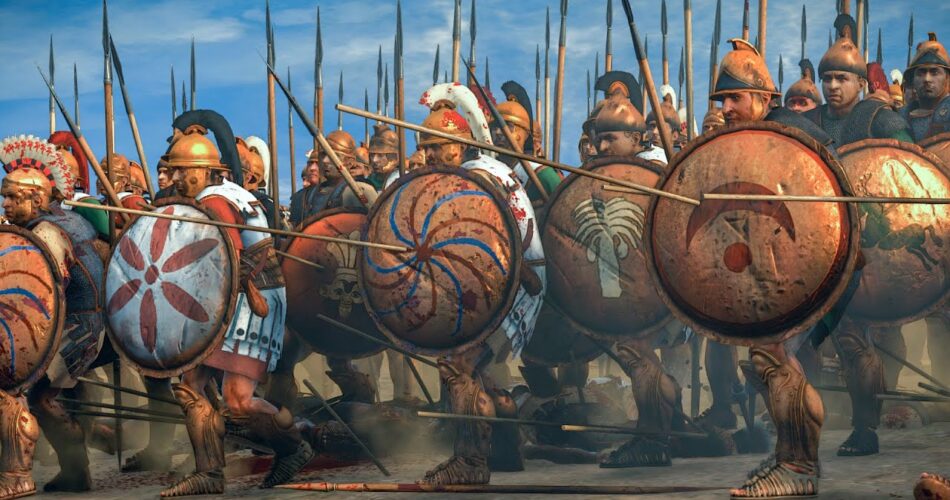
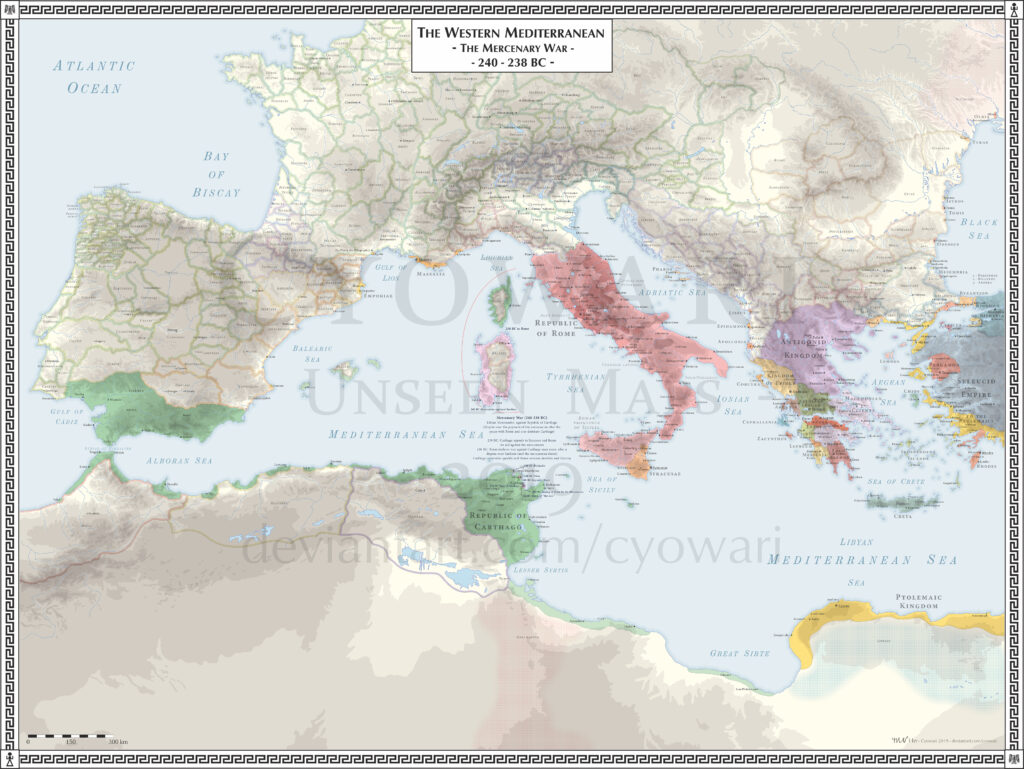
Following the Battle of Utica in 240 BC, Hamilcar Barca assumed command from Hanno, inheriting a force described by Polybius as a mix of freshly recruited mercenaries, rebel deserters, citizen cavalry, infantry, and 70 elephants. This army, though assembled with urgency, would have required substantial preparation and coordination, particularly as new mercenary arrivals were delayed until spring due to seasonal sailing conditions. The composition of Hamilcar’s army suggests a patchwork force, both in terms of skill and loyalty. Citizen levies were likely organized immediately after the mutiny began, with deserters augmenting their numbers in the preceding months. However, despite these reinforcements, Hamilcar faced the daunting task of leading a force that was numerically inferior and potentially less cohesive than the rebel forces they confronted. Recognizing the strategic importance of acting swiftly, Hamilcar moved to take the offensive with minimal delay. His primary challenge was the geography around Carthage. The isthmus connecting Carthage to the mainland was only about 2,000 yards wide, and to the south lay a rugged, defensible range of hills, heavily guarded by Matho’s rebel troops. Hamilcar’s task was not only to overcome these natural and man-made barriers but to do so with a force still in the process of consolidation and training—a test of both strategic acumen and leadership under severe constraints.
The initial strategy likely aimed for Hanno to decisively defeat or at least contain the rebels around Utica, which would have ideally weakened rebel morale in the surrounding areas. Hamilcar, in turn, would join the effort as soon as circumstances allowed, possibly coordinating a two-pronged assault on the rebel forces stationed at Tunis. However, Hanno’s failure forced a revision of this plan. Carthaginian strategy remained shaped by its limited resources. Hamilcar, with only 10,000 troops, could not afford to openly challenge Mathos’ forces at Tunis. The rebels held firm control over key strategic points, including the single bridge spanning the Bagradas River and the passes through the nearby hills. This effectively blocked any conventional advance. To break out into the open countryside, Hamilcar needed to achieve surprise, as his force was too small to confront the heavily guarded passes or attempt a crossing at the well-defended bridge. Thus, his strategy required careful planning and tactical ingenuity, relying on surprise attacks or exploiting weaknesses in the rebels’ defenses, rather than engaging in direct confrontation, which would have exposed his army to overwhelming opposition.
The Night Crossing of the Bagradas River
Polybius provides a detailed account of Hamilcar’s initial maneuvers, more thorough than his description of Hanno’s efforts. At first, the prospects of attacking the rebel forces seemed unlikely. However, Hamilcar noticed a natural advantage caused by a quirk of tide and weather. When the wind blew from the west and the tide was low, a sandbar would be partially exposed across the salt flats at the mouth of the river, making it possible to ford. Seizing this opportunity, Hamilcar waited for the conditions to align. When they did, he led his men out of the city under the cover of darkness. By using the sandbar, they successfully crossed before dawn without detection. From there, Hamilcar directed his forces inland, following the course of the Bagradas River to secure the strategically important bridge. Afterward, they advanced in an extended line northward across the plain, positioning themselves to confront the rebels with the advantage of surprise.
Hamilcar’s Tactical Manoeuvre
After Spendius overcame his initial shock at the sudden change in events, he quickly moved to confront Hamilcar. Leading the 10,000 men who had been stationed around the bridge, he was soon reinforced by an additional 15,000 troops from Utica. Confident in his numerical superiority, Spendius advanced toward the Carthaginians with the aim of overwhelming them. He extended his left flank in an effort to outflank Hamilcar’s forces and encircle them, pinning the Carthaginians against the river, thus limiting their ability to maneuver or retreat.
Hamilcar organized his forces with the 70 elephants leading as the vanguard, followed by the citizen cavalry and light-armed skirmishers in the middle, and the heavy infantry bringing up the rear. It was unusual for cavalry to be positioned behind the elephants, as they typically took on a leading or flanking role in ancient warfare. Additionally, there is no mention of cavalry scouts operating ahead or along the flanks of the formation. One interpretation is that Hamilcar’s cavalry was too limited in number to fulfill their traditional roles. However, they were still numerous enough to play a decisive role in the battle and are estimated to have numbered at least 1,000, which was a reasonable cavalry-to-infantry ratio for the time. Despite their smaller numbers, the cavalry would have been a crucial element in Hamilcar’s strategy.
Despite their unusual positioning, the cavalry and light-armed troops were still fulfilling their typical role of screening the infantry. The light infantry may have been relatively few in number, possibly no more than 1,000. These units, in turn, were screened by the elephants at the front. Given Hamilcar’s awareness of his force being heavily outnumbered, the elephants were essential for any confrontation. Placing them in the vanguard provided additional protection against a frontal assault, while the cavalry and light troops could fan out from the center to counter any flanking threats if needed. However, this formation also meant that the entire army was limited to the slower pace of the elephants. By the time of the impending battle, the elephants had already marched nearly 24 kilometers since the previous evening. Even with brief rests along the way, they were likely fatigued and moving slowly, which influenced the overall movement of Hamilcar’s forces as they prepared for the clash with the rebels. This fatigue and slow pace were key factors in the coordination and timing of the approaching battle.
As previously noted, Hamilcar was fully aware of his numerical disadvantage, yet he sought to engage in a decisive battle. The two-pronged attack by Spendius from the west and north was unlikely to have caught him off guard. In fact, it is highly probable that Hamilcar had anticipated this and had planned his response accordingly. Long before the engagement, it would have been evident that, wherever he met the rebel forces, he would be significantly outnumbered. This situation required his troops to master additional maneuvers beyond the basics of maintaining formation and charging on command—such as executing an orderly retreat. The key maneuvers Hamilcar employed—initially wheeling his troops around in a controlled retreat, then turning them again to face the enemy—were likely practiced within the city walls and open spaces of Carthage. However, given that not all, and perhaps only a minority, of his forces were battle-hardened veterans, the maneuvers had to be kept relatively simple to avoid confusion and disarray. These straightforward tactical movements ensured that even a largely inexperienced army could maintain discipline and cohesion in the face of overwhelming odds.
The Battle of the Bagradas River
These considerations are essential for understanding Polybius’ account of the battle. According to his narrative, the two rebel divisions either came into sight of one another or, based on another interpretation of the Greek text, physically joined together like the two parts of a hinge. In either case, they were close enough to communicate by shouting, offering mutual encouragement, and reinforcing their confidence. The rebels believed they had successfully trapped the Carthaginians in the center of their combined forces, convinced that Hamilcar’s army had been encircled and was at their mercy.
As the rebel armies came into view, still some distance away across the countryside, Hamilcar ordered his forces to halt and signaled a retreat. The fact that there was soon a noticeable gap between his cavalry and infantry suggests that they were not marching in a tightly compact formation, though they were not widely dispersed either. Seeing the Carthaginians in retreat, the rebel forces quickened their pace to close the distance, but in doing so, they began to lose their cohesion. It is crucial to note that both rebel divisions likely accelerated their advance in this manner. Polybius strongly implies this, and logically, if one division increased its speed to attack, the other would have felt compelled to follow suit in order to maintain coordination and offer support. This rush to catch the retreating Carthaginians contributed to the disorder in the rebel ranks, weakening their overall formation and making them more vulnerable to counterattack.
Spendius had, or appeared to have, several tactical options at his disposal. As noted earlier, the rebels initially believed they could trap the Carthaginians against the river, with the division from Utica attacking their northern flank and the bridge division advancing from the west to strike their rear. Alternatively, Spendius could have employed a more deliberate strategy, allowing one division to engage while holding the other in reserve for a decisive blow once the Carthaginians were fully committed in battle. Unfortunately for the rebels, Spendius lacked the strategic finesse of commanders like Hannibal, who famously executed such a maneuver at Cannae, or Napoleon, whose mastery of this tactic was evident at Austerlitz. Instead, Spendius seems to have lost control over the movements of his forces. As the Carthaginians continued their eastward retreat—approximately a kilometer ahead—the plan for a coordinated flank attack was abandoned, replaced by a disorganized direct pursuit. One of the rebel divisions, likely the force from Utica, surged ahead of the other and broke formation in their eagerness to catch the retreating enemy. At this moment of disarray, Hamilcar seized the opportunity to strike, launching his counterattack against the overextended and vulnerable rebel troops.
First, he halted the infantrymen’s retreat and, in Polybius’ words, “ordered them to wheel around after their turnabout.” This “turnabout” likely refers to their previous maneuver to retreat; now, they wheeled to face west once again. As the cavalry and elephants, having retreated alongside the infantry, approached, Hamilcar signaled them to execute the same maneuver. By this point, the rebel forces—now in disarray—were likely a disorderly half-kilometer away. These movements were among the simplest any army could learn once they had mastered the basic skills of maintaining formation and executing charges. However, the key to success in such maneuvers lay not only in technical proficiency but also in psychological preparedness: maintaining composure during a retreat and readiness to attack when commanded. Clearly, Hamilcar had drilled his newly-formed army in these essential principles, ensuring they could execute such fundamental maneuvers effectively under pressure.
The rebel forces, many of whom were recent recruits, suddenly found themselves facing a coordinated strike by Hamilcar’s elephants and cavalry, both advancing in disciplined formation. Adding to their distress, they could see behind these advancing units the organized ranks of over 7,000 heavy infantry. What had begun as disorganization quickly spiraled into outright panic, turning their retreat into a chaotic flight. Meanwhile, the second rebel division, advancing from the rear in similarly loose formation, had limited visibility of the unfolding events ahead. When their fleeing comrades, terror-stricken, crashed into their ranks, it naturally sparked fears that a catastrophe had occurred. This confusion was compounded when they saw Hamilcar’s cavalry and elephants bearing down on them, cutting down and trampling those attempting to flee. Given the disarray and the sight of their comrades being overtaken, the panic that spread through the second division was inevitable, leading to a complete breakdown of their morale and cohesion.
Polybius employs compression and implicitness in his description of the battle. He states that the first group of rebels, upon colliding with the second, “destroyed both themselves and their comrades,” and notes that “many were trampled when the cavalry and elephants attacked them at close quarters.” However, he cannot literally mean that the fleeing first army annihilated the second; if that were the case, there would be no rebels left for the Carthaginian forces to confront, and it raises the question of what the rebels would have been doing in the meantime. More plausibly, Polybius is suggesting that the two groups of rebels clashed, possibly with one faction attempting to stop the other from fleeing the battlefield. After a brief, chaotic engagement, they likely suffered mutual casualties before ultimately being overwhelmed by the Carthaginian forces. Describing the encounter as “destroyed both themselves and their comrades” serves as a literary image rather than a precise factual account. It captures the chaos and devastation of the moment while allowing for a more nuanced understanding of the events that unfolded.
Casualties and Aftermath
The reported killing of 6,000 rebels represents a significant portion—nearly 25 percent—of Spendius’ forces, particularly if we consider that this loss was attributed solely to Hamilcar’s cavalry and elephants. With only 70 elephants and approximately 1,000 cavalrymen available, it is likely that the infantry also contributed to these casualties and helped secure 2,000 prisoners. However, the scale of the rebel losses is surprising, especially if many were in flight across the countryside. Elephants, unlike cavalry, cannot maintain a rapid pursuit over long distances due to their considerable weight. Yet, Polybius indicates that the battle occurred close to the Bagradas River. One may infer that Hamilcar successfully drove many rebels toward the bank of this fast-flowing river, where they were cornered and subsequently overwhelmed by a combined assault from cavalry, elephants, infantry, and light-armed troops who targeted stragglers. This operation exemplified Hamilcar’s tactical acumen, achieving success in two significant ways: first, through the element of surprise afforded by the nighttime river crossing, and second, through a well-executed tactical maneuver. Such a display of superior leadership not only contributed to the victory but also likely bolstered the morale of Hamilcar’s troops. Although this battle is often overshadowed by larger conflicts to come, Hamilcar Barca’s victory on the banks of the Bagradas River serves as a classic example of imaginative and skillful military leadership.
© 2026 History and War
Author: Jishu Roy
Unauthorized reproduction of this content is prohibited.