A Short but Dangerous Conflict
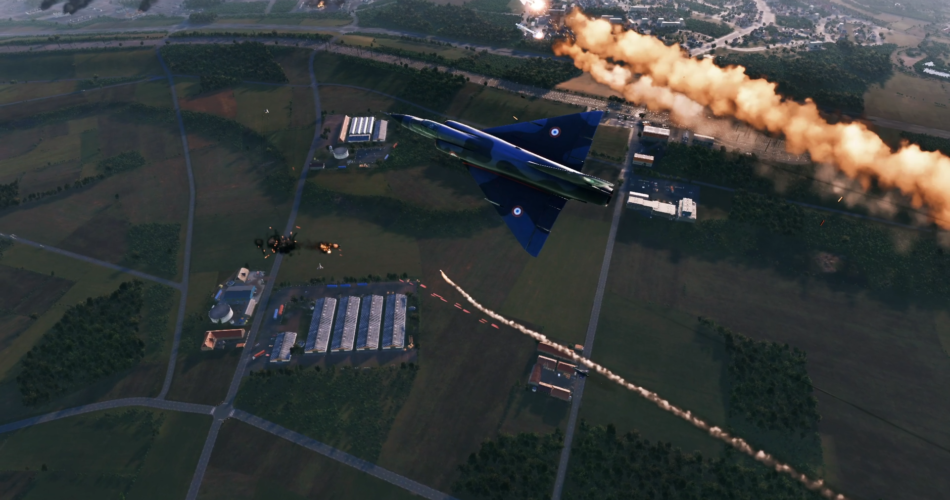
The Egyptian–Libyan War of July 1977 was a brief but significant military confrontation that marked the culmination of several years of deteriorating relations between Egypt and Libya. Once associated with efforts to achieve Arab political and military unity, the relationship between the two states progressively deteriorated as President Anwar Sadat and Libyan leader Muammar Gaddafi developed increasingly divergent political objectives. By the mid-1970s, disagreements over Arab unity, the Arab–Israeli conflict, and Egypt’s changing foreign policy had evolved into open political hostility and growing military tension along the two countries’ shared border.
This article examines the development of the Egyptian–Libyan confrontation from the collapse of earlier attempts at political integration to the military escalation that preceded the outbreak of war. It considers the political and strategic factors that shaped the rivalry between Sadat and Gaddafi, the military expansion undertaken by Libya during the 1970s, and Egypt’s subsequent preparations for a possible conflict. Particular attention is given to the contrasting strengths and weaknesses of the two armed forces, including their numerical strength, combat experience, training, operational readiness, command structures, and military equipment.
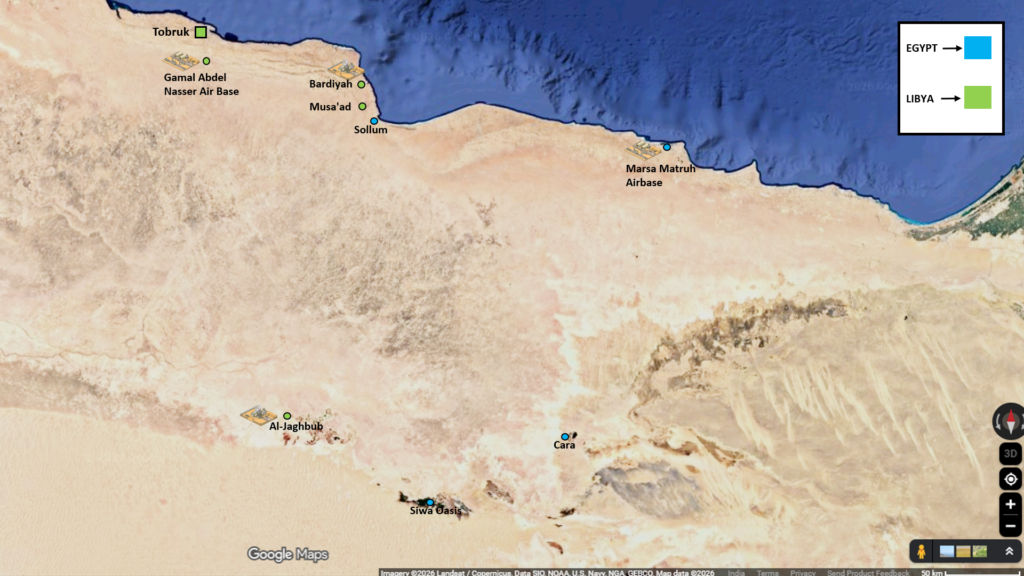
The article then examines the four days of fighting beginning on 21 July 1977, tracing the conflict from the initial clashes around Sollum and the Egyptian advance toward Musa’ad to the increasingly intensive air and ground operations that followed. The Egyptian air campaign, including repeated attacks against the Gamal Abdel Nasser Air Base near Tobruk, is examined alongside Libyan attempts to employ its fighter force and air-defence network. The role of Egyptian helicopter-borne commandos in attacks against Libyan radar installations, logistical facilities, and forward military positions is also considered.
Finally, the article examines the circumstances that brought the conflict to an abrupt end, including the decision by Sadat to halt the Egyptian offensive despite preparations for a potentially larger invasion. The consequences of the war are assessed through the available evidence concerning military losses, damage to Libyan military infrastructure, and the broader political consequences for Egyptian–Libyan relations. Taken together, these developments illustrate how a prolonged political rivalry between two neighbouring Arab states escalated into a short conventional war in which Egypt’s greater military experience and operational preparedness proved decisive.
From Arab Unity to Political Rivalry
Between 1969 and 1970, the political landscape of both Libya and Egypt underwent significant changes, as each country entered a new political era. In September 1969, Colonel Muammar Gaddafi seized power in Libya through a military coup and established the Libyan Arab Republic. His new government moved to bring much of the country’s oil industry under state control and introduced a series of socialist reforms aimed at transforming Libya’s political and economic system.
Gaddafi was a committed supporter of Arab unity and was deeply influenced by the ideas of Egyptian President Gamal Abdel Nasser. The performance of the Egyptian armed forces during the Six-Day War of 1967 also left a strong impression on him. Although Egypt and its Arab allies suffered a major military defeat in the war, the conflict reinforced Gaddafi’s belief that Arab states needed greater political and military unity to confront their common enemies. Following his rise to power, Gaddafi therefore began pursuing an increasingly ambitious foreign policy centred on Pan-Arabism. By the early 1970s, he was actively seeking ways to promote Arab unity and closer political cooperation among Arab states.
Throughout early 1970, Colonel Muammar Gaddafi held discussions with Egyptian leaders about the possibility of establishing a political union between Libya and Egypt. Following President Gamal Abdel Nasser’s death in September 1970, the negotiations continued under his successor, President Anwar Sadat. Gaddafi increasingly sought to present himself as a new ideological champion of Arab nationalism and attempted to carry forward the vision of Arab unity that had been strongly associated with Nasser.
The negotiations later expanded when Syria’s new leader, Lieutenant General Hafiz al-Assad, expressed support for joining the proposed union. After a series of further discussions, Gaddafi, Sadat, and Assad announced in April 1971 their agreement to establish a federation consisting of Libya, Egypt, and Syria. In August, the three leaders signed a draft constitution, which was subsequently approved by large majorities in referendums held in all three countries.
The new arrangement, known as the Federation of Arab Republics, formally came into existence on January 1, 1972. Sadat was appointed the first president of the federation’s Council of Heads of State, which was intended to serve as its principal governing body. The three governments developed ambitious plans for gradual integration, including cooperation and eventual coordination in areas such as legal systems, legislation, employment, armed forces, and foreign policy.
In practice, however, the federation struggled to move beyond broad declarations of unity. The leaders were unable to reach agreement on many of the practical measures required for integration, and the FAR never developed into a functioning political union. Its achievements therefore remained largely symbolic, including the adoption of a common flag.
One of Gaddafi’s principal foreign-policy objectives, shared by many Arab nationalists at the time, was the destruction of Israel. He believed that Libya’s growing financial resources, generated by its oil wealth, combined with Egypt’s large population and substantial military capabilities, could provide the strength necessary to confront Israel. This objective also encouraged Gaddafi to pursue closer political relations with Egypt. He therefore entered into negotiations with President Anwar Sadat over a complete political union between Libya and Egypt, which would transform the two neighbouring states into a single political entity within the broader framework of the Federation of Arab Republics.
On paper, the proposed union brought together two countries with dramatically different demographic and economic resources. Egypt had a population of roughly 34 million, while Libya had fewer than 2 million inhabitants. Libya, however, possessed enormous financial advantages because of its rapidly expanding oil revenues. Its per capita income was many times higher than Egypt’s, while its financial reserves in 1972 were estimated at more than US$2.5 billion—at least ten times those of Egypt.
In August 1972, following a meeting with Gaddafi, Sadat publicly expressed his support for the proposed union. Serious difficulties soon emerged, however, particularly over the pace and method of integration. Gaddafi demanded rapid unification, with a constitution to be drafted afterward, whereas Sadat favoured a gradual process that would allow sufficient time to prepare the political, legal, and administrative structures required for a successful union.
As Sadat’s enthusiasm for the project increasingly declined, Gaddafi attempted to demonstrate the strength of popular support for unification. In 1973, he even offered to resign as Libya’s head of state if his departure would remove an obstacle to the agreement. He also organized what became known as the “holy march” toward Cairo, involving an estimated 30,000 Libyans who marched in support of Egyptian-Libyan unity. The demonstration, however, failed to persuade Sadat to accelerate the merger.
The September 1, 1973, deadline that Sadat had previously proposed for decisive action on the union passed without any substantive progress. By this stage, opposition to the project had grown in both countries. The proposed merger faced deep political and institutional differences, as well as mutual suspicion between Egyptians and Libyans. Egypt and Libya also followed markedly different political systems: Egypt under Sadat retained a more established state bureaucracy and political institutions, while Gaddafi’s Libya was moving toward a highly centralized revolutionary system based on his own interpretation of Arab socialism and direct popular rule.
Consequently, despite Gaddafi’s persistent efforts to achieve political union, the proposed merger never became a reality. The differences between the two governments, combined with declining Egyptian support, ultimately prevented the Federation of Arab Republics from developing into a genuine political union.
Although the proposed merger between Libya and Egypt ultimately failed, Gaddafi remained committed to the idea of Arab unity. He therefore sought to turn this vision into practical military cooperation with Egypt. Libyan aircraft were secretly transferred to the Egyptian Air Force and subsequently took part in the October 1973 War against Israel.
The war, however, became a major turning point in relations between Gaddafi and the Egyptian leadership. Although Libya had provided military assistance to Egypt, Gaddafi was excluded from the planning of the joint Egyptian-Syrian offensive. President Anwar Sadat and Syrian President Hafiz al-Assad had coordinated the operation largely in secret, leaving Gaddafi outside the decision-making process.
Gaddafi was deeply critical of his partners in the Federation of Arab Republics. He believed that Egypt and Syria had committed valuable resources to a war with limited objectives rather than pursuing a more decisive confrontation with Israel. He was particularly angered by Sadat’s decision to accept a cease-fire after the initial Arab successes and Israel’s subsequent counteroffensive.
Gaddafi accused Sadat of cowardice and of deliberately undermining the Federation. In response, Sadat revealed that he had intervened earlier in 1973 to prevent a planned Libyan submarine attack on the British passenger liner Queen Elizabeth 2, which was carrying a group of Jewish tourists in the Mediterranean.
The revelation further damaged the already strained relationship between the two leaders. From this point onward, Gaddafi and Sadat increasingly exchanged accusations and public criticism. Their political differences became increasingly difficult to reconcile, effectively bringing an end to serious discussions about an Egyptian-Libyan merger.
Libya’s Military Expansion
By the mid-1970s, Gaddafi had launched a major programme of military expansion, financed by Libya’s rapidly increasing oil revenues following the 1973 oil crisis. He wanted Libya to play a greater role in Middle Eastern affairs and increasingly viewed military power as essential to achieving this ambition. His growing disagreements with President Anwar Sadat also encouraged him to strengthen Libya’s armed forces, particularly as Egypt moved increasingly toward a diplomatic solution to the Arab-Israeli conflict.
To acquire modern and sophisticated weapons, Gaddafi increasingly turned to the Soviet Union. Soviet-Libyan military cooperation expanded considerably during the 1970s, with large quantities of weapons and military equipment being supplied to Libya. By the late 1970s, a significant portion of these weapons was being positioned in eastern Libya, particularly around Tobruk and the surrounding area near the Egyptian border. This gave Libya a substantial concentration of military resources close to Egypt.
The Soviet arms deliveries included SCUD-B surface-to-surface missiles, with a range of approximately 270 to 280 kilometres, as well as MiG-21 and MiG-23 fighter aircraft, surface-to-air missile systems, BM-21 multiple rocket launchers, Tu-22 supersonic bombers, and hundreds of T-54 and T-55 tanks. The acquisition of these weapons greatly increased the size and capabilities of the Libyan armed forces.
According to a 1979 Military Review assessment, the SCUD-B was equipped with a two-key activation system intended to preserve ultimate Soviet control over its use. This arrangement reflected the Soviet Union’s desire to retain a degree of control over some of the most sensitive weapons supplied to Libya.
The Soviet Union was not Libya’s only source of military equipment. East Germany also played an important role in supplying and delivering Soviet-designed weapons and other military matériel to Libya. Through its state-controlled trading organizations, East Germany provided Libya with large quantities of infantry weapons, including AK-47 rifles, machine guns, SKS rifles, and RPG-7 anti-tank launchers. Other supplies included military vehicles, helicopters, rocket systems, mortars, naval vessels, mines, landing craft, engineering equipment, and various optical and fire-control systems. Libya also acquired advanced avionics and computerized military equipment through these channels.
Gaddafi simultaneously sought weapons from Western suppliers, demonstrating that his military procurement policy was not dependent entirely on the Soviet Union. After Libya failed to obtain British Chieftain tanks in the early 1970s, largely because of a dispute with Britain over a cancelled defence agreement worth £150 million, Libya turned to France for alternative equipment. It subsequently acquired approximately 200 AMX-30 medium tanks through France’s SOFMA arms-export organization, along with an order for 155mm self-propelled howitzers mounted on AMX-13 chassis.
Through this extensive purchasing programme, Gaddafi rapidly transformed Libya into one of the most heavily armed states in the Arab world. His growing arsenal was intended not merely to strengthen Libya’s territorial defence but also to provide the military capability needed to pursue a more assertive foreign policy. With its expanding armed forces and substantial financial resources, Libya was increasingly positioned to challenge regional powers and intervene in conflicts across the Middle East and North Africa.
As Sadat moved increasingly toward negotiations with Israel, Gaddafi sought to pressure him into abandoning this course. His opposition initially took the form of public criticism and aggressive rhetoric, but it gradually escalated into more direct forms of interference in Egyptian affairs. Gaddafi began supporting Egyptian dissidents, including members of the Muslim Brotherhood, and later provided assistance to groups seeking to challenge Sadat’s government. His confrontation with the Egyptian president eventually became even more extreme, with the Libyan regime becoming involved in efforts to arm and train Egyptian insurgents and, ultimately, in alleged plots to assassinate Sadat.
The growing hostility between Gaddafi and Sadat eventually extended beyond political disagreements and into concerns about military intervention and attempts to undermine each other’s governments. During a discussion with U.S. Secretary of State Henry Kissinger on February 28, 1974, Sadat reportedly asked the United States to persuade Israel not to attack Egypt if a conflict broke out between Egypt and Libya. This reflected Cairo’s growing concern about Gaddafi’s increasingly confrontational policies.
The tensions became even more serious in 1975, when Gaddafi faced an unsuccessful coup attempt led by two former members of Libya’s Revolutionary Command Council, Major Abd al-Munim al-Huni and Major Omar Muhayshi. Gaddafi accused Sadat of supporting the plot, a charge that the Egyptian president denied. Nevertheless, Sadat provided refuge to the two officers and refused to extradite them after they were implicated in the coup attempt. Their presence in Egypt further convinced Gaddafi that Sadat was actively working against his government.
Sadat, meanwhile, accused Gaddafi of attempting to destabilize Egypt and of supporting efforts to overthrow his government. The mutual accusations marked a further deterioration in relations, transforming the former partners in the Federation of Arab Republics into increasingly hostile regional rivals. Under these circumstances, on July 22, 1976, Gaddafi declared that Libya would sever diplomatic relations with Egypt and subsequently ordered the closure of the Egyptian Consulate in Benghazi.
By early 1976, tensions escalated along the Egyptian-Libyan border. Gaddafi began using Libya’s conventional forces to harass Egyptian units in the border region, prompting Egypt to respond with measures of its own. Cairo supported Libyan dissidents, provided assistance to Chadian forces fighting against Libya, and reportedly became involved in efforts to destabilize Gaddafi’s government. Border clashes between Egyptian and Libyan forces further increased tensions.
In the summer of 1976, Egypt dramatically reinforced its western frontier. Two Egyptian mechanized divisions were moved from the Suez and Nile Delta regions toward the Libyan border, while around 80 combat aircraft—including several squadrons of the newer MiG-23s—were deployed to Marsa Matruh, Egypt’s westernmost major airbase. Until then, Egypt had maintained only lightly armed border forces in the area. The sudden military buildup therefore alarmed the Libyan government.
An estimated 25,000 to 30,000 Egyptian troops were positioned or moved toward the frontier, roughly comparable in size to Libya’s entire army at the time. Gaddafi responded by sending approximately 3,000 to 5,000 Libyan troops, supported by around 150 tanks, to reinforce the border. For several weeks, the two sides remained locked in a tense military standoff, creating the impression that Egypt might launch an invasion of Libya.
However, no full-scale invasion followed. At the time, many observers believed that Sadat had decided against military action because a war with Libya would place an additional burden on Egypt’s already struggling economy. It could also have further complicated Egypt’s relations with the Soviet Union and with the oil-rich Arab monarchies of the Persian Gulf, many of which were already uneasy about Sadat’s increasingly close relationship with the United States and his changing approach toward Israel.
Later assessments, however, suggested that military preparedness may have been an equally important factor. Some well-informed diplomatic sources maintained that Sadat had seriously considered advancing on Tripoli and removing Gaddafi from power. Yet the Egyptian military had not adequately planned or rehearsed a large-scale offensive across the Libyan desert. Egypt also lacked the necessary logistical, transportation, and communications infrastructure to sustain a major invasion deep into Libya.
The Egyptian General Staff nevertheless appears to have begun developing contingency plans for a possible large-scale assault on Libya. Although the Egyptian economic and military logistical crisis stopped short of open war, the military build-up demonstrated that the rivalry between Sadat and Gaddafi had reached a point where armed conflict between Egypt and Libya was a genuine possibility.
The Egyptian military build-up did little to deter Gaddafi. When Cairo ultimately refrained from launching an attack, he appears to have interpreted this as a sign of Egyptian weakness. Rather than reducing tensions, Tripoli increased its pressure on Egypt through increasingly aggressive rhetoric, covert activities, and military measures. At the same time, Egypt continued strengthening its forces and logistical preparations near the Libyan border. Behind the scenes, the Egyptian General Staff further refined its plans for a possible invasion of Libya.
By the spring of 1977, the Soviet Union had become increasingly concerned about the situation. Whether through intelligence obtained from sources inside Egypt or by observing the continuing Egyptian military preparations in the western desert, Moscow concluded that Cairo was seriously considering a full-scale invasion of Libya. In May, the Soviet Union warned Libya and other friendly Arab governments that it had reliable information indicating that Egypt was preparing to attack.
Despite these warnings, the Libyan leadership did not take adequate measures to place its armed forces on a high state of readiness. Some Libyan commanders remained confident in the country’s growing military capabilities, particularly its air force. Colonel Farijani, for example, reportedly argued that Libya possessed sufficient aircraft and manpower to defeat the Egyptian Air Force within days and potentially open the way toward Cairo. Yet Libya lacked the operational experience necessary to make full use of its expanding arsenal, while Egypt was already familiar with many aspects of Libyan military capabilities from their earlier cooperation.
Egyptian and Libyan military strength
By early July 1977, the Egyptian forces stationed near the Libyan border had been brought to full strength and were prepared for action. The two mechanized divisions that had been deployed to the area in 1976 were reinforced with several battalions of commandos, additional combat-support units, and other formations. Egypt had also prepared to move a third heavy division rapidly from the Cairo region, together with additional commando units. During the four days of fighting that preceded the Egyptian offensive, Cairo was able to increase its ground forces facing Libya to more than 40,000 troops, organized into three heavy divisions and twelve commando battalions.
The Egyptian army also possessed a significant advantage in combat experience. All of the major Egyptian formations had participated in the October War against Israel only four years earlier, and many of their officers and soldiers—particularly within the elite commando units—were combat veterans. The Egyptian armed forces also retained a relatively professional officer corps. Officers were generally selected for military competence rather than political loyalty, units trained specifically for conventional warfare, and the army had a strong tradition of preparing systematically for large-scale operations.
Libya, by contrast, faced serious disadvantages despite the rapid expansion of its armed forces during the preceding years. In July 1977, the entire Libyan army numbered approximately 32,000 men, but only around 5,000 troops were organized into seven or eight battalions grouped in three brigade-sized formations that could be deployed against an Egyptian attack. The Libyan army therefore had far fewer troops immediately available to confront the Egyptian force along the frontier.
The greatest weakness of the Libyan forces was their lack of combat experience and military professionalism. Unlike the Egyptians, Libyan ground forces had no significant experience of actual warfare. Although Libya possessed a large number of modern tanks and aircraft, it had trained crews for only around 200 to 300 tanks and no more than 150 trained pilots. Maintenance was also a serious problem, and even elite Libyan formations rarely achieved operational readiness rates above approximately 50 percent.
The structure of the Libyan armed forces further weakened their effectiveness. Gaddafi was deeply suspicious of the military and refused to allow standing formations larger than battalions. He frequently appointed politically loyal officers to important command positions regardless of their professional qualifications and rotated senior commanders regularly to prevent them from developing strong relationships with their troops. He also placed informants and so-called “people’s commissars” within the armed forces to monitor military personnel and maintain political control over the army. As a result, the Libyan military was heavily politicized and lacked the professional institutional structure of its Egyptian counterpart.
Despite these weaknesses, the Libyan forces possessed one important advantage: relatively high morale. Many Libyan soldiers believed that Egypt had betrayed the wider Arab cause by moving toward peace with Israel, and they therefore viewed the coming confrontation as a defence of Arab nationalism. Egyptian morale was more complicated. Many Egyptian soldiers still regarded Libyans as fellow Arabs and were uncomfortable with the prospect of fighting them. For some, the conflict was an unfortunate consequence of Sadat’s increasingly controversial policy toward Israel.
Despite the Soviet warning, Gaddafi chose to disregard the threat and continued to apply pressure along the Egyptian border. Libyan forces carried out further cross-border raids while artillery exchanges with Egyptian troops became increasingly frequent. The clashes intensified throughout July. Heavy fighting broke out on July 12 and again on July 16, followed by a four-hour engagement between battalion-sized forces on July 19. Two days later, the confrontation escalated into open war.
The War Begins
On July 21, 1977, another Libyan raid along the Egyptian border provided Sadat with the opportunity to respond militarily. Libyan forces launched a battalion-sized attack against the Egyptian border town of Sollum on the Mediterranean coast, similar to the operation carried out two days earlier. The Libyan 9th Tank Battalion, however, soon encountered an Egyptian ambush. The Egyptian forces had prepared a coordinated counterattack, and an Egyptian mechanized division moved against the Libyan unit. The attack inflicted heavy losses on the 9th Battalion, which suffered nearly 50 percent casualties before the surviving troops withdrew across the border in considerable disorder. With the Libyan ground forces taking heavy losses, the Libyan Army called upon the Libyan Arab Air Force to provide support.
As the Libyan ground forces fell back, the LAAF attempted to intervene from the air. In theory, it could call upon more than 100 Mirage fighters and around 100 MiG-23s by this stage. In practice, however, technical problems with the MiG-23 fleet severely limited their availability. Only the Mirage-equipped units and training squadrons at Misurata were considered operationally ready. Consequently, during the afternoon of July 21, only Mirage fighters from No. 1002 Squadron, based at Gamal Abdel Nasser Air Base, appeared over Sollum.
The Libyan aircraft caused little damage, and Egyptian forces claimed to have shot down two of the Mirages with ground fire, including one reportedly destroyed by an SA-7 man-portable surface-to-air missile. The limited effectiveness of the Libyan air intervention did little to halt the Egyptian response. With the LAAF now involved in the fighting, Cairo proceeded to widen its military operations against Libya.
Later that afternoon, Colonel Adil Nassr, one of the senior Egyptian officers who had previously commanded Egyptian-Libyan forces while they were based in Libya, and who was now commanding Egyptian Air Force units at Marsa Matruh, received orders to attack the Gamal Abdel Nasser Air Base, south of Tobruk.
Nassr assembled his squadron commanders and ordered an attack involving eight Su-7s, divided into two flights led by Mohi al-Noor and Kamal Abdel, along with four Mirage aircraft. Four MiG-21s were assigned to provide top cover, while two of the Mirages were also armed with air-to-air missiles. At the same time, other Egyptian fighter-bombers were ordered to attack Libyan radar stations at Bardiyah and al-Jaghbub in an effort to disrupt Libya’s air-defence network.
The Egyptian aircraft departed from Marsa Matruh and flew westward along a specially planned corridor within their own air-defence network. From a distance, the crews could clearly see Tobruk before turning left toward the air base. As the attack began, the Su-7s encountered heavy Libyan air defences, and one aircraft flown by Major Mohammad Ifaat was shot down in flames.
The Mirage aircraft achieved greater success, striking several Libyan aircraft parked on the airfield. Major Ifaat survived the crash and was captured by Libyan forces. Later that evening, the Libyans displayed him on television after severely beating him and reportedly forced him to make statements against Egypt. The treatment of the captured Egyptian pilot became one of the most disturbing incidents of the conflict.
The effectiveness of the Egyptian air strike was later disputed. Some contemporary Western reports described the damage inflicted on the Libyan air base as minimal, but accounts from Libyan pilots suggest that the attack was considerably more destructive. Egyptian pilots claimed to have hit seven aircraft on the ground, while Libyan pilot Bajigni recalled that Colonel Farijani had ordered more than 20 Galeb and Jastreb aircraft from the Misurata Academy to redeploy to Nasser Air Base. According to his account, nearly all of these aircraft were destroyed on the ground. Although the Libyans succeeded in shooting down one Egyptian Su-7 and capturing its pilot, Bajigni described the redeployment as a disaster.
The number of Egyptian aircraft lost during the attack is also disputed. Available accounts disagree over whether Major Ifaat’s Su-7 was brought down by a Libyan Mirage or by ground-based air defences. Egyptian sources generally identify it as the only Egyptian fighter-bomber lost over Libya during the operation.
Former Yugoslav instructors serving at Misurata, however, recalled a different picture. According to their accounts, they had been ordered to prepare the Libyan aircraft for combat but never received the opportunity to conduct combat sorties because the war ended so quickly. Soviet instructors were also helping Libya establish and operate its air-defence systems. The instructors recalled that Egyptian aircraft attacked Nasser Air Base several times, destroying lines of Libyan aircraft on the ground, while Soviet personnel operating the Libyan air defences reportedly succeeded in shooting down a number of Egyptian aircraft in return.
The conflicting accounts make the precise number of aircraft destroyed and lost difficult to establish. Nevertheless, the available testimony indicates that the Egyptian attacks inflicted significantly greater damage on Libyan aviation infrastructure and aircraft than some contemporary Western reports suggested.
Following the air strikes, Egyptian ground forces launched an advance into Libya along the coastal route toward the town of Musa’ad. The attacking force may have consisted of as many as two full mechanized divisions. Libyan troops largely withdrew ahead of the Egyptian advance, although several small tank engagements took place along the way.
The Egyptian operation appears to have been intended primarily as a reconnaissance-in-force rather than the beginning of a full-scale invasion. Egyptian forces advanced approximately 15 miles into Libyan territory before withdrawing across the border later that day. During the fighting around Sollum and Musa’ad, they reportedly destroyed around 60 Libyan tanks and other armoured vehicles.
Libyan Counterattacks & Egyptian Commando Raid
Over the following two days, fighting continued along the border, but neither side achieved a decisive advantage. Egyptian and Libyan artillery units exchanged fire, although the bombardment caused relatively little damage. Still influenced by Farijani’s assessment of Libya’s military strength, Gaddafi ordered the fighting to continue. Early the following morning, LAAF Mirage aircraft carried out sixteen low-level strikes against Egyptian ground forces in the Sollum area.
Egyptian air defences claimed to have shot down two Libyan aircraft during the attacks. Tripoli confirmed that two aircraft had been lost, but disputed the Egyptian account of how they were brought down, maintaining that one had been hit by Libyan air-defence fire while the other had crashed during a reconnaissance mission.
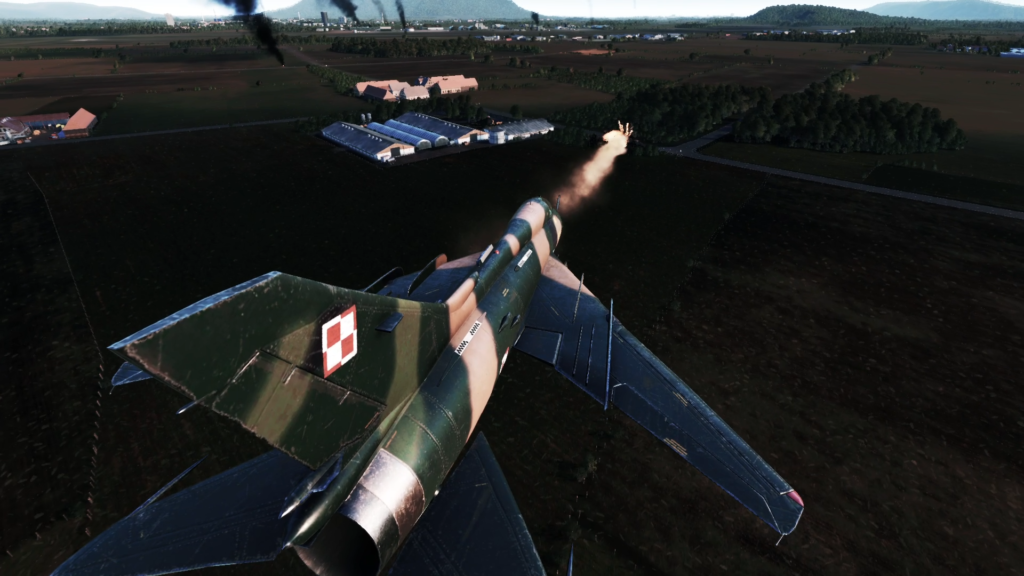
The Egyptians now sought to suppress Libya’s air operations. Lieutenant Colonel Mohammed al-Ibrahim, commander of No. 55 Squadron, which was equipped with Su-20s, was ordered to carry out another strike against the Gamal Abdel Nasser Air Base. The attack, conducted by eight Sukhoi aircraft, succeeded in putting the major Libyan air base in eastern Libya out of action for the remainder of July 22, 1977.
Egypt then used the opportunity to expand its operations beyond the airfield. During the following night, Egyptian helicopter-borne commandos attacked additional radar installations, forward supply depots, and military facilities in al-Kufra and al-Jaghbub. They also targeted several training camps used by Egyptian dissidents.
Despite the damage inflicted on Gamal Abdel Nasser Air Base, the LAAF resumed its offensive operations on the morning of July 23. Libyan Mirage aircraft flew at low altitude over the Mediterranean before turning south to attack targets deep inside Egypt, including Marsa Matruh Air Base. The Libyan strikes were supported by Mil Mi-8 helicopters equipped to conduct electronic countermeasures. Their jamming operations temporarily reduced the effectiveness of the Egyptian Air Defence Command in controlling the airspace along the border and Mediterranean coast. However, the effect was limited by the continuous combat air patrols maintained by Egyptian MiG-21s along the main approach route. During the course of the day, Egyptian pilots and ground-based air-defence units claimed to have shot down four Libyan Mirage aircraft.
Egypt’s Final Offensive
On July 24, Egypt escalated the conflict once again, apparently as part of preparations for the larger invasion that had been planned. The day began with the largest Egyptian air raid yet against the Gamal Abdel Nasser Air Base. This time, the air strikes were coordinated with helicopter-borne Egyptian commandos.
Despite repeated Egyptian attacks over the preceding three days, the Libyans had still failed to disperse, relocate, conceal, or adequately protect the aircraft stationed at the base. The latest Egyptian assault therefore inflicted substantial damage. The attackers cratered the runway, destroyed several armoured vehicles, knocked out a number of early-warning radar installations, and damaged several surface-to-air missile sites. They also destroyed between six and twelve Libyan Mirage aircraft on the ground, although the exact number remains uncertain.
The Libyan air defences nevertheless managed to shoot down at least two Egyptian Su-20s with anti-aircraft fire. Egyptian aircraft also attacked al-Kufrah Air Base, but caused little significant damage there. Meanwhile, Egyptian helicopter-borne commandos struck Libyan forward logistics facilities at al-Jaghbub and Gamal Abdel Nasser Air Base. These raids inflicted considerable damage on the supply infrastructure supporting Libyan forces near the border.
Ceasefire
Despite the scale and effectiveness of the Egyptian operations on July 24, the conflict ended far more abruptly than expected. While Egyptian commandos were still operating around al-Jaghbub, President Sadat unexpectedly announced an immediate ceasefire. The decision surprised many observers, particularly because Egyptian officials had reportedly been telling diplomats in Cairo since the beginning of the fighting that Egypt intended to launch a full-scale invasion of Libya and remove Gaddafi from power.
Several diplomatic sources later attributed Sadat’s decision to strong pressure from the United States. Washington was reportedly aware that Egypt was considering a major invasion, possibly because Cairo had informed the Americans of its intentions. The United States, however, strongly opposed such an operation.
American military and intelligence assessments reportedly concluded that Egypt could defeat Libyan forces in the border region but might struggle to sustain a prolonged advance deep into Libya. Egypt’s western desert had limited logistical and transportation infrastructure, while an advance of roughly 1,000 kilometres toward Tripoli would have placed enormous demands on the Egyptian military. The Americans also feared that the Egyptian army could become overextended and that a stalled offensive—particularly if Egyptian forces advanced as far as Benghazi without overthrowing Gaddafi—could end in a humiliating withdrawal.
Washington was especially concerned about the possible political consequences for Sadat. At the time, he was central to the emerging Egyptian-Israeli peace process, and much of his domestic authority rested on the prestige he had gained from the October 1973 War. A failed invasion of Libya, the Americans feared, could seriously weaken Sadat’s position and potentially threaten his ability to continue pursuing peace with Israel. According to these diplomatic accounts, the United States therefore exerted considerable pressure on Sadat to abandon the planned invasion. Whatever the precise weight of American influence, Egyptian offensive operations stopped almost as suddenly as they had begun.
Some fighting continued for another two days as Egyptian commando units withdrew from Libyan territory, but Sadat’s announcement effectively brought the war to an end. No formal peace treaty, armistice, or officially negotiated ceasefire was concluded. Instead, both sides gradually observed an informal truce and halted further combat operations. Over time, Egypt and Libya also reduced their forces along the border, where the limited infrastructure made it difficult to maintain large military formations for an extended period.
Although the fighting lasted only a few days, the 1977 Egyptian-Libyan War demonstrated the sharp military imbalance between the two countries and marked the collapse of any remaining possibility of reconciliation between Sadat and Gaddafi.
Aftermath and Casualties
The short war nevertheless inflicted substantially greater losses on Libya than on Egypt. Libyan forces lost around 30 tanks and approximately 40 armoured personnel carriers, while about 400 personnel were killed or wounded and 12 were captured. According to Cooper and Grandolini, the Libyan Arab Air Force lost six Mirage aircraft and as many as 20 Soko G-2 Galeb and J-21 Jastreb aircraft. Most Libyan military installations east of Tobruk also suffered damage during the fighting.
Egypt’s losses were considerably lower. Egyptian forces lost no more than four aircraft and suffered approximately 100 casualties, in addition to a number of personnel who were captured. Arab diplomats also reported that three Soviet military technicians assisting Libya with its radar systems were accidentally killed during the Egyptian air strikes, although they were not directly participating in the fighting.
The conflict appears to have caused little or no loss of civilian life. An Egyptian military spokesman stated during the war that Egyptian forces had taken care to avoid harming Libyan civilians, while journalist Mayada El Gohary reported that no Libyan civilians were killed during the conflict.
Bibliography
1) THE HISTORY OF LIBYA | Bukola A Oyeniyi
2) LIBYA : A COUNTRY STUDY | Helen Chapin Metz (ed.)
3) ARABS AT WAR : MILITARY EFFECTIVENESS, 1948-1991 | Kenneth M. Pollack
4) MILITARY REVIEW (NOVEMBER, 1977) | Libya: Military Spearhead Against Sadat? | Dennis Chaplin
5) LIBYAN AIR WARS : PART 1 : 1973-1985 | Albert Grandolini, Tom Cooper
© 2026 History and War
Author: Jishu Roy
Unauthorized reproduction of this content is prohibited.